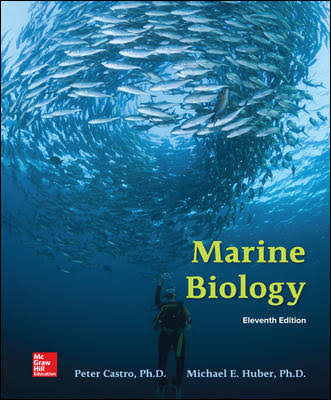
Marine Biology 11th Edition by Castr -Test Bank

Marine Biology 11th Edition by Castr -Test Bank   Instant Download - Complete Test Bank With Answers     Sample Questions Are Posted Below   Marine Biology, 11e (Castro) Chapter 5   The Microbial World   1) Which of the following statements about marine viruses is not true? A) Are involved in the release of DOM …

$19.99

Marine Biology 11th Edition by Castr -Test Bank


Instant Download – Complete Test Bank With Answers


Sample Questions Are Posted Below


Marine Biology, 11e (Castro)

Chapter 5   The Microbial World


1) Which of the following statements about marine viruses is not true?

  1. A) Are involved in the release of DOM (dissolved organic matter) into the water
  2. B) Bridge the gap between the nonliving and the living
  3. C) Their genetic material is in the form of DNA or RNA
  4. D) Cause diseases in many types of organisms
  5. E) Consist of minute cells sometimes attached into chains


Answer:  E

Section:  05.01 Viruses

Topic:  Viruses

Bloom’s:  02. Understand


2) Bacteriophages are types of:

  1. A) Archaea
  2. B) Bacteria
  3. C) Protozoa
  4. D) Algae
  5. E) Viruses


Answer:  E

Section:  05.01 Viruses

Topic:  Viruses

Bloom’s:  01. Remember


3) Prokaryotes differ from eukaryotes in regards to:

  1. A) Shape of DNA molecules
  2. B) Size of ribosomes
  3. C) Presence of nucleus
  4. D) Shape of DNA and size of ribosomes
  5. E) All of the above


Answer:  E

Section:  05.02 Prokaryotes

Topic:  Prokaryotes

Bloom’s:  02. Understand


4) Which of the following is not true of decay bacteria?

  1. A) Break down waste products and dead organic matter
  2. B) Carry out photosynthesis
  3. C) Are heterotrophs
  4. D) Are particularly abundant in bottom sediments
  5. E) Ensure the recycling of essential nutrients


Answer:  B

Section:  05.02 Prokaryotes

Topic:  Bacteria

Bloom’s:  03. Apply


5) Bacteria that make their own organic compounds by obtaining energy from chemical compounds and not directly from light are known as:

  1. A) Heterotrophic
  2. B) Decay
  3. C) Photosynthetic
  4. D) Protists
  5. E) Chemosynthetic


Answer:  E

Section:  05.02 Prokaryotes

Topic:  Bacteria

Bloom’s:  02. Understand


6) Cyanobacteria are characterized by being:

  1. A) Decomposers
  2. B) Found only in the plankton
  3. C) Having a glass-like skeleton
  4. D) Protists
  5. E) Photosynthetic


Answer:  E

Section:  05.02 Prokaryotes

Topic:  Bacteria

Bloom’s:  01. Remember


7) Which of the following would be classified as autotrophic?

  1. A) Cyanobacteria
  2. B) Lysogenic viruses
  3. C) Bacteriophages
  4. D) Lysogenic viruses and bacteriophages
  5. E) All of the above


Answer:  A

Section:  05.02 Prokaryotes

Topic:  Bacteria

Bloom’s:  03. Apply


8) Endophytes are primary producers that live:

  1. A) On the surface of planktonic organisms
  2. B) Inside primary producers
  3. C) Inside animals
  4. D) On the surface of animals
  5. E) Within decay organisms


Answer:  B

Section:  05.02 Prokaryotes

Topic:  Bacteria

Bloom’s:  01. Remember


9) Archaea are classified as:

  1. A) Prokaryotic
  2. B) Autotrophs only
  3. C) Heterotrophs only
  4. D) Consisting of nucleic acids and a protein coat
  5. E) Eukaryotic


Answer:  A

Section:  05.02 Prokaryotes

Topic:  Archaea

Bloom’s:  01. Remember


10) Archaea are now being detected in many environments by identifying one of the following chemicals characteristic of the group:

  1. A) Pigments
  2. B) Chlorophyll
  3. C) Nucleic acids
  4. D) Proteins
  5. E) Carbohydrates


Answer:  C

Section:  05.02 Prokaryotes

Topic:  Archaea

Bloom’s:  03. Apply


11) Organisms having a shell made of silica (SiO2):

  1. A) Foraminiferans
  2. B) Stromatolites
  3. C) Cyanobacteria
  4. D) Diatoms
  5. E) Ciliates


Answer:  D

Section:  05.03 Unicellular Algae

Topic:  Diatoms

Bloom’s:  01. Remember


12) Diatoms are mostly:

  1. A) Heterotrophs
  2. B) Planktonic
  3. C) Multicellular
  4. D) Red in color
  5. E) Prokaryotic


Answer:  B

Section:  05.03 Unicellular Algae

Topic:  Diatoms

Bloom’s:  02. Understand


13) Which of the following are considered to be extremophiles due to the habitats they exist in?

  1. A) Marine lichens
  2. B) Diatoms
  3. C) Archaea
  4. D) Radiolarians


Answer:  C

Section:  05.02 Prokaryotes

Topic:  Archaea

Bloom’s:  01. Remember


14) Which of the following can be dangerous to human health?

  1. A) Diatoms
  2. B) Dinoflagellates
  3. C) Radiolarians
  4. D) Diatoms and dinoflagellates
  5. E) All of the above


Answer:  D

Section:  05.04 Protozoans: The Animal-Like Protists

Topic:  Diatoms; Dinoflagellates

Bloom’s:  01. Remember


15) Some planktoic cyanobacteria have the ability to “fix” which of the following elements, thus having a fertilizing effect on the marine environment similar to the ability of land plants legumes?

  1. A) Oxygen
  2. B) Helium
  3. C) Hydrogen
  4. D) Nitrogen


Answer:  D

Section:  05.02 Prokaryotes

Topic:  Prokaryote Metabolism

Bloom’s:  01. Remember


16) Red tides are caused mostly by:

  1. A) Diatoms
  2. B) Foraminiferans
  3. C) Dinoflagellates
  4. D) Red seaweeds
  5. E) Radiolarians


Answer:  C

Section:  05.03 Unicellular Algae

Topic:  Diatoms

Bloom’s:  02. Understand


17) Dinoflagellates that live in association with reef-building corals and other animals are known as:

  1. A) Zooxanthellae
  2. B) Zooplankton
  3. C) Silicoflagellates
  4. D) Bioluminescent dinoflagellates
  5. E) Cryptomonads


Answer:  A

Section:  05.03 Unicellular Algae

Topic:  Dinoflagellates

Bloom’s:  01. Remember


18) Generally the dominant group of planktonic primary producers in cold water:

  1. A) Foraminiferans
  2. B) Silicoflagellates
  3. C) Dinoflagellates
  4. D) Photosynthetic bacteria
  5. E) Diatoms


Answer:  E

Section:  05.03 Unicellular Algae

Topic:  Diatoms

Bloom’s:  02. Understand


19) Marine fungi:

  1. A) Are mostly photosynthetic
  2. B) Are parts of lichens that live on rocky shores
  3. C) Secrete calcareous skeletons
  4. D) Produce red tides
  5. E) None of the choices are correct: there are no marine fungi.


Answer:  B

Section:  05.05 Fungi

Topic:  Fungi

Bloom’s:  02. Understand


20) Which of the following does not apply to protozoans?

  1. A) Multicellular
  2. B) Their name derives from “first animals”
  3. C) Some are heterotrophs
  4. D) Are included among the Protista
  5. E) Some are autotrophs


Answer:  A

Section:  05.04 Protozoans: The Animal-Like Protists

Topic:  Ciliates; Foraminiferans; Radiolarians

Bloom’s:  02. Understand


21) Radiolarians are characterized by:

  1. A) Being mostly planktonic
  2. B) Having a calcareous skeleton
  3. C) Being autotrophs
  4. D) Having two flagella
  5. E) Causing red tides


Answer:  A

Section:  05.04 Protozoans: The Animal-Like Protists

Topic:  Radiolarians

Bloom’s:  02. Understand


22) Which of the following are not protozoans?

  1. A) Radiolarians
  2. B) Foraminiferans
  3. C) Dinoflagellates
  4. D) Ciliates
  5. E) Unicellular, planktonic organisms whose sediments form huge limestone deposits on land


Answer:  C

Section:  05.04 Protozoans: The Animal-Like Protists

Topic:  Ciliates; Foraminiferans; Radiolarians

Bloom’s:  03. Apply


23) Which of the following are not protists?

  1. A) Dinoflagellates
  2. B) Cyanobacteria
  3. C) Diatoms
  4. D) Foraminiferans
  5. E) Ciliates


Answer:  B

Section:  05.03 Unicellular Algae; 05.04 Protozoans: The Animal-Like Protists

Topic:  Ciliates; Diatoms; Dinoflagellates; Foraminiferans

Bloom’s:  01. Remember


24) What is the purpose of the spines seen on the frustules of diatoms?

  1. A) Floatation
  2. B) Hunting
  3. C) Photosynthesis
  4. D) Reproduction
  5. E) Restore normal size


Answer:  A

Section:  05.03 Unicellular Algae

Topic:  Diatoms

Bloom’s:  03. Apply


25) What is the function of an auxospore?

  1. A) Floatation
  2. B) Hunting
  3. C) Photosynthesis
  4. D) Reproduction
  5. E) Restore normal size


Answer:  E

Section:  05.03 Unicellular Algae

Topic:  Diatoms

Bloom’s:  02. Understand


26) An algal bloom is defined as:

  1. A) Mass reproduction of algal cells
  2. B) Mass death of algal cells
  3. C) Mass feeding on algal cells by zooplankton
  4. D) Mass vertical migrations of algal cells
  5. E) Mass horizontal migrations of algal cells


Answer:  A

Section:  05.03 Unicellular Algae

Topic:  Diatoms

Bloom’s:  01. Remember


27) Bioluminescence is observed in:

  1. A) Diatoms
  2. B) Dinoflagellates
  3. C) Radiolarians
  4. D) Foraminiferans
  5. E) Lichens


Answer:  B

Section:  05.03 Unicellular Algae

Topic:  Dinoflagellates

Bloom’s:  01. Remember


28) Zooxanthellae, which live symbiotically with many species, are classified as:

  1. A) Diatoms
  2. B) Dinoflagellates
  3. C) Radiolarians
  4. D) Foraminiferans
  5. E) Lichens


Answer:  B

Section:  05.03 Unicellular Algae

Topic:  Dinoflagellates

Bloom’s:  01. Remember


29) What feature do all protozoa share?

  1. A) Reproductive strategies
  2. B) Habitats
  3. C) Feeding strategy
  4. D) Structure
  5. E) Being unicellular


Answer:  E

Section:  05.04 Protozoans: The Animal-Like Protists

Topic:  Ciliates; Foraminiferans; Radiolarians

Bloom’s:  02. Understand


30) A survival advantage of ________ is the ability to withstand exposure to air for long periods of time during tidal cycles.

  1. A) diatoms
  2. B) dinoflagellates
  3. C) radiolarians
  4. D) foraminiferans
  5. E) lichens


Answer:  E

Section:  05.05 Fungi

Topic:  Fungi

Bloom’s:  02. Understand


31) Which of the following is a group of unicellular algae that have two flagella but lack a skeleton?

  1. A) Radiolarians
  2. B) Diatoms
  3. C) Archaea
  4. D) Cryptophytes


Answer:  D

Section:  05.03 Unicellular Algae

Topic:  Other Unicellular Algae

Bloom’s:  02. Understand

Activity Type:  New

Additional information

Add Review

Your email address will not be published. Required fields are marked *