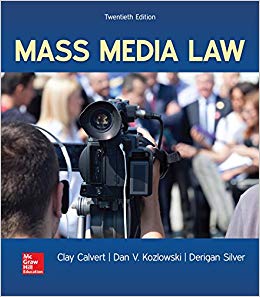
Mass Media Law 20th Edition by Clay Calvert - Test Bank

Mass Media Law 20th Edition by Clay Calvert - Test Bank   Instant Download - Complete Test Bank With Answers     Sample Questions Are Posted Below   Chapter 5   MULTPLE-CHOICE QUESTIONS:   Which of the following does NOT accurately describe New York Times v. Sullivan (1964)? The Supreme Court said that, as a …

$19.99

Mass Media Law 20th Edition by Clay Calvert – Test Bank


Instant Download – Complete Test Bank With Answers


Sample Questions Are Posted Below


Chapter 5


MULTPLE-CHOICE QUESTIONS:


  1. Which of the following does NOT accurately describe New York Times v. Sullivan (1964)?
  2. The Supreme Court said that, as a public official, Sullivan voluntarily took on a job that invited public attention and criticism.
  3. The Supreme Court ruled that public officials must prove actual malice in libel suits.
  4. The Supreme Court said we had a national commitment to the principle that debate on

public issues should be robust, uninhibited, and wide open.

  1. For the first time, the U.S. Supreme Court applied the First Amendment to libel law.
  2. The Supreme Court ruled that all libel plaintiffs must prove some level of fault.

Answer: E


  1. A publication could be regarded as exhibiting actual malice if it published material
  2. that had been rejected by other publications.
  3. that had been aggregated from various online blogs.
  4. that it knew was false.
  5. none of the answers is correct.

Answer: C


  1. Some courts have used three factors to determine whether a reporter or editor exhibited reckless disregard for the truth. Which of the following is NOT one of these three?
  2. What was the nature of the story?
  3. How reliable was the source of the story?
  4. Was the story probable or inherently believable?
  5. Did the reporter or editor demonstrate ill will toward the subject of the report?

Answer: D


  1. In the 1967 ruling involving the two cases AP v. Walker and Curtis Publishing Co. v. Butts, the Supreme Court laid down a test for
  2. libel per se.
  3. truth.
  4. reckless disregard.
  5. none of the answers is correct.

Answer: C


  1. A reporter who deliberately alters a direct quote from a news source may be guilty of actual malice if
  2. the alteration results in a material change in the meaning of the statement.
  3. the altered material turns out to be false.
  4. the alteration puts the quoted individual in a bad light.
  5. the alteration is the result of a failure to exercise reasonable care.

Answer: A


  1. In determining whether an individual is a limited-purpose public figure for purposes of a libel action, a court will consider
  2. whether the individual was involved in a public controversy.
  3. the nature of the defamatory statement and whether it is related to a controversy in which the individual was involved.
  4. if the individual attempted to sway public opinion about a controversy.
  5. all of the answers are correct.

Answer: D


  1. In which of the following situations would an individual most likely be deemed to be a public official in a libel suit?
  2. A newspaper story reports that a public school teacher said she was born in the United States on her job application when she was really born in France.
  3. A story claims that a custodian at a state office building was accused of stealing cleaning supplies.
  4. A story alleges that a city councilwoman has taken money from a developer in exchange for her vote to approve a rezoning application.
  5. None of the answers is correct.

Answer: C


  1. According to the American Law Institute, which of the following is an element in the definition of the tort?
  2. whether the defendant’s conduct was intentional or reckless
  3. whether the defendant’s conduct was outrageous
  4. whether the defendant’s conduct caused emotional distress
  5. all of the answers are correct.

Answer: B


SHORT-ANSWER QUESTIONS:


  1. What are the criteria for a limited-purpose public figure?

Answer: The individual must normally have been involved in a public controversy, must have voluntarily stepped into the public spotlight, and must have made some attempt to lead public opinion toward the resolution of a public issue.


  1. Distinguish between negligence and actual malice.

Answer: Negligence has been generally defined as the failure to exercise reasonable care. Actual malice requires proof of a far higher level of misbehavior on the defendant’s part. Evidence that the material was published even though the defendant knew it was false, or that the defendant exhibited reckless disregard for the truth, is required.


TRUE-FALSE QUESTIONS:


  1. A plaintiff must only prove that a story has serious errors to prove actual malice.

Answer: F


  1. An individual can be regarded as an all-purpose public figure if he or she is well known nationally or well known exclusively in the geographic area (such a state or city) in which the libel was circulated.

Answer: T


  1. Once a person is considered a public figure for the purposes of a libel suit, he or she will always be regarded as a public figure in future libel cases, regardless of the subject matter of the subsequent libelous publication.

Answer: F


  1. All government employees are regarded as public officials.

Answer: F


  1. Individuals whose actions inadvertently or innocently push them into a public controversy are rarely regarded as public figures.

Answer: F


  1. Lower courts have consistently ruled that persons married to or closely associated with public persons are also public persons for the purposes of libel action.

Answer: F


  1. In libel law, a public controversy is defined as a controversy in which the resolution of the issues involved will affect a larger group of persons than those directly involved in the dispute.

Answer: T


  1. “Reckless disregard for the truth” has been defined as having a high degree of awareness that a statement is probably false.

Answer: T


  1. Whether or not a reporter sought a comment from the subject of a libelous story will always be a critical factor in determining actual malice.

Answer: F


  1. All businesses are regarded as public figures for the purposes of a libel suit.

Answer: F


Additional information

Add Review

Your email address will not be published. Required fields are marked *