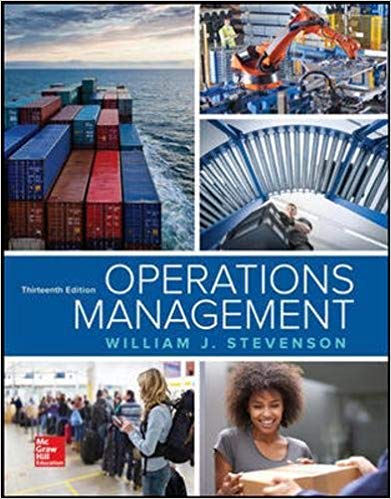
Operations Management 13th Edition by William J Stevenson - Test Bank

Operations Management 13th Edition by William J Stevenson - Test Bank   Instant Download - Complete Test Bank With Answers     Sample Questions Are Posted Below   Chapter 05 Test Bank – Static   1. The term capacity refers to the maximum quantity an operating unit can process over a given period of time. …

$19.99

Operations Management 13th Edition by William J Stevenson – Test Bank


Instant Download – Complete Test Bank With Answers


Sample Questions Are Posted Below


Chapter 05 Test Bank – Static


1. The term capacity refers to the maximum quantity an operating unit can process over a given period of time.

TRUE


An operation’s capacity is defined as the maximum rate of output possible.


AACSB: Reflective Thinking
Accessibility: Keyboard Navigation
Blooms: Remember
Difficulty: 1 Easy
Learning Objective: 05-03 Describe ways of defining and measuring capacity.
Topic: Defining and Measuring Capacity
2. Capacity decisions are usually one-time decisions; once they have been made, we know the limits of our operations.

FALSE


A number of factors can either increase or reduce a unit’s capacity over time. While capacity decisions often involve long-term commitments, we need to monitor both our performance and demand to identify needs to adjust capacity.


AACSB: Reflective Thinking
Accessibility: Keyboard Navigation
Blooms: Understand
Difficulty: 1 Easy
Learning Objective: 05-02 Explain the importance of capacity planning.
Topic: Capacity Decisions are Strategic
3. Stating capacity in dollar amounts generally results in a consistent measure of capacity regardless of the actual units of measure.

FALSE


The dollar value of a unit’s output can change even though that unit’s capacity hasn’t.


AACSB: Reflective Thinking
Accessibility: Keyboard Navigation
Blooms: Understand
Difficulty: 2 Medium
Learning Objective: 05-03 Describe ways of defining and measuring capacity.
Topic: Defining and Measuring Capacity


4. Design capacity refers to the maximum output rate that can be achieved under ideal conditions.

TRUE


Design capacity is the maximum output rate or service rate an operation, process, or facility is designed for.


AACSB: Reflective Thinking
Accessibility: Keyboard Navigation
Blooms: Remember
Difficulty: 1 Easy
Learning Objective: 05-03 Describe ways of defining and measuring capacity.
Topic: Defining and Measuring Capacity


5. If the unit cost to buy something is less than the variable cost to make it, the decision to make or buy is based solely on the fixed costs.

FALSE


Cost is not the only consideration that enters into the make-or-buy decision. Other factors such as available capacity, expertise, quality, and risks must also be considered.


AACSB: Reflective Thinking
Accessibility: Keyboard Navigation
Blooms: Understand
Difficulty: 2 Medium
Learning Objective: 05-05 Discuss factors to consider when deciding whether to operate in-house or outsource.
Topic: Do It In-House or Outsource It?
6. Increasing productivity and also quality will result in increased effective capacity.

TRUE


Effective capacity can be increased over time by these and similar factors.


AACSB: Reflective Thinking
Accessibility: Keyboard Navigation
Blooms: Understand
Difficulty: 1 Easy
Learning Objective: 05-04 Name several determinants of effective capacity.
Topic: Determinants of Effective Capacity


7. Utilization is defined as the ratio of effective capacity to design capacity.

FALSE


Utilization is the ratio of actual output to design capacity.


AACSB: Reflective Thinking
Accessibility: Keyboard Navigation
Blooms: Understand
Difficulty: 2 Medium
Learning Objective: 05-03 Describe ways of defining and measuring capacity.
Topic: Defining and Measuring Capacity


8. Increasing capacity just before a bottleneck operation will improve the output of the process.

FALSE


If the bottleneck isn’t increased, the capacity of the process remains unchanged.


AACSB: Reflective Thinking
Accessibility: Keyboard Navigation
Blooms: Understand
Difficulty: 2 Medium
Learning Objective: 05-06 Discuss the major considerations related to developing capacity alternatives.
Topic: Developing Capacity Strategies


9. An example of an external factor that influences effective capacity is government safety regulations.

TRUE


Stricter safety regulations can reduce effective capacity.


AACSB: Reflective Thinking
Accessibility: Keyboard Navigation
Blooms: Understand
Difficulty: 1 Easy
Learning Objective: 05-04 Name several determinants of effective capacity.
Topic: Determinants of Effective Capacity


10. Having excess capacity tends to keep operating costs low.

FALSE


Operating costs tend to be minimized when capacity and demand requirements are matched.


AACSB: Reflective Thinking
Accessibility: Keyboard Navigation
Blooms: Understand
Difficulty: 3 Hard
Learning Objective: 05-02 Explain the importance of capacity planning.
Topic: Capacity Decisions are Strategic
11. Capacity increases are usually acquired in fairly large “chunks” rather than in smooth increments.

TRUE


Hotels and hospitals are among many examples of circumstances in which capacity cannot be added in very small increments.


AACSB: Reflective Thinking
Accessibility: Keyboard Navigation
Blooms: Remember
Difficulty: 2 Medium
Learning Objective: 05-06 Discuss the major considerations related to developing capacity alternatives.
Topic: Developing Capacity Strategies
12. In cost-volume analysis, costs that vary directly with volume of output are referred to as fixed costs because they are a fixed percentage of output levels.

FALSE


Costs that vary directly with volume of output are variable costs.


AACSB: Reflective Thinking
Accessibility: Keyboard Navigation
Blooms: Understand
Difficulty: 1 Easy
Learning Objective: 05-08 Briefly describe approaches that are useful for evaluating capacity alternatives.
Topic: Evaluating Alternatives
13. The break-even quantity can be determined by dividing the fixed costs by the difference between the revenue per unit and the variable cost per unit.

TRUE


The difference between the revenue per unit and the variable cost per unit goes toward covering fixed costs.


AACSB: Reflective Thinking
Accessibility: Keyboard Navigation
Blooms: Apply
Difficulty: 2 Medium
Learning Objective: 05-08 Briefly describe approaches that are useful for evaluating capacity alternatives.
Topic: Evaluating Alternatives
14. According to the reading on restaurant sourcing practices, only fast-food restaurants are able to bring in outsourced foods.

FALSE


A wide range of restaurants use outsourced foods.


AACSB: Reflective Thinking
Accessibility: Keyboard Navigation
Blooms: Understand
Difficulty: 1 Easy
Learning Objective: 05-05 Discuss factors to consider when deciding whether to operate in-house or outsource.
Topic: Additional Challenges of Planning Service Capacity
Topic: Do It In-House or Outsource It?


15. The more current capacity exceeds desired capacity, the greater the opportunity for profit.

FALSE


A substantial capacity overage increases operating costs and reduces the opportunity for profit; but it may serve as a deterrent to entry by competitors.


AACSB: Reflective Thinking
Accessibility: Keyboard Navigation
Blooms: Understand
Difficulty: 2 Medium
Learning Objective: 05-02 Explain the importance of capacity planning.
Topic: Capacity Decisions are Strategic
16. The current trend toward global operations has made capacity decisions much easier since we have the whole world in which to consider operations.

FALSE


Global operations increase the complexity of decision making with regard to capacity.


AACSB: Reflective Thinking
Accessibility: Keyboard Navigation
Blooms: Understand
Difficulty: 2 Medium
Learning Objective: 05-02 Explain the importance of capacity planning.
Topic: Capacity Decisions are Strategic
17. Capacity planning requires an analysis of needs: what kind, how much, and when.

TRUE


Type, quantity, and timing are essential to capacity decisions.

 AACSB: Reflective Thinking
Accessibility: Keyboard Navigation
Blooms: Understand
Difficulty: 2 Medium
Learning Objective: 05-01 Name the three key questions in capacity planning.
Topic: Introduction
18. Waiting line analysis can be useful for capacity design, especially for service systems.

TRUE


In service systems, waiting lines are symptoms of bottleneck operations.

 AACSB: Reflective Thinking
Accessibility: Keyboard Navigation
Blooms: Understand
Difficulty: 1 Easy
Learning Objective: 05-08 Briefly describe approaches that are useful for evaluating capacity alternatives.
Topic: Evaluating Alternatives


19. Capacity decisions often involve a long-term commitment of resources which, when implemented, are difficult or impossible to modify without major added costs.

TRUE


The cost to modify capacity decisions, once they’ve been made, is what makes capacity decisions so consequential.


AACSB: Reflective Thinking
Accessibility: Keyboard Navigation
Blooms: Understand
Difficulty: 2 Medium
Learning Objective: 05-02 Explain the importance of capacity planning.
Topic: Capacity Decisions are Strategic
20. Outsourcing some production is a means of supporting a constraint.

FALSE


Reducing the burden placed on a constraint is an example of overcoming the constraint.


AACSB: Reflective Thinking
Accessibility: Keyboard Navigation
Blooms: Remember
Difficulty: 2 Medium
Learning Objective: 05-07 Describe the steps that are used to resolve constraint issues.
Topic: Constraint Management


21. Outsourcing some production is a means of _________ a capacity constraint.

A. identifying
B. modifying
C. supporting
D. overcoming
E. repeating


Outsourcing some production reduces the burden placed on the constraint.


AACSB: Reflective Thinking
Accessibility: Keyboard Navigation
Blooms: Remember
Difficulty: 2 Medium
Learning Objective: 05-07 Describe the steps that are used to resolve constraint issues.
Topic: Constraint Management
22. Which of the following is a key question in capacity planning?

A. Should we make the product in-house or outsource it?
B. Where do we need the capacity?
C. When do we need the capacity?
D. Who will pay for the capacity change?
E. Should we change capacity all at once, or through several small changes?


What kind, how much, and when is it needed are the three key questions in capacity planning.


AACSB: Reflective Thinking
Accessibility: Keyboard Navigation
Blooms: Remember
Difficulty: 1 Easy
Learning Objective: 05-01 Name the three key questions in capacity planning.
Topic: Introduction
23. Allowances for which of these factors would be subtracted from design capacity when calculating effective capacity?

A. personal time
B. equipment maintenance
C. scheduling problems
D. changing the mix of products
E. all of the other choices


Effective capacity reflects all of the above issues, including required personal time, periodic maintenance of equipment, delays due to scheduling problems, and changes to the product mix.


AACSB: Reflective Thinking
Accessibility: Keyboard Navigation
Blooms: Understand
Difficulty: 2 Medium
Learning Objective: 05-03 Describe ways of defining and measuring capacity.
Topic: Defining and Measuring Capacity
24. Which of the following is not a reason why capacity decisions are so important?

A. Capacity limits the rate of output possible.
B. Capacity affects operating costs.
C. Capacity is a major determinant of initial costs.
D. Capacity is a long-term commitment of resources.
E. Capacity chunks can be added or deleted quickly and inexpensively.


Capacity is a strategic decision that influences costs and the firm’s ability to satisfy customers. Capacity increases frequently come in large chunks which can require significant time and money to complete.


AACSB: Reflective Thinking
Accessibility: Keyboard Navigation
Blooms: Understand
Difficulty: 1 Easy
Learning Objective: 05-02 Explain the importance of capacity planning.
Topic: Capacity Decisions are Strategic


25. Which of the following is the case where capacity is measured in terms of inputs?

A.  tons of steel per day that can be produced by a steel mill

B.  kilowatt hours per day that can be generated by an electrical power plant

C.  number of meals per day that can be served by a restaurant

D.  gallons of gasoline that can be produced per day by a petroleum refinery

E.  number of passenger seats that can be filled per day on an airline route

Airlines measure capacity in terms of passenger seats available, which are inputs to their service processes. The other capacity measures above are all based on outputs.


AACSB: Reflective Thinking
Accessibility: Keyboard Navigation
Blooms: Understand
Difficulty: 2 Medium
Learning Objective: 05-03 Describe ways of defining and measuring capacity.
Topic: Defining and Measuring Capacity
26. Unbalanced systems are evidenced by:

A. top-heavy operations.
B. labor unrest.
C. bottleneck operations.
D. increasing capacities.
E. assembly lines.


Bottleneck operations have capacities that restrict the overall output of the system to something less than could be achieved by the non-bottleneck operations.


AACSB: Reflective Thinking
Accessibility: Keyboard Navigation
Blooms: Remember
Difficulty: 2 Medium
Learning Objective: 05-06 Discuss the major considerations related to developing capacity alternatives.
Topic: Developing Capacity Strategies
27. Maximum capacity commonly refers to the upper limit on:

A. utilization.
B. the rate of demand.
C. efficiency.
D. the rate of output.
E. finances.


Capacity often refers to the maximum rate of output that is possible; although in some industries it may refer to a limit on inputs.


AACSB: Reflective Thinking
Accessibility: Keyboard Navigation
Blooms: Remember
Difficulty: 2 Medium
Learning Objective: 05-03 Describe ways of defining and measuring capacity.
Topic: Defining and Measuring Capacity
28. The impact that a significant change in capacity will have on a key vendor is a:

A. supply chain factor.
B. process limiting factor.
C. internal factor.
D. human resource factor.
E. operational process factor.


Vendors and their performance can be critical factors with respect to effective capacity.


AACSB: Reflective Thinking
Accessibility: Keyboard Navigation
Blooms: Understand
Difficulty: 2 Medium
Learning Objective: 05-04 Name several determinants of effective capacity.
Topic: Determinants of Effective Capacity


29. The maximum possible output given a product mix, scheduling difficulties,  personal time, and so on is:

A. utilization.
B. design capacity.
C. efficiency.
D. effective capacity.
E. available capacity.


Effective capacity reflects the realities of the production environment.


AACSB: Reflective Thinking
Accessibility: Keyboard Navigation
Blooms: Remember
Difficulty: 1 Easy
Learning Objective: 05-03 Describe ways of defining and measuring capacity.
Topic: Defining and Measuring Capacity
30. Efficiency is defined as the ratio of:

A. actual output to effective capacity.
B. actual output to design capacity.
C. design capacity to effective capacity.
D. effective capacity to actual output.
E. design capacity to actual output.


Efficiency measures the usage of effective capacity.


AACSB: Reflective Thinking
Accessibility: Keyboard Navigation
Blooms: Remember
Difficulty: 2 Medium
Learning Objective: 05-03 Describe ways of defining and measuring capacity.
Topic: Determinants of Effective Capacity


31. Utilization is defined as the ratio of:

A. actual output to effective capacity.
B. actual output to design capacity.
C. design capacity to effective capacity.
D. effective capacity to actual output.
E. design capacity to actual output.


Utilization measures the usage of design capacity.


AACSB: Reflective Thinking
Accessibility: Keyboard Navigation
Blooms: Remember
Difficulty: 2 Medium
Learning Objective: 05-03 Describe ways of defining and measuring capacity.
Topic: Defining and Measuring Capacity
32. Which of the following would tend to reduce effective capacity?

A. suppliers that provide more reliable delivery performance
B. reduced changeover times
C. employees that are fully trained
D. improved production quality
E. greater variety in the product line


All things being equal, product line variety reduces effective capacity.


AACSB: Reflective Thinking
Accessibility: Keyboard Navigation
Blooms: Understand
Difficulty: 2 Medium
Learning Objective: 05-04 Name several determinants of effective capacity.
Topic: Determinants of Effective Capacity


33. The decision to outsource opens the firm up to certain risks, among them _________ and ________.

A. lower costs; fewer task-specific investments
B. loss of direct control over operations; need to disclose proprietary information
C. access to greater expertise; greater demand variability
D. greater capacity rigidity; tight knowledge control
E. higher marketing costs; small orders


Loss of direct control over operations, knowledge sharing, and the possible need to disclose proprietary information are three risks that accompany outsourcing.


AACSB: Reflective Thinking
Accessibility: Keyboard Navigation
Blooms: Understand
Difficulty: 2 Medium
Learning Objective: 05-05 Discuss factors to consider when deciding whether to operate in-house or outsource.
Topic: Do It In-House or Outsource It?
34. The ratio of actual output to effective capacity is:

A. design capacity.
B. effective capacity.
C. actual capacity.
D. efficiency.
E. utilization.


Efficiency measures the usage of effective capacity.


AACSB: Reflective Thinking
Accessibility: Keyboard Navigation
Blooms: Remember
Difficulty: 2 Medium
Learning Objective: 05-03 Describe ways of defining and measuring capacity.
Topic: Defining and Measuring Capacity


35. The ratio of actual output to design capacity is:

A. design capacity.
B. effective capacity.
C. actual capacity.
D. efficiency.
E. utilization.


Utilization measures the usage of design capacity.


AACSB: Reflective Thinking
Accessibility: Keyboard Navigation
Blooms: Remember
Difficulty: 2 Medium
Learning Objective: 05-03 Describe ways of defining and measuring capacity.
Topic: Defining and Measuring Capacity
36. Given the following information, what would efficiency be?

Effective capacity = 80 units per day
Design capacity = 100 units per day
Utilization = 48 percent

A. 20 percent
B. 35 percent
C. 48 percent
D. 60 percent
E. 80 percent


Efficiency = (actual output / effective capacity) x 100% = (48 / 80) × 100% = 60%


AACSB: Analytic
Accessibility: Keyboard Navigation
Blooms: Apply
Difficulty: 3 Hard
Learning Objective: 05-03 Describe ways of defining and measuring capacity.
Topic: Defining and Measuring Capacity
37. Given the following information, what would efficiency be?

Effective capacity = 50 units per day
Design capacity = 100 units per day
Actual output = 30 units per day

A. 40 percent
B. 50 percent
C. 60 percent
D. 80 percent
E. 90 percent


Efficiency is actual output divided by effective capacity. (30 / 50) × 100% = 60%


AACSB: Analytic
Accessibility: Keyboard Navigation
Blooms: Apply
Difficulty: 2 Medium
Learning Objective: 05-03 Describe ways of defining and measuring capacity.
Topic: Defining and Measuring Capacity


38. Given the following information, what would utilization be?

Effective capacity = 20 units per day
Design capacity = 60 units per day
Actual output = 15 units per day

A. 25%
B. 33%
C. 50%
D. 75%
E. none of these


Utilization is actual output divided by design capacity. (15 / 60) × 100% = 25%


AACSB: Analytic
Accessibility: Keyboard Navigation
Blooms: Apply
Difficulty: 2 Medium
Learning Objective: 05-03 Describe ways of defining and measuring capacity.
Topic: Defining and Measuring Capacity
39. Which of the following is not a strategy to manage service capacity or cope with service capacity limitations?

A. hiring extra workers
B. storing inventories of the service
C. pricing and promotion
D. part-time workers
E. subcontracting


Backordering for services is simply shifting demand to a later period.


AACSB: Reflective Thinking
Accessibility: Keyboard Navigation
Blooms: Understand
Difficulty: 2 Medium
Learning Objective: 05-06 Discuss the major considerations related to developing capacity alternatives.
Topic: Additional Challenges of Planning Service Capacity
40. Which of the following is not a determinant of effective capacity?

A. facilities
B. product mix
C. actual output
D. human factors
E. external factors


Actual output can be limited by effective capacity.


AACSB: Reflective Thinking
Accessibility: Keyboard Navigation
Blooms: Understand
Difficulty: 1 Easy
Learning Objective: 05-04 Name several determinants of effective capacity.
Topic: Determinants of Effective Capacity
41. Everything else being equal, a firm considering outsourcing would find all of the following desirable except:

A. total costs will be lower for outsources goods or services.
B. its supplier has more expertise in whatever is being outsourced.
C. it can maintain tight control over knowledge.
D. proprietary information will be disclosed to the supplier.
E. control over operations will be maintained by the firm.


Disclosure of proprietary information to a supplier is an undesirable risk of outsourcing.


AACSB: Reflective Thinking
Accessibility: Keyboard Navigation
Blooms: Understand
Difficulty: 3 Hard
Learning Objective: 05-05 Discuss factors to consider when deciding whether to operate in-house or outsource.
Topic: Do It In-House or Outsource It?
42. Capacity in excess of expected demand that is intended to offset uncertainty is a:

A. margin protect.
B. line balance.
C. capacity cushion.
D. timing bubble.
E. positioning hedge.


A capacity cushion provides flexibility to meet uncertain fluctuations in demand


AACSB: Reflective Thinking
Accessibility: Keyboard Navigation
Blooms: Remember
Difficulty: 2 Medium
Learning Objective: 05-06 Discuss the major considerations related to developing capacity alternatives.
Topic: Strategy Formulation
43. Short-term considerations in determining capacity requirements include:

A. demand trend.
B. cyclical demand variations.
C. seasonal demand variations.
D. mission statements.
E. new product development plans.


Trends, cycles, and fundamental strategic changes are long-term considerations.


AACSB: Reflective Thinking
Accessibility: Keyboard Navigation
Blooms: Remember
Difficulty: 3 Hard
Learning Objective: 05-06 Discuss the major considerations related to developing capacity alternatives.
Topic: Forecasting Capacity Requirements
44. Which of the following is not a criterion for developing capacity alternatives?

A. design structured, rigid systems
B. take a big-picture approach to capacity changes
C. prepare to deal with capacity in “chunks”
D. attempt to smooth out capacity requirements
E. identify the optimal operating level


The long-term nature of capacity decisions calls for flexibility, not rigidity.


AACSB: Reflective Thinking
Accessibility: Keyboard Navigation
Blooms: Understand
Difficulty: 1 Easy
Learning Objective: 05-06 Discuss the major considerations related to developing capacity alternatives.
Topic: Developing Capacity Strategies


45. Seasonal variations are often easier to deal with in capacity planning than random variations because seasonal variations tend to be:

A. smaller.
B. larger.
C. predictable.
D. controllable.
E. less frequent.


When variation is predictable, it can be managed.


AACSB: Reflective Thinking
Accessibility: Keyboard Navigation
Blooms: Understand
Difficulty: 1 Easy
Learning Objective: 05-06 Discuss the major considerations related to developing capacity alternatives.
Topic: Forecasting Capacity Requirements
46. Production units have an optimal rate of output where:

A. total costs are minimum.
B. average unit costs are minimum.
C. marginal costs are minimum.
D. rate of output is maximum.
E. total revenue is maximum.


Average unit costs reflect both fixed and variable costs.


AACSB: Reflective Thinking
Accessibility: Keyboard Navigation
Blooms: Understand
Difficulty: 2 Medium
Learning Objective: 05-06 Discuss the major considerations related to developing capacity alternatives.
Topic: Developing Capacity Strategies


47. When the output is less than the optimal rate of output, the average unit cost will be:

A. lower.
B. the same.
C. higher.
D. could be either higher or lower.
E. could be either higher, lower or the same.


At too low a volume, fixed costs are too burdensome.


AACSB: Reflective Thinking
Accessibility: Keyboard Navigation
Blooms: Analyze
Difficulty: 3 Hard
Learning Objective: 05-06 Discuss the major considerations related to developing capacity alternatives.
Topic: Developing Capacity Strategies
48. When buying component parts, risk does not include:

A. loss of control.
B. vendor viability.
C. interest rate fluctuations.
D. need to disclose proprietary information.
E. product liability.


Buying component parts creates a dependency on a supplier and increases risks based on that dependency. Interest rate fluctuations are a financing risk regardless of whether we make or buy components.


AACSB: Reflective Thinking
Accessibility: Keyboard Navigation
Blooms: Remember
Difficulty: 3 Hard
Learning Objective: 05-06 Discuss the major considerations related to developing capacity alternatives.
Topic: Do It In-House or Outsource It?


49. At the break-even point:

A. output equals capacity.
B. total cost equals total revenue.
C. total cost equals profit.
D. variable cost equals fixed cost.
E. variable cost equals total revenue.


At the break-even point, total profit (total revenue minus total cost) is zero.


AACSB: Reflective Thinking
Accessibility: Keyboard Navigation
Blooms: Understand
Difficulty: 1 Easy
Learning Objective: 05-08 Briefly describe approaches that are useful for evaluating capacity alternatives.
Topic: Evaluating Alternatives
50. What is the break-even quantity for the following situation?

FC = $1,200 per week
VC = $2 per unit
Rev = $6 per unit

A. 100
B. 200
C. 600
D. 1,200
E. 300


Break-even quantity = FC / (Rev – VC) = $1200 / ($6 – $2) = 300. A volume of 300 units leads to $1,200 in margin to offset fixed costs.


AACSB: Analytic
Accessibility: Keyboard Navigation
Blooms: Apply
Difficulty: 2 Medium
Learning Objective: 05-08 Briefly describe approaches that are useful for evaluating capacity alternatives.
Topic: Evaluating Alternatives
51. An alternative will have fixed costs of $10,000 per month, variable costs of $50 per unit, and revenue of $70 per unit. The break-even point volume is:

A. 100.
B. 2,000.
C. 500.
D. 1,000.
E. 800.


Break-even quantity = FC / (Rev – VC) = $10000 / ($70 – $50) = 500. A volume of 500 units leads to $10,000 in margin to offset fixed costs.


AACSB: Analytic
Accessibility: Keyboard Navigation
Blooms: Apply
Difficulty: 2 Medium
Learning Objective: 05-08 Briefly describe approaches that are useful for evaluating capacity alternatives.
Topic: Evaluating Alternatives
52. For fixed costs of $2,000, revenue per unit of $2, and variable cost per unit of $1.60, the break-even quantity is:

A. 1,000.
B. 1,250.
C. 2,250.
D. 5,000.
E. 3,000.


Break-even quantity = FC / (Rev – VC) = $2000 / ($2 – $1.60) = 5000. Dividing the fixed costs of $2,000 by the per-unit contribution margin of $0.40 leads to a break-even quantity of 5,000 units.


AACSB: Analytic
Accessibility: Keyboard Navigation
Blooms: Apply
Difficulty: 2 Medium
Learning Objective: 05-08 Briefly describe approaches that are useful for evaluating capacity alternatives.
Topic: Evaluating Alternatives


53. Which of the following would not be a potential upside in a decision to outsource?

A. increased total production capacity
B. potential to lower fixed costs
C. supplier may have greater expertise to do the outsourced work
D. disclosure of proprietary information to supplier
E. supplier cost may be lower


Loss of direct control over operations, knowledge sharing, and the possible need to disclose proprietary information are three risks of outsourcing.


AACSB: Reflective Thinking
Accessibility: Keyboard Navigation
Blooms: Understand
Difficulty: 2 Medium
Learning Objective: 05-05 Discuss factors to consider when deciding whether to operate in-house or outsource.
Topic: Do It In-House or Outsource It?
54. If the output rate is increased but the average unit costs also increase, we are experiencing:

A. market share erosion.
B. economies of scale.
C. diseconomies of scale.
D. value-added accounting.
E. step-function scaleup.


Diseconomies of scale involve producing above the optimal production rate.


AACSB: Reflective Thinking
Accessibility: Keyboard Navigation
Blooms: Understand
Difficulty: 3 Hard
Learning Objective: 05-06 Discuss the major considerations related to developing capacity alternatives.
Topic: Developing Capacity Strategies


55. The method of financial analysis which focuses on the length of time it takes to recover the initial cost of an investment is:

A. payback.
B. net present value.
C. internal rate of return.
D. queuing.
E. cost-volume.


The payback period does not take into account the time value of money.


AACSB: Reflective Thinking
Accessibility: Keyboard Navigation
Blooms: Remember
Difficulty: 2 Medium
Learning Objective: 05-08 Briefly describe approaches that are useful for evaluating capacity alternatives.
Topic: Evaluating Alternatives
56. When determining the timing and degree of capacity change, one can use the approach of:

A. lead time flexibility strategy.
B. expand-early strategy.
C. go-with-the-flow strategy.
D. backordering.
E. delayed differentiation.


The expand-early strategy adds capacity before demand materializes and may be used to achieve economies of scale, to expand market share, or to preempt competitors from expanding.


AACSB: Reflective Thinking
Accessibility: Keyboard Navigation
Blooms: Remember
Difficulty: 2 Medium
Learning Objective: 05-06 Discuss the major considerations related to developing capacity alternatives.
Topic: Operations Strategy


57. The method of financial analysis which results in an equivalent interest rate is:

A. payback.
B. net present value.
C. internal rate of return.
D. queuing.
E. cost-volume.


The internal rate of return is the discount rate that would make a cash flow stream’s net present value be equal to zero.


AACSB: Reflective Thinking
Accessibility: Keyboard Navigation
Blooms: Remember
Difficulty: 1 Easy
Learning Objective: 05-08 Briefly describe approaches that are useful for evaluating capacity alternatives.
Topic: Evaluating Alternatives
58. The first, and perhaps most important, step in constraint management is to ____________ the most pressing constraint.

A. improve
B. support
C. identify
D. elevate
E. modify


The most pressing constraint must first be identified before any steps to resolve it can be undertaken.


AACSB: Reflective Thinking
Accessibility: Keyboard Navigation
Blooms: Understand
Difficulty: 1 Easy
Learning Objective: 05-07 Describe the steps that are used to resolve constraint issues.
Topic: Constraint Management


59. A market constraint can be overcome by:

A. lobbying.
B. cash flow management.
C. outsourcing.
D. advertising or price changes.
E. supplier development.


A market constraint involves demand being too low; advertising or price changes are means of stimulating demand.


AACSB: Reflective Thinking
Accessibility: Keyboard Navigation
Blooms: Remember
Difficulty: 1 Easy
Learning Objective: 05-07 Describe the steps that are used to resolve constraint issues.
Topic: Constraint Management
60. Improving cash flow would be a reasonable thing to focus on when trying to overcome a _________ constraint.

A. financial
B. market
C. demand
D. supplier
E. material


If additional funds are needed, working to improve cash flow, borrowing, and issuing stocks or bonds may be options to overcome such a financial constraint.


AACSB: Reflective Thinking
Accessibility: Keyboard Navigation
Blooms: Remember
Difficulty: 1 Easy
Learning Objective: 05-07 Describe the steps that are used to resolve constraint issues.
Topic: Constraint Management
61. The owner of Firewood To Go is considering buying a hydraulic wood splitter which sells for $50,000. He figures it will cost an additional $100 per cord to purchase and split wood with this machine, while he can sell each cord of split wood for $125. What would the potential profit be if he were to split 4,000 cords of wood with this machine?

A. $0
B. $200,000
C. $100,000
D. $75,000
E. $50,000


Total revenue for 4,000 cords would be 4000 × $125 = $500,000. Total variable cost would be 4000 × $100 = $400,000. Total fixed cost would be $50,000. Therefore, profit would be $500,000 – ($50,000 + $400,000) = $50,000.


AACSB: Analytic
Accessibility: Keyboard Navigation
Blooms: Apply
Difficulty: 2 Medium
Learning Objective: 05-08 Briefly describe approaches that are useful for evaluating capacity alternatives.
Topic: Evaluating Alternatives
62. The owner of Firewood To Go is considering buying a hydraulic wood splitter which sells for $50,000. He figures it will cost an additional $100 per cord to purchase and split wood with this machine, while he can sell each cord of split wood for $125. How many cords of wood would he have to split with this machine to break even?

A. 5,000
B. 3,000
C. 2,000
D. 1,000
E. 0


Divide the fixed cost of $50,000 by the per-cord contribution margin of $125 – $100 = $25. Break-even quantity = $50000/$25 = 2000.


AACSB: Analytic
Accessibility: Keyboard Navigation
Blooms: Apply
Difficulty: 2 Medium
Learning Objective: 05-08 Briefly describe approaches that are useful for evaluating capacity alternatives.
Topic: Evaluating Alternatives
63. The owner of Firewood To Go is considering buying a hydraulic wood splitter which sells for $50,000. He figures it will cost an additional $100 per cord to purchase and split wood with this machine, while he can sell each cord of split wood for $125. How many cords of wood would he have to split with this machine to make a profit of $30,000?

A. 3,200
B. 1,500
C. 2,000
D. 1,000
E. 500


Add the desired profit to the fixed cost: $50,000 + $30,000 = $80,000. Then divide that total by the per-cord contribution margin of $125 – $100 = $25. Quantity = $80000/$25 = 3200.


AACSB: Analytic
Accessibility: Keyboard Navigation
Blooms: Analyze
Difficulty: 2 Medium
Learning Objective: 05-08 Briefly describe approaches that are useful for evaluating capacity alternatives.
Topic: Evaluating Alternatives
64. The owner of Firewood To Go is considering buying a hydraulic wood splitter which sells for $50,000. He figures it will cost an additional $100 per cord to purchase and split wood with this machine, while he can sell each cord of split wood for $125. If, for this machine, design capacity is 50 cords per day, effective capacity is 40 cords per day, and actual output is anticipated to be 35 cords per day, what would be its utilization?

A. 100 percent
B. 80 percent
C. 75 percent
D. 70 percent
E. 0 percent


Divide actual output by design capacity. Utilization = (35/50) x 100% = 70%.


AACSB: Analytic
Accessibility: Keyboard Navigation
Blooms: Apply
Difficulty: 2 Medium
Learning Objective: 05-03 Describe ways of defining and measuring capacity.
Topic: Defining and Measuring Capacity
65. The owner of Firewood To Go is considering buying a hydraulic wood splitter which sells for $50,000. He figures it will cost an additional $100 per cord to purchase and split wood with this machine, while he can sell each cord of split wood for $125. If, for this machine, design capacity is 50 cords per day, effective capacity is 40 cords per day, and actual output is expected to be 32 cords per day, what would be its efficiency?

A. 100 percent
B. 80 percent
C. 75 percent
D. 70 percent
E. 0 percent


Divide actual output by effective capacity. Efficiency = (32/40) x 100% = 80%.


AACSB: Analytic
Accessibility: Keyboard Navigation
Blooms: Apply
Difficulty: 2 Medium
Learning Objective: 05-03 Describe ways of defining and measuring capacity.
Topic: Defining and Measuring Capacity
66. The owner of a greenhouse and nursery is considering whether to spend $6,000 to acquire the licensing rights to grow a new variety of rosebush, which she could then sell for $6 each. Per-unit variable cost would be $3. What would the profit be if she were to produce and sell 5,000 rosebushes?

A. $0
B. $9,000
C. $15,000
D. $10,000
E. $30,000


Total revenue would be 5000 × $6 = $30,000. Total cost (fixed = $6,000, variable = 5000 × $3 = $15,000) would be $21,000. Profit = $30,000 – $21,000 = $9,000.


AACSB: Analytic
Accessibility: Keyboard Navigation
Blooms: Apply
Difficulty: 2 Medium
Learning Objective: 05-08 Briefly describe approaches that are useful for evaluating capacity alternatives.
Topic: Evaluating Alternatives


67. The owner of a greenhouse and nursery is considering whether to spend $6,000 to acquire the licensing rights to grow a new variety of rosebush, which she could then sell for $6 each. Per-unit variable cost would be $3. How many rosebushes would she have to produce and sell in order to break even?

A. 1,600
B. 2,400
C. 2,000
D. 1,000
E. 1,500


Divide the fixed cost of $6,000 by the per-unit contribution margin of $6 &ndash $3 = $3. Break-even quantity = $6000/$3 = 2000.


AACSB: Analytic
Accessibility: Keyboard Navigation
Blooms: Apply
Difficulty: 2 Medium
Learning Objective: 05-08 Briefly describe approaches that are useful for evaluating capacity alternatives.
Topic: Evaluating Alternatives
68. The owner of a greenhouse and nursery is considering whether to spend $6,000 to acquire the licensing rights to grow a new variety of rosebush, which she could then sell for $6 each. Per-unit variable cost would be $3. How many rosebushes would she have to produce and sell in order to make a profit of $6,000?

A. 1,600
B. 2,400
C. 3,000
D. 1,000
E. 4,000


Add the desired profit of $6,000 to the fixed cost; $6,000 + $6,000 = $12,000. Then divide the sum by the per-unit contribution margin; $12000/($6 – $3) = 4000.


AACSB: Analytic
Accessibility: Keyboard Navigation
Blooms: Analyze
Difficulty: 2 Medium
Learning Objective: 05-08 Briefly describe approaches that are useful for evaluating capacity alternatives.
Topic: Evaluating Alternatives


69. The owner of a greenhouse and nursery is considering whether to spend $6,000 to acquire the licensing rights to grow a new variety of rosebush, which she could then sell for $6 each. Per-unit variable cost would be $3. If her available land has design and effective capacities of 3,000 and 2,000 rosebushes per year respectively, and she plans to grow 1,200 rosebushes each year on this land, what will be the utilization of this land?

A. 0 percent
B. 40 percent
C. 60 percent
D. 67 percent
E. 100 percent


Divide actual output by the design capacity. Utilization = (1200/3000) × 100% = 40%.


AACSB: Analytic
Accessibility: Keyboard Navigation
Blooms: Apply
Difficulty: 2 Medium
Learning Objective: 05-03 Describe ways of defining and measuring capacity.
Topic: Defining and Measuring Capacity
70. The owner of a greenhouse and nursery is considering whether to spend $6,000 to acquire the licensing rights to grow a new variety of rosebush, which she could then sell for $6 each. Per-unit variable cost would be $3. If her available land has design and effective capacities of 3,000 and 2,000 rosebushes per year, respectively, and she expects to be 80 percent efficient in her use of this land, how many rosebushes does Rose plan to grow each year on this land?

A. 1,600
B. 2,400
C. 3,000
D. 2,000
E. 1,000


Multiply the effective capacity of 2,000 rosebushes by 0.8. Actual output = 2000 × 0.80 = 1600.


AACSB: Analytic
Accessibility: Keyboard Navigation
Blooms: Analyze
Difficulty: 2 Medium
Learning Objective: 05-03 Describe ways of defining and measuring capacity.
Topic: Defining and Measuring Capacity


71. A Virginia county is considering whether to pay $50,000 per year to lease a prisoner transfer facility in a prime location near Washington, D.C. They estimate it will cost $50 per prisoner to process the paperwork at this new location. The county is paid a $75 commission for each new prisoner they process. What would be the county’s annual profit if they were to process 4,000 prisoners per year at this new location?

A. $0
B. $75,000
C. $50,000
D. $100,000
E. $300,000


Total revenue would be 4000 × $75 = $300,000. Total cost would be $250,000 (fixed = $50,000; variable = 4000 × $50 = $200,000). Profit = $300,000 – ($50,000 + $200,000) = $50,000.


AACSB: Analytic
Accessibility: Keyboard Navigation
Blooms: Apply
Difficulty: 2 Medium
Learning Objective: 05-08 Briefly describe approaches that are useful for evaluating capacity alternatives.
Topic: Evaluating Alternatives
72. A Virginia county is considering whether to pay $50,000 per year to lease a prisoner transfer facility in a prime location near Washington, D.C. They estimate it will cost $50 per prisoner to process the paperwork at this new location. The county is paid a $75 commission for each new prisoner they process. How many prisoners would they have to process annually to break even at this new location?

A. 5,000
B. 8,000
C. 2,000
D. 4,000
E. 6,000


Divide the fixed cost of $50,000 by the per-unit contribution margin of $75 – $50 = $25. Break-even quantity = $50000/$25 = 2000.


AACSB: Analytic
Accessibility: Keyboard Navigation
Blooms: Apply
Difficulty: 2 Medium
Learning Objective: 05-08 Briefly describe approaches that are useful for evaluating capacity alternatives.
Topic: Evaluating Alternatives
73. A Virginia county is considering whether to pay $50,000 per year to lease a prisoner transfer facility in a prime location near Washington, D.C. They estimate it will cost $50 per prisoner to process the paperwork at this new location. The county is paid a $75 commission for each new prisoner they process. How many prisoners would they have to process annually to make a profit of $100,000 at this new location?

A. 5,000
B. 8,000
C. 2,000
D. 4,000
E. 6,000


Add the desired profit of $100,000 to the fixed costs; $50,000 + $100,000 = $150,000. Then divide the sum by the per-unit contribution margin; $150,000/($75–$50) = 6000.


AACSB: Analytic
Accessibility: Keyboard Navigation
Blooms: Analyze
Difficulty: 2 Medium
Learning Objective: 05-08 Briefly describe approaches that are useful for evaluating capacity alternatives.
Topic: Evaluating Alternatives
74. A Virginia county is considering whether to pay $50,000 per year to lease a prisoner transfer facility in a prime location near Washington, D.C. They estimate it will cost $50 per prisoner to process the paperwork at this new location. The county is paid a $75 commission for each new prisoner they process. If the holding area at this new location has design and effective capacities of 10,000 and 7,500 prisoners processed annually, respectively, and 5,000 prisoners will be processed per year, what will be the utilization of the holding area?

A. 0 percent
B. 30 percent
C. 50 percent
D. 60 percent
E. 100 percent


Divide the actual output by the design capacity. Utilization = (5000/10000) × 100% = 50%.


AACSB: Analytic
Accessibility: Keyboard Navigation
Blooms: Apply
Difficulty: 2 Medium
Learning Objective: 05-03 Describe ways of defining and measuring capacity.
Topic: Defining and Measuring Capacity


75. A Virginia county is considering whether to pay $50,000 per year to lease a prisoner transfer facility in a prime location near Washington, D.C. They estimate it will cost $50 per prisoner to process the paperwork at this new location. The county is paid a $75 commission for each new prisoner they process. If their holding area at this new location has design and effective capacities of 10,000 and 7,500 prisoners processed annually, respectively, and they plan to be 80 percent efficient in their use of this space, how many prisoners does the county plan to process per year?

A. 5,000
B. 8,000
C. 2,000
D. 4,000
E. 6,000


Multiply the effective capacity by 0.8. Actual output = 7500 × 0.80 = 6000.


AACSB: Analytic
Accessibility: Keyboard Navigation
Blooms: Analyze
Difficulty: 2 Medium
Learning Objective: 05-03 Describe ways of defining and measuring capacity.
Topic: Defining and Measuring Capacity
76.


Doctor J. is considering purchasing a new blood analysis machine to test for HIV; it will cost $60,000. He estimates that he could charge $25.00 for an office visit to have a patient’s blood analyzed, while the actual cost of a blood analysis would be $5.00. What would be his profit if he were to perform 5,000 HIV blood analyses?

A. $0
B. $40,000
C. $60,000
D. $25,000
E. $100,000


Total revenue would be 5000 × $25 = $125,000. Total cost would be $85,000 (fixed = $60,000; variable = 5000 × $5 = $25,000). Profit = $125,000 – $85,000 = $40,000.


AACSB: Analytic
Accessibility: Keyboard Navigation
Blooms: Apply
Difficulty: 2 Medium
Learning Objective: 05-08 Briefly describe approaches that are useful for evaluating capacity alternatives.
Topic: Evaluating Alternatives


77. Doctor J. is considering purchasing a new blood analysis machine to test for HIV; it will cost $60,000. He estimates that he could charge $25.00 for an office visit to have a patient’s blood analyzed, while the actual cost of a blood analysis would be $5.00. How many HIV blood analyses would he have to perform in order to break even?

A. 12,000
B. 2,400
C. 3,000
D. 1,000
E. 5,000


Divide the fixed cost of $60,000 by the per-unit contribution margin of $25 – $5 = $20. Break-even quantity = $60,000/$20 = 3000.


AACSB: Analytic
Accessibility: Keyboard Navigation
Blooms: Apply
Difficulty: 2 Medium
Learning Objective: 05-08 Briefly describe approaches that are useful for evaluating capacity alternatives.
Topic: Evaluating Alternatives
78. Doctor J. is considering purchasing a new blood analysis machine to test for HIV; it will cost $60,000. He estimates that he could charge $25.00 for an office visit to have a patient’s blood analyzed, while the actual cost of a blood analysis would be $5.00. How many HIV blood analyses would he have to perform in order to make a profit of $15,000?

A. 3,000
B. 4,800
C. 5,000
D. 12,000
E. 3,750


Add the desired profit to the fixed cost; $60,000 + $15,000 = $75,000. Then divide the sum by the per-unit contribution margin; $75,000/($25 – $5) = 3750.


AACSB: Analytic
Accessibility: Keyboard Navigation
Blooms: Analyze
Difficulty: 2 Medium
Learning Objective: 05-08 Briefly describe approaches that are useful for evaluating capacity alternatives.
Topic: Evaluating Alternatives


79. Doctor J. is considering purchasing a new blood analysis machine to test for HIV; it will cost $60,000. He estimates that he could charge $25.00 for an office visit to have a patient’s blood analyzed, while the actual cost of a blood analysis would be $5.00. If this new blood analysis machine has design and effective capacities of 6,000 and 5,000 blood analyses per year, respectively, and Dr. J. expects to perform 4,500 HIV blood analyses each year, what will be the utilization of this machine?

A. 0 percent
B. 75 percent
C. 83 percent
D. 90 percent
E. 100 percent


Divide the actual output by the design capacity. Utilization = (4500/6000) × 100% = 75%.


AACSB: Analytic
Accessibility: Keyboard Navigation
Blooms: Apply
Difficulty: 2 Medium
Learning Objective: 05-03 Describe ways of defining and measuring capacity.
Topic: Defining and Measuring Capacity
80. Doctor J. is considering purchasing a new blood analysis machine to test for HIV; it will cost $60,000. He estimates that he could charge $25.00 for an office visit to have a patient’s blood analyzed, while the actual cost of a blood analysis would be $5.00. If this new blood analysis machine has design and effective capacities of 6,000 and 5,000 blood analyses per year, respectively, and Dr. J. expects to be 80 percent efficient in his use of this machine, how many HIV blood analyses does he plan to perform each year?

A. 3,200
B. 4,800
C. 4,000
D. 1,000
E. 5,000


Multiply the effective capacity by 0.8. Actual output = 5000 – 0.80 = 4000.


AACSB: Analytic
Accessibility: Keyboard Navigation
Blooms: Analyze
Difficulty: 2 Medium
Learning Objective: 05-03 Describe ways of defining and measuring capacity.
Topic: Defining and Measuring Capacity


81. Operation X feeds into operation Y. Operation X has an effective capacity of 55 units per hour. Operation Y has an effective capacity of 50 units per hour. Increasing X’s effective capacity to ensure that Y’s utilization is maximized would be an example of ________ a(n) constraint.

A. overcoming
B. outsourcing
C. insourcing
D. cushioning
E. supporting


Increasing the effective capacity of an operation that precedes a constraint is an example of supporting the constraint.


AACSB: Reflective Thinking
Accessibility: Keyboard Navigation
Blooms: Understand
Difficulty: 2 Medium
Learning Objective: 05-07 Describe the steps that are used to resolve constraint issues.
Topic: Constraint Management
82. Operation X feeds into operation Y. Operation X has an effective capacity of 55 units per hour. Operation Y has an effective capacity of 50 units per hour. Finding a way to increase Y’s effective capacity would be an example of ________ a constraint.

A. overcoming
B. cushioning
C. insourcing
D. cycling
E. repositioning


Increasing the effective capacity of a constraint is an example of overcoming the constraint.


AACSB: Reflective Thinking
Accessibility: Keyboard Navigation
Blooms: Remember
Difficulty: 2 Medium
Learning Objective: 05-07 Describe the steps that are used to resolve constraint issues.
Topic: Constraint Management
83. Which of the following makes using present value approaches in capacity decisions difficult?

A. The discount rate must be adjusted to account for inflation.
B. Some cash flows are positive and other cash flows are negative.
C. The payback period might not be long enough to justify a capacity decision.
D. Capacity decisions are made amidst much uncertainty, so cash flows cannot be estimated with great accuracy.
E. There is a cash outflow at the outset followed by, possibly, net cash inflows.


PV approaches require accurate estimates of cash flows. These are difficult to formulate when circumstances are as uncertain as they are in capacity decisions.


AACSB: Reflective Thinking
Accessibility: Keyboard Navigation
Blooms: Understand
Difficulty: 2 Medium
Learning Objective: 05-08 Briefly describe approaches that are useful for evaluating capacity alternatives.
Topic: Evaluating Alternatives
84. Suppose operation X feeds directly into operation Y. All of X’s output goes to Y, and Y has no other operations feeding into it. X has a design capacity of 80 units per hour and an effective capacity of 72 units per hour. Y has a design capacity of 100 units per hour. What is Y’s maximum possible utilization?

A. 80 percent
B. 72 percent
C. 90 percent
D. 70 percent
E. 60 percent


If the maximum rate of output from X is 72 units per hour, then the maximum rate of input into Y (and therefore output from Y) is 72 units per hour. Therefore, the maximum utilization of Y = output / design capacity = (72/100) × 100% = 72%.


AACSB: Analytic
Accessibility: Keyboard Navigation
Blooms: Analyze
Difficulty: 2 Medium
Learning Objective: 05-03 Describe ways of defining and measuring capacity.
Topic: Defining and Measuring Capacity
85. Students at a major university must go through several registration steps. Officials have observed that it is typically the case that the waiting line at the fee-payment station is the longest. This would seem to suggest that the fee-payment station is the ___________ in the student registration process.

A. capacity cushion
B. first station
C. bottleneck
D. economy of scale
E. diseconomy of scale


The longest waiting line is generally indicative of a bottleneck operation.


AACSB: Reflective Thinking
Accessibility: Keyboard Navigation
Blooms: Remember
Difficulty: 1 Easy
Learning Objective: 05-06 Discuss the major considerations related to developing capacity alternatives.
Topic: Developing Capacity Strategies


Chapter 05 Test Bank – Static Summary

Category # of Questions
AACSB: Analytic 27
AACSB: Reflective Thinking 58
Accessibility: Keyboard Navigation 85
Blooms: Analyze 9
Blooms: Apply 20
Blooms: Remember 23
Blooms: Understand 33
Difficulty: 1 Easy 20
Difficulty: 2 Medium 58
Difficulty: 3 Hard 7
Learning Objective: 05-01 Name the three key questions in capacity planning. 2
Learning Objective: 05-02 Explain the importance of capacity planning. 6
Learning Objective: 05-03 Describe ways of defining and measuring capacity. 24
Learning Objective: 05-04 Name several determinants of effective capacity. 5
Learning Objective: 05-05 Discuss factors to consider when deciding whether to operate in-house or outsource. 5
Learning Objective: 05-06 Discuss the major considerations related to developing capacity alternatives. 14
Learning Objective: 05-07 Describe the steps that are used to resolve constraint issues. 7
Learning Objective: 05-08 Briefly describe approaches that are useful for evaluating capacity alternatives. 22
Topic: Additional Challenges of Planning Service Capacity 2
Topic: Capacity Decisions are Strategic 6
Topic: Constraint Management 7
Topic: Defining and Measuring Capacity 23
Topic: Determinants of Effective Capacity 6
Topic: Developing Capacity Strategies 8
Topic: Do It In-House or Outsource It? 6
Topic: Evaluating Alternatives 22
Topic: Forecasting Capacity Requirements 2
Topic: Introduction 2
Topic: Operations Strategy 1
Topic: Strategy Formulation 1


Additional information

Add Review

Your email address will not be published. Required fields are marked *