No products in the cart.

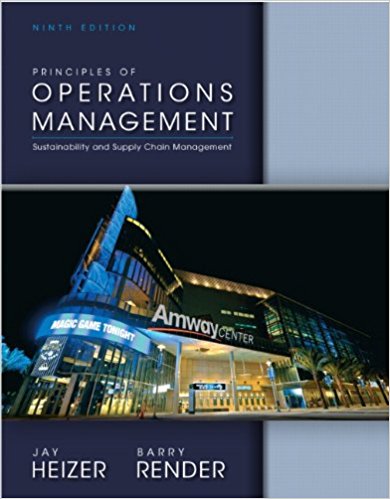
Operations Management 9Th Edition By Heizer Render - Test Bank

Operations Management 9Th Edition By Heizer Render - Test Bank   Instant Download - Complete Test Bank With Answers     Sample Questions Are Posted Below   1168. The total of all outputs produced by the transformation process divided by the total of the inputs isa. utilizationb. greater in manufacturing than in servicesc. defined only …

$19.99

Operations Management 9Th Edition By Heizer Render – Test Bank


Instant Download – Complete Test Bank With Answers


Sample Questions Are Posted Below


11
68. The total of all outputs produced by the transformation process divided by the total of the inputs is
a. utilization
b. greater in manufacturing than in services
c. defined only for manufacturing firms
d. multifactor productivity
e. none of the above
d (The productivity challenge, moderate)
69. Which of the following inputs has the greatest potential to increase productivity?
a. labor
b. globalization
c. management
d. capital
e. none of the above
c (The productivity challenge, moderate)
70. Productivity can be improved by
a. increasing inputs while holding outputs steady
b. decreasing outputs while holding inputs steady
c. increasing inputs and outputs in the same proportion
d. decreasing inputs while holding outputs steady
e. none of the above
d (The productivity challenge, moderate)
71. The largest contributor to productivity increases is ________, estimated to be responsible for
_____ of the annual increase.
a. management; over one-half
b. Mr. Deming; one-half
c. labor; two-thirds
d. capital; 90%
e. technology; over one-half
a (The productivity challenge, moderate)
72. The factor responsible for the largest portion of productivity increase in the U.S. is
a. labor
b. management
c. capital
d. all three combined; it is impossible to determine the contribution of individual factors
e. none of these; most productivity increases come from investment spending
b (The productivity challenge, moderate)
73. Which of the following is not true when explaining why productivity tends to be lower in the
service sector than in the manufacturing sector?
a. Services are typically labor-intensive.
b. Services are often difficult to evaluate for quality.
c. Services are often an intellectual task performed by professionals.
d. Services are difficult to automate.
e. Service operations are typically capital intensive.
e (The productivity challenge, moderate)
12
74. Three commonly used productivity variables are
a. quality, external elements, and precise units of measure
b. labor, capital, and management
c. technology, raw materials, and labor
d. education, diet, and social overhead
e. quality, efficiency, and low cost
b (The productivity challenge, moderate)
75. The service sector has lower productivity improvements than the manufacturing sector because
a. the service sector uses less skilled labor than manufacturing
b. the quality of output is lower in services than manufacturing
c. services usually are labor-intensive
d. service sector productivity is hard to measure
e. none of the above
c (The productivity challenge, moderate)
76. Productivity tends to be more difficult to improve in the service sector because the work is
a. often difficult to automate
b. typically labor-intensive
c. frequently processed individually
d. often an intellectual task performed by professionals
e. all of the above
e (The productivity challenge, moderate)
77. Among the ethical and social challenges facing operations managers are
a. honoring community commitments
b. maintaining a clean environment
c. efficiently developing and producing safe quality products
d. providing a safe workplace
e. all of the above
e (Ethics and social responsibility, easy) {AACSB: Ethical Reasoning}
78. Among the ethical and social challenges facing operations managers are
a. honoring financial commitments
b. maintaining a clean environment
c. developing low-cost products
d. providing an efficient workplace
e. all of the above
b (Ethics and social responsibility, moderate) {AACSB: Ethical Reasoning}
79. Which of the following is not among the ethical and social challenges facing operations managers?
a. honoring community commitments
b. maintaining a clean environment
c. efficiently developing and producing safe quality products
d. increasing executive pay
e. providing a safe workplace
d (Ethics and social responsibility, easy) {AACSB: Ethical Reasoning}
13
80. A business’s stakeholders, whose conflicting perspectives cause ethical and social dilemmas,
include
a. lenders
b. suppliers
c. owners
d. employees
e. all of the above
e (Ethics and social responsibility, easy) {AACSB: Ethical Reasoning}
FILL-IN-THE-BLANK
81. Starbuck’s stopped requiring signatures on credit-card purchases under $25 in an attempt to reduce
_____________________________ .
transaction time (or service time) (The productivity challenge, easy)
82. _____________________________ is the set of activities that transforms inputs into goods and
services.
Operations management (What is operations management? easy)
83. Marketing, Production, and _____________________________ are the three functions that all
organizations must perform to create goods and services.
finance/accounting (Organizing to produce goods and services, easy)
84. “Should we make or buy this component?” is an issue in the _____________________________
critical decision area.
supply chain management (What operations managers do, easy)
85. Henry Ford and _____________________________ are credited with the development of the
moving assembly line.
Charles Sorensen (The heritage of operations management, easy)
86. When a tangible product is not included in a service, it is called a
_____________________________.
pure service (Operations in the service sector, easy)
87. _____________________________ is the ability of the organization to be flexible enough to cater
to the individual whims of consumers.
Mass customization (Exciting new trends in operations management, moderate)
88. _____________________________ is the operations management trend that moves more decision
making to the individual worker.
Empowered employees (Exciting new trends in operations management, moderate)
89. ____________________________ is the total of all outputs produced by the transformation
process divided by the total of the inputs.
Multifactor productivity (The productivity challenge, easy)
14
90. Productivity is the ratio of ____________ to _________. Using this relationship, productivity can
be improved by ______________________ or _________________________.
inputs, outputs; reducing inputs while holding outputs constant; increasing outputs while
holding inputs constant. (The productivity challenge, moderate)
SHORT ANSWER
91. Identify three or more operations-related tasks carried out by Hard Rock Café.
Providing custom meals; designing, testing, and costing meals; acquiring, receiving , and
storing supplies; recruiting and training employees; preparing employee schedules; designing
efficient restaurant layouts. (Global company profile, easy)
92. Identify two operations-related tasks carried out by Hard Rock Café. Match each to its area of the
Ten Critical Decisions.
Providing custom meals—design of goods and services; designing, testing, and costing
meals—design of goods and services; acquiring, receiving , and storing supplies—supply
chain management; recruiting and training employees—human resources and job design;
preparing employee schedules—intermediate and short-term scheduling; designing efficient
restaurant layouts—layout strategy. (Global company profile, moderate)
93. Define operations management. Will your definition accommodate both manufacturing and
service operations?
Operations management can be defined as the management of all activities directly related to
the creation of goods and/or services through the transformation of inputs into outputs.
(What is operations management? easy)
94. Identify the items that Fredrick W. Taylor believed management should be more responsible for.
He believed that management should be more responsible for matching employees to the
right job, providing the proper training, providing proper work methods and tools, and
establishing legitimate incentives for work to be accomplished. (The heritage of operations
management, moderate)
95. Operations managers should be well versed in what disciplines in order to make good decisions?
Management science, information technology, and often one of the biological or physical
sciences. (The heritage of operations management, moderate)
96. Why are services typically more difficult to standardize, automate, and make efficient?
Services typically require customer interaction, which makes it difficult to standardize,
automate, and make efficient. (Operations in the service sector, moderate)
97. How do services differ from goods? Identify five ways.
Pick from the following: a service is usually intangible; it is often produced and consumed
simultaneously; often unique; it involves high customer interaction; product definition is
inconsistent; often knowledge-based; and frequently dispersed. (Operations in the service
sector, moderate)
15
98. Services are often knowledge-based. Provide two examples, and explain why they are knowledge-
based.
Answer will vary, but the textbook used educational, medical, and legal services. (Operations
in the service sector, moderate)
99. Why are organizations changing from batch (large) shipments to just-in-time (JIT) shipments?
Organizations are switching to JIT shipments because inventory requires a large financial
investment, and impedes the responsiveness to changes in the marketplace. (Exciting new
trends in operations management, moderate)
100. Why are organizations becoming more global?
Organizations are becoming more global with the decline in the cost of communication and
transportation. Additionally, resources—capital, material, talent, and labor–are also
becoming more global. (Exciting new trends in operations management)
101. Identify the three productivity variables used in the text.
The three common variables are labor, capital, and management.
(Productivity variables, moderate)
102. What is a knowledge society?
A knowledge society is one in which much of the labor force has migrated from manual work
to work based on knowledge. (The productivity challenge, moderate)
103. Why are operations managers faced with ethical and social challenges?
Businesses have diverse stakeholders, which include owners, employees, lenders, and
distributors. These stakeholders hold conflicting perspectives. (Ethics and social
responsibility, easy) {AACSB: Ethical Reasoning}
104. What are some of the ethical and social challenges faced by operations managers?
Efficiently developing and producing safe quality products; maintaining a clean
environment; providing a safe workplace; honoring community commitments. (Ethics and
social responsibility, easy) {AACSB: Ethical Reasoning}
105. As the administrative manager in a law office, you have been asked to develop a system for
evaluating the productivity of the 15 lawyers in the office. What difficulties are you going to have
in doing this, and how are you going to overcome them?
Productivity measurers for a law office are difficult. Simple criteria, like number of cases
processed, fail to consider complexity of the case. Even counting wins is difficult, as many
cases are settled with some sort of compromise. External elements such as the quality of the
opposing counsel and the tenacity of the opposition also make counting look rather silly.
Categories of cases can help—(i.e., uncontested divorce, no personal injury auto case, etc.)
However, many firms end up counting hours billed. This in turns leads to other problems, as
noted by the number of false billing cases. (The productivity challenge, moderate) {AACSB:
Reflective Thinking}
16
PROBLEMS
106. Susan has a part-time “cottage industry” producing seasonal plywood yard ornaments for resale at
local craft fairs and bazaars. She currently works 8 hours per day to produce 16 ornaments.
a. What is her productivity?
b. She thinks that by redesigning the ornaments and switching from use
of a wood glue to a hot-glue gun she can increase her total
production to 20 ornaments per day. What is her new productivity?
c. What is her percentage increase in productivity?
a. 16 ornaments/8 hours = 2 ornaments/hour
b. 20 ornaments/8 hours = 2.5 ornaments/hour
c. Change in productivity = 0.5 ornaments/hour; percent change = 0.5/2= 25%
(The productivity challenge, moderate) {AACSB: Analytic Skills}
107. A firm cleans chemical tank cars in the Bay St. Louis area. With standard equipment, the firm
typically cleaned 70 chemical tank cars per month. They utilized 10 gallons of solvent, and two
employees worked 20 days per month, 8 hours a day. The company decided to switch to a larger
cleaning machine. Last April, they cleaned 60 tank cars in only 15 days. They utilized 12 gallons of
solvent, and the two employees worked 6 hours a day.
1. What was their productivity with the standard equipment?
2. What is their productivity with the larger machine?
3. What is the change in productivity?
Resource Standard
Equipment
Larger Machine Percent Change
Solvent 7
10
70 = 5
12
60 = %57.28
7
75 =

Labor 22.0
320
70 = 33.
180
60 = %50
22.
22.33. =

(The productivity challenge, moderate) {AACSB: Analytic Skills}
108. The Dulac Box plant produces wooden packing boxes to be used in the local seafood industry.
Current operations allow the company to make 500 boxes per day, in two 8-hour shifts (250 boxes
per shift). The company has introduced some small changes in equipment, and conducted
appropriate job training, so that production levels have risen to 300 boxes per shift. These changes
did not require any change in the amount of capital spending or energy use. What is the firm’s new
labor productivity?
600 boxes per day / 16 hours = 37.5 boxes per hour
(The productivity challenge, moderate) {AACSB: Analytic Skills}
17
109. Mark’s Ceramics spent $4000 on a new kiln last year, in the belief that it would cut energy usage
25% over the old kiln. This kiln is an oven that turns “greenware” into finished pottery. Mark is
concerned that the new kiln requires extra labor hours for its operation. Mark wants to check the
energy savings of the new oven, and also to look over other measures of their productivity to see if
the change really was beneficial. Mark has the following data to work with:
Last Year This Year
Production (finished units) 4000 4000
Greenware (pounds) 5000 5000
Labor (hrs) 350 375
Capital ($) 15000 19000
Energy (kWh) 3000 2600
Were the modifications beneficial?
The energy modifications did not generate the expected savings; labor and capital
productivity decreased. (The productivity challenge, moderate) {AACSB: Analytic Skills}
Resource Last Year This Year Change Pct.
Change
Labor 4000 / 350 = 11.43 4000 / 375 = 10.67 -0.76 -6.7%
Capital 4000 / 15000 = 0.27 4000 / 19000 = .21 -0.06 -22.2%
Energy 4000 / 3000 = 1.33 4000 / 2600 = 1.54 0.21 15.4%
110. Martin Manufacturing has implemented several programs to improve its productivity. They have
asked you to evaluate the firm’s productivity by comparing this year’s performance with last year’s.
The following data are available:
Last Year This Year
Output 10,500 units 12,100 units
Labor Hours 12,000 13,200
Utilities $7,600 $8,250
Capital $83,000 $88,000
Has Martin Manufacturing improved its productivity during the past year?
Productivity improved in all three categories this year; utilities showed the greatest increase,
and labor the least. (The productivity challenge, moderate) {AACSB: Analytic Skills}
Resource Last Year This Year Change Pct.
Change
Labor 10500 / 12000 = 0.88 12100 / 13200 = 0.92 0.04 4.8%
Capital 10500 / 7600 = 1.38 12100 / 8250 = 1.47 0.09 6.2%
Energy 10500 / 83000 = 0.13 12100 / 88000 = 0.14 0.01 8.7%
18
111. Felicien grows mirlitons (that’s Cajun for Chayote squash) in his 100 by 100 foot garden. He then
sells the crop at the local farmers’ market. Two summers ago, he was able to produce and sell 1200
pounds of mirlitons. Last summer, he tried a new fertilizer that promised a 50% increase in yield.
He harvested 1900 pounds. Did the fertilizer live up to its promise?
Since the productivity gain was 58.3%, not 50%, the fertilizer was at least as good as
advertised. (The productivity challenge, moderate) {AACSB: Analytic Skills}
Two summers ago Last summer Change
1200 ÷ 10,000 = .12
lbs/sq. ft
1900 ÷ 10,000 = .19
lbs/sq. ft
(.19 – .12) ÷ .12 =
58.3%
112. The Dulac Box plant produces wooden packing boxes to be used in the local seafood industry.
Current operations allow the company to make 500 boxes per day, in two 8-hour shifts (250 boxes
per shift). The company has introduced some moderate changes in equipment, and conducted
appropriate job training, so that production levels have risen to 300 boxes per shift. Labor costs
average $10 per hour for each of the 5 full-time workers on each shift. Capital costs were
previously $3,000 per day, and rose to $3,200 per day with the equipment modifications. Energy
costs were unchanged by the modifications, at $400 per day. What is the firm’s multifactor
productivity before and after the changes?
MFP before: 500 boxes / ($10x5x16 + $3000 + $400) = 500 / 4200 = 0.119 boxes/dollar
MFP after: 600 boxes / ($10x5x16 + $3200 + $400) = 600 / 4400 = 0.136 boxes/dollar
(The productivity challenge, moderate) {AACSB: Analytic Skills}
113. Gibson Products produces cast bronze valves for use in offshore oil platforms. Currently, Gibson
produces 1600 valves per day. The 20 workers at Gibson work from 7 a.m. until 4 p.m., with 30
minutes off for lunch and a 15 minute break during the morning work session and another at the
afternoon work session. Gibson is in a competitive industry, and needs to increase productivity to
stay competitive. They feel that a 20 percent increase is needed.
Gibson’s management believes that the 20 percent increase will not be possible without a change in
working conditions, so they change work hours. The new schedule calls on workers to work from
7:30 a.m. until 4:30 p.m., during which workers can take one hour off at any time of their choosing.
Obviously, the number of paid hours is the same as before, but production increases, perhaps
because workers are given a bit more control over their workday. After this change, valve
production increased to 1800 units per day.
a. Calculate labor productivity for the initial situation
b. Calculate labor productivity for the hypothetical 20 percent increase
c. What is the productivity after the change in work rules?
d. Write a short paragraph analyzing these results.
(a) Workers are active for eight hours per day; labor productivity is 10 valves/hour
(b) Productivity rises by 20 percent, to 12 valves/hour; output will be 12x8x20 = 1920
(c) New productivity is 1800 / (20 x 8) = 11.25 valves/hour
(d) Gibson did not gain the desired 20 percent increase in productivity, but they did gain over
ten percent, without extra equipment or energy, and without increasing the wage bill.
(The productivity challenge, moderate) {AACSB: Analytic Skills}

Additional information

Add Review

Your email address will not be published. Required fields are marked *