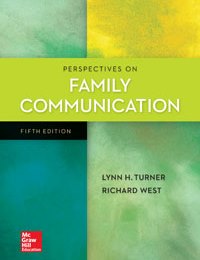
Perspectives on Family Communication Lynn Turner 5e - Test Bank

Perspectives on Family Communication Lynn Turner 5e - Test Bank   Instant Download - Complete Test Bank With Answers     Sample Questions Are Posted Below   CHAPTER FIVE – TW 5e   Multiple Choice   Habitual, mundane communication (e.g., joking around, gossiping, recapping events of the day) that affects the health of relationships in …

$19.99

Perspectives on Family Communication Lynn Turner 5e – Test Bank


Instant Download – Complete Test Bank With Answers


Sample Questions Are Posted Below


CHAPTER FIVE – TW 5e


Multiple Choice


  1. Habitual, mundane communication (e.g., joking around, gossiping, recapping events of the day) that affects the health of relationships in families is known as which of the following?
  2. small talk
  3. chit chat talk
  4. lighthearted talk
  5. everyday talk*


  1. The authors state that which term is synonymous with closeness?
  2. proximal
  3. intimacy*
  4. commitment
  5. affection


  1. An interpersonal process within which two [or more in the case of a family] interaction partners experience and express feelings, communicate verbally and nonverbally, satisfy social motives, augment or reduce social fears, talk and learn about themselves and their unique characteristics, and become “close” (psychologically and often physically: touching, using intimate names and tones of voice) is defined as which of the following?
  2. interdependence
  3. devotion
  4. presence
  5. intimacy*


  1. Francis gets upset whenever she gets angry with her son. Which of the following best describes this?
  2. emotional duality
  3. guilt by association
  4. meta-emotions*
  5. secondary emotions


  1. Saying things like, “I love you,” “You are the best wife anyone could ask for,” and “I adore you” announce the strength of the bond between people, and are all examples of which of the following?
  2. positive absolute statements*
  3. playfulness
  4. giving comfort and support
  5. negative absolute statements


  1. The approach-avoidance relationship that people tend to have toward self-disclosure is best explained by which of the following?
  2. Self-disclosure has the potential for both rewards as well as risk.*
  3. People prefer to self-disclose to strangers.
  4. Self-disclosure increases intimacy quickly.
  5. Self-disclosure provides boundaries for family members.


  1. The competing tensions of wanting both closeness and distance within our family relationships can best be described by which of the following?
  2. monologic thinking
  3. dialectic approach*
  4. dialogistics
  5. synchronous discourse


  1. Thinking about closeness as linear and on a continuum, where relationships “get close” or “grow apart” illustrates which of the following?
  2. dialectic thinking
  3. complementary thinking
  4. monologic thinking*
  5. dualistic thinking


  1. When focusing on the complex nature of separateness and connected­ness in the family, intimacy is seen not as the absence of distance; but rather, intimacy and distance are seen as simultaneously operating in family relation­ships. This type describes which of the following?
  2. dialectic thinking*
  3. complementary thinking
  4. monologic thinking
  5. dualistic thinking


  1. Amy has currently finished her master’s thesis and is extremely stressed. While she has always had a very open and loving relationship with her parents, they realize that this is a stressful time and decide to keep their distance from Amy until the project is completed to avoid any possibility of getting into a conflict. Amy’s parents have adopted which style of managing the dialectical tension of closeness and distance?
  2. cyclic alteration*
  3. reframing
  4. neutralizing
  5. disqualifying


  1. Couples who isolate separate spheres for the dialectical tensions of closeness and autonomy, or who designate the times they spend together, are employing which strategy for managing dialectical tensions?
  2. cyclic alternation
  3. reframing
  4. selection
  5. segmentation*


  1. The strategy of finding a “happy medium” as a compromise between competing dialectical tensions is referred to as which of the following?
  2. reframing
  3. segmentation
  4. neutralizating*
  5. disqualifying


  1. Which theory posits that the relationship between infant and caregiver will establish patterns of behavior that determine how the infant approaches relationships later in life?
  2. Attachment*
  3. Systems
  4. Social Exchange
  5. Circumplex


  1. Which theory is based on the notion that people think about their relationships in economic terms.
  2. Attachment
  3. Systems
  4. Social Exchange*
  5. Intimacy


  1. 15. The Circumplex Model posits that family life is conducted along which two dimensions?
  2. monologic and dialogic
  3. content and relational
  4. adaptability and cohesion*
  5. autonomy and connectedness


Short Answer/Essay Questions


  1. Explain what “everyday talk” is and describe why it is important to intimate relationships.
  2. Identify and describe Knapp and Vangelisti’s seven communication behaviors that manifest intimacy and closeness.
  3. Define self-disclosure and explain the complexity of it within the context of intimate relationships.
  4. Compare and contrast the following ways of thinking about closeness and distance in family relationships: monologic approach, dialogic approach, dualistic approach.
  5. Describe the six strategies for managing dialectical tensions in the family. Which strategy seems the most effective? Which strategy seems the least effective? Defend your position.
  6. Discuss the impact of one’s culture on expectations for closeness and distance in the family. What aspects of your culture do you feel have impacted the expectations for closeness and distance in your own family?
  7. Explain Attachment Theory and describe the typology of infant-caregiver relationships and how those develop into each attachment style in adulthood.
  8. Distinguish between the comparison level and the comparison level for alternatives in the Social Exchange Theory. Provide an example of each.
  9. Explain the Circumplex Model and describe how a family can be balanced or unbalanced.


Additional information

Add Review

Your email address will not be published. Required fields are marked *