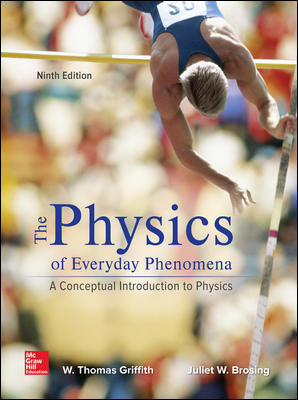
Physics of Everyday Phenomena 9Th edition By W,Thomas - Test Bank

Physics of Everyday Phenomena 9Th edition By W,Thomas - Test Bank   Instant Download - Complete Test Bank With Answers     Sample Questions Are Posted Below   The Physics of Everyday Phenomena, 9e (Griffith) Chapter 5   Circular Motion, the Planets, and Gravity   1) Earth's gravity attracts a person with a force of 120 …

$19.99

Physics of Everyday Phenomena 9Th edition By W,Thomas – Test Bank


Instant Download – Complete Test Bank With Answers


Sample Questions Are Posted Below


The Physics of Everyday Phenomena, 9e (Griffith)

Chapter 5   Circular Motion, the Planets, and Gravity


1) Earth’s gravity attracts a person with a force of 120 lbs. The force with which the Earth is attracted towards the person is

  1. A) billions and billions of tons.
  2. B) 120 lbs.
  3. C) small but not zero.
  4. D) zero.


Answer:  B

Difficulty: 1 Easy

Topic:  Newton’s Law of Universal Gravitation

Chapter:  05 Circular Motion, the Planets, and Gravity

Type:  Conceptual

Accessibility:  Keyboard Navigation


2) Which planets exhibit retrograde motion, that is, periodically appear to reverse their direction of motion across the sky?

  1. A) Only Mars, Mercury, and Venus
  2. B) Only Mars, Jupiter, and Venus
  3. C) Only Mars, Jupiter, and Saturn
  4. D) Only Venus, Saturn, and Jupiter
  5. E) All of the planets show retrograde motion


Answer:  E

Difficulty: 1 Easy

Topic:  Planetary Motion

Chapter:  05 Circular Motion, the Planets, and Gravity

Type:  Conceptual; Definition

Accessibility:  Keyboard Navigation


3) After their rocket engines shut off, astronauts experience weightlessness in the orbiting Space Shuttle,

  1. A) but they are not accelerating, since nothing actually has weight in space.
  2. B) and they are accelerating because they are actually in free-fall.
  3. C) and they are accelerating because they have constant velocity as they pass overhead.
  4. D) but they cannot accelerate because their rocket engines are shut off.


Answer:  B

Difficulty: 1 Easy

Topic:  The Moon and Other Satellites

Chapter:  05 Circular Motion, the Planets, and Gravity

Type:  Conceptual

Accessibility:  Keyboard Navigation


4) A rock that weighs 100 lb on Earth is taken to the Moon. Which of the following statements accurately describes what would be observed?

  1. A) The rock is easier to lift because its mass is less on the moon
  2. B) The rock is easier to lift because its weight is less on the moon
  3. C) The rock is more difficult to lift because the Moon’s radius is less than Earth’s
  4. D) The rock is just as difficult to lift on the Moon as it is on Earth because its mass hasn’t changed


Answer:  B

Difficulty: 2 Medium

Topic:  Newton’s Law of Universal Gravitation

Chapter:  05 Circular Motion, the Planets, and Gravity

Type:  Conceptual

Accessibility:  Keyboard Navigation


5) For reasons known only to them, a group of extraterrestrials offers you your choice of three gold ingots. One weighs 10 lb on Earth, the second weighs 10 lb on Jupiter, and the third weighs 10 lb on the Moon. To get the most gold, you should choose the ingot that weighs 10 lb on

  1. A) Earth.
  2. B) Jupiter.
  3. C) the Moon.
  4. D) No difference; 10 lbs is 10 lbs wherever you go


Answer:  C

Difficulty: 1 Easy

Topic:  Newton’s Law of Universal Gravitation

Chapter:  05 Circular Motion, the Planets, and Gravity

Type:  Conceptual

Accessibility:  Keyboard Navigation


6) An object weighs 30 newtons on Earth. What is its approximate mass?

  1. A) 640 kg
  2. B) 30 g
  3. C) 12 kg
  4. D) 3 kg
  5. E) 294 kg


Answer:  D

Difficulty: 1 Easy

Topic:  Newton’s Law of Universal Gravitation

Chapter:  05 Circular Motion, the Planets, and Gravity

Type:  Numerical

Accessibility:  Keyboard Navigation


7) An object undergoes uniform circular motion. Which pair of vectors is perpendicular?

  1. A) Its centripetal acceleration and the centripetal force
  2. B) Its centripetal acceleration and velocity vectors
  3. C) All three vectors are mutually perpendicular: centripetal acceleration, centripetal force, and velocity


Answer:  B

Difficulty: 1 Easy

Topic:  Centripetal Forces

Chapter:  05 Circular Motion, the Planets, and Gravity

Type:  Conceptual

Accessibility:  Keyboard Navigation


8) Which of the following is NOT a vector?

  1. A) Acceleration
  2. B) Mass
  3. C) Weight
  4. D) Velocity
  5. E) All of these choices are correct


Answer:  B

Difficulty: 1 Easy

Topic:  Centripetal Acceleration

Chapter:  05 Circular Motion, the Planets, and Gravity

Type:  Conceptual

Accessibility:  Keyboard Navigation


9) A banked curve in a roadway is designed for a speed of 35 mph. During an ice storm cars should be able to safely negotiate this curve at 35 mph, because at this speed

  1. A) the necessary centripetal force is supplied entirely by gravity.
  2. B) (and at all speeds) the acceleration vector of the car points down, helping maintain stability.
  3. C) the necessary centripetal force is supplied entirely by the normal force from the road.
  4. D) the centrifugal force of the car exactly balances the centripetal force.


Answer:  C

Difficulty: 2 Medium

Topic:  Centripetal Forces

Chapter:  05 Circular Motion, the Planets, and Gravity

Type:  Conceptual

Accessibility:  Keyboard Navigation


10) The mass of an apple on the Earth is 0.2 kg. On the Moon, the mass of the same apple would be

  1. A) greater than 0.2 kg.
  2. B) 0.2 kg.
  3. C) greater than zero but less than 0.2 kg.
  4. D) zero.


Answer:  B

Difficulty: 1 Easy

Topic:  Newton’s Law of Universal Gravitation

Chapter:  05 Circular Motion, the Planets, and Gravity

Type:  Conceptual

Accessibility:  Keyboard Navigation


11) Arnold can bench press 315 pounds in his gym in California. That is exactly six big 45-pound weight plates and the 45-pound bar. He can lift all that one time, but he cannot lift 325 pounds even once. At the NASA gym on the Moon, Arnold would

  1. A) be able to bench press more than 315 pounds.
  2. B) be able to bench press the bar and more than 6 weight plates.
  3. C) be unable to bench press 315 pounds due to weak gravitational field of the Moon.


Answer:  B

Difficulty: 2 Medium

Topic:  Newton’s Law of Universal Gravitation

Chapter:  05 Circular Motion, the Planets, and Gravity

Type:  Conceptual

Accessibility:  Keyboard Navigation


12) Six identical blocks of steel, each with mass 10.0 kg, are taken to the Moon. On the Moon, their combined mass is

  1. A) zero.
  2. B) 10.0 kg.
  3. C) 360 kg.
  4. D) 60.0 kg.


Answer:  D

Difficulty: 1 Easy

Topic:  Newton’s Law of Universal Gravitation

Chapter:  05 Circular Motion, the Planets, and Gravity

Type:  Conceptual

Accessibility:  Keyboard Navigation


13) Two cars that have the same mass are moving around a circular track at the same constant speed. The track is perfectly level. If car 1 is at the inner edge of the track and car 2 is at the outer edge, then

  1. A) the frictional force on car 1 is greater than the frictional force on car 2.
  2. B) the frictional force on car 1 is less than the frictional force on car 2.
  3. C) the frictional forces on both cars are equal and greater than zero.
  4. D) the frictional force on both cars is zero.


Answer:  A

Difficulty: 2 Medium

Topic:  Centripetal Forces

Chapter:  05 Circular Motion, the Planets, and Gravity

Type:  Conceptual

Accessibility:  Keyboard Navigation


14) A cyclist races around a circular track at the constant speed of 20 m/s. The radius of the track is 40 m. The centripetal acceleration of the cyclist is

  1. A) zero.
  2. B) 10 m/s2, toward the center of the track.
  3. C) 10 m/s2, downward.
  4. D) 20 m/s2, in the direction of travel.


Answer:  B

Difficulty: 1 Easy

Topic:  Centripetal Acceleration

Chapter:  05 Circular Motion, the Planets, and Gravity

Type:  Numerical

Accessibility:  Keyboard Navigation


15) A man weighs 650 N while on the surface of Earth. If he is transported to the planet Mythos, which has the same mass as Earth but a radius that is five times larger than Earth’s, his weight would be

  1. A) 16,250 N.
  2. B) 3,250 N.
  3. C) 650 N.
  4. D) 130 N.
  5. E) 26 N.


Answer:  E

Difficulty: 2 Medium

Topic:  Newton’s Law of Universal Gravitation

Chapter:  05 Circular Motion, the Planets, and Gravity

Type:  Numerical

Accessibility:  Keyboard Navigation


16) The orbit of Comet UX209 about the Sun is not a circle but it orbits once every 365 days, just as Earth does. UX209 is closer to the Sun in April than it is in October. Thus, the speed of UX209 as it moves along its orbit is

  1. A) steadily increasing all year long.
  2. B) greater in April than in October.
  3. C) greater in October than it is in April.
  4. D) steadily decreasing all year long.
  5. E) the same all year long.


Answer:  B

Difficulty: 1 Easy

Topic:  Planetary Motion

Chapter:  05 Circular Motion, the Planets, and Gravity

Type:  Conceptual

Accessibility:  Keyboard Navigation


17) An asteroid moving around the Sun happens to experience only negligible forces from other objects in the solar system. The path of this asteroid will be

  1. A) a sinusoid.
  2. B) a parabola.
  3. C) an ellipse.
  4. D) a straight line.


Answer:  C

Difficulty: 1 Easy

Topic:  Planetary Motion

Chapter:  05 Circular Motion, the Planets, and Gravity

Type:  Conceptual; Definition

Accessibility:  Keyboard Navigation


18) A car travels around a curve with constant speed. The correct statement from the following is

  1. A) the car has an acceleration directed inward toward the center of the curve.
  2. B) the velocity of the car is constant.
  3. C) the car has an acceleration directed outward from the center of the curve.
  4. D) the car has zero acceleration.
  5. E) the car has an acceleration directed in the instantaneous direction of the velocity vector.


Answer:  A

Difficulty: 1 Easy

Topic:  Centripetal Acceleration

Chapter:  05 Circular Motion, the Planets, and Gravity

Type:  Conceptual

Accessibility:  Keyboard Navigation


19) A ball is whirled on the end of a string in a horizontal circle at constant speed. Suddenly, the string breaks. Immediately after the string breaks, the ball will

  1. A) have a horizontal velocity away from the center of the circle.
  2. B) have a horizontal velocity that is tangential to the circle.
  3. C) have a horizontal velocity toward the center of the circle.
  4. D) have a horizontal velocity partly in away from the center of the circle and partly tangent to the circle.
  5. E) have no horizontal velocity.


Answer:  B

Difficulty: 1 Easy

Topic:  Centripetal Acceleration

Chapter:  05 Circular Motion, the Planets, and Gravity

Type:  Conceptual

Accessibility:  Keyboard Navigation


20) Car A travels with speed v around curve number one, which has a radius r. Car B travels with speed 2v around curve number two, which has a radius 2r. The acceleration will be

  1. A) greater for car A.
  2. B) greater for car B.
  3. C) zero for both cars.
  4. D) the same for both cars.


Answer:  B

Difficulty: 2 Medium

Topic:  Centripetal Acceleration

Chapter:  05 Circular Motion, the Planets, and Gravity

Type:  Conceptual

Accessibility:  Keyboard Navigation


21) If a ball at the end of a string is whirled in a vertical circle at constant speed, the tension will be

  1. A) the same throughout the motion.
  2. B) greatest at the highest point in the motion.
  3. C) greatest at the lowest point in the motion.
  4. D) greatest at a point where the string is instantaneously parallel to the ground.


Answer:  C

Difficulty: 2 Medium

Topic:  Centripetal Forces

Chapter:  05 Circular Motion, the Planets, and Gravity

Type:  Conceptual

Accessibility:  Keyboard Navigation


22) The first scientist to determine that the orbits of the planets are ellipses was

  1. A) Galileo.
  2. B) Kepler.
  3. C) Ptolemy.
  4. D) Copernicus.
  5. E) Newton.


Answer:  B

Difficulty: 1 Easy

Topic:  Planetary Motion

Chapter:  05 Circular Motion, the Planets, and Gravity

Type:  Definition

Accessibility:  Keyboard Navigation


23) The heliocentric model of the solar system gained preference over the early Greek epicycle model because

  1. A) the heliocentric model gave a more accurate description of observed planetary motions.
  2. B) the heliocentric model was simpler.
  3. C) only the heliocentric model could explain retrograde motion.


Answer:  B

Difficulty: 1 Easy

Topic:  Planetary Motion

Chapter:  05 Circular Motion, the Planets, and Gravity

Type:  Conceptual

Accessibility:  Keyboard Navigation


24) According to Newton’s Law of Gravitation, if the distance between two bodies is doubled the attractive force between them becomes

  1. A) unchanged.
  2. B) twice as large.
  3. C) half as large.
  4. D) four times as large.
  5. E) one quarter as large.


Answer:  E

Difficulty: 1 Easy

Topic:  Newton’s Law of Universal Gravitation

Chapter:  05 Circular Motion, the Planets, and Gravity

Type:  Conceptual; Definition

Accessibility:  Keyboard Navigation


25) The Sun and Moon both have an effect on the tides. Which one has the larger effect, and why?

  1. A) The Moon, because its force differs more between the surface and center of the Earth
  2. B) The Sun, because its force differs more between the surface and center of the Earth
  3. C) The Moon, because it exerts a larger force on the ocean
  4. D) The Sun, because it exerts a larger force on the ocean
  5. E) Both the sun and Moon equally affect the tides


Answer:  A

Difficulty: 2 Medium

Topic:  The Moon and Other Satellites

Chapter:  05 Circular Motion, the Planets, and Gravity

Type:  Conceptual; Definition

Accessibility:  Keyboard Navigation


26) Suppose a planet has a mass of 10 times that of the Earth and a radius that is 100 times that of the Earth. The acceleration of gravity on the surface of the planet, expressed in units of the Earth’s acceleration of gravity, g, is

  1. A) g.
  2. B) 10 g.
  3. C) g/10.
  4. D) 1000 g.
  5. E) g/1000.


Answer:  E

Difficulty: 2 Medium

Topic:  Newton’s Law of Universal Gravitation

Chapter:  05 Circular Motion, the Planets, and Gravity

Type:  Numerical

Accessibility:  Keyboard Navigation


27) Suppose an artificial satellite has been put into circular orbit about the Earth, at a distance from the center of the Earth equal to 1/4 the distance from the Earth’s center to the Moon’s center. In terms of the Moon’s period Tm, what will be the period of the satellite?

  1. A) 16 Tm.
  2. B) 8 Tm.
  3. C) Tm.
  4. D) Tm/8.
  5. E) Tm/16.


Answer:  D

Difficulty: 3 Hard

Topic:  The Moon and Other Satellites

Chapter:  05 Circular Motion, the Planets, and Gravity

Type:  Numerical

Accessibility:  Keyboard Navigation

28) On a two-lane highway (not divided), a car headed north experiences a centripetal acceleration directed toward the west. Simultaneously, a truck passes the car, headed south in the other lane. The direction of the centripetal acceleration on the truck is

  1. A) west.
  2. B) east.
  3. C) north.
  4. D) south.


Answer:  A

Difficulty: 2 Medium

Topic:  Centripetal Acceleration

Chapter:  05 Circular Motion, the Planets, and Gravity

Type:  Conceptual

Accessibility:  Keyboard Navigation


29) What are the units for the constant G used in Newton’s law of universal gravitation?

  1. A) kg2/m2
  2. B) kg m /s2
  3. C) (N m2)/kg2
  4. D) N/m2
  5. E) None of these choices are correct


Answer:  C

Difficulty: 2 Medium

Topic:  Newton’s Law of Universal Gravitation

Chapter:  05 Circular Motion, the Planets, and Gravity

Type:  Definition

Accessibility:  Keyboard Navigation


30) If you are ever fortunate enough to experience a total eclipse of the Sun, you can be sure that it will happen when the Moon is

  1. A) in its “first quarter” phase.
  2. B) in its “last quarter” phase.
  3. C) in the “new Moon” phase.
  4. D) full.
  5. E) No way to tell; it’s a matter of chance


Answer:  C

Difficulty: 1 Easy

Topic:  The Moon and Other Satellites

Chapter:  05 Circular Motion, the Planets, and Gravity

Type:  Conceptual

Accessibility:  Keyboard Navigation


31) In Vienna, there is a Ferris wheel designed so that the passengers ride in a standing position. If one of the passengers were standing on a bathroom scale while the ride rotated at a constant speed, the scale would read lowest at

  1. A) the lowest point in the ride.
  2. B) the highest point in the ride.
  3. C) the point in the ride where they were ascending most rapidly.
  4. D) the point in the ride where they were descending most rapidly.


Answer:  B

Difficulty: 2 Medium

Topic:  Centripetal Forces

Chapter:  05 Circular Motion, the Planets, and Gravity

Type:  Conceptual

Accessibility:  Keyboard Navigation


32) During a new Moon, when the Sun and the Moon are on the same side of the Earth, the people who live next to the ocean will see about how many high tides per day?

  1. A) One
  2. B) Two
  3. C) Three
  4. D) Four


Answer:  B

Difficulty: 2 Medium

Topic:  The Moon and Other Satellites

Chapter:  05 Circular Motion, the Planets, and Gravity

Type:  Conceptual

Accessibility:  Keyboard Navigation


33) Two artificial satellites are in circular orbits about the Earth. Which of the two will be moving more slowly along its orbit?

  1. A) The one with the smaller mass
  2. B) The one with the larger mass
  3. C) The lower one
  4. D) The higher one


Answer:  D

Difficulty: 1 Easy

Topic:  The Moon and Other Satellites

Chapter:  05 Circular Motion, the Planets, and Gravity

Type:  Conceptual

Accessibility:  Keyboard Navigation


34) A full Moon is just now rising. Approximately what time of day is it?

  1. A) 6 PM (sunset)
  2. B) Midnight
  3. C) 6 AM (sunrise)
  4. D) Noon
  5. E) It could be any time of day


Answer:  A

Difficulty: 2 Medium

Topic:  The Moon and Other Satellites

Chapter:  05 Circular Motion, the Planets, and Gravity

Type:  Conceptual

Accessibility:  Keyboard Navigation


35) If a curve is banked to accommodate cars traveling at 15 m/s, what will happen during an ice storm (no friction with the road) to a car moving at a faster speed?

  1. A) It will gradually slide down the bank
  2. B) It will continue to follow the curve as if there were no ice
  3. C) It will gradually slide up the bank
  4. D) It will slide up the bank and then slide down the bank, oscillating in its vertical position


Answer:  C

Difficulty: 2 Medium

Topic:  Centripetal Acceleration

Chapter:  05 Circular Motion, the Planets, and Gravity

Type:  Conceptual

Accessibility:  Keyboard Navigation


36) In his model of the motions of the planets, Copernicus

  1. A) assumed that the Earth is the center of the solar system.
  2. B) revived the idea that our solar system is heliocentric (Sun-centered).
  3. C) found that the planets move in paths shaped like ellipses.
  4. D) was able to make predictions that were much more accurate than Ptolemy’s model.


Answer:  B

Difficulty: 3 Hard

Topic:  Planetary Motion

Chapter:  05 Circular Motion, the Planets, and Gravity

Type:  Definition

Accessibility:  Keyboard Navigation


37) In order to move in a perfectly circular path, the net force on an object must

  1. A) always change magnitude but not direction.
  2. B) always change direction but not magnitude.
  3. C) always change both magnitude and direction.
  4. D) have a constant magnitude and direction.
  5. E) equal zero.


Answer:  B

Difficulty: 2 Medium

Topic:  Centripetal Acceleration

Chapter:  05 Circular Motion, the Planets, and Gravity

Type:  Conceptual

Accessibility:  Keyboard Navigation


38) Two stars of different mass move directly toward each other. As the distance between the stars decreases, the speed of the stars

  1. A) gets smaller for both.
  2. B) stays the same for both.
  3. C) increases for both.
  4. D) stays constant for the larger one and increases for the smaller one.
  5. E) stays constant for the smaller one and decreases for the larger one.


Answer:  C

Difficulty: 2 Medium

Topic:  Newton’s Law of Universal Gravitation

Chapter:  05 Circular Motion, the Planets, and Gravity

Type:  Conceptual

Accessibility:  Keyboard Navigation


39) If you took a Ferris wheel ride in space while sitting on a bathroom scale, your weight

  1. A) would start small and continually increase.
  2. B) would be zero for the entire ride.
  3. C) would be constant and larger than zero for the entire ride.
  4. D) would start large and continually decrease.
  5. E) would increase and decrease just as on Earth.


Answer:  C

Difficulty: 1 Easy

Topic:  Centripetal Forces

Chapter:  05 Circular Motion, the Planets, and Gravity

Type:  Conceptual

Accessibility:  Keyboard Navigation


40) Two cyclists of different mass take a turn on a level road. They follow the same path and are moving the same constant speed for the turn. Which of the following statements is correct?

  1. A) The acceleration is zero for both
  2. B) The acceleration is larger for the less massive cyclist
  3. C) The acceleration is larger for the more massive cyclist
  4. D) The acceleration is not zero but is the same for both


Answer:  D

Difficulty: 1 Easy

Topic:  Centripetal Acceleration

Chapter:  05 Circular Motion, the Planets, and Gravity

Type:  Conceptual

Accessibility:  Keyboard Navigation


41) If Newton’s law of universal gravitation turned out to be Gm1m2/r rather than Gm1m2/r2, tides on Earth

  1. A) would still occur because each side of the Earth would feel a different gravitational force from the Moon.
  2. B) would not happen because the force of gravity from the Moon would be too strong.
  3. C) would not occur because the Sun would cancel out the Moon’s gravity.
  4. D) would not occur because gravity would then be a repulsive force.


Answer:  A

Difficulty: 2 Medium

Topic:  The Moon and Other Satellites

Chapter:  05 Circular Motion, the Planets, and Gravity

Type:  Conceptual

Accessibility:  Keyboard Navigation


42) If two bicyclists move around a circular track of radius 100 m, at the same speed, 10 m/s, but in opposite directions, then

  1. A) one has centripetal acceleration of 1 m/s2and the other has centrifugal acceleration of 1 m/s2.
  2. B) they have opposite accelerations, +1 m/s2(inward) and -1 m/s2(outward).
  3. C) they have equal size accelerations, 1 m/s2.
  4. D) they might have different accelerations, depending on whether they have identical mass or not.


Answer:  C

Difficulty: 2 Medium

Topic:  Centripetal Acceleration

Chapter:  05 Circular Motion, the Planets, and Gravity

Type:  Numerical

Accessibility:  Keyboard Navigation


43) You spin your little brother on a “helicopter” ride, which means you hold hands and spin around a vertical axis, usually resulting in the little brother’s feet lifting off the ground.  During the “ride”, the acceleration of your brother is

  1. A) inward toward you, and you must pull him inward.
  2. B) inward toward you, but you push him outward.
  3. C) tangential to the circular path, and that is why it takes two hands to give helicopter rides.
  4. D) outward from you, but he pushes you inward.
  5. E) outward from you because circular paths always have centrifugal acceleration.


Answer:  A

Difficulty: 2 Medium

Topic:  Centripetal Acceleration

Chapter:  05 Circular Motion, the Planets, and Gravity

Type:  Conceptual

Accessibility:  Keyboard Navigation


44) When you swing your partner at an old-time square dance, you lock elbows and your partner is also swinging you. As a result, you both move in a circle. For this reason,

  1. A) you must pull your partner toward you and your partner must push you.
  2. B) you both must push outward against each other.
  3. C) you and your partner must simultaneously pull each other.
  4. D) your pull cancels out your partner’s pull, making for zero net force and no acceleration.


Answer:  C

Difficulty: 1 Easy

Topic:  Centripetal Forces

Chapter:  05 Circular Motion, the Planets, and Gravity

Type:  Conceptual

Accessibility:  Keyboard Navigation


45) Kepler’s three laws of planetary motion were useful but not considered fully explained until

  1. A) Galileo developed the telescope for astronomical observation.
  2. B) Vivaldi composed his astronomical concerto, “The Four Seasons.”
  3. C) Pythagoras developed his famous theorem about right triangles and the Golden Ratio.
  4. D) Newton introduced the law of universal gravitation for astronomical and terrestrial objects.


Answer:  D

Difficulty: 1 Easy

Topic:  Planetary Motion

Chapter:  05 Circular Motion, the Planets, and Gravity

Type:  Definition

Accessibility:  Keyboard Navigation


46) Acceleration due to gravity is 9.8 m/s2 on the surface of Earth, and at orbits 200 miles above the surface of Earth, where the space shuttle orbits, the acceleration is

  1. A) greater than 9.8 m/s2.
  2. B) exactly 9.8 m/s2—same as on the surface of Earth.
  3. C) less than 9.8 m/s2.
  4. D) undetermined, because it depends on the mass of the spacecraft or satellite.


Answer:  C

Difficulty: 1 Easy

Topic:  Newton’s Law of Universal Gravitation

Chapter:  05 Circular Motion, the Planets, and Gravity

Type:  Conceptual

Accessibility:  Keyboard Navigation


47) The ________ of a body decreases as it is moved away from the surface of the Earth.


Answer:  weight

Difficulty: 1 Easy

Topic:  Newton’s Law of Universal Gravitation

Chapter:  05 Circular Motion, the Planets, and Gravity

Type:  Conceptual

Accessibility:  Keyboard Navigation


48) A body moving in a circular path at constant speed exhibits acceleration because its ________ is changing.


Answer:  velocity

direction

Difficulty: 1 Easy

Topic:  Centripetal Acceleration

Chapter:  05 Circular Motion, the Planets, and Gravity

Type:  Conceptual

Accessibility:  Keyboard Navigation


49) A car can move at constant speed on a level curve on a highway as long as the force of ________ between the pavement and tires is sufficient to provide the necessary centripetal force.


Answer:  friction

Difficulty: 1 Easy

Topic:  Centripetal Forces

Chapter:  05 Circular Motion, the Planets, and Gravity

Type:  Conceptual

Accessibility:  Keyboard Navigation


50) A car could move at constant speed on an icy curve which is banked for ________ (all, one, no) speed(s) of the car.


Answer:  one

1

Difficulty: 1 Easy

Topic:  Centripetal Acceleration

Chapter:  05 Circular Motion, the Planets, and Gravity

Type:  Conceptual

Accessibility:  Keyboard Navigation


51) A person weighing 500 N rides on a Ferris wheel sitting on a bathroom scale. At the highest point of motion, the scale reads 200 N while the person continues to move in a circular path. The centripetal force on the person at this point is ________ N.


Answer:  300

Difficulty: 1 Easy

Topic:  Centripetal Forces

Chapter:  05 Circular Motion, the Planets, and Gravity

Type:  Numerical

Accessibility:  Keyboard Navigation


52) To explain the retrograde motion of planets, Ptolemy introduced the concept of ________.


Answer:  epicycles

Difficulty: 1 Easy

Topic:  Planetary Motion

Chapter:  05 Circular Motion, the Planets, and Gravity

Type:  Conceptual; Definition

Accessibility:  Keyboard Navigation


53) If a person sits on a bathroom scale while riding on a Ferris wheel, the reading on the scale will be lowest while passing through the ________ point (indicate a point in the path).


Answer:  highest

top

Difficulty: 1 Easy

Topic:  Centripetal Forces

Chapter:  05 Circular Motion, the Planets, and Gravity

Type:  Conceptual

Accessibility:  Keyboard Navigation


54) Two satellites are launched into circular orbits about the Earth. The one closer to the Earth has a period of 90 minutes. The one farther away will have a period which is ________ (longer than, shorter than, or the same as) 90 minutes.


Answer:  longer

longer than

Difficulty: 1 Easy

Topic:  The Moon and Other Satellites

Chapter:  05 Circular Motion, the Planets, and Gravity

Type:  Conceptual

Accessibility:  Keyboard Navigation


55) If the Earth rotated more slowly so that the length of a day was longer, the radius of a communications satellite in synchronous orbit would be ________.


Answer:  larger

bigger

Difficulty: 2 Medium

Topic:  The Moon and Other Satellites

Chapter:  05 Circular Motion, the Planets, and Gravity

Type:  Conceptual

Accessibility:  Keyboard Navigation


56) A lunar eclipse can only happen when the moon is ________ (what moon phase).


Answer:  full

Difficulty: 1 Easy

Topic:  The Moon and Other Satellites

Chapter:  05 Circular Motion, the Planets, and Gravity

Type:  Conceptual; Definition

Accessibility:  Keyboard Navigation


57) Strictly speaking, Newton’s law of universal gravitation, F = Gm1m2/r2, is valid only if the masses are either point masses or ________.


Answer:  perfect (uniform) spheres

perfect spheres

spheres

Difficulty: 1 Easy

Topic:  Newton’s Law of Universal Gravitation

Chapter:  05 Circular Motion, the Planets, and Gravity

Type:  Definition

Accessibility:  Keyboard Navigation

Additional information

Add Review

Your email address will not be published. Required fields are marked *