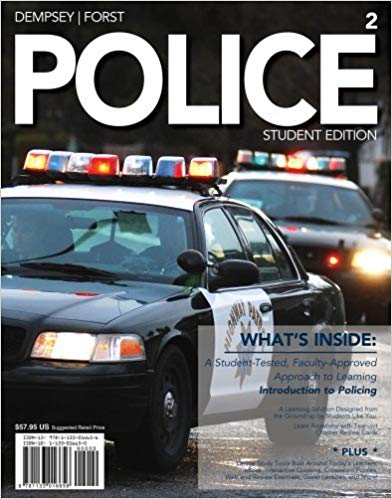
POLICE 2nd Edition by John S. Dempsey - Test Bank

POLICE 2nd Edition by John S. Dempsey - Test Bank   Instant Download - Complete Test Bank With Answers     Sample Questions Are Posted Below   Chapter 05: The Police Role and Police Discretion   TRUE/FALSE   Movies and television shows about the police emphasize the police crime-fighting role.   ANS:  T                    PTS:   1                    …

$19.99

POLICE 2nd Edition by John S. Dempsey – Test Bank


Instant Download – Complete Test Bank With Answers


Sample Questions Are Posted Below


Chapter 05: The Police Role and Police Discretion


TRUE/FALSE


  1. Movies and television shows about the police emphasize the police crime-fighting role.


ANS:  T                    PTS:   1                    REF:   p. 68


  1. A concept that suggests that the police are always present or always seem to be present is known as deterrence.


ANS:  F                    PTS:   1                    REF:   p. 71


  1. The police role is extremely ambiguous.


ANS:  T                    PTS:   1                    REF:   pp. 68–69


  1. The primary goal or objective of the police should be to arrest all offenders.


ANS:  F                    PTS:   1                    REF:   pp. 70–71


  1. The police officer is generally the first decision maker in the U.S. criminal justice system and is often the most important.


ANS:  T                    PTS:   1                    REF:   p. 73


  1. A serious crime leaves the police less freedom or ability to ignore it or to exercise discretion regarding it.


ANS:  T                    PTS:   1                    REF:   p. 74


  1. According to Siegel and Senna, “Crime Fighters” enforce the law by the book.


ANS:  F                    PTS:   1                    REF:   p. 72


  1. Because of the nature of police work, discretion by individual officers can never be totally eliminated.


ANS:  T                    PTS:   1                    REF:   pp. 73–74


  1. Tennessee v. Garner is the U.S. Supreme Court case that ended the use of the fleeing felon rule.


ANS:  T                    PTS:   1                    REF:   p. 75


  1. Most local police and sheriff’s departments have a policy regarding nonlethal force, and almost all departments authorize the use of one or more nonlethal weapons.


ANS:  T                    PTS:   1                    REF:   p. 77


  1. The taser is the most popularly approved nonlethal weapon.


ANS:  F                    PTS:   1                    REF:   p. 77


  1. The use of deadly force is the ultimate use of discretion.


ANS:  T                    PTS:   1                    REF:   p. 75


  1. According to the 2007 report Contacts between Police and the Public, 2005, most of the police contacts with citizens involved motor vehicle or traffic-related issues.


ANS:  T                    PTS:   1                    REF:   p. 75


  1. The two primary goals and objectives of police departments, according to Sheehan and Cordner, are maintaining order and protecting life and property.


ANS:  T                    PTS:   1                    REF:   p. 70


  1. The criminal justice system involves a tremendous amount of discretion.


ANS:  T                    PTS:   1                    REF:   p. 73


MULTIPLE CHOICE


  1. In 1985, the fleeing felon rule was declared unconstitutional by the U.S. Supreme Court in the landmark case of _____.
a. Mapp v. Ohio c. Tennessee v. Garner
b. Lawrence v. Texas d. Terry v. Ohio


ANS:  C                    PTS:   1                    REF:   p. 75


  1. Of the approximate 43 million citizen contacts with the police, only what percent involved police use of force?
a. 8.5% c. 1.6%
b. 5.3% d. 12%


ANS:  C                    PTS:   1                    REF:   p. 75


  1. The legality and morality of the fleeing felon rule is challenged because of the U.S. legal concept of:
a. presumption of innocence c. cruel and unusual punishment
b. fundamental fairness d. application of equality


ANS:  A                    PTS:   1                    REF:   p. 76


  1. Which of the following is incorrect?
a. The police make more arrests for minor violations than for serious crime.
b. The police make more arrests for driving while intoxicated (DWI/DUI) than they do for drug offenses.
c. The police make more arrests for aggravated or felony assault than they do for misdemeanor assault arrests.
d. The violation of liquor laws, drunkenness, disorderly conduct, vagrancy, and loitering are responsible for approximately 2.5 million arrests a year.


ANS:  C                    PTS:   1                    REF:   p. 68


  1. The vast majority of arrests the police make are for:
a. violent crimes c. financial crimes
b. property crimes d. quality of life crimes


ANS:  D                    PTS:   1                    REF:   p. 69


  1. Most of police contacts involve:
a. motor vehicle or traffic-related issues c. arresting offenders
b. dealing with family violence d. testifying in court


ANS:  A                    PTS:   1                    REF:   p. 68


  1. The police role is:
a. very ambiguous c. mainly related to violent crime
b. very clearly defined d. mainly related to arresting offenders


ANS:  A                    PTS:   1                    REF:   pp. 68–69


  1. All are current less than lethal tools departments use except:
a. O.C. Spray c. Tasers
b. Expandable Batons d. Slapjack


ANS:  D                    PTS:   1                    REF:   p. 77


  1. Sheehan and Cordner state that the two primary goals and objectives of police departments are:
a. maintaining order and protecting life and property
b. preventing crime and arresting offenders
c. preventing crime and maintaining order
d. protecting life and property and preventing crime


ANS:  A                    PTS:   1                    REF:   p. 70


  1. Which of the following is not one of the secondary goals and objectives of police departments?
a. recovering stolen and missing property
b. enforcing non-criminal regulation
c. delivering services not available elsewhere in the community
d. settling arguments and disputes


ANS:  D                    PTS:   1                    REF:   p. 71


  1. Who arranged for the organization of the first paid, full-time, uniformed police department, conceived of the police role as a conspicuous community-oriented patrol designed more for prevention and deterrence than for enforcement?
a. Henry Fielding c. Sir Robert Peel
b. Carl B. Klockars d. Egon Bittner


ANS:  C                    PTS:   1                    REF:   p. 69


  1. Officer Smith believes her role is to maintain order on her beat by arresting criminals. According to Broderick, she would be considered a/an:
a. realist c. enforcer
b. optimist d. idealist


ANS:  C                    PTS:   1                    REF:   p. 72


  1. Officer Brown believes his role is keeping the peace and preserving the social order, yet he is very careful not to violate the constitutional rights of individuals. According to Broderick, he would be considered a/an:
a. realist c. enforcer
b. optimist d. idealist


ANS:  D                    PTS:   1                    REF:   p. 72


  1. Officer Green believes that it is impossible to achieve the goals and objectives of the police department and concentrates his efforts on the concept of police loyalty and the mutual support of his fellow officers. According to Broderick, he would be considered a/an:
a. realist c. enforcer
b. optimist d. idealist


ANS:  A                    PTS:   1                    REF:   p. 72


  1. Officer White concentrates her efforts on helping people in trouble, rather than on keeping society safe. According to Broderick, she would be considered a/an:
a. realist c. enforcer
b. optimist d. idealist


ANS:  B                    PTS:   1                    REF:   p. 72


  1. Which of the following is not one of James Q. Wilson’s operating styles?
a. watchman c. service
b. legalistic d. aggressive


ANS:  D                    PTS:   1                    REF:   p. 73


  1. The Bigtown Police Department maintains order through informal police intervention, including persuasion and threats, or hassling or roughing up disruptive people instead of formal arrests. According to James Q. Wilson, it would be considered to be a _____ department.
a. watchman c. moralistic
b. legalistic d. service


ANS:  A                    PTS:   1                    REF:   p. 72


  1. The Largetown Police Department issues many summonses and makes many misdemeanor arrests. According to James Q. Wilson, it would be considered to be a _____ department.
a. watchman c. moralistic
b. legalistic d. service


ANS:  B                    PTS:   1                    REF:   p. 73


  1. The Smalltown Police Department uses social service agencies to provide counseling for minor offenders. According to James Q. Wilson, it would be considered a _____ department.
a. watchman c. moralistic
b. legalistic d. service


ANS:  D                    PTS:   1                    REF:   p. 73


  1. Police officers have _____ discretion.
a. little c. limited
b. tremendous d. no


ANS:  B                    PTS:   1                    REF:   pp. 73–74


  1. The first decision maker in the criminal justice system and often the most important is:
a. the judge c. the police officer
b. the defense attorney d. the prosecutor


ANS:  C                    PTS:   1                    REF:   p. 73


  1. The two primary goals and objectives of police departments, according to Sheehan and Cordner are:
a. maintain order and protect life c. maintain order and prevent crime
b. investigate crimes and make arrest d. arrest individuals and protect property


ANS:  A                    PTS:   1                    REF:   p. 70


  1. All are secondary goals of policing except:
a. preventing crime c. assisting the sick and injured
b. arresting and prosecuting offenders d. all are secondary goals of policing


ANS:  D                    PTS:   1                    REF:   p. 71


COMPLETION


  1. Carl B. Klockars, in Idea of Police, broadly defines the basic function of the police as dealing with all those problems that may require the use of ____________________ force.


ANS:  coercive


PTS:   1                    REF:   p. 69


  1. The police try to create a sense that they are always there. This is called ____________________.


ANS:  omnipresence


PTS:   1                    REF:   p. 71


  1. The availability of a choice of options or actions one can take in a situation is called ____________________.


ANS:  discretion


PTS:   1                    REF:   p. 73


  1. ____________________ and assisting prosecutors in bringing charges against defendants is one of the primary methods used by police to maintain order and protect life and property.


ANS:  Arresting offenders


PTS:   1                    REF:   p. 71


  1. In 1985 in Tennessee v. Garner, the U.S. Supreme Court dealt with police use of deadly force, declaring the ____________________ unconstitutional.


ANS:  fleeing felon rule


PTS:   1                    REF:   p. 77


  1. The police emphasize their role as ___________.


ANS:

crime fighters

crime-fighters


PTS:   1                    REF:   p. 68


  1. The U.S. system of criminal justice is interested in the ____________________ in addition to the letter of the law.


ANS:  spirit of the law


PTS:   1                    REF:   p. 73


  1. Studies indicate that people who engage in ____________________ are much more likely to be the victims of police shootings.


ANS:  violent crime


PTS:   1                    REF:   p. 76


  1. A major view of the role of the police that emphasizes crime fighting or law enforcement: ____________________.


ANS:  crime fighting role


PTS:   1                    REF:   p. 68


  1. A view of the role of the police that emphasizes keeping the peace and providing social services: _________________.


ANS:  order maintenance


PTS:   1                    REF:   p. 68


  1. The concept of “what do the police do” is known as the ________________.


ANS:  police role


PTS:   1                    REF:   p. 67


  1. The concept that the police role is very diverse and dynamic: _____________.


ANS:  ambiguous


PTS:   1                    REF:   pp. 68–69


  1. Studies of police discretion have shown that the most significant factor in the decision to arrest is the ____________ of the offense committed.


ANS:  seriousness


PTS:   1                    REF:   p. 74


  1. Statistics for the latest reporting year reveal that U.S. police made more than 13.7 million arrests for all criminal infractions, excluding _____ violations.


ANS:  traffic


PTS:   1                    REF:   p. 68


ESSAY


  1. What do you think the police’s role really is?


ANS:

Student answers will vary.


PTS:   1                    REF:   pp. 67–70


  1. List the primary and secondary goals of policing and give an example of how the police work toward each goal.


ANS:

Student answers will vary.


PTS:   1                    REF:   pp. 70–71


  1. List and explain each of Broderick’s styles. Which style of officer would you want in your community? Why?


ANS:

Student answers will vary.


PTS:   1                    REF:   p. 72


  1. Define discretion. Discuss some of the major ways police exercise discretion.


ANS:

Student answers will vary.


PTS:   1                    REF:   pp. 73–78


  1. What is the basic difference between the crime-fighting role and the order-maintenance role of the police?


ANS:

Student answers will vary.


PTS:   1                    REF:   p. 68


  1. Compare and contrast each of James Q. Wilson’s police department operational styles.


ANS:

Student answers will vary.


PTS:   1                    REF:   p. 72


  1. What are some of the major factors that influence police discretion?


ANS:

Student answers will vary.


PTS:   1                    REF:   p. 74


  1. List and discuss what offenses the police deal with the most.  State your opinion to why and provide examples to back up your opinion.


ANS:

Student answers will vary.


PTS:   1                    REF:   pp. 68–69


  1. Discuss the impact of Tennessee v. Garner.


ANS:

Student answers will vary.


PTS:   1                    REF:   p. 77

Additional information

Add Review

Your email address will not be published. Required fields are marked *