Subtotal: $700.00

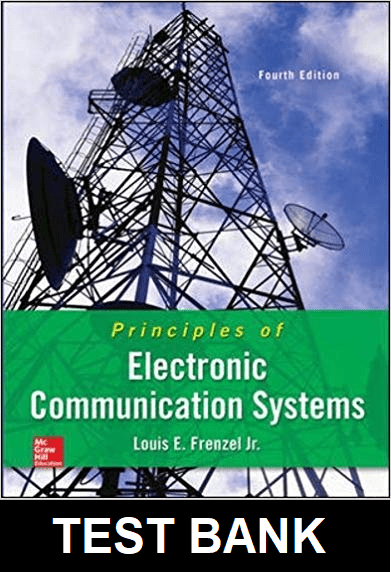
Principles of Electronic Communication Systems 4th Edition by Frenzel - Test Bank

Principles of Electronic Communication Systems 4th Edition by Frenzel - Test Bank   Instant Download - Complete Test Bank With Answers     Sample Questions Are Posted Below   1. A sine wave carrier can be modulated by varying its amplitude, frequency, or phase shift.   TRUE       2. Blooms: 2. Understand Chapter: …

$19.99

Principles of Electronic Communication Systems 4th Edition by Frenzel – Test Bank


Instant Download – Complete Test Bank With Answers


Sample Questions Are Posted Below


1.

A sine wave carrier can be modulated by varying its amplitude, frequency, or phase shift.


TRUE


2.

Blooms: 2. Understand

Chapter: 05 Fundamentals of Frequency Modulation

Difficulty: Easy

Section: 05.01 Basic Principles of Frequency Modulation

Subtopic: Basic Principles of Frequency Modulation

Topic: Fundamentals of Frequency Modulation

Impressing an information signal on a carrier by changing its frequency produces AM.


FALSE


3.

Blooms: 2. Understand

Chapter: 05 Fundamentals of Frequency Modulation

Difficulty: Medium

Section: 05.01 Basic Principles of Frequency Modulation

Subtopic: Basic Principles of Frequency Modulation

Topic: Fundamentals of Frequency Modulation

In FM, the carrier amplitude remains constant and the carrier frequency is changed by the modulating signal.


TRUE


4.

Blooms: 2. Understand

Chapter: 05 Fundamentals of Frequency Modulation

Difficulty: Hard

Section: 05.01 Basic Principles of Frequency Modulation

Subtopic: Basic Principles of Frequency Modulation

Topic: Fundamentals of Frequency Modulation

The frequency of the modulating signal determines the frequency deviation rate.


TRUE

Blooms: 1. Remember

Chapter: 05 Fundamentals of Frequency Modulation

Difficulty: Hard

Section: 05.01 Basic Principles of Frequency Modulation

Subtopic: Basic Principles of Frequency Modulation

Topic: Fundamentals of Frequency Modulation

5.

Frequency-shift keying is widely used in the transmission of binary data in digital cell phones.


TRUE


6.

Blooms: 2. Understand

Chapter: 05 Fundamentals of Frequency Modulation

Difficulty: Medium

Section: 05.02 Principles of Phase Modulation

Subtopic: Principles of Phase Modulation

Topic: Fundamentals of Frequency Modulation

When the amount of phase shift of a constant-frequency carrier is varied in accordance with a modulating signal, the resulting output is a phase modulation signal.


TRUE


7.

Blooms: 1. Remember

Chapter: 05 Fundamentals of Frequency Modulation

Difficulty: Hard

Section: 05.02 Principles of Phase Modulation

Subtopic: Principles of Phase Modulation

Topic: Fundamentals of Frequency Modulation

The maximum frequency deviation produced by a phase modulator occurs when the modulating signal is changing at its slowest rate.


FALSE


8.

Blooms: 2. Understand

Chapter: 05 Fundamentals of Frequency Modulation

Difficulty: Easy

Section: 05.01 Basic Principles of Frequency Modulation

Subtopic: Basic Principles of Frequency Modulation

Topic: Fundamentals of Frequency Modulation

In FM, the frequency deviation is indirectly proportional to the amplitude of the modulating signal.


FALSE

Blooms: 1. Remember

Chapter: 05 Fundamentals of Frequency Modulation

Difficulty: Medium

Section: 05.02 Principles of Phase Modulation

Subtopic: Principles of Phase Modulation

Topic: Fundamentals of Frequency Modulation

9.

In PM, the carrier frequency deviation is proportional to both the modulating frequency and the amplitude.


TRUE


10.

Blooms: 1. Remember

Chapter: 05 Fundamentals of Frequency Modulation

Difficulty: Hard

Section: 05.02 Principles of Phase Modulation

Subtopic: Principles of Phase Modulation

Topic: Fundamentals of Frequency Modulation

PM is made compatible with FM by passing the intelligence signal through a high-pass RC network.


FALSE


11.

Blooms: 1. Remember

Chapter: 05 Fundamentals of Frequency Modulation

Difficulty: Medium

Section: 05.02 Principles of Phase Modulation

Subtopic: Principles of Phase Modulation

Topic: Fundamentals of Frequency Modulation

The process of phase-modulating a carrier with binary data is called


A.
frequency-shift keying

B.
multiplexing

C.
carrier phasing

D.
phase-shift keying


Blooms: 2. Understand

Chapter: 05 Fundamentals of Frequency Modulation

Difficulty: Easy

Section: 05.03 Modulation Index and Sidebands

Subtopic: Modulation Index and Sidebands

Topic: Fundamentals of Frequency Modulation

12.


A.

Any modulation process produces

carriers

B.

sidebands

C.

noise

D.

amplification


13.


A.


Blooms: 2. Understand

Chapter: 05 Fundamentals of Frequency Modulation

Difficulty: Easy

Section: 05.03 Modulation Index and Sidebands

Subtopic: Modulation Index and Sidebands

Topic: Fundamentals of Frequency Modulation

The ratio of the frequency deviation to the modulating frequency is known as the

deviation factor

B.
frequency-shift keying

C.
modulation index

D.
ratio of modulation


Blooms: 1. Remember

Chapter: 05 Fundamentals of Frequency Modulation

Difficulty: Medium

Section: 05.03 Modulation Index and Sidebands

Subtopic: Modulation Index and Sidebands

Topic: Fundamentals of Frequency Modulation

14. The equation that expresses the phase angle in terms of the sine wave modulating signal can be solved by using a complex mathematical process known as


A.

Fourier analysis

B.

Bessel functions

C.

superposition analysis

D.

Thevenin’s Theorem


15.


A.


Blooms: 2. Understand

Chapter: 05 Fundamentals of Frequency Modulation

Difficulty: Easy

Section: 05.03 Modulation Index and Sidebands

Subtopic: Modulation Index and Sidebands

Topic: Fundamentals of Frequency Modulation

The primary purpose of narrowband FM is

to be able to use frequencies above 108 MHz

B.
reduce channel noise

C.
to conserve spectrum space

D.
to be able to use frequencies below 88 MHz


Blooms: 2. Understand

Chapter: 05 Fundamentals of Frequency Modulation

Difficulty: Easy

Section: 05.03 Modulation Index and Sidebands

Subtopic: Modulation Index and Sidebands

Topic: Fundamentals of Frequency Modulation

16.


A.

The higher the modulation index in FM

the greater the number of sidebands and the wider the bandwidth

B.

the greater the number of sidebands and the narrower the bandwidth

C.

the fewer the number of sidebands and the wider the bandwidth

D.

the fewer the number of sidebands and the narrower the bandwidth


Blooms: 2. Understand

Chapter: 05 Fundamentals of Frequency Modulation

Difficulty: Easy

Section: 05.04 Noise Suppression Effects of FM

Subtopic: Noise Suppression Effects of FM

Topic: Fundamentals of Frequency Modulation

17. Interference generated by lightning, motors, automotive ignition systems, and any power line switching that produces transient signals is referred to as


A.
magnetic radiation

B.
stray reactance

C.
induced signals

D.
noise


Blooms: 2. Understand

Chapter: 05 Fundamentals of Frequency Modulation

Difficulty: Easy

Section: 05.05 Frequency Modulation Versus Amplitude Modulation

Subtopic: Frequency Modulation Versus Amplitude Modulation

Topic: Fundamentals of Frequency Modulation

18.


A.

One of the primary benefits of FM over AM is its

line of sight transmission

B.

superior noise immunity

C.

lower signal-to-noise ratio

D.

smaller bandwidth


Blooms: 2. Understand

Chapter: 05 Fundamentals of Frequency Modulation

Difficulty: Hard

Section: 05.04 Noise Suppression Effects of FM

Subtopic: Noise Suppression Effects of FM

Topic: Fundamentals of Frequency Modulation

19. A technique that helps offset high-frequency noise interference by passing a modulating signal through a simple network that amplifies high-frequency components more than the low-frequency components is called


A.
preamplification

B.
deemphasis

C.
preemphasis

D.
crossover boost


Blooms: 1. Remember

Chapter: 05 Fundamentals of Frequency Modulation

Difficulty: Easy

Section: 05.05 Frequency Modulation Versus Amplitude Modulation

Subtopic: Frequency Modulation Versus Amplitude Modulation

Topic: Fundamentals of Frequency Modulation

20.


A.

Which of the following is not an advantage of FM over AM?

noise immunity

B.

capture effect

C.

circuit simplicity

D.

transmitter efficiency


21.


22.


23.


Blooms: 1. Remember

Chapter: 05 Fundamentals of Frequency Modulation

Difficulty: Easy

Section: 05.03 Modulation Index and Sidebands

Subtopic: Modulation Index and Sidebands

Topic: Fundamentals of Frequency Modulation

Considered the greatest disadvantage of FM is its considerably wider signal bandwidth.

Blooms: 2. Understand

Chapter: 05 Fundamentals of Frequency Modulation

Difficulty: Easy

Section: 05.01 Basic Principles of Frequency Modulation

Subtopic: Basic Principles of Frequency Modulation

Topic: Fundamentals of Frequency Modulation

A(n) sine wave carrier can be modulated by varying its amplitude, frequency, or phase shift.

Blooms: 2. Understand

Chapter: 05 Fundamentals of Frequency Modulation

Difficulty: Easy

Section: 05.01 Basic Principles of Frequency Modulation

Subtopic: Basic Principles of Frequency Modulation

Topic: Fundamentals of Frequency Modulation

Impressing an information signal on a carrier by changing its frequency produces FM.

Blooms: 2. Understand

Chapter: 05 Fundamentals of Frequency Modulation

Difficulty: Easy

Section: 05.01 Basic Principles of Frequency Modulation

Subtopic: Basic Principles of Frequency Modulation

Topic: Fundamentals of Frequency Modulation

24. The amount of change in carrier frequency produced by the modulating signal is known as the frequency deviation.

Blooms: 1. Remember

Chapter: 05 Fundamentals of Frequency Modulation

Difficulty: Medium

Section: 05.01 Basic Principles of Frequency Modulation

Subtopic: Basic Principles of Frequency Modulation

Topic: Fundamentals of Frequency Modulation

25. Frequency-shift keying is widely used in the transmission of binary data in cell phones and in some types of low-speed computer modems.


Blooms: 1. Remember

Chapter: 05 Fundamentals of Frequency Modulation

Difficulty: Medium

Section: 05.02 Principles of Phase Modulation

Subtopic: Principles of Phase Modulation

Topic: Fundamentals of Frequency Modulation

26. When the amount of phase shift of a constant-frequency carrier is varied in accordance with a modulating signal, the resulting output is a phase modulation signal.


Blooms: 2. Understand

Chapter: 05 Fundamentals of Frequency Modulation

Difficulty: Medium

Section: 05.02 Principles of Phase Modulation

Subtopic: Principles of Phase Modulation

Topic: Fundamentals of Frequency Modulation

27. The maximum frequency deviation produced by a phase modulator occurs during the time that the modulating signal is changing at its most rapid rate.


28.


Blooms: 1. Remember

Chapter: 05 Fundamentals of Frequency Modulation

Difficulty: Hard

Section: 05.02 Principles of Phase Modulation

Subtopic: Principles of Phase Modulation

Topic: Fundamentals of Frequency Modulation

In FM, the frequency deviation is directly proportional to the amplitude of the modulating signal.

Blooms: 1. Remember

Chapter: 05 Fundamentals of Frequency Modulation

Difficulty: Hard

Section: 05.02 Principles of Phase Modulation

Subtopic: Principles of Phase Modulation

Topic: Fundamentals of Frequency Modulation

29.


30.


31.


32.

To make PM compatible with FM, the intelligence signal is passed through a low-pass RC network.

Blooms: 1. Remember

Chapter: 05 Fundamentals of Frequency Modulation

Difficulty: Medium

Section: 05.02 Principles of Phase Modulation

Subtopic: Principles of Phase Modulation

Topic: Fundamentals of Frequency Modulation

The FM produced by a phase modulator is called indirect FM.

Blooms: 2. Understand

Chapter: 05 Fundamentals of Frequency Modulation

Difficulty: Easy

Section: 05.03 Modulation Index and Sidebands

Subtopic: Modulation Index and Sidebands

Topic: Fundamentals of Frequency Modulation

When a constant-frequency sine wave modulates a carrier, two side frequencies are produced.

Blooms: 2. Understand

Chapter: 05 Fundamentals of Frequency Modulation

Difficulty: Easy

Section: 05.03 Modulation Index and Sidebands

Subtopic: Modulation Index and Sidebands

Topic: Fundamentals of Frequency Modulation

The ratio of the frequency deviation to the modulating frequency is known as the modulation index.

Blooms: 2. Understand

Chapter: 05 Fundamentals of Frequency Modulation

Difficulty: Hard

Section: 05.01 Basic Principles of Frequency Modulation

Subtopic: Basic Principles of Frequency Modulation

Topic: Fundamentals of Frequency Modulation

33. The FM wave is expressed as a composite of sine waves of different frequencies and amplitudes that, when added, give an FM time-domain signal.


34.

Blooms: 1. Remember

Chapter: 05 Fundamentals of Frequency Modulation

Difficulty: Easy

Section: 05.03 Modulation Index and Sidebands

Subtopic: Modulation Index and Sidebands

Topic: Fundamentals of Frequency Modulation

The symbol ! means factorial.

Blooms: 1. Remember

Chapter: 05 Fundamentals of Frequency Modulation

Difficulty: Medium

Section: 05.03 Modulation Index and Sidebands

Subtopic: Modulation Index and Sidebands

Topic: Fundamentals of Frequency Modulation

35. When an FM signal has a modulation index of 0.25 and occupies no more spectrum space than an AM signal, it is called narrowband FM.

Blooms: 1. Remember

Chapter: 05 Fundamentals of Frequency Modulation

Difficulty: Easy

Section: 05.03 Modulation Index and Sidebands

Subtopic: Modulation Index and Sidebands

Topic: Fundamentals of Frequency Modulation

Category # of Questions
Blooms: 1. Remember 16
Blooms: 2. Understand 19
Chapter: 05 Fundamentals of Frequency Modulation 35
Difficulty: Easy 17
Difficulty: Hard 8
Difficulty: Medium 10
Section: 05.01 Basic Principles of Frequency Modulation 10
Section: 05.02 Principles of Phase Modulation 10
Section: 05.03 Modulation Index and Sidebands 11
Section: 05.04 Noise Suppression Effects of FM 2
Section: 05.05 Frequency Modulation Versus Amplitude Modulation 2
Subtopic: Basic Principles of Frequency Modulation 10
Subtopic: Frequency Modulation Versus Amplitude Modulation 2
Subtopic: Modulation Index and Sidebands 11
Subtopic: Noise Suppression Effects of FM 2
Subtopic: Principles of Phase Modulation 10
Topic: Fundamentals of Frequency Modulation 35


Additional information

Add Review

Your email address will not be published. Required fields are marked *