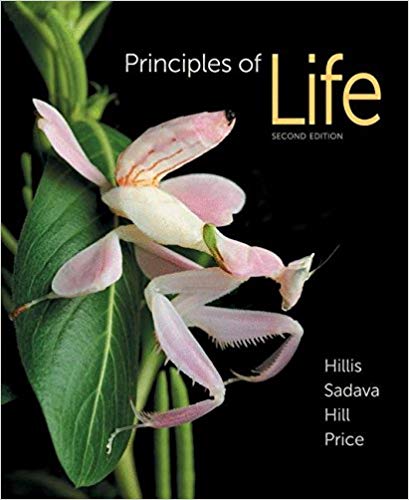
Principles of Life 2nd Edition by David M. Hillis - Test Bank

Principles of Life 2nd Edition by David M. Hillis - Test Bank   Instant Download - Complete Test Bank With Answers     Sample Questions Are Posted Below   1. Biological membranes are composed primarily of   A) nucleotides and nucleosides.   B) enzymes, electron acceptors, and electron donors.   C) fatty acids.   D) …

$19.99

Principles of Life 2nd Edition by David M. Hillis – Test Bank


Instant Download – Complete Test Bank With Answers


Sample Questions Are Posted Below


1. Biological membranes are composed primarily of
  A) nucleotides and nucleosides.
  B) enzymes, electron acceptors, and electron donors.
  C) fatty acids.
  D) monosaccharides.
  E) lipids.


2. The compounds in biological membranes that form a barrier to the movement of hydrophilic materials across the membrane are
  A) integral membrane proteins.
  B) carbohydrates.
  C) lipids.
  D) nucleic acids.
  E) peripheral membrane proteins.


3. In biological membranes, the phospholipids are arranged in a _______, with the _______.
  A) bilayer; fatty acids pointing toward each other
  B) bilayer; fatty acids facing outward
  C) single layer; fatty acids facing the interior of the cell
  D) single layer; phosphorus-containing region facing the interior of the cell
  E) bilayer; phosphorus groups in the interior of the membrane


4. A characteristic of plasma membranes that helps them fuse during vesicle formation and phagocytosis is the
  A) ratio of one protein molecule for every 25 phospholipid molecules.
  B) capacity of lipids to associate and maintain a bilayer organization.
  C) constant length of the fatty acid chain and the degree of saturation.
  D) ability of phospholipid molecules to flip over and trade places with other phospholipid molecules.
  E) asymmetrical distribution of membrane transport proteins.


5. Which statement about cholesterol molecules is true?
  A) They help hold a membrane together.
  B) They alter the fluidity of the membrane.
  C) They attach to carbohydrates.
  D) They disrupt membrane function.
  E) They transport ions across membranes.


6. Houseplants adapted to indoor temperatures may die if they are left outdoors, because in a cold environment their
  A) DNA cannot function.
  B) membranes lack adequate fluidity.
  C) photosynthesis is impaired.
  D) membranes contain too many unsaturated fatty acids.
  E) membranes need more cholesterol.


7. Contact with ice numbs a person’s fingers because at lower temperatures
  A) membrane fluidity is reduced in nerve cells.
  B) no ATP can be produced in the fingers.
  C) protein kinases are activated in the nerves.
  D) membranes in nerve cells unzip.
  E) there are changes in the lipid composition of the membranes in nerve cells.


8. In hibernating animals during the winter,
  A) signal transduction pathways cease.
  B) membrane lipid composition changes: saturated fatty acids are replaced with unsaturated fatty acids.
  C) membranes toughen as more saturated fatty acids accumulate in them.
  D) there are no changes in lipid composition.
  E) integral proteins shrink as temperatures fall.


9. The plasma membranes of winter wheat are able to remain fluid when it is extremely cold by
  A) synthesizing new forms of cholesterol.
  B) closing protein channels.
  C) decreasing the number of hydrophobic proteins present.
  D) replacing saturated fatty acids with unsaturated fatty acids.
  E) using fatty acids with longer tails.


10. Which type of membrane protein would likely be most easily removed in a laboratory experiment?
  A) Integral membrane proteins
  B) Channel proteins
  C) Peripheral membrane proteins
  D) Transmembrane proteins
  E) Gated channels


11. A protein that forms an ion channel through a membrane is most likely
  A) a peripheral membrane protein.
  B) a transmembrane protein.
  C) a phospholipid.
  D) an enzyme.
  E) entirely outside the phospholipid bilayer.


12. The LDL receptor is an integral membrane protein that crosses the plasma membrane, with portions of the protein extending both outside and into the interior of the cell. The amino acid side chains (R groups) in the region of the protein that crosses the membrane are most likely
  A) charged.
  B) hydrophilic.
  C) hydrophobic.
  D) carbohydrates.
  E) lipids.


13. The hydrophilic regions of a membrane protein are most likely
  A) present only in muscle cells.
  B) associated with the fatty acid region of the lipids.
  C) in the interior of the membrane.
  D) exposed on the surface of the membrane.
  E) either on the surface or inserted into the interior of the membrane.


14. Which statement about peripheral membrane proteins is true?
  A) They have hydrophobic regions within the lipid portion of the bilayer.
  B) They have hydrophilic regions that protrude in aqueous environments on both sides of the membrane.
  C) They frequently flip from one side of the bilayer to the other.
  D) They control the rate of simple diffusion.
  E) Their polar regions interact with complementary regions of integral membrane proteins.


15. The two sides of a membrane can be split apart from each other by an experimental technique known as freeze-fracturing. When one side of a freeze-fractured membrane is examined under the electron microscope, the exposed interior of the membrane bilayer appears to be covered with bumps. These bumps are most likely
  A) integral membrane proteins.
  B) ice crystals.
  C) glycolipids.
  D) organelles.
  E) vesicles.


16. When a mouse cell and a human cell are fused, the membrane proteins of the two cells become uniformly distributed over the surface of the hybrid cell. This occurs because
  A) many proteins can move around within the bilayer.
  B) all proteins are anchored within the membrane.
  C) proteins are asymmetrically distributed within the membrane.
  D) all proteins in the plasma membrane are peripheral.
  E) different membranes contain different proteins.


17. Plasma membranes are relatively impermeable to water-soluble molecules because
  A) the membranes are waxy.
  B) water molecules are nonpolar.
  C) their bilayer is comprised of phospholipids.
  D) they have salt crystals embedded within them.
  E) large proteins extend through both sides of the membranes.


18. How do the cell membranes of a hibernating animal change in colder temperatures?
  A) They release all of their peripheral membrane proteins.
  B) Saturated fatty acids are more tightly packed.
  C) Integral membrane proteins increase in number.
  D) Unsaturated fatty acids make up more of the lipid composition.
  E) Fatty acids with longer tails increase in number.


19. Which of the following functions as a recognition site for interactions between cells?
  A) RNA
  B) Phospholipid
  C) Cholesterol
  D) Fatty acid
  E) Glycolipid


20. The rate at which a substance diffuses is not affected by the
  A) diameter of the molecules or ions.
  B) temperature of the solution.
  C) color of the substance.
  D) concentration gradient in the system.
  E) Both a and b


21. The existence of a concentration gradient of glucose across a membrane means that
  A) there is a high concentration of glucose on both sides of the membrane.
  B) the glucose molecules are more crowded on one side of the membrane than on the other.
  C) there is a high concentration of water on both sides of the membrane.
  D) the glucose molecules are chemically bonded more tightly on one side of the membrane than on the other.
  E) there are more glucose molecules within the bilayer of the membrane than outside of the membrane.


22. Which statement about diffusion is false?
  A) Diffusion does not require ATP.
  B) Diffusion continues until the molecular concentrations are in equilibrium.
  C) In diffusion, molecules move from areas of greater concentration to areas of lesser concentration.
  D) Diffusion is a random process.
  E) Simple diffusion depends upon specific carrier proteins.


23. If a drop of red ink is placed in one end of a shallow pan filled with water, and a drop of green ink is placed in the other end, which of the following will be true at equilibrium?
  A) The red ink will be uniformly distributed in one half of the pan, and the green ink will be uniformly distributed in the other half of the pan.
  B) The red and green inks will be uniformly distributed throughout the pan.
  C) Each ink will begin moving down its concentration gradient.
  D) The concentration of each ink will be higher at one end of the pan than at the other end.
  E) No predictions can be made without knowing the molecular weights of the pigment molecules.


24. If a hospital patient is mistakenly given an IV of pure water instead of a saline solution that is isotonic to blood, the patient’s red blood cells will
  A) shrink and collapse.
  B) release water to the plasma along its concentration gradient.
  C) absorb water from the plasma and eventually burst.
  D) transport equal amounts of water across the cell membrane in both directions.
  E) work with white blood cells to maintain the water level in the plasma.


25. The difference between osmosis and diffusion is that
  A) diffusion is passive transport, whereas osmosis is active transport.
  B) only in diffusion do molecules move from areas of high concentration to areas of low concentration.
  C) only diffusion refers to the movement of materials across a semipermeable membrane.
  D) osmosis refers specifically to the movement of water, whereas diffusion refers to the movement of any type of molecules.
  E) only the process of osmosis varies according to the kinds of particles present.


26. The process of osmosis allows water molecules to pass through specialized channels in membranes. Which statement about osmosis is true?
  A) Water will move across a membrane to a region with less solute.
  B) Water will move across a membrane to a region with more solute.
  C) The direction of osmosis is temperature dependent.
  D) If the membrane does not allow solutes to pass, water will be equal on both sides.
  E) A higher solute concentration on one side of a membrane indicates a higher water concentration on that side.


27. Osmosis is a specific form of
  A) diffusion.
  B) pinocytosis.
  C) active transport.
  D) secondary active transport.
  E) movement of water by carrier proteins.


28. Which of the following is not one of the functional roles of membrane proteins?
  A) Allowing movement of molecules that otherwise would be excluded by the lipid components of the membrane
  B) Transferring signals from outside the cell to inside the cell
  C) Facilitating the movement of water across the membrane
  D) Facilitating the transport of macromolecules across the membrane
  E) Stabilizing the lipid bilayer


29. Which of the following is an example of passive transport?
  A) Facilitated diffusion
  B) The sodium–potassium pump
  C) Phagocytosis
  D) Exocytosis
  E) Pinocytosis


30. You are doing a summer internship in a cell biology lab. Your supervisor asks you to change the medium on some cells she is growing. You do so and then examine the cells under a microscope. To your dismay, you can’t find any cells and see only what looks like cell debris. What most likely happened to your cells and why?
  A) The cells shrank because the new medium was hypotonic to the cells.
  B) The cells shrank because the new medium was hypertonic to the cells.
  C) The cells burst because the new medium was hypertonic to the cells.
  D) The cells burst because the new medium was hypotonic to the cells.
  E) The cells burst, although the new medium could not have been the cause.


31. If aquaporins are injected into the membranes of epithelial cells that line blood vessels,
  A) the flow of Na+ through aquaporins will increase.
  B) the intracellular concentration of K+ will increase.
  C) carrier proteins will bind glucose and enter the bloodstream.
  D) the membranes will become more permeable to water.
  E) the electrical properties of the cells will be altered.


32. Osmosis moves water from a region of _______ to a region of _______.
  A) high concentration of dissolved material; low concentration of dissolved material
  B) low concentration of dissolved material; high concentration of dissolved material
  C) hypertonic solution; hypotonic solution
  D) hypertonic solution; isotonic solution
  E) low concentration of water; high concentration of water


33. When placed in water, wilted plants lose their limpness because of
  A) active transport of salts from the water into the plant cells.
  B) active transport of salts into the water from the plant cells.
  C) osmosis of water into the plant cells.
  D) osmosis of water from the plant cells.
  E) diffusion of water from the plant cells.


34. When a severely dehydrated patient is brought to the hospital, an IV of normal saline is started immediately. Distilled water is not used because
  A) it would cause water to leave the cells of the patient and the cells would collapse.
  B) nutrients are provided by the saline.
  C) it would cause the patient’s blood cells to swell and eventually burst.
  D) normal saline is more economical.
  E) the distilled water might be contaminated by bacteria.


35. If a red blood cell is placed in an isotonic solution, it will
  A) shrivel.
  B) swell and burst.
  C) shrivel and then return to normal.
  D) swell and then return to normal.
  E) take up and release water at equal rates.


36. When placed in a hypertonic solution, animal cells
  A) shrink.
  B) swell.
  C) burst.
  D) transport water out using ATP.
  E) transport water in using ATP.


37. Which of the following is the driving force for simple diffusion?
  A) Concentration gradient
  B) ATP hydrolysis
  C) ADP hydrolysis
  D) Phosphorylation
  E) GTP–GDP exchange


38. Which of the following is the driving force for facilitated diffusion?
  A) Concentration gradient
  B) ATP hydrolysis
  C) ADP hydrolysis
  D) Phosphorylation
  E) GTP–GDP exchange


39. Osmosis
  A) helps plant cells maintain turgor pressure.
  B) moves macromolecules from one cell to another.
  C) facilitates the “flipping” of proteins from one side of the membrane to the other.
  D) keeps concentrations uniform in all cells.
  E) causes cells to lose water when they are placed in a hypotonic solution.


40. In a hypothetical study, cells are placed in a solution of glucose in which the concentration of glucose is gradually increased. At first, the rate at which glucose enters the cells is found to increase as the concentration of the glucose solution is increased. But when the glucose concentration of the solution is increased above 10 M, the rate no longer increases. Which of the following is the likely mechanism for glucose transport into these cells?
  A) Facilitated diffusion via a carrier protein
  B) Facilitated diffusion via a channel protein
  C) Pinocytosis
  D) Tertiary active transport
  E) Hydrolysis


41. What is the membrane property that helps ensure the diffusion of glucose into a cell that has a high energy need?
  A) A glucose pump
  B) Specific carrier proteins found only in large muscle cells
  C) A high number of carrier proteins specific for glucose
  D) Special sensitivity to an extracellular environment high in glucose
  E) Additional pores through which water can flow, carrying dissolved glucose


42. Which transport system can move an ion across the plasma membrane against its concentration gradient without using ATP?
  A) Secondary active transport
  B) Primary active transport
  C) Simple diffusion
  D) Facilitated diffusion
  E) Facilitated diffusion via a carrier protein


43. If you were designing a drug with an intracellular target, which type of transport system would you want to include in your design as the most efficient way to deliver the drug?
  A) Secondary active transport
  B) Primary active transport
  C) Simple diffusion
  D) Facilitated diffusion
  E) Facilitated diffusion via a carrier protein


44. Active transport usually moves molecules
  A) in the same direction as diffusion moves them.
  B) in a direction opposite to the one in which diffusion moves them.
  C) in a direction that tends to bring about equilibrium.
  D) from a solution with a lower pH toward one with a higher pH.
  E) from inside to outside the cell.


45. Plant cells transport sucrose across the vacuole membrane against its concentration gradient by a process known as
  A) simple diffusion.
  B) active transport.
  C) passive transport.
  D) facilitated diffusion.
  E) cellular respiration.


46. Which of the following is not involved in secondary active transport?
  A) The direct use of ATP
  B) Coupling to another transport system
  C) Use of an existing concentration gradient
  D) The plasma membrane
  E) The ability to concentrate the transported molecule


47. Which of the following is the driving force for active transport?
  A) Concentration gradient
  B) ATP hydrolysis
  C) ADP hydrolysis
  D) Phosphorylation
  E) GTP–GDP exchange


48. One reason cancer therapy often fails is that the targeted cells become resistant to the drugs that are supposed to kill them. Which of the following is the most likely mechanism of this resistance?
  A) Carrier proteins block diffusion of the drugs into the cancer cells.
  B) Membrane proteins pump nutrients into the cancer cells.
  C) Drugs diffuse into the cancer cells via simple diffusion.
  D) Membrane proteins actively transport the drugs out of the cancer cells.
  E) Channel proteins pump ions into the cancer cells.


49. For each molecule of ATP consumed during active transport of sodium and potassium, there is an import of _______ ion(s) and an export of _______ ion(s).
  A) two Na+; three K+
  B) two Na+; one K+
  C) one K+; three Na+
  D) two K+; three Na+
  E) three K+; two Na+


50. In the intestine, Na+ and an amino acid bind to the same transport protein that moves the two substances in the same direction. This is an example of
  A) passive transport.
  B) simple diffusion.
  C) secondary active transport.
  D) facilitated diffusion.
  E) simple secondary diffusion.


51. Amino acids enter cells against their concentration gradients by means of
  A) simple diffusion.
  B) facilitated diffusion.
  C) primary active transport.
  D) secondary active transport.
  E) osmosis.


52. If a cell needs to acquire dissolved solutes continuously, which mechanism will most likely aid this process?
  A) Osmosis
  B) Diffusion
  C) Receptor-mediated endocytosis
  D) Phagocytosis
  E) Pinocytosis


53. A selectively permeable membrane ensures that
  A) a cell can maintain its ion concentrations by diffusion.
  B) macromolecules can be obtained through active transport.
  C) dissolved substances can be taken up by pinocytosis.
  D) essential macromolecules and other polar molecules cannot leave the cell by diffusion.
  E) fluids can be obtained rapidly.


54. Which statement does not correctly describe the processes by which materials are taken up by the cell?
  A) Vesicles touch the cell membrane and release their contents through a pore.
  B) The plasma membrane forms small vesicles around fluids and dissolved substances.
  C) Bacteria are engulfed by the plasma membranes of white blood cells.
  D) Specific molecules are transported through receptor-mediated endocytosis.
  E) Phagosomes formed by the plasma membrane fuse with lysosomes.


55. Phagocytosis refers to
  A) the specific import of small molecules.
  B) invagination of the plasma membrane.
  C) the export of macromolecules.
  D) the delivery of receptor proteins to specific locations within the cell.
  E) the nonspecific intake of fluids by the cell.


56. Receptor-mediated endocytosis is the primary mechanism for import of
  A) clathrin.
  B) all macromolecules.
  C) ions.
  D) cholesterol.
  E) integral membrane proteins.


57. Which process does not involve the uptake of materials into the cell?
  A) Exocytosis
  B) Pinocytosis
  C) Endocytosis
  D) Receptor-mediated endocytosis
  E) Phagocytosis


58. To respond to a signal, a cell must have a(n) _______ molecule that can detect the signal.
  A) paracrine
  B) receptor
  C) autocrine
  D) responder
  E) All of the above


59. Chemical signals reaching a cell deep inside a multicellular organism may come from
  A) the brain.
  B) the lymphatic system.
  C) glands.
  D) other cell types.
  E) All of the above


60. In a signal transduction pathway, the signal activates a(n)
  A) paracrine molecule.
  B) responder.
  C) receptor.
  D) hormone.
  E) effector molecule.


61. The signals that bind to receptors of the same cell that made them are known as
  A) paracrine signals.
  B) parasitic signals.
  C) autocrine signals.
  D) hormones.
  E) responders.


62. The signals that bind to receptors on nearby cells are known as
  A) paracrine signals.
  B) parasitic signals.
  C) autocrine signals.
  D) hormones.
  E) responders.


63. Signals that travel to distant cells through the circulatory system are known as
  A) paracrine signals.
  B) parasitic signals.
  C) autocrine signals.
  D) hormones.
  E) responders.


64. Vitamin A is a relatively small, lipid-soluble molecule that can behave as a hormone. Most likely its receptor
  A) is an ion channel receptor.
  B) is a protein kinase receptor.
  C) involves a G protein.
  D) is not connected to the cell membrane.
  E) highly vulnerable to antagonists.


65. A molecule that binds to the particular three-dimensional structure of another molecule’s receptor site is known as a(n)
  A) responder.
  B) receptor.
  C) ligand.
  D) ion channel.
  E) filament.


66. In general, all cell signaling causes
  A) increased expression of genes.
  B) an influx of ions.
  C) protein kinase activity.
  D) G protein activation.
  E) a change in receptor conformation.


67. Which statement about ligands and receptors is true?
  A) For most ligand–receptor complexes, binding is favored.
  B) Ligand–receptor interactions are reversible.
  C) Many drugs that alter human behavior prevent the binding of receptors’ specific ligands.
  D) Ligand–receptor interactions often induce conformational changes in channels.
  E) All of the above


68. In what way do ligand–receptor interactions differ from enzyme–substrate reactions?
  A) The ligand signal is not usually metabolized into useful products.
  B) Receptor–ligand interactions do not obey the laws of mass action.
  C) Inhibitors never bind to the ligand-binding site.
  D) Reversibility never occurs in ligand–receptor interactions.
  E) Enzyme–substrate reactions and the ligand–receptor interactions do not differ.


69. Signal ligands can be divided into two groups according to the location of their receptors. Which of the following are the two classes of receptors?
  A) Plasma membrane and ion channel
  B) Plasma membrane and protein kinase
  C) Ion channel and cytoplasmic
  D) G protein–linked and protein kinase
  E) Membrane and intracellular


70. Which molecule has a protein kinase receptor?
  A) Insulin
  B) Estrogen
  C) Acetylcholine
  D) Sodium
  E) G protein


71. Which of the following bind(s) to the acetylcholine receptor?
  A) Estrogen
  B) Acetylcholine
  C) Sodium
  D) Insulin
  E) Protein kinases


72. Which statement about the insulin receptor is false?
  A) It is not an ion channel.
  B) It is a protein kinase receptor.
  C) It catalyzes the phosphorylation of insulin-response substrates.
  D) It is located entirely within the cytoplasm.
  E) It is not regulated by phosphorylation.


73. Which molecule has an ion channel receptor?
  A) Insulin
  B) Estrogen
  C) Acetylcholine
  D) Epinephrine
  E) Norepinephrine


74. Which statement about acetylcholine is true?
  A) It binds to a sodium channel receptor.
  B) It acts as a neurotransmitter.
  C) When bound to its receptor, it allows sodium to diffuse down its concentration gradient.
  D) It binds to receptors on skeletal muscle cells.
  E) All of the above


75. Which statement is false?
  A) Cells are bombarded with numerous signals, but they respond to only a few.
  B) A cell’s receptors determine whether or not the cell will respond to a signal.
  C) Receptor proteins are very specific.
  D) Protein kinase receptors are a type of cytoplasmic receptor.
  E) All of the above are true; none is false.


76. After the GTP-bound subunit of the G protein separates from the rest of the G protein, it travels until it encounters
  A) an activator.
  B) a receptor.
  C) an effector protein.
  D) a protein kinase.
  E) another G protein.


77. For a G protein to play its part in moving events forward in a signal pathway,
  A) GDP must be released, and a GTP must occupy the nucleotide-binding site.
  B) GTP must be released, and a GDP must occupy the nucleotide-binding site.
  C) cGMP must occupy the otherwise empty nucleotide-binding site.
  D) cGMP must leave the otherwise occupied nucleotide-binding site.
  E) it must be linked to a specific intracellular receptor.


78. Which statement about G proteins is true?
  A) G proteins contain only one important binding site.
  B) When a G protein binds to an activated receptor protein, ADP is exchanged for ATP.
  C) G protein–linked receptors are transmembrane proteins.
  D) G proteins usually float free in the cytoplasm.
  E) G proteins signal only the cell from which they are secreted.


79. If a G protein were unable to release its bound nucleotide but could hydrolyze it, signal transduction would
  A) cease.
  B) be continuous.
  C) be unaffected.
  D) be constantly switching on and off.
  E) be unpredictable.


80. G proteins do not bind to
  A) GTP.
  B) GDP.
  C) their receptor.
  D) effector proteins.
  E) glucose.


81. Which molecule acts as a second messenger in the cascade by which epinephrine stimulates the activation of the enzyme glycogen phosphorylase?
  A) Adenosine
  B) Caffeine
  C) Citric acid
  D) Cyclic AMP
  E) Adenylyl cyclase


82. Which of the following would likely not be observed in a person injected with epinephrine?
  A) Decreased production of cAMP in liver cells
  B) Inactivation of glycogen synthase
  C) Increased glucose mobilization
  D) Activation of G proteins
  E) All of the above would be observed.


83. A benefit of the many steps involved in a protein kinase cascade is that they allow for
  A) activation or inhibition of many enzymes.
  B) amplification of the signal.
  C) distribution of the signal throughout the inside of the cell.
  D) variation in the response.
  E) All of the above


84. Which of the following represents the correct ordering of the number of molecules that are activated by a single molecule of epinephrine, from highest to lowest?
  A) cAMP, phosphorylase kinase, glycogen phosphorylase
  B) Glycogen phosphorylase, phosphorylase kinase, cAMP
  C) cAMP, glycogen phosphorylase, phosphorylase kinase
  D) Glycogen phosphorylase, cAMP, phosphorylase kinase
  E) Phosphorylase kinase, glycogen phosphorylase, cAMP


85. How does a protein kinase cascade amplify an intercellular signal?
  A) Protein kinase molecules open cell junctions, amplifying the intercellular signal.
  B) The activated G protein binds and activates a second protein, amplifying the signal.
  C) Nitric oxide opens cell channels, which allows protein kinase molecules to move quickly from cell to cell.
  D) Second messengers create shortcuts that create multiple cascades.
  E) Sequential activation of protein kinases can lead to the activation of thousands of effector proteins.


86. Which statement about cyclic AMP is false?
  A) It is formed from ATP.
  B) In some circumstances it can bind to a protein kinase in the cytoplasm.
  C) The enzyme adenylyl cyclase catalyzes its formation from ATP.
  D) It is a second messenger.
  E) It has enzymatic activity.


87. Which enzyme converts cAMP back to AMP?
  A) Phosphodiesterase
  B) Protein kinase
  C) Adenylyl cyclase
  D) Protein phosphatase
  E) ATPase


88. Increased synthesis of phosphodiesterase would lead to
  A) decreased concentration of cyclic AMP.
  B) increased concentration of cyclic AMP.
  C) increased concentration of epinephrine.
  D) decreased concentration of G proteins.
  E) inhibition of adenylyl cyclase.


89. Many signal transduction pathways cause
  A) alterations in gene expression.
  B) upregulation of genes.
  C) the switching off of genes.
  D) an alteration of the abundance of enzymes.
  E) All of the above


90. The molecular structure of caffeine mimics the molecular structure of
  A) paracrine.
  B) aspirin.
  C) adenosine.
  D) autocrine.
  E) phosphorine.


91. Adenosine is the normal _______ for its membrane receptor.
  A) antagonist
  B) enzyme
  C) ligand
  D) fatty acid
  E) carbohydrate moiety


92. Most of the lipids that make up biological membranes are called _______.


93. Biological membranes are composed of a continuous phospholipid bilayer in which proteins are embedded. This general design is known as the _______ model.


94. Membrane proteins covalently bonded to carbohydrates are called _______.


95. Integral membrane proteins that extend all the way through the bilayer and have both ends exposed are called _______ proteins.


96. The process of random movement of molecules toward a state of equilibrium is called _______.


97. A solution in which the solute molecules are uniformly distributed is said to be at _______.


98. The effectiveness of many anesthetics in reducing feeling or sensation is directly related to their _______ in membrane _______.


99. The ability of membranes to allow some substances to pass through, but not others, is called _______.


100. Plants and some animal cells (such as red blood and kidney cells) have membrane channels that allow water to pass through. These channels are called _______.


101. Primary active transport involves the direct hydrolysis of _______.


102. Secondary active transport does not use _______ directly.


103. The glucose transporter is a _______ protein that allows glucose to enter the cell at a faster rate than would be possible by simple diffusion.


104. The process of _______ involves coated pits, clathrin, and coated vesicles.


105. The process by which the plasma membrane engulfs large particles or even whole cells is called _______.


106. Typically, a signal transduction pathway involves a signal, a _______, and a response.


107. Receptors bind to their ligands noncovalently according to chemistry’s law of _______.


108. The mammalian hormone insulin binds to a _______ receptor on the outside surface of the cell and initiates a response.


109. Phosphorylation changes the _______ of a protein and thus its _______.


110. An important consequence of the multiple steps that make up a signal transduction cascade is that the signal becomes _______.


111. Caffeine restores wakefulness because it binds to receptors for _______, thus preventing this chemical from causing drowsiness.


Use the following to answer questions 112-113:


Refer to the diagram below showing the fluid mosaic model.


112. What does the green dot structure labeled “C” represent, to what type of molecule is it attached, and to what general group does this molecule belong?


113. Which of the labeled components affects the fluidity of the fatty acids in the membrane, and why?


Use the following to answer questions 114-115:


Refer to the diagram below showing a phospholipid bilayer.


114. Describe the portions of the phospholipid bilayer shown with the orange and blue backgrounds.


115. Describe the portion of the phospholipid bilayer with the white background.


Use the following to answer questions 116-117:


The graph below shows the relationship between glucose concentration outside a cell and the rate of glucose diffusion across a cell membrane that has carrier proteins to facilitate diffusion.


116. Explain why the graph reaches a plateau.


117. How would this graph change as the concentration of glucose outside the cell becomes less than inside?


118. The images below show three different solute concentrations of two solutions separated by a membrane, along with the resulting direction of osmosis. Identify the type of solution found outside the cell in each image.


119. The images below represent what happens to a red blood cell placed in three different types of solutions. Describe each type of solution and the resulting flow of water molecules.


Use the following to answer questions 120-121:


In the series of photos below, the plant cells in the middle (panel B) are in an isotonic environment. In panel A and C, the arrow indicates the direction of water movement.


120. What likely happened to make the cells appear as they do in photo A?


121. What likely happened to make the cells appear as they do in photo C?


122. If a cell is bathed in an extracellular solution high in Na+, what type of ion movement would maintain the proper balance of Na+ ions between the inside and the outside of the cell?


123. If hydrolysis of ATP is temporarily blocked, such that transport processes requiring an energy source are halted, what will most likely happen to the ionic concentrations of Na+ and K+ inside the cell?


124. If a cell requires a particular amino acid that exists in low extracellular concentration, which method of uptake would be most efficient when the amino acid is present outside the cell?


125. In terms of specificity, describe the difference between phagocytosis and receptor-mediated endocytosis.


126. Draw what would happen when a hormone binds to a receptor, as shown in the diagram below.


Answer Key


1. E
2. C
3. A
4. B
5. B
6. B
7. A
8. B
9. D
10. C
11. B
12. C
13. D
14. E
15. A
16. A
17. C
18. D
19. E
20. C
21. B
22. E
23. B
24. C
25. D
26. B
27. A
28. E
29. A
30. D
31. D
32. B
33. C
34. C
35. E
36. A
37. A
38. A
39. A
40. A
41. C
42. A
43. B
44. B
45. B
46. A
47. B
48. D
49. D
50. C
51. D
52. E
53. D
54. A
55. B
56. D
57. A
58. B
59. E
60. C
61. C
62. A
63. D
64. D
65. C
66. E
67. E
68. A
69. E
70. A
71. B
72. D
73. C
74. E
75. D
76. C
77. A
78. C
79. A
80. E
81. D
82. A
83. E
84. B
85. E
86. E
87. A
88. A
89. E
90. C
91. C
92. phospholipids
93. fluid mosaic
94. glycoproteins
95. transmembrane
96. diffusion
97. equilibrium
98A. solubility
98B. lipids
99. selective permeability
100. aquaporins
101. ATP
102. ATP
103. carrier
104. receptor-mediated endocytosis
105. phagocytosis
106. receptor
107. mass action
108. protein kinase
109A. shape
109B. function
110. amplified
111. adenosine
112. It is a carbohydrate attached to a transmembrane protein. Collectively, this is called a glycoprotein.
113. D (cholesterol), because it intercalates between the fatty acid tails of phospholipids and influences membrane fluidity.
114. The orange and blue areas contain the charged, or polar, hydrophilic portions (or “heads”) of phospholipids which interact with water molecules.
115. The white area contains the nonpolar hydrophobic fatty acids (or “tails”) of phospholipids.
116. Once the carrier proteins are all occupied, or saturated, the rate of facilitated diffusion is maximal.
117. The rate of diffusion would decrease until there was no net influx of glucose.
118. (A) Hypertonic on the outside; (B) hypotonic on the outside; (C) isotonic
119. (A) Hypotonic solution, water enters the cell; (B) isotonic solution, no net movement of water; (C) hypertonic solution, water flows out of cell
120. Water has flowed out of the cell into the environment, which is now hypertonic to the cell. The cell membranes have shrunken away from the cell wall.
121. Water has flowed into the cells. The cell membranes have expanded toward the cell wall. This indicates that the environment has become hypotonic to the cell.
122. Active transport against the concentration gradient of Na+
123. Diffusion will progress toward equilibrium, with sodium leaking into the cell and potassium leaving the cell.
124. Secondary active transport
125. Receptor-mediated endocytosis is more specific in terms of what it brings into the cell because it only brings in materials associated with specific receptors. Phagocytosis responds to a ligand; however, since it engulfs a large amount of material it is not specific with regard to the materials within the particle or cell that is engulfed.
126.


Additional information

Add Review

Your email address will not be published. Required fields are marked *