Subtotal: $659.98

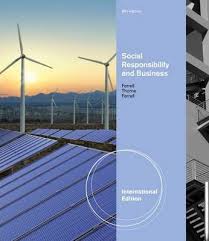
Social Responsibility and Business International Edition 4th Edition by O. C. Ferrell - Test Bank

Social Responsibility and Business International Edition 4th Edition by O. C. Ferrell - Test Bank   Instant Download - Complete Test Bank With Answers     Sample Questions Are Posted Below   Chapter 5—Business Ethics and Ethical Decision Making   MULTIPLE CHOICE   Which of the following best describes ethics? a. Rules about how one …

$19.99

Social Responsibility and Business International Edition 4th Edition by O. C. Ferrell – Test Bank


Instant Download – Complete Test Bank With Answers


Sample Questions Are Posted Below


Chapter 5—Business Ethics and Ethical Decision Making


MULTIPLE CHOICE


  1. Which of the following best describes ethics?
a. Rules about how one should act in a business situation
b. Balancing the ever-changing and complex needs of society with the desire for profit
c. Choices and judgments about acceptable standards of conduct that guide the behavior of individuals and groups
d. Guidelines that a company provides its employees to ensure that they will act in the best interest of society
e. Beliefs held by all people


ANS:  C                    PTS:   1


  1. The most basic of business ethical standards
a. have been uniformly implemented through every firm’s ethics code.
b. are centered around the mutual desire to protect the environment.
c. demonstrate a company’s desires to address the needs of society.
d. have been codified as laws and regulations.
e. include developing trust in all business relationships.


ANS:  D                    PTS:   1


  1. Because it can be difficult to draw a boundary between some legal issues and ethical issues in the workplace, it is important to
a. realize that ethical issues rarely become so important that they reach the courtroom for resolution.
b. recognize that the most cost-effective way to resolve disputes is through the court system.
c. have an organizational mechanism for resolving all questionable issues.
d. ensure that legal issues brought by stakeholders outside of the organization are resolved within the organization.
e. develop a code of conduct to cover every possible issue.


ANS:  C                    PTS:   1


  1. An ethical issue is a problem, situation, or opportunity
a. that harms consumers.
b. that harms the environment.
c. that requires society to choose among several actions that must be evaluated as right or wrong.
d. that requires an individual or organization to choose among several actions that must be evaluated as right or wrong, ethical or unethical.
e. that requires an individual or organization to choose between harming consumers or the environment and earning more profits.


ANS:  D                    PTS:   1


  1. An employee for Acme, Inc., has been asked to carry out an assignment that she believes is questionable. This situation can best be classified as
a. typical.
b. misconduct.
c. an ethical issue.
d. a real-life dilemma.
e. a violation of law.


ANS:  C                    PTS:   1


  1. Which of the following actions is not usually associated with bullying in the workplace?
a. Spreading rumors to damage others
b. Insulting, yelling, and shouting
c. Taking credit for others’ work or ideas
d. Using discriminatory terminology
e. Providing constructive criticism


ANS:  E                    PTS:   1


  1. Lying by omission involves intentionally
a. withholding material facts.
b. creating “noise” within the communication that knowingly confuses or deceives the receiver.
c. using highly technical language that the receiver does not understand.
d. trying to not hurt someone’s feelings.
e. telling “white lies.”


ANS:  A                    PTS:   1


  1. Issues related to fairness and honesty may arise because business is sometimes regarded as a
a. contest, with the most profitable firm “winning.”
b. contest, with the most ethical firm “winning.”
c. war, requiring surprise attacks, guerrilla warfare, and other warlike tactics to win the battle for consumers’ dollars.
d. game governed by its own rules, rather than those of society.
e. game governed by the rules of society.


ANS:  D                    PTS:   1


  1. Conflicts of interest exist when employees must choose whether to
a. advance their own interests, those of the organization, or those of some other group.
b. advance the interests of the organization or those of society.
c. accept bribes.
d. carry out an assignment they perceive as unethical.
e. report an unethical coworker.


ANS:  A                    PTS:   1


  1. Bribery is associated with which of the following?
a. Organizational relationships
b. Marketing
c. Communications
d. Honesty and fairness
e. Conflicts of interest


ANS:  E                    PTS:   1


  1. One of most common fraudulent activities reported by employees about their coworkers is
a. lowering quality standards to cut costs.
b. discriminating in the hiring process.
c. using dishonest messages in advertising campaigns.
d. claiming to have worked extra hours.
e. giving bribes to foreign officials.


ANS:  D                    PTS:   1


  1. Which of the following is not an ethical issue in the area of communications?
a. Concealed facts in advertising
b. Bribery
c. False or deceptive advertising
d. Ambiguous statements in advertising
e. Lying


ANS:  B                    PTS:   1


  1. ____ prohibit(s) employment discrimination on the basis of race, national origin, color, religion and gender.
a. The International Employment Rights Treaty
b. Title VII of the Civil Rights Act of 1964
c. The Americans with Disabilities Act
d. Affirmative Action programs
e. The Equal Employment Opportunity Commission


ANS:  B                    PTS:   1


  1. Concerns involving consumer privacy, website development, and online marketing relate to which classification of ethical issue?
a. Conflict of interest
b. Honesty
c. Communications
d. Discrimination
e. Technology


ANS:  E                    PTS:   1


  1. What are the three primary factors that together influence the ethical decision-making process?
a. Values, norms, and regulations
b. Opportunity, individual factors, and organizational relationships
c. Stakeholder relationships, trust, and corporate culture
d. Society, profits, and longevity
e. Personal ethics, group ethics, and business ethics


ANS:  B                    PTS:   1


  1. Which moral classification considers a decision right or acceptable if it accomplishes a desired result such as pleasure, knowledge, career growth, or utility?
a. Ethical formalism
b. Consequentialism
c. Justice
d. Results theory
e. Egoism


ANS:  B                    PTS:   1


  1. If a doctor exaggerates the condition of a patient in order for it to be a condition covered by insurance, the doctor is most likely applying which moral philosophy?
a. Egoism
b. Consequentialism
c. Illegal behavior
d. Utilitarianism
e. Ethical formalism


ANS:  E                    PTS:   1


  1. If employees believe that salary decisions are fair and consistent for all job categories, what type of justice exists?
a. Interactional
b. Procedural
c. Utilitary
d. Distributive
e. Ethical


ANS:  B                    PTS:   1


  1. In which of Kohlberg’s stages of moral development does an individual emphasize others over himself or herself?
a. Stage of individual instrumental purpose and exchange
b. Stage of punishment and obedience
c. Stage of mutual interpersonal expectation, relationships, and conformity
d. Stage of prior rights, social contract, or utility
e. Stage of social justice and conscience maintenance


ANS:  C                    PTS:   1


  1. According to Kohlberg’s model, moral development
a. is accelerated by gaining education and experience in resolving conflicts.
b. can be defined as six unrelated stages that a person progresses through.
c. depends mostly on the first few years of a person’s life.
d. differs for each individual, resulting in no universal values.
e. is focused primarily on each individual’s needs.


ANS:  A                    PTS:   1


  1. Mary steals office supplies from her employer. Mary’s unethical behavior may be attributed to all of the following except
a. her individual background along with her associations with others at her place of work.
b. the availability of unmonitored office supplies.
c. her personal values alone.
d. her coworkers’ tendencies to steal office supplies.
e. a lax ethical climate at her place of work.


ANS:  C                    PTS:   1


  1. What aspect of corporate culture relates to an organization’s expectations about appropriate conduct?
a. Organizational climate
b. Regulations
c. Significant others
d. Ethical climate
e. Values


ANS:  D                    PTS:   1


  1. Who establishes the ethical tone for the entire firm?
a. Mid-level managers
b. Board of directors
c. Ethics officer
d. Employees
e. Chief Executive Officer


ANS:  E                    PTS:   1


  1. Which of the following most closely exemplifies “groupthink”?
a. The CEO of a company is a strong supporter of family values, so the department managers allow employees time off one day a week to attend a special event for their children.
b. Two employees get together and come up with a scheme to cheat their company out of a substantial amount of money by charging clients more for products than what is recorded.
c. At a company meeting, a possible safety issue with one of the company’s products is discussed, and the employees decide not to recall the item since the possibility of the problem is probably slim.
d. An employee believes that her company’s newly proposed advertising campaign is insulting to certain groups of people but decides not to discuss it with anyone.
e. An employee follows his own ethical principles in making business decisions because he strongly believes in the source of those principles—his family and his religion.


ANS:  C                    PTS:   1


  1. What is the set of conditions that limits barriers or provides rewards?
a. Opportunity
b. Circumstances
c. Motivation
d. Reinforcement
e. Influence


ANS:  A                    PTS:   1


ESSAY


  1. What is corporate culture, and how is it conveyed in an organizational setting?


ANS:

Answers will vary.


PTS:   1


  1. Describe two moral philosophies and how each would impact an employee’s decision in a business situation.


ANS:

Answers will vary.


PTS:   1


  1. What is an ethical issue? Describe four categories of ethical issues and provide examples of specific situations that may occur within each category.


ANS:

Answers will vary.


PTS:   1


  1. According to results from the National Business Ethics Survey, what are the types of misconduct commonly found in the workplace?


ANS:

Answers will vary.


PTS:   1


  1. Describe the three factors that influence ethical decisions in business, and provide an explanation of how they affect employees in the workplace.


ANS:

Answers will vary.


PTS:   1

  1. What can a company do to influence its employees’ opportunity for unethical behavior?


ANS:

Answers will vary.


PTS:   1


  1.        Define fraud and describe three types of fraud relevant to business.


ANS:

Answers will vary.


PTS:   1

Additional information

Add Review

Your email address will not be published. Required fields are marked *