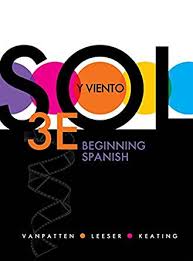
Sol y viento Beginning Spanish 3th Edition by Bill VanPatten - Test Bank

Sol y viento Beginning Spanish 3th Edition by Bill VanPatten - Test Bank   Instant Download - Complete Test Bank With Answers     Sample Questions Are Posted Below   LECCIÓN 5A Examen A (45 points) VOCABULARIO Your instructor will read a series of descriptions of electronic devices and vocabulary related to computers. Circle the …

$19.99

Sol y viento Beginning Spanish 3th Edition by Bill VanPatten – Test Bank


Instant Download – Complete Test Bank With Answers


Sample Questions Are Posted Below


LECCIÓN 5A

Examen A (45 points)

VOCABULARIO

  1. Your instructor will read a series of descriptions of electronic devices and vocabulary related to computers. Circle the item being described.
  2. a. el mensaje                            b.     la contraseña                      c.     el enlace
  3. a. el mando a distancia       b.     el disco duro                      c.     la máquina fax
  4. a. el teclado                              b.     la barra de memoria        c.     la pantalla
  5. a. el televisor                           b.     el ratón                                 c.     la barra de memoria
  6. a. el archivo                             b.     el enlace                               c.     el buzón de voz
  7. Listen as your instructor reads a series of words related to computers. Choose the action associated with each word you hear.
  8. a. encender            b.     apagar             c.     enviar
  9. a. congelarse         b.     copiar              c.     descargar
  10. a. importar            b.     hacer clic        c.     guardar
  11. a. conectar             b.     proteger           c.     apagar
  12. a. chatear               b.     guardar           c.     mandar
  13. Match each personality trait with the action most closely associated with it.
1.                 travieso

2.                 cabezón

3.                 obediente

4.                 torpe

5.                 impaciente

6.                 mentiroso

a.     Hace lo que gente en posiciones de autoridad le dice.

b.     Tiene dificultad en esperar (waiting).

c.     No cambia sus ideas.

d.    No dice la verdad.

e.     Se mete en líos.

f.      Rompe cosas y se cae con frecuencia.

GRAMÁTICA

  1. Paso 1. Write three sentences using three different verbs from column A to talk about your reactions to three of the things from column B.
a

fascinar…

interesar…

molestar…

parecer…

  b

…cómodo (convenient) el mando a distancia

…las personas que usan su celular en clase

…las nuevas tecnologías

…hacer una búsqueda en la red

Paso 2. Ask your instructor whether he or she has the same reaction as you, using one of the phrases you wrote in Paso 1.


Paso 3. Based on the interviews and discussions you had in class about technology, tell what your classmates’ reaction is to one of the things mentioned in Paso 1.

A muchos de mis compañeros                                                                                                                                            

  1. Indicate the correct word(s) to complete each sentence.
  2. Debo cambiar mi contraseña con más frecuencia pero nunca       doy a nadie.
  3. se lo b.     me la                        c.     se la
  4. Fui con mis padres a buscar computadoras y encontramos una que me gusta mucho. Van a       para mi cumpleaños.
  5. comprármela b.     comprársela          c.     comprármelas
  6. Teresa tiene una videocámara muy buena. ¿Por qué no le dices que necesitas usarla? Ella       presta (loan).
  7. se la b.     me la                        c.     te la
  8. Nancy y Mark me pidieron el DVD, pero no       pude dar. No sé dónde está.
  9. se los b.     se lo                          c.     me los
  10. Si Uds. quieren usar mi reproductor de DVD,       doy esta noche.
  11. se lo b.     nos lo                       c.     se los
  12. Paso 1. Using three of the activities listed, indicate one that both you and your friends used to do when you were children, one that your friends used to do but not you, and one that neither you nor your friends used to do.

decir mentiras   dibujar   hacer novillos   jugar al escondite   meterse en líos

  1. Mis amigos y yo
  2. Mis amigos , pero yo no.
  3. Ni mis amigos ni yo

Paso 2. And now? Do you still do the activity you mentioned in Paso 1, item 1? Answer using a complete sentence.

Ahora yo                                                                                                                                                                                    

  1. Write a paragraph (70 words minimum) describing what you used to do on weekends during the
    fall when you were about 14 or 15 years old. Include 1) a sentence about when you would get up
    and what you would do in the morning, 2) two or more sentences about who you would play with or, if you played sports, what you used to play, 3) two to three sentences about what you would do for entertainment in the evening, how late you would stay up, and so on. Your paragraph will be graded based on content, grammar, accuracy, and completeness.


CULTURA (Optativo)

  1. Answer the following questions based on what you have learned in the Vistazos culturales sections.
  2. Bolivia y el Paraguay son los países hispanos con mayor acceso al Internet. ¿Cierto o falso?
                   
  3. En                 hay tantos participiantes en redes sociales como en este país.
  4. Chile b.     México        c.     el Paraguay
  5. El proceso de conseguir la licencia de conducir es más facil y barato en España que en este país.
    ¿Cierto o falso?                
  6. Answer the following questions based on what you have learned in the Panorama cultural section.
  7. Los idiomas indígenas más hablados en Bolivia son…
  8. el aymara y el quechua.
  9. el guaraní y el aymara.
  10. el quechua y el guaraní.
  1. El Salar de Uyuni es…
  2. un plato paraguayo típico.
  3. la montaña más alta de los Andes.
  4. un desierto de sal en Bolivia.
  5. El Parque Nacional Ybycuí es conocido por…
  6. su desierto de sal.
  7. sus montañas nevadas (snowy).
  8. su cantidad de mariposas.
  9. Los platos de carne y papas son típicos del…
  10. Oriente boliviano.
  11. Altiplano boliviano.
  12. Paraguay.

LECCIÓN 5A

Examen B (45 points)

VOCABULARIO

  1. Your instructor will read a series of actions related to computers and computer use. Indicate which word is associated with the action you hear.
  2. a. la contraseña                      b.     la pantalla            c.     la barra de memoria
  3. a. la red                                     b.     el mensaje             c.     el enlace
  4. a. el ratón                                 b.     el disco duro        c.     la pantalla
  5. a. el teclado                             b.     el mensaje             c.     la contraseña
  6. a. el correo electrónico         b.     el enlace                c.     la computadora
  7. Listen as your instructor reads a series of descriptions of electronic devices. Choose the item most closely associated with each description.
  8. a. el juego electrónico                b.     el mando a distancia       c.     el teclado
  9. a. el buzón de voz                      b.     el enlace                               c.     el reproductor de CD
  10. a. el televisor                                b.     el estéreo                              c.     la videocámara
  11. a. la cámara                                  b.     el celular                              c.     la máquina fax
  12. a. el reproductor de DVD        b.     la barra de memoria         c.     el mando a distancia
  13. Match each word or expression on the left with the appropriate description on the right.
1.                 hacer novillos

2.                 pelearse

3.                 enamorarse

4.                 jugar al escondite

5.                 portarse bien

6.                 caer mal

a.     cuando alguien te ofende

b.     cuando otra persona no te ve, pero te busca

c.     cuando eres obediente

d.    cuando no vas a clase

e.     cuando te metes en líos con otra(s) persona(s)

f.      cuando sueñas con (dream about) otra persona porque te gusta

GRAMÁTICA

  1. Paso 1. Write three sentences using three different verbs from column A to talk about your reactions to three of the things in column B.
a

fascinar…

importar…

caer bien/mal…

apetecer…

  b

…las personas que siempre están usando el celular

…los aparatos electrónicos

…leer las noticias en la red y recibir correo

…saber cómo usar la tecnología

Paso 2. Ask your instructor whether he or she has the same reaction as you, using one of the phrases you wrote in Paso 1.


Paso 3. Based on the interviews and discussions you had in class about technology, tell what your classmates’ reaction is to one of the things mentioned in Paso 1.

A muchos de mis compañeros                                                                                                                                            

  1. Indicate the correct word(s) to complete each sentence.
  2. El dinero en la mesa es para Dela. Debes       esta tarde.
  3. dármelo b.     dárselo                       c.         dársela
  4. Perdí mi teléfono celular y mis padres no querían comprarme otro. Qué bueno que Luis lo encontró en su sala. Va a       esta tarde.
  5. traérmelo b.     traérmela                   c.         traérselo
  6. Me encantan las fotos que sacó Magda.       voy a pedir mañana.
  7. Se la b.     Me las                        c.         Se las
  8. Tomé el examen práctico para la licencia de conducir pero no       dieron. ¡No entiendo!
  9. me la b.     se la                             c.         me las
  10. Si quieres podemos pedir el televisor pequeño de mis padres. Creo que ellos       prestan (lend) por un mes.
  11. se lo b.     nos los                        c.         nos lo
  12. Paso 1. Select two of the activities from the list and indicate whether you used to do them or not when you were in high school.

enamorarse frecuentemente   hacer novillos   meterse en líos   portarse bien/mal

Paso 2. And your friends? Choose one of the activities you mentioned in Paso 1 and indicate whether your high school friends used to do it or not.

Mis amigos de la escuela secundaria                                                                                                                                

Paso 3. And your instructor? Choose one of the activities from Paso 1 and ask him or her whether he or she used to do that in high school.


  1. Write a paragraph (70 words minimum) describing what you used to do on weekends during the
    fall when you were in high school. Include 1) a sentence about when you would get up and what
    you would do in the morning, 2) two or more sentences about where you would go (to work, to
    play sports, to visit friends) and how you would get there, 3) two to three sentences about what
    you would do for fun in the evening. Your paragraph will be graded based on content, grammar, accuracy, and completeness.


CULTURA (Optativo)

  1. Answer the following questions based on what you have learned in the Vistazos culturales sections.
  2. El Paraguay y Bolivia son los países hispanos con menos usuarios del Internet. ¿Cierto o falso?
                   
  3. En                 hay tantos participiantes en redes sociales como en este país.
  4. España
  5. México
  6. Bolivia
  7. Para obtener la licencia de conducir en Bolivia y el Paraguay hay que tomar un examen práctico.
    ¿Cierto o falso?                
  8. Answer the following questions based on what you have learned in the Panorama cultural section.
  9. Los idiomas oficiales del Paraguay son el español y…
  10. el guaraní.
  11. el quechua.
  12. el aymara.
  1. Una característica que comparten Bolivia y el Paraguay es…
  2. que los Andes dividen los dos países.
  3. que no tienen acceso al mar.
  4. que el río Paraguay divide los dos países.
  5. El Parque Nacional Ybycuí es…
  6. un desierto de sal en Bolivia.
  7. la playa más famosa de Sudamérica.
  8. una selva subtropical en Paraguay.
  9. Los platos que llevan plátanos y yuca son típicos del…
  10. Oriente boliviano.
  11. Altiplano boliviano.
  12. Paraguay.


LECCIÓN 5B

Examen A (50 points)

VOCABULARIO

  1. Paso 1. Listen as your instructor reads a series of dates. Write the numbers (for example, 1425) that you hear.

Paso 2. Complete the following statement with the correct date from Paso 1.

Cristóbal Colón llegó a América en                .

  1. Paso 1. Listen as your instructor reads the total population of several countries. Write the name of the country and the population (for example, 4.500.000).
  2. país:         población:                                           
  3. país:         población:                                           
  4. país:         población:                                           

Paso 2. Answer the following question with information from Paso 1.

¿Qué país tiene el mayor número de habitantes?                    

  1. Match each feeling on the left with the most logical event on the right. Use each item only once.
1.                 tumultuoso

2.                 feliz

3.                 triste

4.                 orgulloso

5.                 enojado

6.                 nervioso

a.     la graduación

b.     el divorcio

c.     una entrevista de trabajo

d.    la boda

e.     la revolución

f.      la muerte

GRAMÁTICA

  1. Look at Marta’s time line. Order the following sentences based on it.

1981                    escuela                                     Bogotá                 graduación                      trabajo                  2010

  1.     Me gradué de biología en 2003.
  2.     En la escuela secundaria era una chica muy popular.
  3.     Pero poco a poco (little by little) iba conociendo a gente y hacía amigos.
  4.     Nací en un pueblo pequeño.
  5.     Trabajaba en un laboratorio cuando conocí a mi futuro esposo.
  6.     No conocía a nadie y al principio tenía problemas de adaptación, porque era mucho más grande que mi pueblo.
  7.     Me casé.
  8.     Me mudé en 1999 a Bogotá, una ciudad muy grande, para ir a la universidad.
  9. Complete the following narration about how Sofía met Ignacio.
  10. ¡Hola! Soy Sofía y voy a contarles cómo… a mi marido, Ignacio.
  11. conocí b.     conocía
  12. …estudiantes en la universidad, en la facultad de Educación.
  13. Fuimos b.     Éramos
  14. Un día, mientras yo… información para un trabajo en las computadoras de la residencia,
  15. busqué b.     buscaba
  16. un chico… a mi lado.
  17. se sentó b.     se sentaba
  18. De repente (Suddenly), (yo)… música de su computadora.
  19. escuché b.     escuchaba
  20. ¡ …mi canción favorita!
  21. Fue b.     Era
  22. Yo me…, y lo demás es historia.
  23. presenté b.     presentaba


  1. Choose a well-known event that impacted your community, your country, or the world (for example, Sept. 11, 2001, a natural disaster, a political event, and so forth). Specify the event in the space provided and answer the following questions about it in complete sentences in Spanish.

Event:                                       

  1. When and where did this event happen (ocurrir)?


  1. Were you alone or with someone?


  1. What were you doing when the event took place?


  1. What was the first thing you did after you realized what had just happened?


  1. Write a paragraph (70 words minimum) describing a personal event that was important to you. Include 1) three or more sentences to set up the background information (how old you were, where you were, who you were with), 2) three or more sentences about what happened that day, and 3) two or more sentences about how you felt about the event and why it was important to you. Your para­graph will be graded based on content, grammar, accuracy, and completeness.


SOL Y VIENTO

  1. Write the name of the character associated with each of the following sentences, based on Episodio 5.

Andy   Carlos   doña Isabel   Jaime   María

  1. Piensa que es bueno trabajar para la comunidad.                                
  2. Siente resentimiento.                                
  3. Piensa que las cosas van mal.                                
  4. Trabajó en la fermentación del vino.                                
  5. Tiene una actitud impaciente.                                
  6. Siente celos (jealousy) de Diego.                                
  7. Sabe de culturas indígenas.                                

CULTURA (Optativo)

  1. Answer the following questions based on what you have learned in the Vistazos culturales sections.
  2. ¿Cuándo se independizaron de España los países centroamericanos?
  3. 1492
  4. 1914
  5. 1821
  6. Es más correcto hablar de la llegada de Cristóbal Colón a América como…
  7. un encuentro.
  8. un descubrimiento.
  9. En muchas bodas en el mundo hispano…
  10. hay cinco damas de honor.
  11. la ceremonia empieza por la mañana.
  12. el novio va al altar con su madre.
  13. Answer the following questions based on what you have learned in the Panorama cultural section.
  14. Managua es la capital de…
  15. Honduras.
  16. El Salvador.
  17. Nicaragua.
  18. Copán es una ciudad conocida por…
  19. sus jeroglíficos mayas.
  20. sus playas vírgenes.
  21. volcanes.
  22. Muchos poemas de Rubén Darío reflejan…
  23. temas religiosos.
  24. temas indígenas.
  25. preocupaciones políticas.
  26. El Arzobispo Romero predicaba en contra de (preached against)…
  27. los Estados Unidos.
  28. la violencia.
  29. la Revolución sandinista.

LECCIÓN 5B

Examen B (49 points)

VOCABULARIO

  1. Paso 1. Listen as your instructor reads a series of historical events in the Spanish-speaking world. Write down the year that you hear (for example, 1568) and take notes to help you remember the event to which each date refers. You may take the notes in English.
  2. year:         event:                                                                 
  3. year:         event:                                                                 
  4. year:         event:                                                                 
  5. year:         event:                                                                 
  6. year:         event:                                                                 

Paso 2. Order the events in Paso 1 (in Spanish!) from the earliest to the most recent to complete the following time line. Write only the event, not the year.

  1.                                                                                                                                                                                        
  2.                                                                                                                                                                                        
  3.                                                                                                                                                                                        
  4.                                                                                                                                                                                        
  5.                                                                                                                                                                                        

Paso 3. ¿Qué acontecimiento (event) crees que tuvo el mayor impacto o efecto en el mundo hispano?


  1. Listen as your instructor reads some definitions. Choose the most appropriate word for each.
  2. a. la llegada                        b.     la invasión           c.     la celebración
  3. a. el descubrimiento        b.     la migración        c.     el terremoto
  4. a. la independencia         b.     la fundación        c.     la llegada
  5. a. el encuentro                   b.     la conquista         c.     la independencia

GRAMÁTICA

  1. Complete the following dialogue between a detective and a murder suspect.
  2. detective: ¿Qué hacía Ud. ayer a las 6:00 de la tarde?

sospechoso:    Pues…

  1. miraba la televisión. b.     miré la televisión.
  2. detective: ¿Qué programa?

sospechoso:    No recuerdo porque…

  1. estaba cansado. b.     estuve cansado.
  2. detective: ¿Y después?

sospechoso:    Me…

  1. dormía. b.     dormí.
  2. detective: ¿Alguien estaba con Ud. para corroborar su historia?

sospechoso:    Mi perro. Pero, a la 1:00 de la mañana…

  1. llamaba a mi novia. b.     llamé a mi novia.
  2. detective: ¿A su novia? ¿A esa hora? ¿Por qué?

sospechoso:    Bueno, creo que mi novia…

  1. estaba con otro hombre. b.     estuvo con otro hombre.
  2. detective: ¿Sí? ¿Y quién es ese hombre?

sospechoso:    El verdadero asesino (murderer). Si Ud. investiga el caso va a ver que esta mañana, a las 6:00, mi novia y su amante (lover)…

  1. tomaban un avión a las Bahamas. b.     tomaron un avión a las Bahamas.
  2. detective: ¿Y, cómo sabe Ud. eso?

sospechoso:    Pues, porque yo les…

  1. compraba los pasajes (air tickets). b.     compré los pasajes.
  2. Answer the following questions about your first day of classes at the university. Use the appropriate verbs from the list and answer in complete sentences.

conocer   estar   hacer   llegar   sentirse   tener   tomar

  1. How old were you?


  1. At what time did you arrive on campus?


  1. Were you alone or with a friend?


  1. What was the weather like?


  1. How did you feel?


  1. How many classes did you take on that first day?


  1. Did you meet many new people?


  1. Write a paragraph (70 words minimum) about a personal achievement that has impacted you in some way, for example, a graduation, learning how to drive, and so on. Include 1) three or more sentences to set up the background information (how old you were, where you were, who you were with), 2) three or more sentences about what happened that day, and 3) two or more sentences about how you felt about the event and why it was important to you. Your paragraph will be graded based on content, grammar, accuracy, and completeness.


SOL Y VIENTO

  1. Write the name of the character associated with each of the following sentences based on Episodio 5.

Andy   Carlos   doña Isabel   Jaime   María

  1. Explica el significado de mapuche y pachamama.                                
  2. No le gusta su trabajo.                                
  3. Está triste porque piensa que las cosas van mal.                                
  4. Sus padres eran campesinos.                                
  5. Tiene una actitud impaciente.                                
  6. Siente celos (jealousy) por un momento.                                
  7. Dice que no le pasa nada, pero no es verdad.                                

CULTURA (Optativo)

  1. Answer the following questions based on what you have learned in the Vistazos culturales sections.
  2. Para los indígenas de Latinoamérica, la llegada de Cristóbal Colón fue…
  3. un descubrimiento. b.     un encuentro.
  4. En las bodas de los países hispanos es común usar símbolos como el rosario. ¿Cierto o falso?
                   
  1. Answer the following questions based on what you have learned in the Panorama cultural section.
  2. Tegucigalpa es la capital de…
  3. Honduras.
  4. El Salvador.
  5. Nicaragua.
  6. Las pupusas son…
  7. jeroglíficos mayas.
  8. paramilitares de ultraderecha.
  9. el plato nacional de El Salvador.
  10. La poesía de Rubén Darío es conocida por sus temas…
  11. religiosos.
  12. eróticos.
  13. indígenas.
  14. Se encuentran figuras humanas esculpidas (sculpted) en los monumentos mayas en…
  15. Palenque.
  16. Tikal.
  17. Copán.


Episodio 5

Prueba (25 points)

  1. Complete the following phrases based on Episodio 5.
1.                 Mapu significa…

2.                 Che significa…

3.                 Jaime le dice a María que ella no es una profesora…

4.                 Doña Isabel le dice a su esposo muerto que las cosas…

a.     típica.

b.     van mal.

c.     tierra.

d.    gente.

  1. Write the name of the character associated with each of the following statements.

Andy   Carlos   doña Isabel   Jaime   María

  1. Sabe mucho de las culturas indígenas.                                
  2. Siente resentimiento.                                
  3. No quiere vender la viña.                                
  4. Trabajó en la fermentación del vino.                                
  5. Tiene una actitud impaciente.                                
  6. Siente celos (jealousy) por un momento.                                
  7. Sugiere tutearse.                                
  8. Choose the most appropriate answer.
  9. Jaime describe lo que hace: «Trabajo con una compañía de exportaciones, sigo la Bolsa y… »
  10. leo el periódico. b.     corro.                          c.     viajo.
  11. Doña Isabel le dice a Yolanda que…
  12. va a llamar a alguien por teléfono. b.     va a descansar.       c.     está muy enojada.
  13. María y Jaime brindan por…
  14. el amor. b.     la vida.                       c.     la amistad.
  15. La palabra pachamama es de origen…
  16. mapuche. b.     maya.                         c.     quechua.


  1. Write a paragraph (50 words minimum) in which you narrate in your own words a scene from
    Sol y viento. Include 1) two or more sentences to set up the background information, 2) two or
    more sentences to tell what happened, and 3) two or more sentences to describe how the characters involved felt in the scene. Your paragraph will be graded based on content, grammar, accuracy,
    and completeness.


Additional information

Add Review

Your email address will not be published. Required fields are marked *