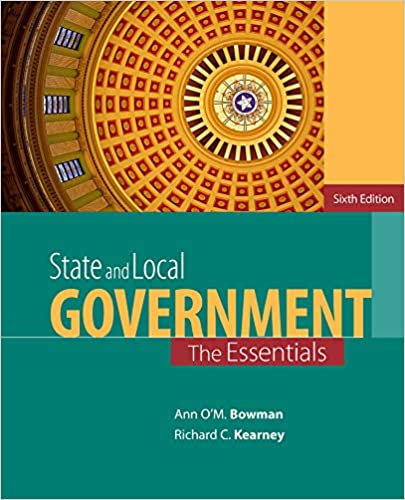
State and Local Government The Essentials 6th Edition by Ann O'M. Bowman - Test Bank

State and Local Government The Essentials 6th Edition by Ann O'M. Bowman - Test Bank   Instant Download - Complete Test Bank With Answers     Sample Questions Are Posted Below   CHAPTER 5: Political Parties, Interest Groups, and Campaigns   MULTIPLE CHOICE   American political parties are composed of three interacting parts: the party …

$19.99

State and Local Government The Essentials 6th Edition by Ann O’M. Bowman – Test Bank


Instant Download – Complete Test Bank With Answers


Sample Questions Are Posted Below


CHAPTER 5: Political Parties, Interest Groups, and Campaigns


MULTIPLE CHOICE


  1. American political parties are composed of three interacting parts: the party organization, the party in government, and
a. the electoral college. c. the party in the judiciary.
b. the party ideology. d. the party in the electorate.


ANS:  D                    REF:   94                  NOT:  Factual


  1. When a voter casts ballots for a Democratic governor and a Republican state legislator in the same general election, they are engaged in
a. fence sitting. c. straight-ticket voting.
b. ticket splitting. d. gerrymandering.


ANS:  B                    REF:   95                  NOT:  Applied


  1. Political parties frequently develop identifiable subsets known as
a. factions. c. interest groups.
b. PACs. d. think tanks.


ANS:  A                    REF:   97                  NOT:  Factual


  1. According to the text, which two of these third parties have enjoyed some success in local races in recent times?
a. the Constitution Party and the Libertarian Party
b. the Green Party and the Constitution Party
c. the Libertarian Party and the Green Party
d. the Socialist Party and the Libertarian Party


ANS:  C                    REF:   98-99             NOT:  Factual


  1. The trend toward _______, or weakening of individual partisan attachments, slowed for a period of time but has begun to pick up again in recent years.
a. partisanship c. open government
b. dealignment d. direct action


ANS:  B                    REF:   100                NOT:  Factual


  1. Cecilia participates in an organization of individuals who share her political views and desire to influence government. These organizations are commonly called
a. factions. c. ticket-splitters.
b. interest groups. d. political action committees.


ANS:  B                    REF:   100                NOT:  Applied


  1. A well represented and powerful interest group in the lobby of the state capitol would be
a. general business organizations.
b. labor unions.
c. public interest research groups (PIRGs).
d. attorneys and state bar associations.


ANS:  A                    REF:   101                NOT:  Factual


  1. The purpose of direct action is to
a. raise money.
b. invest resources to create a positive image.
c. influence the outcome of elections.
d. draw attention to a cause.


ANS:  D                    REF:   102                NOT:  Factual


  1. According to surveys of local officials in small cities, the two functional areas in which interest groups have the greatest influence are economic development and
a. education.
b. taxes.
c. health services.
d. parks and recreation.


ANS:  D                    REF:   102                NOT:  Factual


  1. The explosion of interest groups in state capitals is primarily caused by
a. the reduction in informed elected officials in state legislatures.
b. an increase in campaign finance expenditures over the years.
c. an increase in the number of interests affected by government expansion that cannot afford to be without representation.
d. the increased responsiveness of state legislators to tactics like bribery.


ANS:  C                    REF:   105                NOT:  Conceptual


  1. Social lobbying has been supplemented with which of the following techniques?
a. providing information
b. providing personal favors
c. providing extensive media coverage
d. monitoring debates through lobbyist presence in committee hearings


ANS:  A                    REF:   106                NOT:  Conceptual


  1. Grassroots lobbying occurs when
a. lobbyists position themselves on the steps and the lawn of the capitol building to greet legislators as they enter.
b. lobbyists wine and dine legislators in order to obtain their support on public policies.
c. a group of citizens mobilizes and contacts public officials on behalf of a shared public policy view.
d. lobbyists spend increasing amounts of time with legislators on the golf course, or in other recreational settings, developing a personal relationships with them.


ANS:  C                    REF:   106                NOT:  Factual


  1. Political action committees grew out of
a. a desire to weaken the role of political parties.
b. concern over the rising influence of interest groups.
c. laws that made direct political contributions by corporations and labor unions illegal.
d. an effort to discourage public involvement and participation in politics.


ANS:  C                    REF:   107                NOT:  Conceptual


  1. The Internet has become a powerful campaign tool for all of the following reasons EXCEPT
a. it can disseminate the candidate’s message to far-flung audiences.
b. it can mobilize potential supporters.
c. it reduces the amount of spending on negative and misleading advertising.
d. it serves as a vehicle for attracting contributions.


ANS:  C                    REF:   110                NOT:  Conceptual


  1. Which of the following is an example of a “fair” negative campaign ad?
a. an ad that contains untrue or partially-true statements
b. an ad that emphasizes some embarrassing aspect of an opponent’s voting record or some long-forgotten indiscretion
c. an ad that uses images and music to heighten the emotion of a slanderous claim
d. an ad that focuses on an opponent’s personal life


ANS:  B                    REF:   110                NOT:  Applied


  1. Which of the following actions has been taken to reform negative campaign advertising?
a. Many newspapers and websites report regularly on the content, presentation, and relative accuracy of campaign advertising.
b. Some candidates have begun taking major newspapers to court because of the campaign information they print.
c. Political parties have created fair campaign practices panels to pass judgment on campaign ads.
d. The Democratic Party has brought court action against Republican candidates in four states for defamation of character of their candidates.


ANS:  A                    REF:   110                NOT:  Factual


  1. Which of the following statements about the use of professional political consultants in state and local races is true?
a. It is a passing fad that is too expensive for most state and local politicians to afford.
b. It is an occupational specialty that sprang up during the 1970s and 1980s and is clearly here to stay.
c. It is an occupational specialty that has been around since the heyday of the political parties in the 1930s.
d. A study of legislative elections indicates that the use of campaign professionals is not particularly valuable to challengers who are hoping to unseat incumbents.


ANS:  B                    REF:   111                NOT:  Conceptual


  1. Which of the following types of elections is most likely to have the highest cost of campaigning?
a. a close election in a large metropolitan area
b. a close election in which the incumbent would be unseated
c. an election for an open seat that is not expected to be close
d. an election with an incumbent that is not expected to be close


ANS:  B                    REF:   112                NOT:  Applied


  1. Tamara works for a nonprofit, tax-exempt political organization that accepts contributions and can make expenditures in campaigns, but is not explicitly connected to candidates. This type of organization is known as a
a. 527 group. c. political action committee (PAC).
b. candidate-centered organization. d. third-party committee.


ANS:  A                    REF:   112                NOT:  Applied


  1. Unregulated funds contributed to national political parties and nonparty political groups is called
a. tin money. c. PAC money.
b. soft money. d. hard money.


ANS:  B                    REF:   113                NOT:  Factual


  1. The 1976 U.S. Supreme Court case that held that governments cannot limit a person’s right to spend money in order to spread his or her particular political views in political campaigns was
a. Roe v. Wade. c. South Carolina v. Baker.
b. Serrano v. Priest d. Buckley v. Valeo.


ANS:  D                    REF:   113                NOT:  Factual


  1. Running for public office has become increasingly expensive. In an effort to level the playing field and diminish the role of private money, most states
a. have banned PACs and forbidden direct contributions from corporations, labor unions, and other special interest groups in state elections.
b. have limited the influence of soft money and PACs because of the U.S. Supreme Court’s ruling in Buckley v. Valeo.
c. now provide public financing for all major elections.
d. limit contributions and many now provide for public financing.


ANS:  D                    REF:   114                NOT:  Factual


  1. What proportion of the states has adopted some sort of public funding of some campaigns?
a. one-third c. one-tenth
b. two-thirds d. none


ANS:  A                    REF:   114                NOT:  Factual


  1. Seven states have adopted some form of a fully-funded “clean elections” campaign finance system. Which feature below is NOT generally included in those systems?
a. Candidates must obtain a set minimum number of signatures.
b. Candidates must collect a certain number of small dollar contributions.
c. Candidates may spend up to $50,000 of their own money.
d. Once in the program, candidates must only spend public funds.


ANS:  C                    REF:   114                NOT:  Conceptual


  1. Research on Arizona and Maine’s programs for publicly funding campaigns has demonstrated that
a. there is no effect of these programs whatsoever.
b. public funding decreased competition.
c. public funding increased competition.
d. public funding led to decreased voter turnout.


ANS:  C                    REF:   115                NOT:  Conceptual


  1. In 2002, Governor _______ of _______ became the first governor to be elected with full public financing of her campaign.
a. Jim Douglas; Vermont c. Bill Richardson; New Mexico
b. Janet Napolitano; Arizona d. John Baldacci; Maine


ANS:  B                    REF:   115                NOT:  Factual


TRUE/FALSE


  1. State political parties have undergone a transformation during the past thirty years and they have proven themselves quite adaptable.


ANS:  T                    REF:   94                  NOT:  Factual


  1. The condition of contemporary American political parties has been described as decline, decay, and demise, but some observers believe that parties are enjoying a period of revitalization and rejuvenation.


ANS:  T                    REF:   94                  NOT:  Factual


  1. Ideologically, Republicans tend to be more conservative, favoring a limited role for government; Democrats tend to be more liberal, preferring a more activist government.


ANS:  T                    REF:   94                  NOT:  Factual


  1. In foreign affairs, Republicans favor a much more assertive U.S. policy than do Democrats.


ANS:  T                    REF:   94-95             NOT:  Factual


  1. By 2012, approximately 32 percent of the voting-age population considered themselves Democrats, 24 percent Republican, and 38 percent Independent.


ANS:  T                    REF:   95                  NOT:  Factual


  1. Since the end of the Civil War, the southern states have remained single-party Republican states.


ANS:  F                    REF:   95                  NOT:  Factual


  1. Voters display a remarkable penchant for ticket splitting—that is, voting for a Democrat for one office and a Republican for another in the same election.


ANS:  T                    REF:   95                  NOT:  Factual


  1. Political parties are centralized organizations.


ANS:  F                    REF:   96                  NOT:  Factual


  1. Political parties in the states often contain 527 groups—identifiable subsets within the party.


ANS:  F                    REF:   112                NOT:  Factual


  1. The main reason that there are only two major political parties in the United States is attributable to Article VII, Section 4 in the U.S. Constitution, which mandates that the nation will have only two parties.


ANS:  F                    REF:   98                  NOT:  Factual


  1. Although two political parties dominate politics in the states, third parties have achieved isolated success in some states and at the local level.


ANS:  T                    REF:   98-99             NOT:  Factual


  1. Most states currently exhibit meaningful two-party electoral competition, meaning both Democrats and Republicans are offering credible candidates for state offices.


ANS:  T                    REF:   99                  NOT:  Factual


  1. Divided government in the states refers to one party controlling the governor’s office and the other party controlling the legislature.


ANS:  T                    REF:   99                  NOT:  Factual


  1. Schoolteachers’ organizations are ranked among the most influential interest groups in thirty-one states


ANS:  T                    REF:   101                NOT:  Factual


  1. When an interest group stages a demonstration in front of city hall, it is an indirect action.


ANS:  F                    REF:   102                NOT:  Factual


  1. Most states have not limited the amount of PAC contributions that can be made to a candidate.


ANS:  F                    REF:   108                NOT:  Factual


  1. Negative campaigning in the states persists because government and the media have ignored the issue.


ANS:  F                    REF:   110-111         NOT:  Factual


  1. In 1996, in a lawsuit from Colorado, the Supreme Court instituted a limit on soft money contributions.


ANS:  F                    REF:   113                NOT:  Factual


  1. All states require candidates and political committees to file reports documenting the expenditure of campaign funds.


ANS:  T                    REF:   114                NOT:  Factual


  1. In Buckley v. Valeo, the U.S. Supreme Court put limits on the amount of money candidates could spend on political campaigns.


ANS:  F                    REF:   113                NOT:  Factual


  1. In 2006, the U.S. Supreme Court ruled that Vermont’s spending limits were too low to allow candidates to compete effectively in political campaigns.


ANS:  T                    REF:   114                NOT:  Factual


ESSAY


  1. What are the functions of political parties in state government? Make sure to provide specific examples to illustrate each function.


ANS:

Answers may vary.


  1. Why have third party successes been so infrequent on the American political scene? What is your opinion about the immediate future of third political parties?


ANS:

Answers may vary.


  1. What is the proper role of interest groups in state politics? Do you believe that interest groups (including PACs and 527s) serve the public interest? Are interest groups a form of free speech? How do you define the public interest?


ANS:

Answers may vary.


  1. Should state governments regulate campaign contributions and spending? Discuss how money may affect politics, specifically in terms of the nature of elections (how they are run), the outcome of elections (who wins), and the policies that are influenced. How would public financing or some other form of campaign finance alter these outcomes?


ANS:

Answers may vary.


  1. There are a variety of interest groups in the states. Identify some of the major types of interest groups and discuss what their motivation is for participating in the political system at the state and local level.


ANS:

Answers may vary.


  1. Do new technologies, such as the Internet and social media, change the nature of elections? Provide specific examples to illustrate your points. Are these changes good or bad for democracy?


ANS:

Answers may vary.

Additional information

Add Review

Your email address will not be published. Required fields are marked *