No products in the cart.

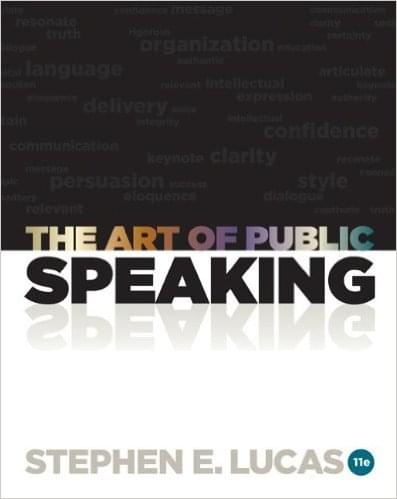
The Art of Public Speaking, 11th Edition by Stephen Lucas - Test Bank

The Art of Public Speaking, 11th Edition by Stephen Lucas - Test Bank   Instant Download - Complete Test Bank With Answers     Sample Questions Are Posted Below       5   Selecting a Topic and a Purpose         T he questions for each chapter are organized according to type: …

$19.99

The Art of Public Speaking, 11th Edition by Stephen Lucas – Test Bank


Instant Download – Complete Test Bank With Answers


Sample Questions Are Posted Below


  5


Selecting a Topic
and a Purpose


T

he questions for each chapter are organized according to type: true-false, multiple-choice, short-answer, and essay. Within each of these categories, questions are clustered by topic, roughly following the order of topics in the textbook.

To provide as much flexibility as possible in constructing examinations, there is deliberate overlap among the questions, both within and across question types. This enables you to choose the wording and question type that best fits your testing objectives. In deciding which questions to use, take care to avoid items such as a multiple-choice question that gives away the answer to a true-false or short-answer question, or an essay question that covers essentially the same ground as a true-false, short-answer, or multiple-choice question.

Each type of question—true-false, multiple-choice, short-answer, and essay—has an automatic numbering system, which means you can copy and paste items from within a question type, and they will automatically number themselves consecutively, beginning with “1.” The five answer choices for each multiple-choice question are also ordered automatically, and so you can add, change, or reorder answer choices without rearranging the lettering.

If you would like to preserve the fonts, indents, and tabs of the original questions, you can substitute questions for those in the sample final exams or copy and paste questions into the Exam Master provided in the final Word file of the Test Bank. In the Exam Master, spaces for your course name, exam type, and the student’s name and section are followed by headings and instructions for true-false, multiple-choice, short-answer, and essay questions. You can add elements unique to your exams and delete elements you don’t want to use. After you customize the Exam Master, you can save it with your changes. Then, each time you open it, click “Save As” to give it the name of the exam you are currently constructing.


True-False Questions

  1. T F      The first step in speechmaking is choosing a topic for your speech.
  2. T F      Outside the classroom, the topic of a speech is usually determined by the occasion, the audience, and the speaker’s qualifications.
  3. T F      It is usually a poor idea to choose a speech topic that requires research.
  4. T F      You should usually avoid drawing on your personal knowledge or experience when choosing a speech topic.
  5. T F      You should usually avoid choosing speech topics that you feel strongly about.
  6. T F      Brainstorming is a method of generating ideas for a speech through free association of words and ideas.
  7. T F      Brainstorming is a way of clearing your mind so you can relax while choosing a speech topic.
  8. T F      No matter how you go about choosing a speech topic, it is important to start the process early.
  9. T F      After choosing a topic, the next step in speech preparation is determining your central idea.
  10. T F      Once you choose the central idea of your speech, the next step is to formulate your general purpose.
  11. T F      After choosing a topic, the next step in speech preparation is determining your general purpose.
  12. T F      After choosing a topic, the next step in speech preparation is determining your specific purpose.
  13. T F      Most often, your general purpose as a speaker is to inform or to persuade.
  14. T F      Most often, a speaker’s general purpose will fall into one of two categories—to inform or to demonstrate.
  15. T F      The difference between informing and persuading is like the difference between explaining and entertaining.
  16. T F      When your general purpose is to persuade, you act as a teacher or lecturer.
  17. T F      The difference between informing and persuading is like the difference between teaching and advocating.
  18. T F      When your general purpose is to inform, you act as an advocate or an opponent.
  19. T F      The specific purpose statement indicates precisely what the speaker hopes to accomplish in a speech.
  20. T F      The specific purpose reveals more about the content of a speech than does the central idea.
  21. T F      The specific purpose of a speech usually “sums up” the main points to be developed in the body of the speech.
  22. T F      The following is an example of an effective specific purpose statement for a speech: “The three major elements of the architectural style of Frank Lloyd Wright are low-pitched roofs, functional designs, and lines that blend into the landscape.”
  23. T F      The specific purpose statement should focus on one aspect of a topic and be expressed in a single infinitive phrase.
  24. T F      “To inform my audience of the major steps in responding to a medical emergency” is an example of an effective specific purpose statement for an informative speech.
  25. T F      “To inform my audience of the major accomplishments of the space shuttle program” is a well-worded specific purpose statement for an informative speech.
  26. T F      “To inform my audience about the causes and effects of lead poisoning in children” is an example of an effective specific purpose statement for a speech.
  27. T F      “To persuade my audience that our school should provide more on-campus parking for students” is an example of a well-worded specific purpose statement for a persuasive speech.
  28. T F      “To persuade my audience that the federal government should require seat belts on all school buses” is an example of a well-worded specific purpose statement for a persuasive speech.
  29. T F      “To inform my audience about terrorism” is an example of a well-worded specific purpose statement for an informative speech.
  30. T F      “To inform my audience about depression” is an example of an effective specific purpose statement for a speech.
  31. T F      “To inform my audience about golf” is an example of an effective specific purpose statement for a speech.
  32. T F      “The effects of light pollution in major cities” is an example of a well-worded specific purpose statement.
  33. T F      “Making a difference through voting” is an example of an effective specific purpose statement for a persuasive speech.
  34. T F      “Conducting regular car maintenance” is an example of an effective specific purpose statement for a speech.
  35. T F      “Learning water safety guidelines” is an example of an effective specific purpose statement for a speech.
  36. T F      It is important to keep your audience in mind as you formulate the specific purpose for your speech.
  37. T F      “To explain three basic hand-sewing techniques” is an example of a well-worded specific purpose statement.
  38. T F      “To explain the causes and treatment of compulsive hoarding” is an example of a well-worded specific purpose statement.
  39. T F      A specific purpose statement should usually be phrased as a question.
  40. T F      “What should you consider when choosing a study abroad program?” is an example of a well-worded specific purpose statement for a speech.
  41. T F      “What can we learn about ourselves from our dreams?” is an example of a well-worded specific purpose statement for a speech.
  42. T F      It is acceptable for a specific purpose statement to include two unrelated ideas.
  43. T F      “To inform my audience about the origins of martial arts and how to perform yoga” is an example of an effective specific purpose statement for an informative speech.
  44. T F      “To inform my audience about the current status of tennis as an international sport” is an example of an effective specific purpose statement for a speech.
  45. T F      “To inform my audience how to build a birdhouse and about the migratory patterns of birds” is an example of an effective specific purpose statement for a speech.
  46. T F      The central idea reveals more about the content of a speech than does the specific purpose.
  47. T F      The central idea of a speech often emerges after you have done your research and have decided on the main points of the speech.
  48. T F      The central idea is usually determined after the bulk of the research for a speech is completed.
  49. T F      The central idea should encapsulate or sum up the main points to be developed in the body of the speech.
  50. T F      The central idea of a speech should be expressed as a full sentence.
  51. T F      The following is an example of a well-worded central idea for a speech: “A diet that encourages eating only foods high in fat and protein has major advantages as well as serious risks.”
  52. T F      “To persuade my audience that the federal government should institute a national sales tax to help pay for social programs” is an example of an effective central idea for a speech.
  53. T F      “The three most distinctive traits of Chow Chows are their black tongues, their thick coats, and their manes” is an example of a well-worded central idea for a speech.
  54. T F      “The three major expenses for people traveling abroad are transportation, food, and lodging” is an example of an effective specific purpose statement for a speech.
  55. T F      “The three major expenses for people traveling abroad are transportation, food, and lodging” is an example of a well-worded central idea for a speech.
  56. T F      “The major responsibilities of an athletic trainer are preventing, diagnosing, and treating injuries” is an example of a well-worded central idea for a speech.
  57. T F      “The major responsibilities of an athletic trainer are preventing, diagnosing, and treating injuries” is an example of a well-worded specific purpose statement for a speech.
  58. T F      The following is an effective central idea for a speech to persuade: “You should vote a $10 increase in student fees to pay for a new intramural athletic facility because such a facility is both necessary and practical.”


Multiple-Choice Questions   (Students are to indicate the best answer for each question by circling the correct letter.)

  1. According to your textbook, brainstorming is especially helpful when you are having trouble
    1. choosing a speech topic.
    2. determining the general purpose.
    3. determining the specific purpose.
    4. phrasing the central idea.
    5. analyzing the audience.
  2. The process of generating ideas for speech topics by free association of words and ideas is known as
    1. linking
    2. aggregating
    3. deliberating
    4. brainstorming
    5. advocating
  3. Which of the following does your textbook recommend as a method of brainstorming for a speech topic?
    1. clustering
    2. taking a personal inventory
    3. conducting an Internet search
    4. all of the above
    5. a and c only
  4. After choosing a topic, what is the next step of speech preparation?
    1. phrasing the central idea
    2. analyzing the occasion
    3. selecting the specific purpose
    4. writing the introduction
    5. determining the general purpose
  5. Which of the following is out of place in a speech to inform?
    1. advocating
    2. explaining
    3. reporting
    4. demonstrating
    5. telling
  6. Advocating a position is most appropriate when the general purpose of your speech is to
  7. When the general purpose of your speech is to __________ , you act primarily as a teacher or lecturer.
    1. inform
    2. convince
    3. entertain
    4. persuade
    5. convert
  8. When the general purpose of your speech is to __________ , you act primarily as an advocate.
    1. persuade
    2. entertain
    3. demonstrate
    4. commemorate
    5. inform
  9. According to your textbook, what is the most important early step in the process of developing a successful speech?
    1. creating a preliminary bibliography
    2. researching for speech materials
    3. formulating the specific purpose
    4. brainstorming for a central idea
    5. selecting the residual message
  10. The __________ expresses precisely what you hope to accomplish with your speech.
    1. central idea
    2. specific purpose
    3. preview statement
    4. thesis statement
    5. goal statement
  11. According to your textbook, the specific purpose for a speech should
    1. include a reference to the audience.
    2. be written as a full infinitive phrase.
    3. be expressed as a question.
    4. all of the above.
    5. a and b only.
  12. “To inform my audience about the history of the Federal Deposit Insurance Corporation” is an example of a
    1. speech topic.
    2. general purpose.
    3. central idea.
    4. thesis statement.
    5. specific purpose.
  13. “To inform my audience about the three basic steps in preventive medicine” is an example of a
    1. main point.
    2. specific purpose.
    3. thesis statement.
    4. central idea.
    5. general purpose.
  14. “To inform my audience about the symptoms, causes, and treatment of chronic fatigue syndrome” is an example of a
    1. specific purpose.
    2. thesis statement.
    3. general purpose.
    4. central idea.
    5. main point.
  15. “To inform my audience about the four major elements in rope climbing” is an example of a
    1. speech topic.
    2. general purpose.
    3. central idea.
    4. thesis statement.
    5. specific purpose.
  16. “To inform my audience how our local water treatment facility ensures the safety of our drinking water” is an example of a
    1. mission statement.
    2. specific purpose.
    3. transition statement.
    4. general purpose.
    5. central idea.
  17. “To inform my audience about the history and rules of water polo” is an example of a
    1. speech topic.
    2. general purpose.
    3. central idea.
    4. thesis statement.
    5. specific purpose.
  18. “To inform my audience how a perpetual motion machine works” is an example of a
    1. general purpose.
    2. main point.
    3. central idea.
    4. specific purpose.
    5. thesis statement.
  19. “Improving personal relationships” is a poorly phrased specific purpose for a speech because it is
    1. too technical for a classroom speech.
    2. written as a sentence rather than a declarative phrase.
    3. expressed in figurative language.
    4. written as a fragment rather than a full infinitive phrase.
    5. written as a statement rather than a question.
  20. “Knowing how to deal with stress” is a poorly phrased specific purpose for a classroom speech because it
    1. is too technical.
    2. does not include a reference to the audience.
    3. contains figurative language.
    4. all of the above.
    5. a and c only.
  21. “To explain the three major benefits of cycling as a form of exercise” is a poorly phrased specific purpose statement because it
    1. is too broad.
    2. deals with more than a single topic.
    3. lacks a reference to the audience.
    4. all of the above.
    5. a and b only.
  22. “To explain how to write an effective job resumé” is a poorly phrased specific purpose statement because it
    1. is too specific.
    2. contains figurative language.
    3. is written as a statement instead of a question.
    4. does not include a reference to the audience.
    5. is too trivial.
  23. “To persuade my audience that continuing to spend money on the space program is like throwing good money after bad” is a poorly phrased specific purpose statement for a speech because it is
    1. expressed in figurative language.
    2. written as a declarative sentence rather than a question.
    3. too technical.
    4. all of the above.
    5. a and c only.
  24. “To inform my audience how the campus administration let the cat out of the bag on the proposal to increase tuition” is a poorly phrased specific purpose statement for a speech because it
    1. includes a reference to the audience.
    2. is written as a declarative sentence rather than a question.
    3. is expressed in figurative language.
    4. all of the above.
    5. a and b only.
  25. “Abandoning nuclear power because of accidents would be like throwing the baby out with the bath water” is a poorly phrased specific purpose statement for a persuasive speech because it
    1. is written as a statement rather than as a question.
    2. is missing a reference to the audience.
    3. contains figurative language.
    4. all of the above.
    5. b and c only.
  26. “To persuade my audience to give blood and to support the Wilderness Society” is a poorly phrased specific purpose statement for a classroom speech because it
    1. is not relevant to this audience.
    2. contains two unrelated ideas.
    3. is written as a statement instead of a question.
    4. is too technical for this audience.
    5. uses figurative language.
  27. “To inform my audience about the basic steps in car maintenance and how to protect their investment with auto insurance” is a poorly phrased specific purpose statement for a classroom speech because it
    1. is too specific.
    2. contains figurative language.
    3. is written as a statement instead of a question.
    4. contains more than one distinct idea.
    5. is too technical.
  28. As a specific purpose statement, “To inform my audience about computer technology” is too
  29. Identify the flaw in the following specific purpose statement for a classroom speech:

“To inform my audience about the solar system.”

  1. It’s too general.
  2. It’s too shallow.
  3. It’s too informative.
  4. It’s too remote.
  5. It’s too impersonal.
  1. Identify the flaw in the following specific purpose statement for a classroom speech:

“To inform my audience about the stock market.”

  1. It’s too figurative.
  2. It’s too detailed.
  3. It’s too general.
  4. It’s too technical.
  5. It’s too trivial.
  1. Identify the flaw in the following specific purpose statement for a classroom speech:

“To inform my audience about Buddhism.”

  1. It’s too technical.
  2. It’s too broad.
  3. It’s too personal.
  4. It’s too figurative.
  5. It’s too specific.
  1. The specific purpose of Stephanie’s informative speech is “To inform my audience about ballet.” Are there any flaws in Stephanie’s specific purpose?
    1. Stephanie has a strong specific purpose statement.
    2. Stephanie’s specific purpose is too impersonal.
    3. Stephanie’s specific purpose is written as a statement rather than a question.
    4. Stephanie’s specific purpose mentions her audience.
    5. Stephanie’s specific purpose is too broad.
  2. As a specific purpose statement, “To inform my audience about climate change” is too
  3. The __________ is a one-sentence statement that sums up or encapsulates the major ideas of a speech.
    1. specific purpose
    2. central idea
    3. introduction
    4. general purpose
    5. outline
  4. The central idea of a speech should be
    1. expressed as a question.
    2. written as a complete sentence.
    3. determined before the specific purpose.
    4. all of the above.
    5. b and c only.
  5. As explained in your textbook, the central idea of a speech should be
    1. phrased as a question.
    2. free of figurative language.
    3. determined before the specific purpose.
    4. all of the above.
    5. a and b only.
  6. The central idea of a speech should be
    1. written as a complete sentence.
    2. expressed as a statement, not a question.
    3. devoid of figurative language.
    4. all of the above.
    5. a and b only.
  7. As explained in your textbook, the central idea of your speech
    1. is usually formulated after you have done some research.
    2. is more precise than your specific purpose statement.
    3. sums up or encapsulate the major ideas of your speech.
    4. all of the above.
    5. b and c only.
  8. According to your textbook, the central idea of a speech should
    1. encapsulate the major ideas of your speech.
    2. be phrased as a statement rather than a question.
    3. be determined as soon as you decide on your topic.
    4. all of the above.
    5. a and b only.
  9. “The laser is a highly versatile instrument with important uses in medicine, industry, and art” is an example of a
    1. specific purpose.
    2. central idea.
    3. general thesis.
    4. topic statement.
  10. “The three major factors to consider when purchasing a bicycle are the kind of riding you plan to do, the amount of riding you plan to do, and the amount of money you are willing to spend” is an example of a
    1. specific purpose.
    2. central idea.
    3. general purpose.
    4. topic statement.
  11. According to your textbook, “Getting an internship is a challenging experience with great rewards” is an example of a(n)
    1. speech proposal.
    2. specific purpose.
    3. informative thesis.
    4. topic statement.
    5. central idea.
  12. “The three kinds of bait used to attract fish are live bait, prepared bait, and artificial bait” is an example of a
    1. central idea.
    2. specific purpose.
    3. topic statement.
    4. general thesis.
  13. “The three main methods of harvesting trees in professional logging are selective cutting, clear cutting, and row thinning” is an example of a
    1. specific purpose.
    2. general purpose.
    3. central idea.
  14. “You can increase your gas mileage by reducing the weight in your car, doing regular maintenance, and reducing your driving speed” is an example of a
    1. topic statement.
    2. general thesis.
    3. specific purpose.
    4. central idea.
  15. “Denying a college education to children of illegal immigrants is like cutting off your nose to spite your face” is a poorly phrased central idea for a persuasive speech because it is
    1. too technical.
    2. expressed in figurative language.
    3. written as a statement instead of as a question.
    4. all of the above.
    5. b and c only.
  16. “The value of a classic car is determined by its condition, its rarity, and its desirability to collectors” is an example of a
    1. speech goal.
    2. transition statement.
    3. specific purpose.
    4. mission statement.
    5. central idea.
  17. “The major parts of a motion-picture camera” is a poorly phrased central idea for an informative speech because it
    1. contains figurative language.
    2. is expressed as a fragment rather than a full sentence.
    3. fails to refer to the audience.
    4. all of the above.
    5. a and c only.
  18. “Awesome NASCAR racers” is a poorly phrased central idea for an informative speech because it is
    1. expressed in figurative language.
    2. written as a fragment instead of as a full sentence.
    3. too technical.
    4. all of the above.
    5. a and b only.
  19. “What should be done about the problem of hacking?” is a poorly phrased central idea for a persuasive speech because it is
    1. is too technical.
    2. is expressed in figurative language.
    3. phrased as a question instead of as a statement.
    4. all of the above.
    5. a and b only.
  20. “What are the four steps in making pottery?” is a poorly phrased central idea for an informative speech because
    1. it is written as a question rather than a statement.
    2. it doesn’t refer to the speaker’s credibility.
    3. it uses figurative language.
    4. all of the above.
    5. a and b only.
  21. “Benefits of cycling” is a poorly phrased central idea for an informative speech because it
    1. is expressed as a fragment instead of a full sentence.
    2. fails to refer to the audience.
    3. is too general.
    4. all of the above.
    5. a and c only.


Short-Answer Questions

  1. When your general purpose is to _______________ , you act as a teacher or lecturer.

inform


  1. When your general purpose is to _______________ , you act as a partisan or an advocate.

persuade


  1. The _______________ reveals precisely what the speaker hopes to accomplish in his or her speech.

specific purpose statement


  1. “To persuade my audience that the U.S. space program provides important benefits to society” is an example of a _______________ .

specific purpose statement


  1. List three questions you should ask about the suitability of your specific purpose for your audience.


Is the purpose relevant to my audience?

Is the purpose too trivial for my audience?

Is the purpose too technical for my audience?


  1. Explain what is wrong with the following poorly written specific purpose statement for a persuasive speech: “To persuade my audience that something must be done about America’s national debt.”

It is too general; it does not indicate what “must be done.”


  1. The _______________ usually encapsulates the main points of your speech in a single sentence.

central idea


  1. The _______________ indicates precisely what the speaker intends to say in the speech.

central idea

  1. Explain what is wrong with the following poorly written central idea for an informative speech: “Will an asteroid destroy the earth?”

It is written as a question rather than as a statement.


  1. Explain what is wrong with the following poorly written central idea for a persuasive speech: “Lawyers who promote frivolous personal injury suits are just a bunch of greedy bums!”

It is expressed with figurative language.


  1. What is wrong with the following specific purpose statement for an informative speech? Rewrite the statement to conform with the criteria given in your textbook for effective specific purpose statements.

Ineffective

Specific Purpose:  To inform my audience about the principles of aerodynamics and how to build a kite.

Error:

More Effective

Specific Purpose:

Error:                 contains more than one distinct idea

More Effective

Specific Purpose:  To inform my audience about the principles of aerodynamics. OR, To inform my audience about how to build a kite.


  1. What is wrong with the following specific purpose statement for an informative speech? Rewrite the statement to conform with the criteria given in your textbook for effective specific purpose statements.

Ineffective

Specific Purpose:  To inform my audience about the Civil War.

Error:

More Effective

Specific Purpose:


Error:                 too vague or general; doesn’t indicate what specific aspects of the Civil War will be dealt with in the speech.

More Effective

Specific Purpose:  [any specific aspect of the Civil War:] To inform my audience about the role of women in the Civil War.


  1. What is wrong with the following specific purpose statement for an informative speech? Rewrite the statement to conform with the criteria given in your textbook for effective specific purpose statements.

Ineffective

Specific Purpose:  To inform my audience about astrology.

Error:

More Effective

Specific Purpose:

Error:                 too vague or general; doesn’t indicate what specific aspects of astrology will be dealt with in the speech.

More Effective

Specific Purpose:  [examples:] To persuade my audience that astrology cannot be accepted as scientifically valid. OR, To inform my audience of the origins of astrology in ancient Egypt.


  1. What is wrong with the following specific purpose statement for an informative speech? Rewrite the statement to conform with the criteria given in your textbook for effective specific purpose statements.

Ineffective

Specific Purpose:  To explain the major beliefs of the Baha’i religion.

Error:

More Effective

Specific Purpose:

Error:                 doesn’t include a reference to the audience

More Effective

Specific Purpose:  To inform my audience about the major beliefs of the Baha’i religion.


  1. What is wrong with the following specific purpose statement for an informative speech? Rewrite the statement to conform with the criteria given in your textbook for effective specific purpose statements.

Ineffective

Specific Purpose:  To talk about the archaeological discoveries made during the cleanup of the BP oil spill.

Error:

More Effective

Specific Purpose:


Error:                 doesn’t include a reference to the audience

More Effective

Specific Purpose:  To inform my audience about the archaeological discoveries made during the cleanup of the BP oil spill.


  1. What is wrong with the following specific purpose statement for a persuasive speech? Rewrite the statement to conform with the criteria given in your textbook for effective specific purpose statements.

Ineffective

Specific Purpose:  To persuade my audience that something must be done to curb the problem of computer theft on our campus.

Error:

More Effective

Specific Purpose:

Error:                 too vague or general; doesn’t specify what should be done

More Effective

Specific Purpose:  [example:] To persuade my audience that tighter security measures are needed in both the dorms and offices to curb the problem of computer theft on our campus.


  1. Supply the general purpose, specific purpose, and central idea for a speech with the following main points:

General Purpose:

Specific Purpose:

Central Idea:

Main Points:             I.    The first type of weapon used in modern fencing is the foil.

  1. The second type of weapon used in modern fencing is the épée.

III.    The third type of weapon used in modern fencing is the sabre.

General Purpose:  To inform

Specific Purpose:  To inform my audience about the three types of weapons used in modern fencing.

Central Idea:       The three types of weapons used in modern fencing are the foil, the épée, and the sabre.


  1. Supply the general purpose, specific purpose, and central idea for a speech with the following main points:

General Purpose:

Specific Purpose:

Central Idea:

Main Points:             I.    The first factor determining the value of a baseball card is the fame of the player.

  1. The second factor determining the value of a baseball card is the age of the card.

III.    The third factor determining the value of a baseball card is the rarity of the card.

  1. The fourth factor determining the value of a baseball card is the physical condition of the card.

General Purpose:  To inform

Specific Purpose:  To inform my audience of the major factors that determine the value of a baseball card.

Central Idea:       The major factors that determine the value of a baseball card are the fame of the player, the age of the card, the rarity of the card, and the physical condition of the card.


  1. Supply the general purpose, specific purpose, and central idea for a speech with the following main points:

General Purpose:

Specific Purpose:

Central Idea:

Main Points:             I.    Our self-esteem is shaped by our immediate family.

  1. Our self-esteem is shaped by our interactions with friends.

III.    Our self-esteem is shaped by the media.

General Purpose:  To inform

Specific Purpose:  To inform my audience of three factors that shape our self-esteem.

Central Idea:       Our self-esteem is shaped by our immediate family, by our interactions with friends, and by the media.


  1. Supply the general purpose, specific purpose, and central idea for a speech with the following main points:

General Purpose:

Specific Purpose:

Central Idea:

Main Points:             I.    The first step in writing a successful essay is prewriting.

  1. The second step in writing a successful essay is drafting.

III.    The third step in writing a successful essay is revising.

  1. The fourth step in writing a successful essay is editing.

General Purpose:  To inform

Specific Purpose:  To inform my audience of the four steps in writing a successful essay.

Central Idea:       The four steps in writing a successful essay are prewriting, drafting, revising, and editing.


  1. Supply the general purpose, specific purpose, and central idea for a speech with the following main points:

General Purpose:

Specific Purpose:

Central Idea:

Main Points:             I.    The first step in making red wine is harvesting the grapes.

  1. The second step in making red wine is preparing the grapes.

III.    The third step in making red wine is fermenting the grapes.

  1. The fourth step in making red wine is pressing the grapes.
  2. The fifth step in making red wine is aging the wine.

General Purpose:  To inform

Specific Purpose:  To inform my audience of the basic steps in making red wine.

Central Idea:       There are five basic steps in making red wine: harvesting the grapes, preparing the grapes, fermenting the grapes, pressing the grapes, and aging the wine.


  1. Supply the general purpose, specific purpose, and central idea for a speech with the following main points:

General Purpose:

Specific Purpose:

Central Idea:

Main Points:             I.    The first stage in dealing with the death of a loved one is denial.

  1. The second stage in dealing with the death of a loved one is anger.

III.    The third stage in dealing with the death of a loved one is depression.

  1. The fourth stage in dealing with the death of a loved one is acceptance.

General Purpose:  To inform

Specific Purpose:  To inform my audience about the stages in dealing with the death of a loved one.

Central Idea:       The four stages in dealing with the death of a loved one are denial, anger, depression, and acceptance.


  1. Supply the general purpose, specific purpose, and main points for a speech with the following central idea:

General Purpose:

Specific Purpose:

Central Idea:         The three major causes of decaying bridges in the United States are overloading, weather, and neglect.

Main Points:


General Purpose:  To inform

Specific Purpose:  To inform my audience of the three major causes of decaying bridges in the United States.

Main Points:          I.   The first major cause of deteriorating bridges in the United States is overloading.

  1. The second major cause of deteriorating bridges in the United States is weather.

III.   The third major cause of deteriorating bridges in the United States is neglect.


  1. Supply the general purpose, specific purpose, and main points for a speech with the following central idea:

General Purpose:

Specific Purpose:

Central Idea:         Devil’s Island was called “the prison from which there is no return” because escape was virtually impossible and because large numbers of prisoners died there.

Main Points:


General Purpose:  To inform

Specific Purpose:  To inform my audience why Devil’s Island was called “the prison from which there is no return.”

Main Points:          I.   Devil’s Island was called “the prison from which there is no return” because escape was virtually impossible.

  1. Devil’s Island was called “the prison from which there is no return” because large numbers of prisoners died there.


  1. Supply the general purpose, specific purpose, and main points for a speech with the following central idea:

General Purpose:

Specific Purpose:

Central Idea:         The major factors to consider when buying a laptop are price, speed, screen quality, and memory.

Main Points:


General Purpose:  To inform

Specific Purpose:  To inform my audience of the major factors to consider when buying a laptop.

Main Points:          I.   The first factor to consider when buying a laptop is price.

  1. The second factor to consider when buying a laptop is speed.

III.   The third factor to consider when buying a laptop is screen quality.

  1. The fourth factor to consider when buying a laptop is memory.


Essay Questions

  1. Your textbook discusses four methods of brainstorming for a speech topic. In a brief essay, identify and explain three of those methods.


  1. Explain the differences between informing and persuading as general speech purposes.


  1. Why is determining the specific purpose such a vital step in the process of preparing a speech?


  1. Your textbook provides five tips for writing specific purpose statements. Identify and briefly explain four of them.


  1. What is the difference between a specific purpose and a central idea? Illustrate your answer by developing a specific purpose statement and a central idea for a hypothetical speech about a topic of your choice.


  1. What are the characteristics of a well-worded central idea? Explain why each characteristic is important.


  1. Imagine that you have been asked to inform a local community group about life as a college student. In a well-developed essay, describe what your general purpose, specific purpose, and central idea would be for this speech. Then draft three main points for a speech on this topic.


  1. Imagine that you have been asked to talk to a group of visiting high school seniors about the process of applying to college. In a well-developed essay, describe what your general purpose, specific purpose, and central idea would be for this speech. Then draft three main points for a speech on this topic.

Additional information

Add Review

Your email address will not be published. Required fields are marked *