No products in the cart.

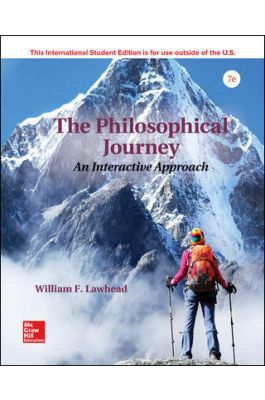
The Philosophical Journey An Interactive Approach 7TH Edition By William Lawhead - Test Bank

The Philosophical Journey An Interactive Approach 7TH Edition By William Lawhead - Test Bank   Instant Download - Complete Test Bank With Answers     Sample Questions Are Posted Below   The Philosophical Journey: An Interactive Approach, 7e (Lawhead) Chapter 5   The Search for Ethical Values   1) In Plato's story of the ring of …

$19.99

The Philosophical Journey An Interactive Approach 7TH Edition By William Lawhead – Test Bank


Instant Download – Complete Test Bank With Answers


Sample Questions Are Posted Below


The Philosophical Journey: An Interactive Approach, 7e (Lawhead)

Chapter 5   The Search for Ethical Values


1) In Plato’s story of the ring of Gyges, the ring had the power to make one invisible.


Answer:  TRUE

Accessibility:  Keyboard Navigation


2) The task of normative ethics is to describe various cultures’ moral beliefs.


Answer:  FALSE

Accessibility:  Keyboard Navigation


3) All religious philosophers necessarily hold to the divine command theory of ethics.


Answer:  FALSE

Accessibility:  Keyboard Navigation


4) In his dialogue Euthyphro, Plato took the position that the gods approve of certain actions because these actions are good.


Answer:  TRUE

Accessibility:  Keyboard Navigation


5) Thomas Hobbes said that the only reason we have morality is to avoid a state of war.


Answer:  TRUE

Accessibility:  Keyboard Navigation


6) The ancient Greek historian Herodotus claimed that all cultures have the same moral values.


Answer:  FALSE

Accessibility:  Keyboard Navigation


7) Ruth Benedict said that “normal” is defined as whatever a particular culture says is normal.


Answer:  TRUE

Accessibility:  Keyboard Navigation


8) In spite of the fact that the Eskimos kill some of their babies, James Rachels says that their values are not all that different from our values.


Answer:  TRUE

Accessibility:  Keyboard Navigation


9) According to your text, someone who embraces the philosophy of ethical egoism is by definition someone who wants to be the center of attention and who has an inflated ego.


Answer:  FALSE

Accessibility:  Keyboard Navigation


10) According to your text, you can act in your own self-interest without being selfish.


Answer:  TRUE

Accessibility:  Keyboard Navigation


11) According to psychological egoism, unselfish behavior is impossible.


Answer:  TRUE

Accessibility:  Keyboard Navigation


12) Psychological egoism is a theory about what we ought to do.


Answer:  FALSE

Accessibility:  Keyboard Navigation


13) The paradox of hedonism is the fact that if your only goal is to find pleasure or happiness, you are unlikely to find it.


Answer:  TRUE

Accessibility:  Keyboard Navigation


14) Ayn Rand was an ethical egoist but not a psychological egoist.


Answer:  TRUE

Accessibility:  Keyboard Navigation


15) Ayn Rand believed that rational selfishness would lead to the best society.


Answer:  TRUE

Accessibility:  Keyboard Navigation


16) Teleological ethics is another name for deontological ethics.


Answer:  FALSE

Accessibility:  Keyboard Navigation


17) Utilitarianism is a form of consequentialism.


Answer:  TRUE

Accessibility:  Keyboard Navigation


18) The principle of utility defines a right action as one that produces as much good for as many people as possible.


Answer:  TRUE

Accessibility:  Keyboard Navigation


19) Jeremy Bentham accepted ethical egoism but rejected psychological egoism.


Answer:  FALSE

Accessibility:  Keyboard Navigation


20) John Stuart Mill said it is better to be a satisfied fool than a philosopher such as Socrates who was dissatisfied.


Answer:  FALSE

Accessibility:  Keyboard Navigation


21) According to utilitarianism, the morality of a particular action can change over time if the consequences change.


Answer:  TRUE

Accessibility:  Keyboard Navigation


22) According to your text, the notions of justice and individual rights are the two main themes in utilitarianism.


Answer:  FALSE

Accessibility:  Keyboard Navigation


23) Immanuel Kant’s ethics is an example of deontological ethics.


Answer:  TRUE

Accessibility:  Keyboard Navigation


24) Kant believed that all true ethics was based on religion.


Answer:  FALSE

Accessibility:  Keyboard Navigation


25) Kant rejected the notion that ethics was based on human psychology.


Answer:  TRUE

Accessibility:  Keyboard Navigation


26) According to Kant, unless doing your duty is something you enjoy, you are not acting morally.


Answer:  FALSE

Accessibility:  Keyboard Navigation


27) Kant uses the term “maxim” to refer to a general rule that guides how we act.


Answer:  TRUE

Accessibility:  Keyboard Navigation


28) In Kant’s ethics, a principle is reversible if we could rationally wish that everyone would act on it.


Answer:  TRUE

Accessibility:  Keyboard Navigation


29) Kant says that it is impossible to treat others as both a means and an end.


Answer:  FALSE

Accessibility:  Keyboard Navigation


30) According to Kant, every moral rule has its exceptions.


Answer:  FALSE

Accessibility:  Keyboard Navigation


31) Kant believed it would be wrong to lie even if the lie produced good consequences.


Answer:  TRUE

Accessibility:  Keyboard Navigation


32) W. D. Ross does not think prima facie duties can be ranked in terms of priority.


Answer:  TRUE

Accessibility:  Keyboard Navigation


33) Virtue ethics can be defined as that area of ethics that is concerned specifically with sexual morality.


Answer:  FALSE

Accessibility:  Keyboard Navigation


34) Aristotle developed an early version of virtue ethics.


Answer:  TRUE

Accessibility:  Keyboard Navigation


35) Confucius developed an ethical theory that criticized the virtue ethics of this time.


Answer:  FALSE

Accessibility:  Keyboard Navigation


36) Feminist ethics is based on traditional ethical theories and merely attempts to apply these theories to issues that concern women, such as sexual discrimination.


Answer:  FALSE

Accessibility:  Keyboard Navigation


37) Carol Gilligan’s work criticized what she considered to be the male bias in traditional research on moral development.


Answer:  TRUE

Accessibility:  Keyboard Navigation


38) In her book Maternal Thinking, Sara Ruddick says that maternal thinking can characterize one’s stance toward life, even if you are a man.


Answer:  TRUE

Accessibility:  Keyboard Navigation


39) Nel Noddings’s book Caring agrees with Kant that caring for others must be based on a firm sense of moral obligation and not on feelings.


Answer:  FALSE

Accessibility:  Keyboard Navigation


40) It is impossible to be a feminist ethical theorist and to reject care-focused ethics.


Answer:  FALSE

Accessibility:  Keyboard Navigation


41) Kantian ethics would argue that abortion fails the universality test.


Answer:  TRUE

Accessibility:  Keyboard Navigation


42) For utilitarian ethics, whether abortion is moral or not has nothing to do with the consequences of the action.


Answer:  FALSE

Accessibility:  Keyboard Navigation


43) Virtue ethics would argue that abortion is morally acceptable depending upon whether the agent is acting virtuously or viciously, or neither.


Answer:  TRUE

Accessibility:  Keyboard Navigation


44) In the reading from Plato’s Republic, Glaucon says that the reason to be moral is because

  1. A) that is simply the right thing to do.
  2. B) of its social consequences.
  3. C) immorality corrupts the soul, which is our true self.
  4. D) we want to avoid punishment in the afterlife.


Answer:  B

Accessibility:  Keyboard Navigation


45) A problem that the text raised with the divine command theory of ethics is that

  1. A) no intelligent person believes in God.
  2. B) many morally abhorrent actions have been defended on the basis of God’s commands.
  3. C) if moral goodness is defined in terms of God’s will, it makes it meaningless to say God’s will is good.
  4. D) all of the above


Answer:  C

Accessibility:  Keyboard Navigation


46) Which of the following is not a problem the text raised with divine command theory of ethics?

  1. A) There is a lack of agreement as to which religious authority should be the basis of ethics.
  2. B) Some ethical questions cannot be answered by traditional religious traditions apart from philosophical considerations.
  3. C) Some nonreligious people are morally good persons but do not derive their morality from any religious tradition.
  4. D) Most religious traditions are concerned with the afterlife and do not address ethical issues.


Answer:  D

Accessibility:  Keyboard Navigation


47) The text explained that ________ morality refers to the study of various cultures’ moral beliefs and practices and ________ ethics refers to the philosophical task of discerning which moral principles are rationally defensible.

  1. A) descriptive; normative
  2. B) consequentialist; deontological
  3. C) objectivist; relativistic
  4. D) religious; secular


Answer:  A

Accessibility:  Keyboard Navigation


48) Which of the following statements contradicts ethical objectivism?

  1. A) What I think is morally right is not necessarily what you think is morally right.
  2. B) An action can be morally right for me and morally wrong for you in different circumstances.
  3. C) A moral principle can be correct for me but not necessarily correct for you.
  4. D) all of the above


Answer:  C

Accessibility:  Keyboard Navigation


49) Which of the following would be an example of subjective ethical relativism?

  1. A) Ernest Hemingway
  2. B) the Sophists
  3. C) Jean-Paul Sartre
  4. D) all of the above


Answer:  D

Accessibility:  Keyboard Navigation


50) The reading by Herodotus illustrated the position of

  1. A) subjective ethical relativism.
  2. B) conventional ethical relativism.
  3. C) ethical objectivism.
  4. D) ethical egoism.


Answer:  B

Accessibility:  Keyboard Navigation


51) Ruth Benedict’s position was that of

  1. A) subjective ethical relativism.
  2. B) conventional ethical relativism.
  3. C) ethical objectivism.
  4. D) ethical egoism.


Answer:  B

Accessibility:  Keyboard Navigation


52) Ruth Benedict said that “it is morally good” is synonymous with

  1. A) “it is a socially approved habit.”
  2. B) “it is commanded by God.”
  3. C) “it is my moral duty.”
  4. D) “it is what makes me personally feel good.”


Answer:  A

Accessibility:  Keyboard Navigation


53) John Ladd uses the term “the dependency thesis” to refer to the claim that

  1. A) morality is dependent on God’s commands.
  2. B) the morality of an action depends on its consequences.
  3. C) morality is dependent on the subjective opinion of each individual.
  4. D) morality is dependent on the moral beliefs and practices of a particular society.


Answer:  D

Accessibility:  Keyboard Navigation


54) Which one of the following claims of the ethical absolutist distinguishes this position from other forms of ethical objectivism?

  1. A) There are universal, objective moral principles.
  2. B) Right and wrong are not a matter of subjective opinion like tastes in food.
  3. C) Moral principles cannot be overridden and cannot have any exceptions.
  4. D) There are objectively right and wrong answers to ethical questions.


Answer:  C

Accessibility:  Keyboard Navigation


55) In the reading by James Rachels, he criticizes the cultural differences argument by saying that

  1. A) the premise concerns what people believe, but the conclusion concerns what really is the case.
  2. B) not everyone accepts the conclusion.
  3. C) if everyone accepted this argument, it would lead to rampant immorality.
  4. D) it ignores the fact that cultures differ both in their practices and in their values.


Answer:  A

Accessibility:  Keyboard Navigation


56) James Rachels says that a consequence of cultural relativism is

  1. A) we could no longer say that the customs of other societies are morally inferior to our own.
  2. B) we could decide whether actions are right or wrong just by consulting the standards of our society.
  3. C) the idea of moral progress would be called into doubt.
  4. D) all of the above


Answer:  D

Accessibility:  Keyboard Navigation


57) Which of the following claims would be that of a universal ethical egoist?

  1. A) I believe I ought to maximize my self-interest, but I have no opinion about how you should act.
  2. B) Everyone has an obligation to serve my interests.
  3. C) Everyone ought to do what will serve his or her own interests.
  4. D) Everyone always acts so as to serve their own interests.


Answer:  C

Accessibility:  Keyboard Navigation


58) Which of the following claims would be that of a psychological egoist?

  1. A) I believe I ought to maximize my self-interest, but I have no opinion about how you should act.
  2. B) Everyone has an obligation to serve my
  3. C) Everyone ought to do what will serve his or her own interests.
  4. D) Everyone always acts so as to serve their own interests.


Answer:  D

Accessibility:  Keyboard Navigation


59) According to Ayn Rand, if an ethical egoist loved another person, the egoist would

  1. A) be contradicting his or her own philosophy.
  2. B) necessarily have to sacrifice his or her own interests.
  3. C) be pursuing his or her own interests.
  4. D) necessarily have no respect for that other person.


Answer:  C

Accessibility:  Keyboard Navigation


60) Which one of the following is an objection raised against psychological egoism by Bishop Butler?

  1. A) It would lead to immorality.
  2. B) Personal satisfaction is often the consequence of getting what we desire, not its goal.
  3. C) Pursuing our own pleasure will not lead to happiness.
  4. D) What we are psychologically driven to do and what we ought to do are different.


Answer:  B

Accessibility:  Keyboard Navigation


61) Which of the following express(es) the relationship between psychological egoism and ethical egoism?

  1. A) It is possible to be a psychological egoist without being an ethical egoist.
  2. B) It is possible to be an ethical egoist without being a psychological egoist.
  3. C) Psychological egoism is frequently used to argue for ethical egoism.
  4. D) all of the above


Answer:  D

Accessibility:  Keyboard Navigation


62) A criticism of Ayn Rand’s egoism made in the text is that

  1. A) it assumes a false dichotomy between pure ethical egoism and pure ethical altruism.
  2. B) egoism would lead to selfish behavior.
  3. C) it is immoral.
  4. D) all of the above


Answer:  A

Accessibility:  Keyboard Navigation


63) The utilitarian rejects which one of the following claims of the ethical egoist?

  1. A) The consequences of an action determine if it is right or wrong.
  2. B) There are objectively correct answers in ethics.
  3. C) People only have a moral obligation to be concerned about their own self-interest.
  4. D) It is impossible for an action to be morally obligatory if it makes no one happy.


Answer:  C

Accessibility:  Keyboard Navigation


64) According to Jeremy Bentham, we are governed by two sovereign masters, which are

  1. A) physical desires and moral obligations.
  2. B) pain and pleasure.
  3. C) God and society.
  4. D) love of self and love of others.


Answer:  B

Accessibility:  Keyboard Navigation


65) Which one of the following was not included in Bentham’s hedonic calculus?

  1. A) Intensity: How strong is the pleasure?
  2. B) Duration: How long will the pleasure last?
  3. C) Value: Is the pleasure a lower, physical pleasure or a higher, intellectual pleasure?
  4. D) Extent: How many people will be affected?


Answer:  C

Accessibility:  Keyboard Navigation


66) Which of the following describes a major difference between Bentham’s and Mill’s ethics?

  1. A) Mill believed an action could produce the best consequences and still be immoral.
  2. B) Bentham said that pleasure is the only desirable end and Mill denied this.
  3. C) Bentham’s was a quantitative hedonism and Mill held to a qualitative hedonism.
  4. D) Mill’s ethics was concerned with the greatest happiness for all and Bentham’s ethics was concerned only with the happiness of the individual.


Answer:  C

Accessibility:  Keyboard Navigation


67) In balancing your own happiness with that of another person, Mill said that you should

  1. A) give no more weight to your own happiness than that of another.
  2. B) be concerned only with your own happiness.
  3. C) be concerned only with the happiness of others and not with your own happiness.
  4. D) realize that producing happiness has nothing to do with morality.


Answer:  A

Accessibility:  Keyboard Navigation


68) Utilitarianism is not a form of ethical relativism because the utilitarian believes that

  1. A) there are actions that are absolutely wrong, even if they produce the best consequences.
  2. B) what produces pleasure or happiness will be the same for everyone.
  3. C) even though moral principles are relative, people tend to arrive at the same moral judgments.
  4. D) moral principles are objective even if their application is relative.


Answer:  D

Accessibility:  Keyboard Navigation


69) In his article “Comparing Harms,” Alastair Norcross argues that

  1. A) a consequentialist would say that it would be permissible to sacrifice a human life only if it saved a number of lives.
  2. B) the consequentialist principle of “lives for convenience” shows that consequentialism is immoral.
  3. C) our society frequently chooses to sacrifice lives for the convenience of the many.
  4. D) there is no situation in which it would be morally permissible to sacrifice an innocent human life.


Answer:  C

Accessibility:  Keyboard Navigation


70) The utilitarian ethics of Bentham and Mill is a version of

  1. A) deontological ethics.
  2. B) consequentialism.
  3. C) divine command theory.
  4. D) virtue ethics.


Answer:  B

Accessibility:  Keyboard Navigation


71) Immanuel Kant said that the only thing in the world that has absolute, unqualified moral value is

  1. A) God.
  2. B) a good will.
  3. C) the trait of moderation.
  4. D) happiness.


Answer:  B

Accessibility:  Keyboard Navigation


72) According to Kant, an action has moral worth if

  1. A) it achieves good consequences.
  2. B) we feel good about doing it.
  3. C) it conforms to our duty.
  4. D) it is done from a sense of duty.


Answer:  D

Accessibility:  Keyboard Navigation


73) According to Kant’s philosophy, the statement “If you want people to be good to you, you should be good to them” is

  1. A) the basis of all true morality.
  2. B) a hypothetical imperative.
  3. C) the first version of the categorical imperative.
  4. D) the second version of the categorical imperative.


Answer:  B

Accessibility:  Keyboard Navigation


74) According to Kant, the basis of the categorical imperative is

  1. A) God’s command.
  2. B) the need for an orderly society.
  3. C) rational consistency.
  4. D) human psychological tendencies.


Answer:  C

Accessibility:  Keyboard Navigation


75) According to Kant’s philosophy, which one of the following commands could be universalized?

  1. A) Tell the truth only when it is convenient to do so.
  2. B) Give all of your money to those who have less than you do.
  3. C) Always charge less for your product than your competitors.
  4. D) Always keep your promises.


Answer:  D

Accessibility:  Keyboard Navigation


76) The second version of the categorical imperative says

  1. A) treat people as an end and never as a means only.
  2. B) decide if the consequences of your action would make people happy.
  3. C) ask yourself if you would want everyone to follow your example.
  4. D) think about how you would feel if people knew what you did.


Answer:  A

Accessibility:  Keyboard Navigation


77) According to Kant, a work of art has ________ value, but people have ________ value.

  1. A) hypothetical; categorical
  2. B) aesthetic; emotional
  3. C) instrumental; extrinsic
  4. D) conditional; intrinsic


Answer:  D

Accessibility:  Keyboard Navigation


78) Which of the following claims made by the utilitarians would Kant reject?

  1. A) Ethical principles are objective.
  2. B) Ethics concerns only our relations with others, for we have no moral duties to ourselves.
  3. C) There can be a difference between what society thinks is moral and what really is.
  4. D) all of the above


Answer:  B

Accessibility:  Keyboard Navigation


79) A prima facie duty is one that

  1. A) never conflicts with other duties.
  2. B) can never be violated under any circumstances.
  3. C) is morally binding unless it conflicts with a more important duty.
  4. D) defines our actual duty in a particular set of circumstances.


Answer:  C

Accessibility:  Keyboard Navigation


80) The ancient Greek philosopher who taught virtue ethics was

  1. A) Aristotle.
  2. B) Protagoras.
  3. C) Epicurus.
  4. D) Herodotus.


Answer:  A

Accessibility:  Keyboard Navigation


81) The utilitarian view of the role of a virtuous character in ethics is that it

  1. A) is totally irrelevant.
  2. B) is more important than simply maximizing happiness.
  3. C) has intrinsic value and not merely instrumental value.
  4. D) will make it more likely that the person will maximize the general good.


Answer:  D

Accessibility:  Keyboard Navigation


82) In virtue ethics, the primary question in ethics is:

  1. A) What actions are morally right?
  2. B) What sort of person should I be?
  3. C) Will the consequences of my action maximize happiness?
  4. D) Am I acting out of sense of duty?


Answer:  B

Accessibility:  Keyboard Navigation


83) In Michael Stocker’s story concerning Smith’s visit to the hospital, the problem with Smith’s behavior, according to virtue ethics, is that Smith

  1. A) lacked the virtues of benevolence and compassion.
  2. B) acted selfishly.
  3. C) did not do all he could to maximize the patient’s happiness.
  4. D) acted in accordance with duty, but not out of a sense of duty.


Answer:  A

Accessibility:  Keyboard Navigation


84) According to Aristotle’s theory, acquiring the moral virtues can be compared to

  1. A) learning the principles of physics by acquiring the right ideas.
  2. B) maturing into adolescence; it is simply something that happens in time.
  3. C) acquiring a musical skill through practice.
  4. D) having brown eyes; one is either born with them or not.


Answer:  C

Accessibility:  Keyboard Navigation


85) Aristotle says that to be a just person, it is not enough to act justly. You must also

  1. A) know what you are doing.
  2. B) deliberately choose the just action for its own sake.
  3. C) act on the basis of a firm and unchangeable character.
  4. D) all of the above


Answer:  D

Accessibility:  Keyboard Navigation


86) In deciding whether or not an action is just, Kant would disagree with Aristotle on which of the following points?

  1. A) The action must be chosen deliberately.
  2. B) The action cannot be done accidentally, for it must be done on the basis of knowledge.
  3. C) It must result from an ingrained habit and involve the emotions.
  4. D) It must be done for its own sake and not for the consequences.


Answer:  C

Accessibility:  Keyboard Navigation


87) “The doctrine of the mean” refers to Aristotle’s view that

  1. A) too many actions are mean spirited.
  2. B) virtue is an intermediate position between two extremes.
  3. C) we often compromise our principles by trying to satisfy everyone.
  4. D) having moral virtue requires that the average of our good actions outweigh the average of our wrong actions.


Answer:  B

Accessibility:  Keyboard Navigation


88) According to Aristotle, the doctrine of the mean does not apply to the situation of

  1. A) confidence in facing danger.
  2. B) enjoying pleasure.
  3. C) an act of adultery.
  4. D) giving money to charity.


Answer:  C

Accessibility:  Keyboard Navigation


89) What is Aristotle’s position on universal and objective moral principles?

  1. A) Their application will be different for different people and circumstances.
  2. B) There are no universal and objective moral principles of any sort.
  3. C) They will dictate the same action for all persons in all circumstances.
  4. D) Different cultures and different historical periods will have different universal and objective moral principles.


Answer:  A

Accessibility:  Keyboard Navigation


90) Which of the following statements express Carol Gilligan’s position on care-focused ethics?

  1. A) The ethics of care should totally replace the ethics of justice.
  2. B) It is an ethical theory that focuses on rules, logic, and rights.
  3. C) It emphasizes the role of relationships, responsibilities, and emotions in ethical thinking.
  4. D) It is an ethical theory that is applicable only to females.


Answer:  C

Accessibility:  Keyboard Navigation


91) The power-focused feminists criticize care-focused ethics by claiming that the latter

  1. A) reinforces traditional stereotypes of women as being more emotional and less rational.
  2. B) emphasizes the model of family relationships, which is inadequate for the realm of public morality.
  3. C) stresses love and compassion, but ignores the issues of freedom, domination, and equality.
  4. D) all of the above


Answer:  D

Accessibility:  Keyboard Navigation


92) Which of the following is true about the application of Kantian ethics?

  1. A) Must be universalized and consistently followed.
  2. B) Must exemplify the principles of the importance of reason, autonomy, and the intrinsic worth of persons.
  3. C) Consequences do not play much of a role.
  4. D) Both A and B.
  5. E) All of the above


Answer:  E

Accessibility:  Keyboard Navigation


93) Discuss the story of the ring of Gyges in Plato’s Republic. What is the point that Glaucon is trying to make with this story? Argue either for or against Glaucon’s view.


Answer:  Answer will vary

Accessibility:  Keyboard Navigation


94) Using the examples in the book or your own examples, discuss the problems that could be raised with making each one of the following factors the most important one in an ethical theory: (1) the moral nature of specific categories of actions, (2) motives, (3) consequences, (4) the moral character of the agent. In the final analysis, which factor do think is the most important one in developing an ethical theory? Provide reasons for your position.


Answer:  Answer will vary

Accessibility:  Keyboard Navigation


95) Discuss the different interpretations of the statement “What is morally right for me is not necessarily morally right for you.” Which interpretations could an ethical objectivist support? Why? Which one would an ethical objectivist have to reject? Why?


Answer:  Answer will vary

Accessibility:  Keyboard Navigation


96) What is the distinction between subjective ethical relativism and conventional ethical relativism?


Answer:  Answer will vary

Accessibility:  Keyboard Navigation


97) What are the strengths of ethical relativism? What are the strengths of ethical objectivism? Which position do you think is the more plausible? Why?


Answer:  Answer will vary

Accessibility:  Keyboard Navigation


98) How do psychological egoism and ethical egoism differ? How do some philosophers use psychological egoism to support ethical egoism? Could one be a psychological egoist but not an ethical egoist and vice versa? Explain.


Answer:  Answer will vary

Accessibility:  Keyboard Navigation


99) What are some of the criticisms that could be made against ethical egoism?


Answer:  Answer will vary

Accessibility:  Keyboard Navigation


100) How might an ethical egoist justify helping other people? Why does Ayn Rand think it possible for an ethical egoist to have friends or to love another person?


Answer:  Answer will vary

Accessibility:  Keyboard Navigation


101) Explain the ethical theory of utilitarianism. How did the utilitarianism of Jeremy Bentham and John Stuart Mill differ?


Answer:  Answer will vary

Accessibility:  Keyboard Navigation


102) How does Alastair Norcross argue for consequentialism in “Comparing Harms: Headaches and Human Lives”? How might someone criticize his argument?


Answer:  Answer will vary

Accessibility:  Keyboard Navigation


103) What does Immanuel Kant mean by the “good will”? Why is it so important to his ethical theory? Why does he think that neither consequences nor inclinations should play a role in ethics?


Answer:  Answer will vary

Accessibility:  Keyboard Navigation


104) What are the two versions of Kant’s categorical imperative discussed in your text? How does a categorical imperative differ from a hypothetical imperative? Give some examples of how Kant would show that the categorical imperative provides ethical guidance in concrete circumstances.


Answer:  Answer will vary

Accessibility:  Keyboard Navigation


105) What criticisms does virtue ethics make of utilitarianism and Kantian ethics?


Answer:  Answer will vary

Accessibility:  Keyboard Navigation


106) What is the difference between care-focused feminist ethics and power-focused feminist ethics?


Answer:  Answer will vary

Accessibility:  Keyboard Navigation

Additional information

Add Review

Your email address will not be published. Required fields are marked *