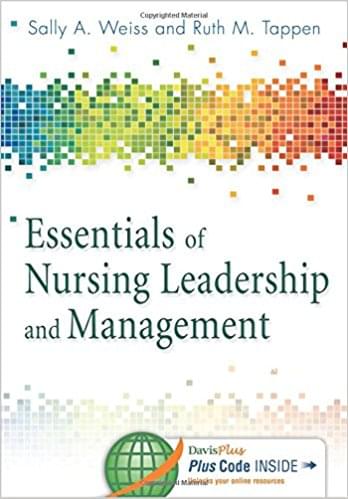
Whitehead Essentials of Nursing Leadership & Management ,6th Edition by Sally A. Weiss, Ruth M. Tappen T -est Bank

Whitehead Essentials of Nursing Leadership & Management ,6th Edition by Sally A. Weiss, Ruth M. Tappen T -est Bank   Instant Download - Complete Test Bank With Answers     Sample Questions Are Posted Below   Chapter 5: Organizations, Power, and Empowerment       MULTIPLE CHOICE       Sources of coercive power come …

$19.99

Whitehead Essentials of Nursing Leadership & Management ,6th Edition by Sally A. Weiss, Ruth M. Tappen T -est Bank


Instant Download – Complete Test Bank With Answers


Sample Questions Are Posted Below


Chapter 5: Organizations, Power, and Empowerment


MULTIPLE CHOICE


  1. Sources of coercive power come from which of the following?
  2. Responsibility
  3. Recognition
  4. Expertise
  5. Punishment


ANS: D

Chapter 5: Organizations, Power, and Empowerment


  1. The structure used in many organizations is the:
  2. Traditional approach.
  3. Organic structure.
  4. Decentralized approach.
  5. Network structure.


ANS: A

Chapter 5: Organizations, Power, and Empowerment


  1. Empowerment is psychological and includes a feeling of:
  2. Control.
  3. Loss.
  4. Effectiveness.
  5. Quantity.


ANS: C

Chapter 5: Organizations, Power, and Empowerment


  1. Empowerment occurs more often with:
  2. Authoritarian management.
  3. Shared governance.
  4. Laissez-faire governance.
  5. Autocratic management.


ANS: B

Chapter 5: Organizations, Power, and Empowerment


  1. Sharing decision-making responsibilities may be difficult for some managers for which of the following reasons?
  2. They believe that empowered staff members have higher levels of job-related tension.
  3. There is inadequate staffing on the unit.
  4. There is a lack of time and situational support.
  5. They may be reluctant to give up their control.


ANS: D

Chapter 5: Organizations, Power, and Empowerment


  1. For registered nurses to enhance their expertise and sense of empowerment, certain activities are necessary. Which of the following will least prepare registered nurses for enhancing their competence?
  2. Actively participating in interdisciplinary team conferences
  3. Attending professional organization meetings
  4. Refraining from participating in research projects in a clinical specialty
  5. Returning to school to earn a higher degree in nursing


ANS: C

Chapter 5: Organizations, Power, and Empowerment


  1. The term shared governance describes:
  2. Informal ways in which access to opportunity is made available to staff.
  3. Staff nurses’ inclusion in decision-making through representation in governing practice and management issues.
  4. Nurses’ involvement in decision-making at the administrative level.
  5. Shared staffing on various levels to serve the needs of the institution.


ANS: B

Chapter 5: Organizations, Power, and Empowerment


  1. A clinic run by volunteer doctors and nurses belongs in which of the following categories?
  2. Voluntary for profit
  3. Publicly supported
  4. Not for profit
  5. Governmental agency


ANS: C

Chapter 5: Organizations, Power, and Empowerment


  1. The most obvious aspect of organizational culture is:
  2. The unwritten rules.
  3. The employee handbook.
  4. The care environment.
  5. The organizational climate.


ANS: B

Chapter 5: Organizations, Power, and Empowerment


  1. Which of the following is a common goal for a health-care organization?
  2. Survival
  3. Limited existence
  4. Cooperation with the competition
  5. Downsizing


ANS: A

Chapter 5: Organizations, Power, and Empowerment


  1. Staff members at the bottom of the organizational hierarchy have:
  2. No power.
  3. No power and no authority.
  4. High authority and high power.
  5. Little authority, but some power.


ANS: D

Chapter 5: Organizations, Power, and Empowerment


  1. A positive aspect of hierarchy is:
  2. Few policies or practices.
  3. Consistent operation.
  4. Flexibility.
  5. Promotion of creativity.


ANS: B

Chapter 5: Organizations, Power, and Empowerment


  1. Why is it important for a health-care organization to create a culture of safety?
  2. It reflects the diversity of the patient population.
  3. Interpreters make it easier to understand patients who do not speak English.
  4. It can contribute to a decrease in errors.
  5. Staff are better protected.


ANS: C

Chapter 5: Organizations, Power, and Empowerment


  1. Which of the following is a characteristic of a culture of safety?
  2. Staff willingness to admit having made a mistake
  3. Finding the staff member responsible for insulting a patient
  4. Consistently placing insensitive staff on suspension
  5. More efficient use of scarce resources


ANS: A

Chapter 5: Organizations, Power, and Empowerment


  1. A health-care organization that wants to achieve excellence in patient care should:
  2. Review unit expenses for possible fraud.
  3. Refuse to accept mediocrity in patient care.
  4. Provide monitors to staff and arrive on time.
  5. Update staff job descriptions.


ANS: B

Chapter 5: Organizations, Power, and Empowerment


  1. Why is the culture of an organization important to a new graduate?
  2. The culture can create an environment that is hostile to new employees.
  3. It impacts an organization’s public image.
  4. Culture determines the financial health of an organization.
  5. Culture allows free speech.


ANS: A

Chapter 5: Organizations, Power, and Empowerment


  1. What are the benefits of collective bargaining?
  2. Improved management-staff relationships
  3. A more collegial environment for nursing staff
  4. Fair treatment and protection of benefits
  5. Increased staff and patient satisfaction


ANS: C

Chapter 5: Organizations, Power, and Empowerment


  1. What are the benefits of joining a professional organization?
  2. Higher pay
  3. Shared governance
  4. Patient safety
  5. Representation


ANS: D

Chapter 5: Organizations, Power, and Empowerment


  1. Why is shared governance important?
  2. Regulates licensing of registered nurses and practical nurses
  3. Provides staff nurses with a voice in setting standards and policies
  4. Provides staff nurses with representation in the political arena
  5. Provides oversight and treatment of impaired nurses


ANS: B

Chapter 5: Organizations, Power, and Empowerment

Additional information

Add Review

Your email address will not be published. Required fields are marked *