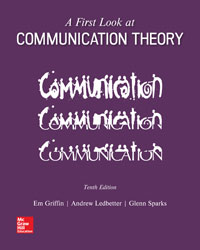
A First Look At Communication Theory Em Griffin 10e - Test Bank

A First Look At Communication Theory Em Griffin 10e - Test Bank   Instant Download - Complete Test Bank With Answers     Sample Questions Are Posted Below   A First Look At Communication Theory, 10e (Griffin) Chapter 5   Symbolic Interactionism   1) ________ is defined as the tendency for our expectations to evoke responses …

$19.99

A First Look At Communication Theory Em Griffin 10e – Test Bank


Instant Download – Complete Test Bank With Answers


Sample Questions Are Posted Below


A First Look At Communication Theory, 10e (Griffin)

Chapter 5   Symbolic Interactionism


1) ________ is defined as the tendency for our expectations to evoke responses that confirm what we originally anticipated.

  1. A) Looking-glass self
  2. B) Generalized other
  3. C) Self-fulfilling prophecy
  4. D) Participant observation


2) Herbert Blumer stated three core principles of symbolic interactionism that deal with meaning, language, and thinking. Identify a true statement about meaning.

  1. A) It is pre-existent in a state of nature.
  2. B) It is negotiated through the use of language.
  3. C) It is developed through self-talk.
  4. D) It is inherent in objects.


3) According to George Herbert Mead, the self is an ongoing process combining the “I” and the “me.” Which of the following statements is true about the “I”?

  1. A) It is organized in the self.
  2. B) It is the driving force that fosters all that is novel.
  3. C) It is predictable and well known.
  4. D) It is the image of self seen when one takes the role of the other.


4) According to George Herbert Mead, the self is an ongoing process combining the “I” and the “me.” Identify a true statement about the “me.”

  1. A) It refers to the motivating factor that drives actions.
  2. B) It is spontaneous and unpredictable.
  3. C) It refers to the objective self.
  4. D) It is akin to right-brain creativity.


5) George Herbert Mead advocated research through a form of ethnography in which researchers systematically set out to share in the lives of the people they study; this is called:

  1. A) participant observation.
  2. B) survey research.
  3. C) textual analysis.
  4. D) experimentation.


6) According to George Herbert Mead, humans have a unique capacity to ________.

  1. A) communicate with each other
  2. B) be in conversation
  3. C) interact with others
  4. D) take the role of the other


7) The looking-glass self is defined as:

  1. A) the mental image others have of us.
  2. B) the mental image we introspectively think we have.
  3. C) the mental self-image that results from taking the role of the other.
  4. D) the mental self-image of the physical attributes that we observe.


8) For George Herbert Mead, the generalized other refers to:

  1. A) a person’s general belief system.
  2. B) the composite mental image a person has of his or her self based on societal expectations and responses.
  3. C) a particular target or person.
  4. D) the self before the “me” develops.


9) Which of the following statements is true about the book The Presentation of Self in Everyday Life, written by sociologist Erving Goffman, University of California, Berkeley?

  1. A) In the book, he claimed that people are all involved in a constant negotiation with others to publicly define their identities and the nature of the situation.
  2. B) In the book, he warned that the impression of reality fostered by a performance is a delicate, fragile thing that can be shattered by minor mishaps.
  3. C) In the book, he described social interaction as a dramaturgical performance.
  4. D) All of the answers are correct.


10) An inner dialogue used to test alternatives, rehearse actions, and anticipate reactions before responding is called:

  1. A) minding.
  2. B) a looking-glass conversation.
  3. C) participant observation.
  4. D) an I/me interaction.


11) Which of the following statements is true about the European Jewish philosopher Emmanuel Levinas?

  1. A) He dismissed the idea that the self is socially constructed.
  2. B) He used the term “ethical echo” to designate the responsibility he believed people have to take care of each other.
  3. C) He contended that the looking-glass self develops through the way “others respond to us.”
  4. D) He rejected the idea that the identity of an individual’s “I” is formed by the way he or she responds to others.


12) Which of the following criteria that are used to evaluate good interpretive theories does symbolic interactionism fail to meet?

  1. A) clarification of values
  2. B) community of agreement
  3. C) reform of society
  4. D) understanding of people


13) The person who coined the term “symbolic interactionism” was:

  1. A) George Herbert Mead.
  2. B) Herbert Blumer.
  3. C) Douglas Hofstadter.
  4. D) Charles Cooley.


14) Keith believes that his thoughts, self-concept, and society are created through communication. He most likely is a social constructionist.


15) George Herbert Mead, an early social constructionist, thought that the true test of any theory is whether it is useful in solving complex social problems.


16) George Herbert Mead believed that symbolic naming is the basis for human society.


17) Most sociologists saw society as consisting of individual actors who make their own choices, whereas Herbert Mead believed in society-by-previous-design rather than in society-in-the-making.


18) There is no “me” at birth.


19) The “me” is viewed as an object—the image of self seen in the looking glass of other people’s reactions.


20) George Herbert Mead used tightly controlled behavioral experiments and checklist surveys to verify his theory.


21) A default assumption demonstrates how a belief in our language can limit our thinking.


22) Symbolic interactionists reject the idea that the self is a function of language.


23) Taking the role of the other is defined as the process of mentally imagining that you are someone else who is viewing you.


24) Herbert Blumer suggests that ________ arises out of the social interaction that people have with each other.


25) An inner dialogue used to test alternatives, rehearse actions, and anticipate reactions before responding is called ________.


26) The ________ is the composite mental image a person has of his or her self based on societal expectations and responses.


27) For Emmanuel Levinas, the identity of a person’s “I” is formed by ________.


28) Discuss the differences between “I” and “me.” Are they always different?


29) What is a self-fulfilling prophecy? Provide an example or two of this phenomenon.


30) In folklore and in fiction, there are stories of humans reared by animals (for example, Mowgli in Rudyard Kipling’s The Jungle Book) who are conceptualized as having a sense of self. Could such a person exist? Explain your position.


31) Discuss the developmental process an individual goes through as he or she develops a self.


32) How are the forces of your “I” and your “me” balanced to allow you to develop as an individual?


33) Symbolic interactionism was the creation of a philosopher and his students before the rise of the modern communication curriculum. How could this old theory help you to become a better communicator in the twenty-first century? Be specific.


34) Is symbolic interactionism an objective or interpretive theory? How does it measure up to the standards of a good theory?


35) How would a symbolic interactionist evaluate Shannon and Weaver’s work? What feedback would information theorists provide George Herbert Mead’s disciples?


36) How might an objective scholar seek to identify and measure the communication effects that George Herbert Mead had identified?


A First Look At Communication Theory, 10e (Griffin)

Chapter 5   Symbolic Interactionism


1) ________ is defined as the tendency for our expectations to evoke responses that confirm what we originally anticipated.

  1. A) Looking-glass self
  2. B) Generalized other
  3. C) Self-fulfilling prophecy
  4. D) Participant observation


Answer:  C

Accessibility:  Keyboard Navigation


2) Herbert Blumer stated three core principles of symbolic interactionism that deal with meaning, language, and thinking. Identify a true statement about meaning.

  1. A) It is pre-existent in a state of nature.
  2. B) It is negotiated through the use of language.
  3. C) It is developed through self-talk.
  4. D) It is inherent in objects.


Answer:  B

Accessibility:  Keyboard Navigation


3) According to George Herbert Mead, the self is an ongoing process combining the “I” and the “me.” Which of the following statements is true about the “I”?

  1. A) It is organized in the self.
  2. B) It is the driving force that fosters all that is novel.
  3. C) It is predictable and well known.
  4. D) It is the image of self seen when one takes the role of the other.


Answer:  B

Accessibility:  Keyboard Navigation


4) According to George Herbert Mead, the self is an ongoing process combining the “I” and the “me.” Identify a true statement about the “me.”

  1. A) It refers to the motivating factor that drives actions.
  2. B) It is spontaneous and unpredictable.
  3. C) It refers to the objective self.
  4. D) It is akin to right-brain creativity.


Answer:  C

Accessibility:  Keyboard Navigation


5) George Herbert Mead advocated research through a form of ethnography in which researchers systematically set out to share in the lives of the people they study; this is called:

  1. A) participant observation.
  2. B) survey research.
  3. C) textual analysis.
  4. D) experimentation.


Answer:  A

Accessibility:  Keyboard Navigation


6) According to George Herbert Mead, humans have a unique capacity to ________.

  1. A) communicate with each other
  2. B) be in conversation
  3. C) interact with others
  4. D) take the role of the other


Answer:  D

Accessibility:  Keyboard Navigation


7) The looking-glass self is defined as:

  1. A) the mental image others have of us.
  2. B) the mental image we introspectively think we have.
  3. C) the mental self-image that results from taking the role of the other.
  4. D) the mental self-image of the physical attributes that we observe.


Answer:  C

Accessibility:  Keyboard Navigation


8) For George Herbert Mead, the generalized other refers to:

  1. A) a person’s general belief system.
  2. B) the composite mental image a person has of his or her self based on societal expectations and responses.
  3. C) a particular target or person.
  4. D) the self before the “me” develops.


Answer:  B

Accessibility:  Keyboard Navigation


9) Which of the following statements is true about the book The Presentation of Self in Everyday Life, written by sociologist Erving Goffman, University of California, Berkeley?

  1. A) In the book, he claimed that people are all involved in a constant negotiation with others to publicly define their identities and the nature of the situation.
  2. B) In the book, he warned that the impression of reality fostered by a performance is a delicate, fragile thing that can be shattered by minor mishaps.
  3. C) In the book, he described social interaction as a dramaturgical performance.
  4. D) All of the answers are correct.


Answer:  D

Accessibility:  Keyboard Navigation


10) An inner dialogue used to test alternatives, rehearse actions, and anticipate reactions before responding is called:

  1. A) minding.
  2. B) a looking-glass conversation.
  3. C) participant observation.
  4. D) an I/me interaction.


Answer:  A

Accessibility:  Keyboard Navigation


11) Which of the following statements is true about the European Jewish philosopher Emmanuel Levinas?

  1. A) He dismissed the idea that the self is socially constructed.
  2. B) He used the term “ethical echo” to designate the responsibility he believed people have to take care of each other.
  3. C) He contended that the looking-glass self develops through the way “others respond to us.”
  4. D) He rejected the idea that the identity of an individual’s “I” is formed by the way he or she responds to others.


Answer:  B

Accessibility:  Keyboard Navigation


12) Which of the following criteria that are used to evaluate good interpretive theories does symbolic interactionism fail to meet?

  1. A) clarification of values
  2. B) community of agreement
  3. C) reform of society
  4. D) understanding of people


Answer:  C

Accessibility:  Keyboard Navigation


13) The person who coined the term “symbolic interactionism” was:

  1. A) George Herbert Mead.
  2. B) Herbert Blumer.
  3. C) Douglas Hofstadter.
  4. D) Charles Cooley.


Answer:  B

Accessibility:  Keyboard Navigation


14) Keith believes that his thoughts, self-concept, and society are created through communication. He most likely is a social constructionist.


Answer:  TRUE

Accessibility:  Keyboard Navigation


15) George Herbert Mead, an early social constructionist, thought that the true test of any theory is whether it is useful in solving complex social problems.


Answer:  TRUE

Accessibility:  Keyboard Navigation


16) George Herbert Mead believed that symbolic naming is the basis for human society.


Answer:  TRUE

Accessibility:  Keyboard Navigation


17) Most sociologists saw society as consisting of individual actors who make their own choices, whereas Herbert Mead believed in society-by-previous-design rather than in society-in-the-making.


Answer:  FALSE

Accessibility:  Keyboard Navigation


18) There is no “me” at birth.


Answer:  TRUE

Accessibility:  Keyboard Navigation


19) The “me” is viewed as an object—the image of self seen in the looking glass of other people’s reactions.


Answer:  TRUE

Accessibility:  Keyboard Navigation


20) George Herbert Mead used tightly controlled behavioral experiments and checklist surveys to verify his theory.


Answer:  FALSE

Accessibility:  Keyboard Navigation


21) A default assumption demonstrates how a belief in our language can limit our thinking.


Answer:  TRUE

Accessibility:  Keyboard Navigation


22) Symbolic interactionists reject the idea that the self is a function of language.


Answer:  FALSE

Accessibility:  Keyboard Navigation


23) Taking the role of the other is defined as the process of mentally imagining that you are someone else who is viewing you.


Answer:  TRUE

Accessibility:  Keyboard Navigation


24) Herbert Blumer suggests that ________ arises out of the social interaction that people have with each other.


Answer:  meaning

Accessibility:  Keyboard Navigation


25) An inner dialogue used to test alternatives, rehearse actions, and anticipate reactions before responding is called ________.


Answer:  minding

Accessibility:  Keyboard Navigation


26) The ________ is the composite mental image a person has of his or her self based on societal expectations and responses.


Answer:  generalized other

Accessibility:  Keyboard Navigation


27) For Emmanuel Levinas, the identity of a person’s “I” is formed by ________.


Answer:  the way he or she responds to others

Accessibility:  Keyboard Navigation


28) Discuss the differences between “I” and “me.” Are they always different?


Answer:  Answers will vary

Accessibility:  Keyboard Navigation


29) What is a self-fulfilling prophecy? Provide an example or two of this phenomenon.


Answer:  Answers will vary

Accessibility:  Keyboard Navigation


30) In folklore and in fiction, there are stories of humans reared by animals (for example, Mowgli in Rudyard Kipling’s The Jungle Book) who are conceptualized as having a sense of self. Could such a person exist? Explain your position.


Answer:  Answers will vary

Accessibility:  Keyboard Navigation


31) Discuss the developmental process an individual goes through as he or she develops a self.


Answer:  Answers will vary

Accessibility:  Keyboard Navigation


32) How are the forces of your “I” and your “me” balanced to allow you to develop as an individual?


Answer:  Answers will vary

Accessibility:  Keyboard Navigation


33) Symbolic interactionism was the creation of a philosopher and his students before the rise of the modern communication curriculum. How could this old theory help you to become a better communicator in the twenty-first century? Be specific.


Answer:  Answers will vary

Accessibility:  Keyboard Navigation


34) Is symbolic interactionism an objective or interpretive theory? How does it measure up to the standards of a good theory?


Answer:  Answers will vary

Accessibility:  Keyboard Navigation


35) How would a symbolic interactionist evaluate Shannon and Weaver’s work? What feedback would information theorists provide George Herbert Mead’s disciples?


Answer:  Answers will vary

Accessibility:  Keyboard Navigation


36) How might an objective scholar seek to identify and measure the communication effects that George Herbert Mead had identified?


Answer:  Answers will vary

Accessibility:  Keyboard Navigation

Additional information

Add Review

Your email address will not be published. Required fields are marked *