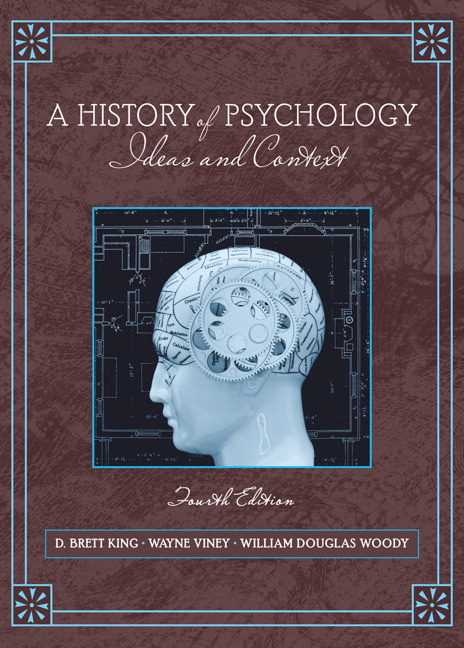
A History Of Psychology Ideas and Context 4th Edition by King - Test Bank

A History Of Psychology Ideas and Context 4th Edition by King - Test Bank   Instant Download - Complete Test Bank With Answers     Sample Questions Are Posted Below   Lecture Outline for Chapter 1 – Historical Studies: Some Issues 1) Why Study History? a) History has a utilitarian role in human understanding of …

$19.99

A History Of Psychology Ideas and Context 4th Edition by King – Test Bank


Instant Download – Complete Test Bank With Answers


Sample Questions Are Posted Below


Lecture Outline for Chapter 1 – Historical Studies: Some Issues
1) Why Study History?
a) History has a utilitarian role in human understanding of the future.
b) Knowledge of history enriches our understanding of the present.
c) The study of history contributes to departmental, institutional, and disciplinary goals of a
broad and liberal education.
d) History teaches humility to students and instructors alike as we see tremendous minds of
the past and as we see past thinkers approach what we consider to be current problems.
e) History teaches a healthy skepticism as we see fads and explanations rise and fail across
time.
f) History influences our thought processes; as we learn the errors of others, we become
more open to seeing our own possible mistakes.
2) Some Problems in historiography (see Table 1.1)
a) Historiography can be defined in three ways:
i) the researching and writing of history,
ii) philosophical questions about history and historical method, and
iii) characteristics of a body of historical writings (e.g., presence or absence of the
contributions of women and minorities in the history of psychology).
b) Historical consciousness grew over time and reflected the importance of historical events.
i) Herodotus first attempted a comprehensive history of the world, and he emphasized
natural instead of supernatural causes.
ii) Thucydides extended the naturalistic approach in this classic History of the
Peloponnesian War.
c) History is defined as the interpretive study of the human past, and it contains an empirical
component and an explanatory component.
i) The empirical component includes data such as letters, written or recorded accounts
of events, official documents, and works in the field.
ii) The explanatory component of history addresses the efforts of historians to make
sense of the empirical data.
d) Can history be objective? Objectivity implies a correspondence between a historical
narrative and the past events it describes.
i) Historians cannot directly observe the events and must be selective with the data;
there are no concrete guidelines for the selection of historical data.
ii) But, objectivity is a desirable ideal for historians.
e) Presentism and Historicism.
i) Historicism, defined as the commitment to understanding the past for its own sake,
contrasts with
ii) presentism, which emphasizes the biased nature of human experience and the
difficulties in separating historical facts from current biases.
iii) There may be room for a middle ground depending on the nature of the question and
the educational setting.
f) Is There a Pattern or Direction in History?
i) The cyclical hypothesis suggests that history repeats itself in cycles.7Instructor’s Manual
ii) The linear-progressive hypothesis argues that progress is a fundamental characteristic
of history and that each generation builds upon the progress of earlier generations.
iii) The chaos hypothesis maintains that there is no overall identifiable and universal
meaning of history.
g) What makes history?
i) The great-person theory suggests that powerful individuals are most important in
shaping history.
ii) The Zeitgeist (spirit of a time) and Ortgeist (spirit of a place) combine to provide the
context that shapes thinkers.
iii) History may require an efficient combination of productive individuals working
within a receptive social, political, educational, technological, and temporal context.
h) New or Old history?
i) Older histories were usually written by practicing scientists in the field, were
internalist, or focused on the discipline without reference to cultural and social
contexts, and have been accused of presentism.
ii) New history is typically written by professional historians, emphasizes the contexts in
which the events occurred, and relies more heavily on archival and other original
sources.
iii) Some thinkers argue that this distinction not clear and that multiple perspectives in
the writing of history improve the discipline
3) The history of the history of psychology.
a) Early thinkers (e.g., Wundt and James) acknowledged contributions from fields outside
of psychology such as physiology, philosophy, and physics.
b) The first work appeared in 1913 when James Mark Baldwin wrote History of
Psychology: A sketch and an Interpretation.
c) Several works followed that are now classics, including those by Boring (1929), Brett
(1912), and Heidbreder (1933).
d) The 1960s formalized the history of psychology.
i) The Journal of the History of the Behavioral Sciences was founded in 1965.
ii) The Archives of the History of American Psychology were established in 1965.
iii) The APA formed division 26, The Division of the History of Psychology in 1965.
iv) In 1967, the University of New Hampshire started the first Ph.D. program in the
History of Psychology.
v) In 1968, Cheiron, the International Society for the History of the Behavioral and
Social Sciences, was created.


TEST BANK
Chapter 1
Historical Studies: Some Issues
1. As a self-conscious formal discipline, psychology is
a. about 300 years old.
* b. little more than 100 years old.
c. only 50 years old.
d. almost 500 years old.
[p. 2]
2. Each of the following is a reason to study history EXCEPT
* a. History encourages a narrow perspective.
b. History teaches a healthy skepticism.
c. History teaches humility.
d. History is a key to understanding the future.
[pp. 2-4]
3. In a broad and philosophical sense, the term historiography refers to
a. philosophical questions about history.
b. philosophical questions about historical methodology.
c. characteristics of a body of historical writings.
* d. all of the above.
[p. 4]
4. According to the text, history has an empirical component. The empirical component includes
a. attempts by historians to make sense of the data they collect.
b. only those rare instances when historians conduct experiments.
c. explanations offered by historians.
* d. data such as unpublished letters, diaries, etc.
[pp. 1-3]
5. According to the text, history has an explanatory component. The explanatory component includes
* a. attempts by historians to make sense of the data they collect.
b. attempts by historians to define history.
c. chronological records.
d. data such as unpublished letters, newspaper accounts, etc.
[p. 5]
6. There are many definitions of history. The definition preferred by the authors of your text is that history is
* a. the interpretive study of the events of the human past.
b. the chronology of the events that provide the raw material for the historian.
c. the scientific study of the past.
d. all of the above.
[p. 6]
7. The kind of objectivity that we might reasonably expect of historical writing is that objectivity characterized by
a. correspondence between a historical narrative and the events of the past.
* b. an honest attempt to present all sides of an issue.
c. an attempt to simply chronicle the events of the past.
d. the attempt to leave all feeling out of the historical narrative.
[pp. 6-7]64A History of Psychology: Ideas and Context, Fourth Edition
8. The term presentism, as used in the text, refers to
a. the correspondence between a historical narrative and the events of the past that it describes.
* b. the difficulties of separating historical facts from present perspectives.
c. the attempt to understand the past for its own sake.
d. the belief that past traditions and values are always superior to present values.
[p. 7]
9. It is almost impossible to separate historical facts from current interests and values. Such a contention is most
consistent with
* a. presentism.
b. historicism.
c. the chaos hypothesis.
d. the cyclical hypothesis.
[p. 7]
10. An individual who believes that the human situation is continually improving over time and generations
accepts
* a. the linear-progressive hypothesis.
b. the chaos hypothesis.
c. the linear-regressive.
d. the cyclical hypothesis.
[p. 8]
11. The belief that history has no identifiable or universal meaning is
a. the linear-progressive hypothesis.
* b. the chaos hypothesis.
c. the linear-regressive.
d. the cyclical hypothesis.
[pp. 8-9]
12. The German term Zeitgeist is relevant to the problem of causality in history. The term refers to
* a. the spirit of the time.
b. the spirit of the place.
c. the causal role of persons in history.
d. the importance of emphasizing biographical studies in history.
[p. 9]
13. The German term Ortgeist is relevant to the problem of causality in history. The term refers to
a. the spirit of the time.
* b. the spirit of the place.
c. the causal role of persons in history.
d. the importance of emphasizing biographical studies in history.
[p. 9]
14. Internalist or old histories of psychology emphasized
a. the social-cultural context in which a discipline develops.
b. the cumulative knowledge of the network of historical experts in a given area of history.
* c. the development of ideas within a discipline with little discussion of the larger context.
d. the socially acceptable historiographic biases that prevail at a given time.
[p. 10]65Test Bank

Additional information

Add Review

Your email address will not be published. Required fields are marked *