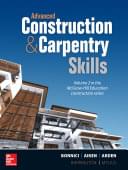
Advanced Construction And Carpentry Skills by Bonnici 1 - Test Bank

Advanced Construction And Carpentry Skills by Bonnici 1 - Test Bank   Instant Download - Complete Test Bank With Answers     Sample Questions Are Posted Below   Chapter 05 Testbank Student: ___________________________________________________________________________ Prior to installing any lining materials the frames must be: A. fully braced and corners all finish fixed and blocked as required B. straightened …

$19.99

Advanced Construction And Carpentry Skills by Bonnici 1 – Test Bank


Instant Download – Complete Test Bank With Answers


Sample Questions Are Posted Below


Chapter 05 Testbank

Student: ___________________________________________________________________________

  1. Prior to installing any lining materials the frames must be:
    A. fully braced and corners all finish fixed and blocked as required
    B. straightened to within 3–5 mm depending upon finish level required
    C. fitted out for services such as plumbing, electrical and ducting
    D. All the answers are correct.


  1. Partially cutting a stud (and appropriately applying side blocking) in order to straighten it is known as:
    A. cramping
    B. clamping
    C. crippling
    D. coaching


  1. Wall lining materials, such as plasterboard, timber panelling and fibre cement sheet, should always be fixed with a small gap at top and bottom (6–10 mm). The purpose of this gap is:
    A. to allow floorboard to expand and not bind against the lining
    B. to ensure firm fitting of the skirting against the base of the wall
    C. in case there is shrinkage in the frame that could lead to the lining buckling
    D. to allow for any upward expansion of the floor due to ground movement


  1. Checking the installation of door jambs for ‘wind’ is to:
    A. sight by eye from one jamb to the other to check for parallel
    B. sight the edge of the jambs to check if they are bowed before installing
    C. sight the edge of the jambs to check if they have spring before installing
    D. sight the edge of each jamb for straightness as you fix-off


  1. Backing off’ a door is designed to ensure the door can close without the edge striking against the opening or lock side jamb.
    True    False


  1. Scribing is the preferred approach to jointing internal corners for skirting. This is because any gaps that may be produced during installation, or over the life of the building due to movement, are less visible.
    True    False


  1. To ‘arris’, or ‘arrising’, is the planing or sanding of the faces of materials so as to produce a sharp edge (the arris).
    True    False


  1. You must always use ‘planted’ (nailed on) door stops on external doors as this allows them to be adjusted over time if the door expands or shrinks with the weather.
    True    False


Chapter 05 Testbank Key

  1. Prior to installing any lining materials the frames must be:
    A.fully braced and corners all finish fixed and blocked as required
    B. straightened to within 3–5 mm depending upon finish level required
    C. fitted out for services such as plumbing, electrical and ducting
    D. All the answers are correct.


Competency: CPCCCA3013A Install lining, panelling and moulding
Difficulty: Easy
Performance criteria: CPCCCA3013A 1.1

  1. Partially cutting a stud (and appropriately applying side blocking) in order to straighten it is known as:
    A.cramping
    B. clamping
    C. crippling
    D. coaching


Competency: CPCCCA3013A Install lining, panelling and moulding
Difficulty: Easy
Performance criteria: CPCCCA3013A 1.1

  1. Wall lining materials, such as plasterboard, timber panelling and fibre cement sheet, should always be fixed with a small gap at top and bottom (6–10 mm). The purpose of this gap is:
    A.to allow floorboard to expand and not bind against the lining
    B. to ensure firm fitting of the skirting against the base of the wall
    C. in case there is shrinkage in the frame that could lead to the lining buckling
    D. to allow for any upward expansion of the floor due to ground movement


Competency: CPCCCA3013A Install lining, panelling and moulding
Difficulty: Easy
Performance criteria: CPCCCA3013A 1.1

  1. Checking the installation of door jambs for ‘wind’ is to:
    A.sight by eye from one jamb to the other to check for parallel
    B. sight the edge of the jambs to check if they are bowed before installing
    C. sight the edge of the jambs to check if they have spring before installing
    D. sight the edge of each jamb for straightness as you fix-off


Competency: CPCCCA3013A Install lining, panelling and moulding
Difficulty: Easy
Performance criteria: CPCCCA3013A 1.2
Performance criteria: CPCCCA3013A 2.2

  1. Backing off’ a door is designed to ensure the door can close without the edge striking against the opening or lock side jamb.
    TRUE


Competency: CPCCCA3013A Install lining, panelling and moulding
Difficulty: Easy
Performance criteria: CPCCCA3013A 1.2
Performance criteria: CPCCCA3013A 2.2

  1. Scribing is the preferred approach to jointing internal corners for skirting. This is because any gaps that may be produced during installation, or over the life of the building due to movement, are less visible.
    TRUE


Competency: CPCCCA3013A Install lining, panelling and moulding
Difficulty: Easy
Performance criteria: CPCCCA3013A 4.4

  1. To ‘arris’, or ‘arrising’, is the planing or sanding of the faces of materials so as to produce a sharp edge (the arris).
    FALSE


Competency: CPCCCA3013A Install lining, panelling and moulding
Difficulty: Easy
Performance criteria: CPCCCA3013A 1.1

  1. You must always use ‘planted’ (nailed on) door stops on external doors as this allows them to be adjusted over time if the door expands or shrinks with the weather.
    FALSE


Competency: CPCCCA3013A Install lining, panelling and moulding
Difficulty: Easy
Performance criteria: CPCCCA3013A 1.1


Chapter 05 Testbank Summary

Category # of Questions
Competency: CPCCCA3013A Install lining, panelling and moulding 8
Difficulty: Easy 8
Performance criteria: CPCCCA3013A 1.1 5
Performance criteria: CPCCCA3013A 1.2 2
Performance criteria: CPCCCA3013A 2.2 2
Performance criteria: CPCCCA3013A 4.4 1


Additional information

Add Review

Your email address will not be published. Required fields are marked *