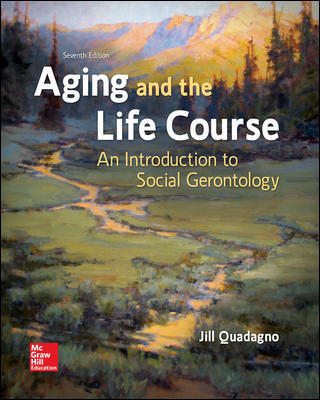
Aging And the Life Course An Introduction to Social Gerontology 7Th Edition By Jill - Test Bank

Aging And the Life Course An Introduction to Social Gerontology 7Th Edition By Jill - Test Bank   Instant Download - Complete Test Bank With Answers     Sample Questions Are Posted Below   Chapter 05 Old Age and the Welfare State     Multiple Choice Questions (p. 95)Before _____, the United States had no national …

$19.99

Aging And the Life Course An Introduction to Social Gerontology 7Th Edition By Jill – Test Bank


Instant Download – Complete Test Bank With Answers


Sample Questions Are Posted Below


Chapter 05

Old Age and the Welfare State


Multiple Choice Questions

  1. (p. 95)Before _____, the United States had no national social welfare program.
    A. 1915
    B. 1935
    C. 1960
    D. 1980


Accessibility: Keyboard Navigation

  1. (p. 96)The term “welfare” as used by social scientists refers to programs that protect people from the risk of loss due to all of the following except:
    A. unemployment.
    B. retirement.
    C. accidents.
    D. disability.


Accessibility: Keyboard Navigation

  1. (p. 96)Which of the following is not one of the classifications of welfare programs?
    A. social insurance
    B. social maintenance
    C. public assistance
    D. fiscal welfare


Accessibility: Keyboard Navigation


  1. (p. 97)Social insurance programs, as their main purpose, provide:
    A. help to individuals who meet certain means tests.
    B. economic security over the life course and prevent people from falling into destitution.
    C. economic security to people during the middle years of the life course.
    D. tax breaks to individuals.


Accessibility: Keyboard Navigation

  1. (p. 97)In the United States, social insurance benefits are paid for through:
    A. tax deductions.
    B. investments.
    C. payroll taxes.
    D. voluntary contributions.


Accessibility: Keyboard Navigation

  1. (p. 97)In the United States, fiscal welfare is called:
    A. tax consumption.
    B. tax expenditures.
    C. tax assistance.
    D. tax investment.


Accessibility: Keyboard Navigation

  1. (p. 99)In 2015, more than _____ million Americans received Social Security benefits.
    A. 15
    B. 30
    C. 56
    D. 85


Accessibility: Keyboard Navigation


  1. (p. 101)In 2010, 64 percent of Social Security benefits went to retired workers. The next highest level (15 percent) went to:
    A. the disabled.
    B. widows, widowers, and parents.
    C. children.
    D. wives and husbands of retired workers.


Accessibility: Keyboard Navigation

  1. (p. 101)The replacement rate in the context of Social Security refers to the amount of preretirement pay that is replaced by the Social Security retirement benefit. Compared with high-wage earners, for low-wage earners, the replacement rate is:
    A. lower.
    B. higher.
    C. none.
    D. None of the answers is correct.


Accessibility: Keyboard Navigation

  1. (p. 100)What is the single most important source of income for older people?
    A. Social Security
    B. SSI
    C. Disability Insurance
    D. private pensions


Accessibility: Keyboard Navigation


  1. (p. 100)Which of the following statements is true about Social Security in the United States?
    A. Nearly three-fourths of African American and Hispanic seniors rely on Social Security for more than half of their income.
    B. The support for Social Security is absent among minority elderly.
    C. Nearly 90 percent of Americans have major issues paying Social Security taxes.
    D. Less than 15 percent of white Americans see Social Security as the foundation for their retirement.


Accessibility: Keyboard Navigation

  1. (p. 100)Which of the following statements is true about the various attitudes toward Social Security in the United States?
    A. African Americans are most likely to agree that Americans should preserve Social Security by increasing taxes.
    B. Most Hispanics oppose Social Security.
    C. Nearly 90 percent of white Americans are opposed to paying Social Security taxes.
    D. Less than 70 percent of white Americans are against preserving Social Security by increasing taxes.


Accessibility: Keyboard Navigation

  1. (p. 102)A reason why SSI (Supplemental Security Income) doesn’t adequately protect the poorest elderly is that:
    A. people spend the money too quickly when they get it.
    B. payments are eliminated if a recipient lives with a relative.
    C. many older people are unwilling to endure the humiliating scrutiny of a means test.
    D. the program is set up so that the payments only come once a year.


Accessibility: Keyboard Navigation


  1. (p. 102)An individual is most likely to receive the highest benefit of Social Security when he or she retires and claims the benefit at the age of _____.
    A. 57
    B. 62
    C. 70
    D. 68


Accessibility: Keyboard Navigation

  1. (p. 102)How was the Delayed Retirement Credit useful to Americans?
    A. It excused people from paying Social Security taxes until the age of 70.
    B. It enabled people to receive extra income if they decided to retire and claim Social Security benefits by the age of 50.
    C. It increased benefits for people who waited beyond the full retirement age to claim Social Security benefits.
    D. It allowed people to receive free health care until the age of 60.


Accessibility: Keyboard Navigation

  1. (p. 102)An accurate statement about Supplemental Security Income is that it:
    A. provides greater monetary benefit than that received from Social Security.
    B. is primarily funded by Social Security taxes.
    C. is available to aged, blind, and disabled people who are very poor.
    D. increases monetary benefits by one-third if a recipient lives with a relative.


Accessibility: Keyboard Navigation

  1. (p. 104)Medicare contains Parts A, B, C, and D. Part B of Medicare pays for which of the following?
    A. hospitalization
    B. physician’s office visit
    C. nursing home care
    D. community-based service care


Accessibility: Keyboard Navigation


  1. (p. 104)The most recent change to Medicare was the Medicare Modernization Act of 2003, which added:
    A. coverage for family members.
    B. a prescription drug benefit.
    C. coverage for medical equipment.
    D. coverage for physical therapy.


Accessibility: Keyboard Navigation

  1. (p. 108)Identify an accurate statement about Medicaid.
    A. It is the largest program in the federal budget.
    B. It does not cover people who are below the age of 65.
    C. It does not cover women, children, and individuals with disabilities.
    D. It is the primary public health insurance benefit for low-income people.


Accessibility: Keyboard Navigation

  1. (p. 107)What has the U.S. used as an incentive to encourage employers to provide health insurance?
    A. free coverage for low-income workers
    B. tax code
    C. matching funds
    D. employees’ contributions


Accessibility: Keyboard Navigation


  1. (p. 107)Physicians have a role in determining if applicants for Disability Insurance meet the criteria for benefits. There are several problems with determining eligibility. Which of the following is not one of these factors?
    A. Doctors must know not only the individual’s impairment but also what abilities her/his job requires.
    B. For many people, there are no clear organic impairments.
    C. Some people with a given impairment may be able to work, while others may not.
    D. Doctors must be able to document thoroughly the cause of impairment.


Accessibility: Keyboard Navigation

  1. (p. 108)Once an individual is awarded Disability Insurance benefits, he or she may receive them until medical recovery or:
    A. return to work.
    B. up to six months.
    C. up to one year.
    D. up to two years.


Accessibility: Keyboard Navigation

  1. (p. 108)The Supplemental Security Income disability program is operated by:
    A. the states.
    B. the federal government.
    C. the federal government and the states.
    D. private agencies.


Accessibility: Keyboard Navigation

  1. (p. 108)A type of long-term care service is:
    A. nursing care.
    B. physician service.
    C. home health care.
    D. recreational therapy.


Accessibility: Keyboard Navigation


  1. (p. 109)The main source of public funding for long-term care is:
    A. Medicare.
    B. private long-term-care insurance.
    C. Medicaid.
    D. home and community-based services program.


Accessibility: Keyboard Navigation

  1. (p. 97)Which of the following best fits the concept of social insurance?
    A. a program that provides minimal benefits to people below poverty level
    B. a program that provides economic security and is based on the concept of earned entitlement
    C. indirect payments to individuals through the tax system
    D. health insurance for working-age people provided through their employers


Accessibility: Keyboard Navigation

  1. (p. 110)There are variations in the cost for private long-term-care insurance. Which of the following is not one of these variations?
    A. age of person
    B. person’s health
    C. type of policy
    D. gender of person


Accessibility: Keyboard Navigation

  1. (p. 110)The Older Americans Act (OAA) _____.
    A. provided services to enhance independent living, including meals, personal care, and meals-on-wheels
    B. established the Social Security program
    C. established Medicare and Medicaid
    D. provided funding for nursing home care for the frail elderly


Accessibility: Keyboard Navigation


  1. (p. 110)One of the services not provided by the Older Americans Act is:
    A. dental care.
    B. day care.
    C. meals-on-wheels.
    D. personal care.


Accessibility: Keyboard Navigation

  1. (p. 110)Which of the following is not a barrier in the use of senior centers by the elderly?
    A. lack of transportation
    B. lack of culturally sensitive programs
    C. lack of professional staff
    D. lack of knowledge about the centers


Accessibility: Keyboard Navigation

  1. (p. 110)A problem related to private long-term-care insurance is that it:
    A. is unavailable to people who are above the age of 75.
    B. does not give any tax credit to people who pay their insurance premiums.
    C. lacks enough regulation to ensure the financial stability of the insurance plans.
    D. is only available to women and children.


Accessibility: Keyboard Navigation

  1. (p. 112)The _____ component of housing policy expands the supply of low-income housing through a provision known as Section 8.
    A. tax expenditure
    B. tax deduction
    C. subsidy
    D. home share


Accessibility: Keyboard Navigation


  1. (p. 112)An ideal housing policy would provide a continuum of services. These services would range from:
    A. independent to community-based care.
    B. independent to institutional care.
    C. semi-independent to community-based care.
    D. semi-independent to institutional care.


Accessibility: Keyboard Navigation

  1. (p. 104)Which of the following best describes Medicare?
    A. a health insurance program for people 65 and older
    B. a needs-based health insurance program
    C. an income support program for retirees
    D. a program that pays for the nursing home care for the oldest-old


Accessibility: Keyboard Navigation

  1. (p. 112)A country that has been a pioneer in designing and implementing a long-term-care program that promotes health care and reduces institutionalization is:
    A. Denmark.
    B. France.
    C. Japan.
    D. Norway.


Accessibility: Keyboard Navigation

  1. (p. 113)There is currently a debate related to who should be eligible to receive social benefits. Some people feel that _____ should be the criterion for receiving such benefits.
    A. need
    B. income
    C. health status
    D. age


Accessibility: Keyboard Navigation


True / False Questions

  1. (p. 96)Medicaid was the first social welfare program that was introduced in the United States in 1930.
    FALSE


Accessibility: Keyboard Navigation

  1. (p. 96-97)Public assistance programs provide minimal benefits for the very needy.
    TRUE


Accessibility: Keyboard Navigation

  1. (p. 97)In practice, social insurance increases inequality in old age.
    FALSE


Accessibility: Keyboard Navigation

  1. (p. 97)Tax expenditures are most likely to benefit the working class in the United States.
    FALSE


Accessibility: Keyboard Navigation

  1. (p. 97)Benefit levels for Social Security are determined by a formula that reflects length of time worked and the amount of wages earned.
    TRUE


Accessibility: Keyboard Navigation


  1. (p. 99)The Supplemental Security Income program serves as a magnet to attract poor immigrants to the United States.
    FALSE


Accessibility: Keyboard Navigation

  1. (p. 104)Medicare is a national health insurance program for all people 60 years and older who are also eligible for Social Security.
    FALSE


Accessibility: Keyboard Navigation

  1. (p. 104)Medicaid pays for nursing home care.
    TRUE


Accessibility: Keyboard Navigation

  1. (p. 107)Many people remain on Disability Insurance for the fear they might lose their employment or might not earn enough to survive.
    TRUE


Accessibility: Keyboard Navigation

  1. (p. 108)The oldest-old, those age 90 and older, are the fastest growing age group in the United States.
    TRUE


Accessibility: Keyboard Navigation


  1. (p. 112)An example of one of the programs under the Older Americans Act is senior centers.
    TRUE


Accessibility: Keyboard Navigation


Essay Questions

  1. Discuss the advantages and the disadvantages of social assistance, social insurance, and fiscal welfare programs.

Answers will vary.


  1. What are the pros and cons of using age and need in determining the eligibility for social benefits programs?

Answers will vary.


Additional information

Add Review

Your email address will not be published. Required fields are marked *