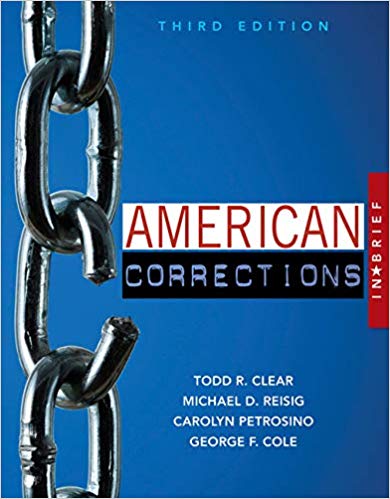
American Corrections in Brief 3rd Edition by Todd R. Clear - Test Bank

American Corrections in Brief 3rd Edition by Todd R. Clear - Test Bank   Instant Download - Complete Test Bank With Answers     Sample Questions Are Posted Below   The nation’s first probation agencies were units of the judicial branches of city and county governments and were primarily found in the southern United True …

$19.99

American Corrections in Brief 3rd Edition by Todd R. Clear – Test Bank


Instant Download – Complete Test Bank With Answers


Sample Questions Are Posted Below


  1. The nation’s first probation agencies were units of the judicial branches of city and county governments and were primarily found in the southern United
    1. True
    2. False


ANSWER:                            False

REFERENCES:                   Probation

LEARNING OBJECTIVES:  ACIB.CLEA.17.04.01 – Describe the history and development of probation, including how it is organized today.

KEYWORDS:                       Bloom’s: Remember


  1. It costs S. taxpayers almost twice as much to have a person placed on probation than to incarcerate them in a prison or jail cell.
    1. True
    2. False


ANSWER:                            False

REFERENCES:                   Probation

LEARNING OBJECTIVES:  ACIB.CLEA.17.04.01 – Describe the history and development of probation, including how it is organized today.

KEYWORDS:                       Bloom’s: Remember


  1. The nation’s first full-time probation officer and creator of the actual term probation was Alexander
    1. True
    2. False


ANSWER:                            False

REFERENCES:                   Probation

LEARNING OBJECTIVES:  ACIB.CLEA.17.04.01 – Describe the history and development of probation, including how it is organized today.

KEYWORDS:                       Bloom’s: Remember


  1. From the 1940s through the 1960s, leaders of probation and other correctional branches throughout the United States embraced a medical model, focusing primarily on the treatment of the
    1. True
    2. False


ANSWER:                            True

REFERENCES:                   Probation

LEARNING OBJECTIVES:  ACIB.CLEA.17.04.01 – Describe the history and development of probation, including how it is organized today.

KEYWORDS:                       Bloom’s: Remember


  1. Probation is for nonserious
    1. True
    2. False


ANSWER:                            False

REFERENCES:                   Probation

LEARNING OBJECTIVES:  ACIB.CLEA.17.04.01 – Describe the history and development of probation, including how it is organized today.

KEYWORDS:                       Bloom’s: Remember


  1. The law enforcement role of probation emphasizes surveillance of the offender and close controls on
    1. True
    2. False


ANSWER:                            True

REFERENCES:                   Probation

LEARNING OBJECTIVES:  ACIB.CLEA.17.04.01 – Describe the history and development of probation, including how it is organized today.

KEYWORDS:                       Bloom’s: Remember


  1. According to recent criminological studies, prison has been quite successful at changing people for the
    1. True
    2. False


ANSWER:                            False

REFERENCES:                   Intermediate Sanctions

LEARNING OBJECTIVES:  ACIB.CLEA.17.04.02 – Describe the rationale for intermediate sanctions.

KEYWORDS:                       Bloom’s: Remember


  1. When looking at the use of intermediate sanctions, the only factor considered is the crime the offender
    1. True
    2. False


ANSWER:                            False

REFERENCES:                   Intermediate Sanctions

LEARNING OBJECTIVES:  ACIB.CLEA.17.04.02 – Describe the rationale for intermediate sanctions.

KEYWORDS:                       Bloom’s: Remember


  1. Intermediate sanctions are used for offenders coming out of
    1. True
    2. False


ANSWER:                            False

REFERENCES:                   Intermediate Sanctions

LEARNING OBJECTIVES:  ACIB.CLEA.17.04.02 – Describe the rationale for intermediate sanctions.

KEYWORDS:                       Bloom’s: Remember


  1. Under the continuum of sanctions, offenders are moved based on their degree of response to correctional
    1. True
    2. False


ANSWER:                            True

REFERENCES:                   Intermediate Sanctions

LEARNING OBJECTIVES:  ACIB.CLEA.17.04.03 – Illustrate the continuum-of- sanctions concept.

KEYWORDS:                       Bloom’s: Remember


  1. Compared to other Western democracies, the United States makes little use of fines as the sole punishment for crimes more serious than motor vehicle
    1. True
    2. False


ANSWER:                            True

REFERENCES:                   Intermediate Sanctions

LEARNING OBJECTIVES:  ACIB.CLEA.17.04.04 – List the various types of intermediate sanctions and who administers them.

KEYWORDS:                       Bloom’s: Remember


  1. Under home confinement, offenders can carry out their sentence of incarceration only in their homes; no variations

are possible.

  1. True
  2. False


ANSWER:                            False

REFERENCES:                   Intermediate Sanctions

LEARNING OBJECTIVES:  ACIB.CLEA.17.04.04 – List the various types of intermediate sanctions and who administers them.

KEYWORDS:                       Bloom’s: Remember


  1. There are currently three different types of electronic monitoring devices that are used throughout the United States: active, passive, and
    1. True
    2. False


ANSWER:                            False

REFERENCES:                   Intermediate Sanctions

LEARNING OBJECTIVES:  ACIB.CLEA.17.04.04 – List the various types of intermediate sanctions and who administers them.

KEYWORDS:                       Bloom’s: Remember


  1. One common problem with intermediate sanctions programs is that many in the field believe these programs lead to increasing the number of offenders who are unnecessarily controlled by the
    1. True
    2. False


ANSWER:                            True

REFERENCES:                   Intermediate Sanctions

LEARNING OBJECTIVES:  ACIB.CLEA.17.04.05 – Explain some of the problems associated with intermediate sanctions.

KEYWORDS:                       Bloom’s: Remember


  1. A drug court is an example of a specialized
    1. True
    2. False


ANSWER:                            True

REFERENCES:                   Intermediate Sanctions

LEARNING OBJECTIVES:  ACIB.CLEA.17.04.05 – Explain some of the problems associated with intermediate sanctions.

KEYWORDS:                       Bloom’s: Remember


  1. When both the requirements of supervision and the surveillance of offenders increase, more violations are detected

and more probationers face revocation of probation.

  1. True
  2. False


ANSWER:                            True

REFERENCES:                   Intermediate Sanctions

LEARNING OBJECTIVES:  ACIB.CLEA.17.04.06 – Describe what it takes to make intermediate sanctions work.

KEYWORDS:                       Bloom’s: Remember


  1. The new correctional professional is less accountable for decision
    1. True
    2. False


ANSWER:                            False

REFERENCES:                   The New Correctional Professional

LEARNING OBJECTIVES:  ACIB.CLEA.17.04.08 – Assess the role of the “new correctional professional.”

KEYWORDS:                       Bloom’s: Remember


  1. Today in the United States, nongovernment agencies can also be used to administer community corrections
    1. True
    2. False


ANSWER:                            True

REFERENCES:                   The New Correctional Professional

LEARNING OBJECTIVES:  ACIB.CLEA.17.04.08 – Assess the role of the “new correctional professional.”

KEYWORDS:                       Bloom’s: Remember


  1. __________, a Boston boot-maker, was the first recorded probation officer in the United States, dating back to
    1. Elam Lynds
    2. Jeremy Bentham
    3. John Augustus
    4. John Howard


ANSWER:                            c

REFERENCES:                   Probation

LEARNING OBJECTIVES:  ACIB.CLEA.17.04.01 – Describe the history and development of probation, including how it is organized today.

KEYWORDS:                       Bloom’s: Remember


  1. The goal of __________ is to minimize the probability that an offender will commit a new offense, especially by applying tight controls over the probationer’s activities and maintaining careful
    1. risk management
    2. treatment management
    3. split sentencing
    4. community justice


ANSWER:                            a

REFERENCES:                   Probation

LEARNING OBJECTIVES:  ACIB.CLEA.17.04.01 – Describe the history and development of probation, including how it is organized today.

KEYWORDS:                       Bloom’s: Remember


  1. It is estimated that one out of every four probationers in the United States today has committed a __________ crime resulting in his or her current
    1. drug
    2. violent
    3. misdemeanor
    4. hate


ANSWER:                            b

REFERENCES:                   Probation

LEARNING OBJECTIVES:  ACIB.CLEA.17.04.01 – Describe the history and development of probation, including how it is organized today.

KEYWORDS:                       Bloom’s: Remember


  1. All of the following are ways in which those convicted in the United States are currently placed on probation, EXCEPT
    1. direct probation sentence
    2. suspended probation sentence
    3. intermediate sentence
    4. split sentence


ANSWER:                            c

REFERENCES:                   Probation

LEARNING OBJECTIVES:  ACIB.CLEA.17.04.01 – Describe the history and development of probation, including how it is organized today.

KEYWORDS:                       Bloom’s: Remember


  1. More than two-thirds of people under correctional authority are
    1. sentenced to home confinement
    2. in prison
    3. under community supervision
    4. actually innocent


ANSWER:                            c

REFERENCES:                   Probation

LEARNING OBJECTIVES:  ACIB.CLEA.17.04.01 – Describe the history and development of probation, including how it is organized today.

KEYWORDS:                       Bloom’s: Remember


  1. In the past, probation was mainly used for __________
    1. violent
    2. drug
    3. first-time
    4. sex


ANSWER:                            c

REFERENCES:                   Probation

LEARNING OBJECTIVES:  ACIB.CLEA.17.04.01 – Describe the history and development of probation, including how it is organized today.

KEYWORDS:                       Bloom’s: Remember


  1. Probationers in the United States are more likely to be __________ than are offenders confined to jail or
    1. white and female
    2. black and male
    3. white and male
    4. Latino and male


ANSWER:                            a

REFERENCES:                   Probation

LEARNING OBJECTIVES:  ACIB.CLEA.17.04.01 – Describe the history and development of probation, including how it is organized today.

KEYWORDS:                       Bloom’s: Remember


  1. Which of the following was NOT an innovation initially developed by John Augustus?
    1. parole
    2. probation
    3. supervision conditions
    4. presentence investigation


ANSWER:                            a

REFERENCES:                   Probation

LEARNING OBJECTIVES:  ACIB.CLEA.17.04.01 – Describe the history and development of probation, including how it is organized today.

KEYWORDS:                       Bloom’s: Remember


  1. Between 1200 and 1827, English common law used the benefit of clergy to discriminate
    1. against the upper social classes
    2. against minorities
    3. in favor of monks, nuns, and priests
    4. in favor of the upper social classes


ANSWER:                            c

REFERENCES:                   Probation

LEARNING OBJECTIVES:  ACIB.CLEA.17.04.01 – Describe the history and development of probation, including how it is organized today.

KEYWORDS:                       Bloom’s: Remember


  1. The medical model of probation was popular in which of the following time periods?
    1. the 1920s through 1930s
    2. the 1980s through 1990s
    3. the 1940s through 1960s
    4. the 1970s through 1980s


ANSWER:                            c

REFERENCES:                   Probation

LEARNING OBJECTIVES:  ACIB.CLEA.17.04.01 – Describe the history and development of probation, including how it is organized today.

KEYWORDS:                       Bloom’s: Remember


  1. Judicial reprieve in the United States was .
    1. used only for juvenile offenders
    2. used only for female offenders with small children
    3. never enacted and used
    4. declared unconstitutional in 1916


ANSWER:                            d

REFERENCES:                   Probation

LEARNING OBJECTIVES:  ACIB.CLEA.17.04.01 – Describe the history and development of probation, including how it is organized today.

KEYWORDS:                       Bloom’s: Remember


  1. Intermediate sanctions fit the concept of __________, which is a range of punishments that vary in intrusiveness and
    1. widening the net
    2. pretrial diversion
    3. primary sanctions
    4. continuum of sanctions


ANSWER:                            d

REFERENCES:                   Intermediate Sanctions

LEARNING OBJECTIVES:  ACIB.CLEA.17.04.03 – Illustrate the continuum-of- sanctions concept.

KEYWORDS:                       Bloom’s: Remember


  1. According to your authors, proponents of boot camps argue that young offenders get involved in crime because they lack
    1. education
    2. job skills
    3. good parents
    4. self-respect


ANSWER:                            d

REFERENCES:                   Intermediate Sanctions

LEARNING OBJECTIVES:  ACIB.CLEA.17.04.04 – List the various types of intermediate sanctions and who administers them.

KEYWORDS:                       Bloom’s: Remember


  1. Probation granted under conditions of strict reporting to a probation officer with a limited caseload is known as

___________________.

  1. PSI
  2. ISP
  3. SIP
  4. IPS


ANSWER:                            b

REFERENCES:                   Intermediate Sanctions

LEARNING OBJECTIVES:  ACIB.CLEA.17.04.04 – List the various types of intermediate sanctions and who administers them.

KEYWORDS:                       Bloom’s: Remember


  1. Government seizure of property and other assets derived from or used in criminal activity is called
    1. day fine
    2. forfeiture
    3. assessed valuation
    4. recidivism


ANSWER:                            b

REFERENCES:                   Intermediate Sanctions

LEARNING OBJECTIVES:  ACIB.CLEA.17.04.04 – List the various types of intermediate sanctions and who administers them.

KEYWORDS:                       Bloom’s: Remember


  1. Intermediate sanctions have two general goals, first, to provide more effective alternatives to probation and, second, to serve as
    1. tougher way of handling offenders
    2. deterrent for future criminal behavior
    3. way to eliminate biases in the system
    4. less costly alternative to prison


ANSWER:                            d

REFERENCES:                   Intermediate Sanctions

LEARNING OBJECTIVES:  ACIB.CLEA.17.04.04 – List the various types of intermediate sanctions and who administers them.

KEYWORDS:                       Bloom’s: Remember


  1. Which of the following is NOT one of the probation-based enforcement centers?
    1. probation centers
    2. fine centers
    3. restitution centers
    4. day reporting centers


ANSWER:                            b

REFERENCES:                   Intermediate Sanctions

LEARNING OBJECTIVES:  ACIB.CLEA.17.04.04 – List the various types of intermediate sanctions and who administers them.

KEYWORDS:                       Bloom’s: Remember


  1. According to your authors, the two most common types of intermediate sanctions used to lessen prison overcrowding in the United States are __________ and boot
    1. intensive supervised probation
    2. home confinement
    3. shock incarceration
    4. community service


ANSWER:                            c

REFERENCES:                   Intermediate Sanctions

LEARNING OBJECTIVES:  ACIB.CLEA.17.04.04 – List the various types of intermediate sanctions and who administers them.

KEYWORDS:                       Bloom’s: Remember


  1. Which of the following is NOT one of the criticisms of shock incarceration?
    1. Offenders are not incarcerated long enough to be
    2. Offenders who are incarcerated lose their
    3. Offenders acquire the label of
    4. Offenders are exposed to the brutalizing experiences of the


ANSWER:                            a

REFERENCES:                   Intermediate Sanctions

LEARNING OBJECTIVES:  ACIB.CLEA.17.04.04 – List the various types of intermediate sanctions and who administers them.

KEYWORDS:                       Bloom’s: Remember


  1. According to the text, boot camps are designed for what type of offender?
    1. young
    2. violent
    3. career criminals
    4. female


ANSWER:                            a

REFERENCES:                   Intermediate Sanctions

LEARNING OBJECTIVES:  ACIB.CLEA.17.04.04 – List the various types of intermediate sanctions and who administers them.

KEYWORDS:                       Bloom’s: Remember


  1. If an offender falls behind on paying compensation for financial, physical, or emotional loss, they may be sent to a

______.

  1. restitution center
  2. day reporting center
  3. boot camp
  4. bank


ANSWER:                            a

REFERENCES:                   Intermediate Sanctions

LEARNING OBJECTIVES:  ACIB.CLEA.17.04.04 – List the various types of intermediate sanctions and who administers them.

KEYWORDS:                       Bloom’s: Remember


  1. Which of the following is NOT one of the three major problems your authors cite regarding intermediate sanctions?
    1. net destroying
    2. selecting offenders
    3. selecting agencies
    4. net widening


ANSWER:                            a

REFERENCES:                   Intermediate Sanctions

LEARNING OBJECTIVES:  ACIB.CLEA.17.04.05 – Explain some of the problems associated with intermediate sanctions.

KEYWORDS:                       Bloom’s: Remember


  1. When prison alternatives are correctly applied to nonprison cases, they cannot
    1. reduce crime
    2. save money
    3. deter crime
    4. lower recidivism rates


ANSWER:                            b

REFERENCES:                   Intermediate Sanctions

LEARNING OBJECTIVES:  ACIB.CLEA.17.04.06 – Describe what it takes to make intermediate sanctions work.

KEYWORDS:                       Bloom’s: Remember


  1. Because intermediate sanctions rely on discretion there is more of an opportunity for
    1. use of force
    2. bias
    3. forgiveness
    4. clemency


ANSWER:                            b

REFERENCES:                   Intermediate Sanctions

LEARNING OBJECTIVES:  ACIB.CLEA.17.04.06 – Describe what it takes to make intermediate sanctions work.

KEYWORDS:                       Bloom’s: Remember


  1. The idea that different forms of intermediate sanctions can be calibrated to make them equivalent as punishments despite their differences in approach is known as the principle of
    1. incarceration
    2. initiation
    3. interchangeability
    4. integration


ANSWER:                            c

REFERENCES:                   Intermediate Sanctions

LEARNING OBJECTIVES:  ACIB.CLEA.17.04.06 – Describe what it takes to make intermediate sanctions work.

KEYWORDS:                       Bloom’s: Remember


  1. Which of the following is NOT one of the three major arguments offered to support the community corrections movement in the United States?
    1. reduce the number and rate of people sentenced to intermediate sanctions
    2. reduce tax revenues spent on corrections by transferring both the costs and the funding to less-expensive local correctional facilities
    3. reduce prison populations in general
    4. reduce the number and rate of people sentenced to state prisons


ANSWER:                            a

REFERENCES:                   Community Corrections Legislation

LEARNING OBJECTIVES:  ACIB.CLEA.17.04.07 – Explain how community corrections legislation works and describe its effectiveness.

KEYWORDS:                       Bloom’s: Remember


  1. Which S. state passed the nation’s first Comprehensive Community Corrections Act in 1973?
    1. New York
    2. Pennsylvania
    3. Minnesota
    4. Massachusetts


ANSWER:                            c

REFERENCES:                   Community Corrections Legislation

LEARNING OBJECTIVES:  ACIB.CLEA.17.04.07 – Explain how community corrections legislation works and describe its effectiveness.

KEYWORDS:                       Bloom’s: Remember


  1. Which of the following is NOT one of the three major shifts in the working environment of the new correctional

professional?

  1. The relationship between the professional and the client has become more similar to a doctor–patient
  2. Nongovernment organizations have emerged to administer community corrections
  3. An increased emphasis on accountability has reduced individual
  4. The relationship between the professional and the client has become less important than the principles of

criminal justice that underlie that relationship.


ANSWER:                            a

REFERENCES:                   The New Correctional Professional

LEARNING OBJECTIVES:  ACIB.CLEA.17.04.07 – Explain how community corrections legislation works and describe its effectiveness.

KEYWORDS:                       Bloom’s: Remember


  1. The main goal of community corrections is to
    1. reduce the costs to taxpayers
    2. improve reintegration of offenders into society
    3. improve rehabilitation efforts for offenders
    4. reduce reliance on prisons


ANSWER:                            d

REFERENCES:                   Community Corrections Legislation

LEARNING OBJECTIVES:  ACIB.CLEA.17.04.07 – Explain how community corrections legislation works and describe its effectiveness.

KEYWORDS:                       Bloom’s: Remember


  1. What type of agencies contract with probation and parole agencies to provide services to clients in the community?
    1. nonprofit
    2. hospitals
    3. banks
    4. television


ANSWER:                            a

REFERENCES:                   The New Correctional Professional

LEARNING OBJECTIVES:  ACIB.CLEA.17.04.08 – Assess the role of the “new correctional professional.”

KEYWORDS:                       Bloom’s: Remember


  1. One way corrections predicts the risk of future criminal behavior is by using .
    1. objective risk assessment instruments
    2. gut feelings
    3. the offender’s past success on supervision only
    4. polygraph tests


ANSWER:                            a

REFERENCES:                   The Future of Community Corrections

LEARNING OBJECTIVES:  ACIB.CLEA.17.04.08 – Assess the role of the “new correctional professional.”

KEYWORDS:                       Bloom’s: Remember


  1. According to your text, one of the most popular objective risk assessment systems is the
    1. LSI-R
    2. polygraph
    3. STS
    4. EHM


ANSWER:                            a

REFERENCES:                   The Future of Community Corrections

LEARNING OBJECTIVES:  ACIB.CLEA.17.04.08 – Assess the role of the “new correctional professional.”

KEYWORDS:                       Bloom’s: Remember


  1. When savings from community corrections are used to help build up the crime prevention programs in communities that have the most people under community supervision, this process is referred to as “justice ”
    1. distribution
    2. allocation
    3. sharing
    4. reinvestment


ANSWER:                            d

REFERENCES:                   The Future of Community Corrections

LEARNING OBJECTIVES:  ACIB.CLEA.17.04.09 – Critically assess the future of probation, intermediate sanctions, and community corrections.

KEYWORDS:                       Bloom’s: Remember


  1. Those that support intermediate sanctions and community corrections must address three problems in order for the programs to be Which of the following is NOT one of those problems?
    1. Community support for intermediate sanctions must
    2. The government must respond to the need for better
    3. The resistance to placing offenders in less restrictive options must be
    4. The purpose of intermediate sanctions must be


ANSWER:                            b

REFERENCES:                   Intermediate Sanctions

LEARNING OBJECTIVES:  ACIB.CLEA.17.04.09 – Critically assess the future of probation, intermediate sanctions, and community corrections.

KEYWORDS:                       Bloom’s: Remember


Nate was sentenced for a check forgery offense. Per court order, he will spend 30 days in jail before being released under community supervision. The sentencing model used when imposing Nate’s sentence assumes Nate can change without extended incarceration.

  1. What type of sentence was imposed for Nate?
    1. split sentence
    2. prison sentence
    3. two-phase sentencing
    4. parole sentence


ANSWER:                            a

REFERENCES:                   Probation

PREFACE NAME:               Scenario #1

LEARNING OBJECTIVES:  ACIB.CLEA.17.04.01 – Describe the history and development of probation, including how it is organized today.

KEYWORDS:                       Bloom’s: Apply


  1. Nate was placed on what type of supervision?
    1. probation
    2. parole
    3. unsupervised
    4. not ordered to any form of supervision


ANSWER:                            a

REFERENCES:                   Probation

PREFACE NAME:               Scenario #1

LEARNING OBJECTIVES:  ACIB.CLEA.17.04.01 – Describe the history and development of probation, including how it is organized today.

KEYWORDS:                       Bloom’s: Apply


  1. What model was used when imposing Nate’s sentence?
    1. community corrections
    2. crime control
    3. medical model
    4. treatment model


ANSWER:                            a

REFERENCES:                   Community Corrections Legislation

PREFACE NAME:               Scenario #1

LEARNING OBJECTIVES:  ACIB.CLEA.17.04.07 – Explain how community corrections legislation works and describe its effectiveness.

KEYWORDS:                       Bloom’s: Apply


Katie is placed on probation and sentenced to participate in a boot camp.  After completion of the boot camp, she will be placed on a small caseload with a probation officer under strict supervision conditions.  One of the conditions is that Katie is confined to her home for 60 days.  Katie is also ordered to pay $1000.00 to the victim of the offense.

  1. The boot camp is an example of a(n)
    1. intermediate sanction
    2. community sanction
    3. community service
    4. rehabilitation service


ANSWER:                            a

REFERENCES:                   Intermediate Sanctions

PREFACE NAME:               Scenario #2

LEARNING OBJECTIVES:  ACIB.CLEA.17.04.04 – List the various types of intermediate sanctions and who administers them.

KEYWORDS:                       Bloom’s: Apply


  1. What type of probation supervision is Katie going to be on?
    1. intensive supervision program (ISP)
    2. Ricky probation
    3. unsupervised probation
    4. standard probation


ANSWER:                            a

REFERENCES:                   Intermediate Sanctions

PREFACE NAME:               Scenario #2

LEARNING OBJECTIVES:  ACIB.CLEA.17.04.04 – List the various types of intermediate sanctions and who administers them.

KEYWORDS:                       Bloom’s: Apply


  1. A condition of home confinement is commonly known as
    1. electronic monitoring
    2. ETG monitoring
    3. limited monitoring
    4. TAD monitoring


ANSWER:                            a

REFERENCES:                   Intermediate Sanctions

PREFACE NAME:               Scenario #2

LEARNING OBJECTIVES:  ACIB.CLEA.17.04.04 – List the various types of intermediate sanctions and who administers them.

KEYWORDS:                       Bloom’s: Apply


  1. The money Katie is ordered to pay is known as a
    1. restitution
    2. debt
    3. fine
    4. fee


ANSWER:                            a

REFERENCES:                   Intermediate Sanctions

PREFACE NAME:               Scenario #2

LEARNING OBJECTIVES:  ACIB.CLEA.17.04.04 – List the various types of intermediate sanctions and who administers them.

KEYWORDS:                       Bloom’s: Apply


Ryan is found guilty of a DWI.  As a consequence, he was ordered to pay $500.00, his car was taken by the county, and he was ordered to work 50 hours in an animal shelter.

  1. The $500.00 Ryan is ordered to pay is an example of what type of punishment?
    1. fine
    2. incarceration
    3. monitoring
    4. reporting center


ANSWER:                            a

REFERENCES:                   Intermediate Sanctions

PREFACE NAME:               Scenario #3

LEARNING OBJECTIVES:  ACIB.CLEA.17.04.04 – List the various types of intermediate sanctions and who administers them.

KEYWORDS:                       Bloom’s: Apply


  1. Ryan’s car was taken due to the commission of this This is an example of _______.
    1. forfeiture
    2. stealing
    3. robbery
    4. restitution


ANSWER:                            a

REFERENCES:                   Intermediate Sanctions

PREFACE NAME:               Scenario #3

LEARNING OBJECTIVES:  ACIB.CLEA.17.04.04 – List the various types of intermediate sanctions and who administers them.

KEYWORDS:                       Bloom’s: Apply


  1. The work Ryan was ordered to perform is also known as
    1. community service
    2. public service
    3. community labor
    4. public labor


ANSWER:                            a

REFERENCES:                   Intermediate Sanctions

PREFACE NAME:               Scenario #3

LEARNING OBJECTIVES:  ACIB.CLEA.17.04.04 – List the various types of intermediate sanctions and who administers them.

KEYWORDS:                       Bloom’s: Apply


  1. In the United States, _______ is the most commonly imposed

ANSWER:                            probation

REFERENCES:                   Probation

LEARNING OBJECTIVES:  ACIB.CLEA.17.04.01 – Describe the history and development of probation, including how it is organized today.

KEYWORDS:                       Bloom’s: Remember


  1. __________ was a practice under English common law whereby a judge could suspend the imposition or execution of a sentence on a condition of good behavior on the part of the

ANSWER:                            Judicial reprieve

REFERENCES:                   Probation

LEARNING OBJECTIVES:  ACIB.CLEA.17.04.01 – Describe the history and development of probation, including how it is organized today.

KEYWORDS:                       Bloom’s: Remember


  1. ___________________ is the term used to define the primary punishment alternative to incarceration employed

in contemporary society.

ANSWER:                            Community corrections Probation

REFERENCES:                   Probation

LEARNING OBJECTIVES:  ACIB.CLEA.17.04.01 – Describe the history and development of probation, including how it is organized today.

KEYWORDS:                       Bloom’s: Remember


  1. Probation is an alternative to

ANSWER: incarceration prison

REFERENCES:                   Probation

LEARNING OBJECTIVES:  ACIB.CLEA.17.04.01 – Describe the history and development of probation, including how it is organized today.

KEYWORDS:                       Bloom’s: Remember


  1. A(n) __________ sentence is when the court imposes a period of incarceration to be served prior to

ANSWER:                            split

REFERENCES:                   Probation

LEARNING OBJECTIVES:  ACIB.CLEA.17.04.01 – Describe the history and development of probation, including how it is organized today.

KEYWORDS:                       Bloom’s: Remember


  1. __________ are a variety of punishments that are more restrictive than probation but less severe and costly than

ANSWER:                            Intermediate sanctions

REFERENCES:                   Intermediate Sanctions

LEARNING OBJECTIVES:  ACIB.CLEA.17.04.02 – Describe the rationale for intermediate sanctions.

KEYWORDS:                       Bloom’s: Remember


  1. Intermediate sanctions tailored to meet the __________’s circumstances may provide the greatest justice for

ANSWER:                            offender

REFERENCES:                   Intermediate Sanctions

LEARNING OBJECTIVES:  ACIB.CLEA.17.04.02 – Describe the rationale for intermediate sanctions.

KEYWORDS:                       Bloom’s: Remember


  1. Pretrial diversion typically targets petty __________

ANSWER:                            drug

REFERENCES:                   Intermediate Sanctions

LEARNING OBJECTIVES:  ACIB.CLEA.17.04.02 – Describe the rationale for intermediate sanctions.

KEYWORDS:                       Bloom’s: Remember


  1. A continuum of sanctions is a range of correctional management strategies based on the degree of ___________

and control over the offender.

ANSWER:                            intrusiveness

REFERENCES:                   Intermediate Sanctions

LEARNING OBJECTIVES:  ACIB.CLEA.17.04.03 – Illustrate the continuum-of- sanctions concept.

KEYWORDS:                       Bloom’s: Remember


  1. __________ is a sum of money that the offender must pay either to the victim or to a public fund for crime

ANSWER:                            Restitution

REFERENCES:                   Intermediate Sanctions

LEARNING OBJECTIVES:  ACIB.CLEA.17.04.04 – List the various types of intermediate sanctions and who administers them.

KEYWORDS:                       Bloom’s: Remember


  1.                   is compensation for an injury to society, such as cleaning

ANSWER:                            Community service

REFERENCES:                   Intermediate Sanctions

LEARNING OBJECTIVES:  ACIB.CLEA.17.04.04 – List the various types of intermediate sanctions and who administers them.

KEYWORDS:                       Bloom’s: Remember


  1. __________ occurs when the government seizes property derived from or used in criminal activity and can take both civil and criminal

ANSWER:                            Forfeiture

REFERENCES:                   Intermediate Sanctions

LEARNING OBJECTIVES:  ACIB.CLEA.17.04.04 – List the various types of intermediate sanctions and who administers them.

KEYWORDS:                       Bloom’s: Remember


  1. A(n) __________ is a monetary criminal sanction based on the amount of income an offender earns in a day’s

work.

ANSWER:                            day fine

REFERENCES:                   Intermediate Sanctions

LEARNING OBJECTIVES:  ACIB.CLEA.17.04.04 – List the various types of intermediate sanctions and who administers them.

KEYWORDS:                       Bloom’s: Remember


  1. Under civil law, property used in criminal activity can be seized without a finding of

ANSWER:                            guilt

REFERENCES:                   Intermediate Sanctions

LEARNING OBJECTIVES:  ACIB.CLEA.17.04.04 – List the various types of intermediate sanctions and who administers them.

KEYWORDS:                       Bloom’s: Remember


  1. Probation granted with conditions of strict reporting to a probation officer with a limited caseload is

ANSWER:                            intensive supervision probation

REFERENCES:                   Intermediate Sanctions

LEARNING OBJECTIVES:  ACIB.CLEA.17.04.04 – List the various types of intermediate sanctions and who administers them.

KEYWORDS:                       Bloom’s: Remember


  1. A satellite tracking system is an example of a(n) electronic monitoring

ANSWER:                            active

REFERENCES:                   Intermediate Sanctions

LEARNING OBJECTIVES:  ACIB.CLEA.17.04.04 – List the various types of intermediate sanctions and who administers them.

KEYWORDS:                       Bloom’s: Remember


  1. The principle of __________ is the idea that different forms or intermediate sanctions can be calibrated to make them equivalent as punishments despite their differences in

ANSWER:                            interchangeability

REFERENCES:                   Intermediate Sanctions

LEARNING OBJECTIVES:  ACIB.CLEA.17.04.06 – Describe what it takes to make intermediate sanctions work.

KEYWORDS:                       Bloom’s: Remember


  1. __________ is based on the goal of finding the least-restrictive alternative – punishing the offender as severely as needed to protect the community and to satisfy the

ANSWER:                            Community corrections

REFERENCES:                   Community Corrections: Assumptions

LEARNING OBJECTIVES:  ACIB.CLEA.17.04.07 – Explain how community corrections legislation works and describe its effectiveness.

KEYWORDS:                       Bloom’s: Remember


  1. The main goal of community corrections legislation is to limit the dependence on

ANSWER:                            prison

incarceration

REFERENCES:                   Community Corrections Legislation

LEARNING OBJECTIVES:  ACIB.CLEA.17.04.07 – Explain how community corrections legislation works and describe its effectiveness.

KEYWORDS:                       Bloom’s: Remember


  1. Due to changes in the work for correctional professionals, an increased emphasis on accountability has reduced individual

ANSWER:                            discretion

REFERENCES:                   The New Correctional Professional

LEARNING OBJECTIVES:  ACIB.CLEA.17.04.08 – Assess the role of the “new correctional professional.”

KEYWORDS:                       Bloom’s: Remember


  1. Who is John Augustus and what did he do to shape corrections?

ANSWER:                            N/A

REFERENCES:                   Probation

LEARNING OBJECTIVES:  ACIB.CLEA.17.04.01 – Describe the history and development of probation, including how it is organized today.

KEYWORDS:                       Bloom’s: Understand


  1. Define and explain intermediate sanctions, its main uses, advantages, and

ANSWER:                            N/A

REFERENCES:                   Intermediate Sanctions

LEARNING OBJECTIVES:  ACIB.CLEA.17.04.02 – Describe the rationale for intermediate sanctions.

KEYWORDS:                       Bloom’s: Understand


  1. Illustrate the continuum-of-sanctions

ANSWER:                            N/A

REFERENCES:                   Intermediate Sanctions

LEARNING OBJECTIVES:  ACIB.CLEA.17.04.03 – Illustrate the continuum-of- sanctions concept.

KEYWORDS:                       Bloom’s: Remember


  1. Explain some of the problems associated with intermediate

ANSWER:                            N/A

REFERENCES:                   Intermediate Sanctions

LEARNING OBJECTIVES:  ACIB.CLEA.17.04.05 – Explain some of the problems associated with intermediate sanctions.

KEYWORDS:                       Bloom’s: Remember


  1. Explain how community corrections legislation works and describe its

ANSWER:                            N/A

REFERENCES:                   The New Correctional Professional

LEARNING OBJECTIVES:  ACIB.CLEA.17.04.07 – Explain how community corrections legislation works and describe its effectiveness.

KEYWORDS:                       Bloom’s: Understand


  1. Assess the role of the “new correctional ”

ANSWER:                            N/A

REFERENCES:                   Community Corrections Legislation

LEARNING OBJECTIVES:  ACIB.CLEA.17.04.07 – Explain how community corrections legislation works and describe its effectiveness.

KEYWORDS:                       Bloom’s: Remember


  1. Identify the three major trends or shifts in the working environment of Discuss the evolution of the role of the correctional professional focusing on these trends or shifts. What is the significance of these shifts?

ANSWER:                            N/A

REFERENCES:                   The New Correctional Professional

LEARNING OBJECTIVES:  ACIB.CLEA.17.04.08 – Assess the role of the “new correctional professional.”

KEYWORDS:                       Bloom’s: Understand


  1. What is meant by the term justice reinvestment? How have the lessons of community-based corrections helped shape this new model?

ANSWER:                            N/A

REFERENCES:                   The Future of Community Corrections

LEARNING OBJECTIVES:  ACIB.CLEA.17.04.09 – Critically assess the future of probation, intermediate sanctions, and community corrections.

KEYWORDS:                       Bloom’s: Understand

Additional information

Add Review

Your email address will not be published. Required fields are marked *