Subtotal: $520.00

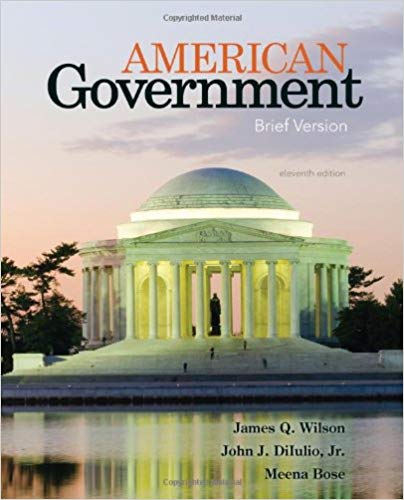
American Government Brief Version 11th Edition by James Q. Wilson - Test Bank

American Government Brief Version 11th Edition by James Q. Wilson - Test Bank   Instant Download - Complete Test Bank With Answers     Sample Questions Are Posted Below   CHAPTER 5: Federalism MULTIPLE CHOICE 1.The Constitution has been amended __________ times in more than 225 years. a. 10 b. 14 c. 19 d. 21 …

$19.99

American Government Brief Version 11th Edition by James Q. Wilson – Test Bank


Instant Download – Complete Test Bank With Answers


Sample Questions Are Posted Below


CHAPTER 5: Federalism
MULTIPLE CHOICE
1.The Constitution has been amended __________ times in more than 225 years.
a. 10
b. 14
c. 19
d. 21
e. 27
ANS: E REF: 81 NOT: Factual
2.Which of the following statements is incorrect?
a. Much of the growth in the federal government has occurred in the last half-century.
b. State and local government spending has risen sharply in recent years.
c. The federal government’s full-time civilian workforce is about the same size that it was in 1960.
d. State and local governments employ twice as many peoples as they did in 1960.
e. None of the above is true.
ANS: E REF: 82 NOT: Factual
3.The federal government’s full-time civilian workforce numbers about __________ million.
a. 1
b. 2
c. 4
d. 6
e. 8
ANS: B REF: 82 NOT: Factual
4.The Constitution was ratified in
a. 1776.
b. 1780.
c. 1788.
d. 1801.
e. 1812.
ANS: C REF: 82 NOT: Factual
5.Since the adoption of the Constitution, the most persistent source of political conflict has been between
a. the president and Congress.
b. the national and state governments.
c. the courts and Congress.
d. local and state governments.
e. the president and the courts.
ANS: B REF: 82 NOT: Conceptual
6.Sovereignty is
a. supreme or ultimate political authority.
b. a political system where authority is shared between the central government and the state.
c. a government that is legally and politically independent of any other government.
d. a political system in which state governments retain ultimate authority except for the powers they expressly delegate to the central government.
e. Both options A and C are correct.
ANS: E REF: 83 NOT: Factual
7.Officials representing __________ states challenged the constitutionality of Obamacare in the federal courts.
a. 5
b. 9
c. 16
d. 22
e. 26
ANS: E REF: 83 NOT: Factual
8.The most controversial aspect of Obamacare was the
a. individual mandate.
b. tuition tax credit.
c. categorical waver.
d. pre-condition exclusion.
e. multiple injury clause.
ANS: A REF: 83 NOT: Factual
9.State officials complained because Obamacare required that the states
a. no longer insure low-income families.
b. meet rigorous standards related to efficient administration of Medicare.
c. verify the citizenship status of health care recipients.
d. develop alternative medical treatments.
e. expand the scope of their support for Medicaid.
ANS: E REF: 83 NOT: Factual
10.In 2012, the Supreme Court ruled the most controversial aspect of Obamacare withstood constitutional scrutiny as a _________ as opposed to a “penalty.”
a. wage supplement
b. garnishment
c. tax
d. shelter
e. reward
ANS: C REF: 83 NOT: Factual
11.A government is not federal unless its state and local units
a. exist independently of the preferences of the national government and make some decisions on their own.
b. have the power to void national laws not in their best interest.
c. are under the direct control of the national government on all matters of policy.
d. obtain approval from the national government for all their policy decisions before implementing them.
e. are governed by appointed officials.
ANS: A REF: 84 NOT: Conceptual
12.Today, federal systems are found in
a. Canada.
b. Australia.
c. India.
d. Germany.
e. All of the above are true.
ANS: E REF: 84 NOT: Factual
13.One of the things that has kept local governments independent of the national government is
a. Article I of the Constitution.
b. the power of free elections.
c. the commitment of Americans to the ideal of local government.
d. the fact that the local tax structure requires local administration.
e. the Second Amendment.
ANS: C REF: 84 NOT: Conceptual
14.Congress has played a major part in preserving federalism by
a. gradually expanding the power of the states beyond what the Constitution allows.
b. placing the national military under the control of state governors when federal troops are located in their states.
c. authorizing the U.S. Treasury to insure any debts acquired by state governments.
d. remaining responsive to local constituencies through the election process.
e. decreasing the size of the federal bureaucracy.
ANS: D REF: 84 NOT: Conceptual
15.Although the central government has acquired more power over the years, the states have managed to maintain a large role in governing through
a. taxing the income of federal employees at a much higher rate.
b. refusing to enforce objectionable federal laws.
c. administering federal programs.
d. refusing to raise the salaries of members of Congress unless certain laws are repealed.
e. selective enforcement of criminal law.
ANS: C REF: 84 NOT: Conceptual
16.There are over __________ elected officials in this county.
a. 10,000
b. 80,000
c. 100,000
d. 200,000
e. 500,000
ANS: E REF: 86 NOT: Factual
17.For the Framers, federalism was a device to
a. protect liberty.
b. allow efficient local administration.
c. encourage participation.
d. encourage factions.
e. enlarge the commercial classes.
ANS: A REF: 86 NOT: Conceptual
18.The alliance among the states that existed from 1776 to 1787 was a
a. unitary system.
b. federal system.
c. confederation.
d. binary system.
e. plutocracy.
ANS: C REF: 87 NOT: Factual
19.A federal republic derives its powers directly from
a. the states.
b. the people.
c. Congress.
d. the courts.
e. factions.
ANS: B REF: 87 NOT: Conceptual
20.The authority left to the states under the Tenth Amendment amounts to
a. control over everything except the military and foreign affairs.
b. all powers that are necessary and proper.
c. all powers not delegated to the federal government by the Constitution or prohibited by it to the states are reserved to the states respectively, or to the people.
d. only the powers specifically granted to them by Congress in legislation.
e. control over taxation.
ANS: C REF: 87 NOT: Factual
21.Knowing the Constitution could not possibly contain an exact and exhaustive list of powers, the __________ clause was added.
a. redactation
b. commerce
c. faithfully executed
d. necessary and proper
e. full faith and credit
ANS: D REF: 87 NOT: Factual
22.Hamilton’s view of the new government generally was rejected by
a. Thomas Jefferson.
b. George Washington.
c. John Marshall.
d. John Adams.
e. Benjamin Franklin.
ANS: A REF: 87 NOT: Factual
23.James Madison’s view of federalism is notable because
a. he was the most ardent champion of states’ rights.
b. he was the most ardent supporter of a strong national government.
c. he first supported states’ rights and then a strong national government.
d. he first favored a strong national government and then states’ rights.
e. he was neutral on the topic.
ANS: D REF: 87 NOT: Conceptual
24.The Civil War settled the issue that
a. state governments were supreme over the national government.
b. the national government derived its sovereignty from the states.
c. the national government derived its sovereignty from the people.
d. the national government derived its sovereignty from both the people and the states.
e. the national and state governments were equal in power and function.
ANS: C REF: 88 NOT: Conceptual
25.In his interpretation of national and state powers, John Marshall was most akin to
a. Thomas Jefferson.
b. Alexander Hamilton.
c. Patrick Henry.
d. Richard Henry Lee.
e. Andrew Jackson.
ANS: B REF: 88 NOT: Conceptual
26.National supremacy became an important legal question in an 1819 case involving a
a. school.
b. military fort.
c. state supreme court.
d. small business that sold horse carriages.
e. bank.
ANS: E REF: 88 NOT: Factual
27.The Supreme Court case that established national supremacy was
a. McCulloch v. Maryland.
b. Marbury v. Madison.
c. United States v. Virginia.
d. Brown v. Maryland.
e. Hubbard v. Morse.
ANS: A REF: 88 NOT: Factual
28.The Supreme Court, in McCulloch v. Maryland, decided that
a. states could not legally secede from the Union.
b. Congress had only the powers specifically enumerated in the Constitution.
c. Congress could not make a law in the same area where a state law already existed.
d. Congress could exercise certain powers, even though they were not specifically mentioned in the Constitution.
e. the judicial branch had the power of judicial review.
ANS: D REF: 88 NOT: Factual
29.The decision in McCulloch v. Maryland rested largely on the premise that the government
a. was established by the states.
b. was established by the people.
c. was created when the Declaration of Independence was signed.
d. was effectively in operation when the Constitution was signed.
e. was illegal.
ANS: B REF: 88 NOT: Conceptual
30.The Civil War led to expansion of the power of the
a. state legislatures.
b. national government.
c. local governments.
d. governors.
e. judiciary.
ANS: B REF: 89 NOT: Conceptual
31.The doctrine of nullification refers to the
a. power of Congress to veto state laws.
b. authority of the states to declare a federal law void.
c. power of the president to veto state laws.
d. authority of the president to dissolve Congress and call for new elections.
e. power of the courts to declare state law unconstitutional.
ANS: B REF: 89 NOT: Conceptual
32.Nullification first appeared in the discourse of American politics when a federal law attempted to regulate
a. commerce.
b. religion.
c. slavery.
d. speech.
e. trade.
ANS: D REF: 89 NOT: Factual
33.The doctrine of dual federalism grew out of a debate on the subject of
a. commerce.
b. banking.
c. manufacturing.
d. welfare.
e. slavery.
ANS: A REF: 89 NOT: Factual
34.The authors of the text suggest that, today, the doctrine of dual federalism is
a. supported by a majority of the Supreme Court.
b. a factor in Northeastern politics.
c. almost extinct.
d. more important than ever.
e. a critical factor in most cases involving the commerce clause.
ANS: C REF: 89 NOT: Factual
35.In 1995 the Court appeared to reverse field, limiting the power of Congress to regulate interstate commerce in a case involving a ban on
a. contraceptives.
b. particular medicinal products.
c. specific brands of gasoline.
d. handguns.
e. loudspeakers.
ANS: D REF: 90 NOT: Factual
36.The people have made it clear that police and schools should be
a. under local control.
b. under state control.
c. under federal control.
d. privatized.
e. a joint venture between public and private ownership.
ANS: A REF: 90 NOT: Conceptual
37.The first federal grants to the states began
a. in the early 1930s.
b. in the late 1800s.
c. before the Constitution was adopted.
d. in the early 1800s.
e. in the mid 1800s.
ANS: C REF: 91 NOT: Factual
38.Early in our Nation’s history, land grants were employed to support the building of
a. wagon roads.
b. canals.
c. railroads.
d. flood-control projects.
e. All of the above are true.
ANS: E REF: 91 NOT: Factual
39.Under the grants-in-aid system,
a. states would run the programs and the national government would pay the bills.
b. the national government would run the programs and the states would pay the bills.
c. states and the national government would run programs jointly.
d. states and the national government would both provide money for programs.
e. states and the national government would prioritize local needs.
ANS: A REF: 92 NOT: Factual
40.In the 1960s and 1970s federal grants to states were increasingly based on
a. the demands of the individual states.
b. what state officials perceived to be important state needs.
c. tariffs.
d. what federal officials perceived to be national needs.
e. population.
ANS: D REF: 93 NOT: Conceptual
41.The term intergovernmental lobby refers to lobbying activities by
a. state and local officials at the national government.
b. one branch of the national government at another branch.
c. governments in international agreements.
d. federal agencies at statehouses and city halls.
e. appointed officials in the U.S. Senate.
ANS: A REF: 93 | 94 NOT: Factual
42.The purpose of the intergovernmental lobby is to
a. get more federal money for states and localities with fewer strings attached.
b. pressure Congress to end grant programs and shift the money to private industry.
c. enable city governments to bypass state rules in the quest for federal money.
d. help Congress to oversee how state governments spend federal money.
e. enhance communication between state and federal bureaucracies.
ANS: A REF: 94 NOT: Conceptual
43.A federal grant designed for a specific purpose defined by a federal law is called a
a. categorical grant.
b. land grant.
c. block grant.
d. revenue-sharing grant.
e. matching-card grant.
ANS: A REF: 94 NOT: Factual
44.The federal government shifted toward block grants because local governments complained that
a. too little federal money was available to them.
b. the purpose of most grants was too narrow to adapt to local needs.
c. the president interfered too frequently in local matters.
d. they had to spend the federal money too quickly without adequate preparation.
e. the money was rarely provided in a timely fashion.
ANS: B REF: 94 NOT: Conceptual
45.If you were a governor or mayor, you most likely would favor
a. block grants.
b. general matching grants.
c. categorical grants.
d. community-development block grants.
e. matching-card grants.
ANS: A REF: 94 NOT: Conceptual
46.Members of Congress can raise a procedural point of order if an unfunded mandate
a. is not supported by one-half the House of Representatives.
b. is criticized by the president.
c. is reviewed by a congressional committee.
d. is not formally announced by the CBO.
e. would cost states and cities more than $50 million.
ANS: E REF: 96 NOT: Factual
47.Federal laws requiring states and cities to take certain actions whether or not they receive federal aid are called
a. conditions of aid.
b. intergovernmental grants.
c. categorical actions.
d. mandates.
e. federal activism.
ANS: D REF: 96 NOT: Factual
48.In recent years, most mandates have concerned
a. civil rights and environmental protection.
b. highways and transportation.
c. education.
d. social welfare.
e. healthcare.
ANS: A REF: 96 NOT: Factual
49.The text suggests that the relationship between federal funds and the growth rate of regions is
a. unclear.
b. slight.
c. considerable.
d. negative.
e. constantly in flux.
ANS: A REF: 96 NOT: Conceptual
50.Distributional formulas have created
a. rivalry among the states.
b. a fair way to allocate federal funds to the states.
c. a way for Congress to get a return on its money from the states.
d. a vast pool of unused money by the states.
e. proportionate funding.
ANS: A REF: 97 NOT: Conceptual
51.When Richard Nixon suggested that many federal grants be given to the states with no strings attached, many state officials objected because
a. the grants were not large enough to begin with.
b. the strings increased their local power.
c. the strings were unrelated to the interests of their region.
d. the northeastern states dominated the allocation process.
e. there were no methods of assessment for the distributional formulas.
ANS: B REF: 98 NOT: Conceptual
TRUE/FALSE
1.The text suggests that the fears of the Antifederalists regarding expansion of the power of the national government have proved to be unfounded.
ANS: F REF: 82
2.Much of the federal government’s growth has occurred in the last half-century.
ANS: T REF: 82
3.The relationship between the national and state governments has been the single most persistent source of political conflict in American politics.
ANS: T REF: 82
4.The federal health care reform law of 2010 was challenged in the courts by officials representing 26 states.
ANS: T REF: 83
5.In 2012, the Supreme Court ruled the individual mandate of “Obamacare” was not a tax.
ANS: F REF: 83
6.Most nations do not have local units of government.
ANS: F REF: 84
7.Federalism discourages the average citizen from becoming involved in political activity.
ANS: F REF: 86
8.Great Britain and France feature unitary systems of government.
ANS: T REF: 86
9.The Framers intended federalism to be a device whereby personal liberty would be protected.
ANS: T REF: 86
10.The Framers were clear about how the federal system was supposed to work.
ANS: F REF: 87
11.The Constitution clearly allocated power to the national and state governments.
ANS: F REF: 87
12.Jefferson generally held that the powers of the federal government should be narrowly construed and strictly limited.
ANS: T REF: 87
13.The Civil War was fought, in part, over the issue of national supremacy versus states’ rights.
ANS: T REF: 88
14.In McCulloch v. Maryland the Supreme Court concluded that chartering a bank was within the powers of Congress.
ANS: T REF: 88
15.The Civil War led to enlargement of the powers of the national government.
ANS: T REF: 89
16.John C. Calhoun was the first to develop the theory of nullification.
ANS: F REF: 89
17.Federal grants to the states began in the early 1900s.
ANS: F REF: 91
18.Congress began slowing the number of grants-in-aid programs during the 1960s owing to the cost of the Vietnam War.
ANS: F REF: 93
19.Until the 1960s, most federal grants-in-aid were designed to serve federal purposes.
ANS: F REF: 93
20.Matching requirements are most common with categorical grants.
ANS: T REF: 94
21.In theory, block grants were supposed to give states and cities considerable freedom in deciding how to spend money.
ANS: T REF: 94
22.Most state and local officials welcomed the 1973 federal law that forbade discrimination against disabled people in any program receiving federal aid.
ANS: F REF: 95
23.Unfunded mandates have been significantly curtailed through use of the Unfunded Mandate Reform Act of 1995.
ANS: F REF: 96
24.Most mandates concern civil rights and environmental protection.
ANS: T REF: 96
25.Block grants are allocated by distributional formulas.
ANS: T REF: 97
26.The allocation of block grants can depend on such things as personal income in an area and housing quality.
ANS: T REF: 97
27.It is not uncommon for the director of the census to be roundly denounced by big-city mayors.
ANS: T REF: 97
28.Even the presidents who have said that they believe in state authority have done little to improve it.
ANS: T REF: 98
29.The states funded most of the interstate highway program.
ANS: F REF: 98
30.President Clinton signed into law the Real ID Act, in effect creating a national identity card.
ANS: F REF: 98
31.The Personal Responsibility and Work Opportunity Reconciliation Act represented a significant reversal in federal policy.
ANS: T REF: 98
ESSAY
1.Summarize the Supreme Court’s decision in National Federation of Independent Business v. Sebelius (2012).
ANS:
(a.) The Court ruled 5–4 that an individual mandate was constitutional as a “tax” within the power of Congress.
(b.) On the other hand, it ruled that the threat of states losing their existing Medicaid funding was unconstitutional.
2.Discuss the views of federalism held by Alexander Hamilton and Thomas Jefferson.
ANS:
(a.) Hamilton thought the national government was superior because of the Supremacy Clause of the Constitution, as the people had created it and their most pressing needs were the national economy and the conduct of foreign relations. As such, its powers should be broadly defined and liberally construed.
(b.) Jefferson saw the national government as a creation of an agreement among the states, but remained concerned that it would be a threat to liberty. As such, its powers should be narrowly construed and strictly limited.
3.Summarize the facts that led up to the classic case McCulloch v. Maryland and summarize the Supreme Court’s opinion.
ANS:
(a.) A branch of the Bank of the United States refused to pay a state tax.
(b.) The Court ruled that the Congress had the right to create such a bank, even though the power was not explicitly mentioned in the Constitution (via the “necessary and proper” clause.
(c.). Maryland did not have the power to tax said bank because the federal government was supreme in the powers conferred upon it.
4.Explain what “dual federalism” means and how it was applied to the subject of commerce.
ANS:
(a.) Dual federalism implied that the national government was supreme in its sphere and the state governments were supreme in their own spheres. It further implied that the two spheres could and should be kept separate.
(b.) As applied to commerce, the national government was thought to be supreme with respect to the regulation of interstate (or between state) commerce and the states were supreme with respect to intrastate (or within state) commerce.
5.Identify four recent laws invalidated by the Supreme Court which have given new life to the notion that states are important and the power of the national government is not without limits.
ANS:
(a.) In 1992, the Court struck down a law regulating radioactive waste within state borders.
(b.) In 1995, the Court struck down a law banning handguns from within one thousand feet of a school.
(c.) In 1997, the Court struck down a law which required local officials to run background checks on people buying handguns.
(d.) In 2000, it struck down a law that allowed victims of rape or domestic violence to bring suits in federal court.
6.Explain why the grants-in-aid system grew so rapidly.
ANS:
(a.) The federal government raised the money through its taxing power.
(b.) Prevailing constitutional interpretation would not allow the federal government to spend money for purposes not authorized by the Constitution, so the solution was to pass the money to the states.
(c.) The money, originally seemed to be “free,” or without “strings” (conditions).
(d.) State and local officials could continue to condemn the national government for its spending habits.
7.List five of the largest programs that account for the change in federal policy priorities and are the source for more than half of the money spent for cash grants-in-aid.
ANS:
(a.) Housing assistance for low-income families
(b.) Medicaid
(c.) Highway construction
(d.) Services to the unemployed
(e.) Welfare programs for mothers with dependent/disabled children
8.Discuss the rivalry between the Snowbelt and Sunbelt states. What shift do these terms represent? What is the debate surrounding these terms in relation to federal spending?
ANS:
(a.) Dubbed by journalists and politicians, these terms represent the shift of growth in population and employment (not income) from the Northeast to the South/Southwest.
(b.) The rivalry is over the debate of whether or not the federal government is awarding some regions unfairly over others with the distribution of federal funds/grants.
9.Explain what a block grant is and why they have not seemed to fulfill the original expectations of recipients.
ANS:
(a.) Categorical grants are for narrow purposes and typically require matching funds. So, block grants were created for general purposes and with few restrictions.
(b.) The amount of money available in this form, however, did not grow as fast as the states desired.
(c.) As a result, the federal government increasingly added strings (conditions) to the spending of this money.
10.Explain how the Personal Responsibility and Work Opportunity Reconciliation Act represented a significant reversal in federal policy. What were the effects?
ANS:
(a.) The welfare reform act was passed in 1996 and signed by President Clinton. This bill (officially, the Personal Responsibility and Work Opportunity Reconciliation Act) turned over to the states the authority to run the federal welfare program. The old policy, Aid to Families with Dependent Children (AFDC), created in 1935, was largely run under federal rules.
(b.) Beginning in 1996, Washington kept paying but the states made the rules, urging applicants to look for work before applying for benefits, and—in part because of the law—the welfare rolls dropped sharply.

Additional information

Add Review

Your email address will not be published. Required fields are marked *