Subtotal: $520.00

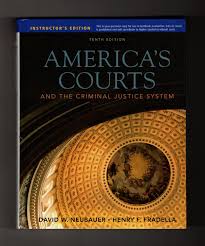
America's Courts and the Criminal Justice System 10th Edition by David W. Neubauer - Test Bank

America's Courts and the Criminal Justice System 10th Edition by David W. Neubauer - Test Bank   Instant Download - Complete Test Bank With Answers     Sample Questions Are Posted Below   Chapter 5 THE DYNAMICS OF COURTHOUSE JUSTICE   TEST BANK     MULTIPLE CHOICE            The _____________ is responsible for transporting …

$19.99

America’s Courts and the Criminal Justice System 10th Edition by David W. Neubauer – Test Bank


Instant Download – Complete Test Bank With Answers


Sample Questions Are Posted Below


Chapter 5

THE DYNAMICS OF COURTHOUSE JUSTICE


TEST BANK


MULTIPLE CHOICE


  1.          The _____________ is responsible for transporting detained defendants from the jail to the courthouse.
a. bailiff c. sheriff’s deputy
b. bail bondsman d. clerk of court


ANS: C                    REF:  119                OBJ:  1


  1.          Which of the following is not a duty of the clerk of court?
a. overseeing jury selection
b. creating a shorthand record of court proceedings
c. docketing cases
d. collecting fees


ANS: B                    REF:  121                OBJ:  1


  1.          Which of the following is not a duty of a court administrator?
a. prepare written opinions for trial cases c. prepare budgets
b. summarize caseload data d. prepare annual reports


ANS: A                   REF:  121                OBJ:  1


  1.          The duties of a court administrator include which of the following?
a. prepare budgets
b. maintain order in the courtroom
c. transport pretrial detainees from jail to the courtroom
d. make verbatim transcripts of court proceedings


ANS: A                   REF:  121                OBJ:  1


  1.          Which of the following is not a member of the courtroom work group?
a. prosecutor c. judge
b. defendant d. defense attorney


ANS: B                    REF:  122 and 124  OBJ:  4

  1.          Which of the following explains why few cases receive individual treatment?
a. discretion
b. speedy-trial laws
c. assembly-line justice
d. the dynamics of the courtroom work group


ANS: C                    REF:  123                OBJ:  2


  1.          An example of assembly-line justice in a big-city public defender’s office may include which of the following?
a. One assistant public defender will conduct the defendant’s initial interview but may not necessarily represent him or her at trial.
b. One assistant public defender will represent the defendant at the initial appearance but may not necessarily represent him or her at trial.
c. One assistant public defender will conduct the defendant’s initial interview but may not necessarily negotiate the defendant’s plea deal.
d. All of the above.


ANS: D                   REF:  123                OBJ:  2


  1.          Feeley (1979) compared two courts in Connecticut—one with a heavy caseload and another with a light caseload.  He found that
a. defense attorneys were more likely to pitch battles with prosecutors in the court with the heavy caseload.
b. each court spent the same amount of time per case.
c. judges set significantly higher bails in the court with the heavy caseload.
d. all of the above.


ANS: B                    REF:  123                OBJ:  2


  1.          Which of the following is not a major subcomponent of discretion?
a. legal judgments c. judicial restraints
b. policy priorities d. personal philosophies


ANS: C                    REF:  124                OBJ:  3


  1.        A discretionary decision based on decision makers’ values and attitudes reflects
a. legal judgments. c. personal philosophies.
b. policy priorities. d. judicial restraints.


ANS: C                    REF:  124                OBJ:  3


  1.        Although a prosecutor may believe that a given defendant violated the law, s/he may decide against moving forward with prosecution based on a belief that no jury would come back with a guilty verdict.  This represents a discretionary decision based on
a. legal judgment. c. personal philosophy.
b. policy priority. d. judicial restraint.


ANS: A                   REF:  124                OBJ:  3


  1.        Prosecutors exercise discretion every day.  Which of the following is not an example of prosecutorial discretion?
a. A prosecutor decides not to prosecute because of a lack of evidence to prove the offense charged.
b. The policy priority of the office is to devote more resources to personal crimes such as murder and assault than to disorderly conduct.
c. The prosecutor decides to drop a case because s/he believes that a jury is unlikely to come back with a guilty verdict.
d. The prosecutor sets the trial date to accommodate an out-of-state witness.


ANS: D                   REF:  124                OBJ:  3


  1.        A judge who accepts a guilty plea agreement reached by the defense attorney and the prosecutor provides an example of
a. discretion. c. routine administration of justice.
b. mutual interdependence. d. assembly-line justice.


ANS: B                    REF:  125                OBJ:  4


  1.        Maverick defense attorneys
a. most often get the best plea bargains for their clients.
b. work cooperatively with prosecutors to resolve cases quickly.
c. generally have few sanctions imposed on them.
d. are seldom able to negotiate the most lenient sentences.


ANS: D                   REF:  127                OBJ:  4


  1.        Thirty-six states have created task forces to investigate gender bias in the legal system.  These task forces have found that
a. female lawyers, more so than their male counterparts, were addressed by their first names.
b. judges addressed female lawyers in a demeaning manner; terms like “sweetie,” “little lady lawyer,” “pretty eyes,” and “dear” were used.
c. courts are biased against women when it comes to awarding them alimony and child support.
d. all of the above.


ANS: D                   REF:  126-127         OBJ:  5


  1.        The American Bar Association recommends that all felony cases reach disposition within
a. six months of arrest. c. one year of arrest.
b. six months of filing. d. one year of filing.


ANS: D                   REF:  128                OBJ:  6


  1.        In the thirteenth century the nobles forced King John to sign the ____________________ and promise not to “deny or delay right or justice.”
a. Declaration of the Rights of Man c. English Constitution
b. Magna Carta d. Code of Wales


ANS: B                    REF:  128                OBJ:  6


  1.        The ____________________ Amendment provides for the right to a speedy and public trial.
a. Fourth c. Sixth
b. Fifth d. Seventh


ANS: C                    REF:  128-129         OBJ:  6


  1.        “Justice delayed is justice denied” means what?
a. State and federal speedy-trial laws must always be enforced.
b. Delay in reaching case disposition undermines the values and guarantees associated with the legal system.
c. Delay is an inevitable consequence of any already burdened criminal justice system.
d. Case delay causes deterioration of cases and pressures prosecutors to offer lenient plea bargains.


ANS: B                    REF:  128                OBJ:  6


  1.        Which of the following is generally not offered as a criticism of delay in case processing?
a. Court delay causes citizens to lose confidence in the swiftness and certainty of punishment.
b. Court delay allows defendants more time to gather evidence to prove their innocence.
c. Victims and witnesses may be forced to make repeated, needless trips to the courthouse.
d. Delay in disposing cases strains the resources of the criminal justice system.


ANS: B                    REF:  128-129         OBJ:  6


  1.        The law on the books approach to delay focuses on
a. courthouse dynamics. c. plea bargaining.
b. the courtroom work group. d. resources and procedures.


ANS: D                   REF:  129                OBJ:  6


  1.        The National Center for State Courts studied 21 courts across the nation and found that
a. the relative size of court caseloads bore little relationship to case-processing time.
b. the level of court resources was not associated with court delay.
c. courts that emphasized plea bargaining processed cases as slowly as courts that emphasized trying cases.
d. all of the above.


ANS: D                   REF:  129                OBJ:  6


  1.        In Barker v Wingo, the Court held that the right to a speedy trial
a. was violated by a five year delay.
b. is a relative, not an absolute, right.
c. was an absolute constitutional mandate.
d. is a right of the prosecution but not the defense.


ANS: B                    REF:  130                OBJ:  6


  1.        The Speedy Trial Act of 1974 (amended in 1979) allows how many days from arrest to indictment in federal courts?
a. 30 c. 60
b. 45 d. 75


ANS: A                   REF:  130                OBJ:  7


  1.        The Speedy Trial Act of 1974 (amended in 1979) allows how many days from indictment to trial?
a. 20 c. 50
b. 30 d. 70


ANS: D                   REF:  130                OBJ:  7


  1.        Most state speedy trial laws are designed to protect
a. defendants. c. the interests of society.
b. the state. d. judicial integrity.


ANS: A                   REF:  130                OBJ:  7


  1.        Various researchers have found that the passage of speedy trial laws in many states has led to
a. a much more rapid handling of cases.
b. a decrease in the speed of case flow.
c. little change in disposition time.
d. the hiring of considerably more judges and attorneys.


ANS: C                    REF:  131                OBJ:  7


  1.        Which of the following is a law in action approach to court delay?
a. implementing speedy trial laws
b. adding court resources
c. streamlining court procedures
d. trying to achieve better coordination among members of the courtroom work group


ANS: D                   REF:  131                OBJ:  8


  1.        Researchers agree that law in action approaches to court delay are
a. less effective than law on the books approaches.
b. more effective than law on the books approaches.
c. equally effective as law on the books approaches.
d. not comparable to law on the books approaches.


ANS: B                    REF:  131                OBJ:  8


  1.        Which of the following statements is true regarding legal ethics?
a. Lawyers are not allowed to mislead the court.
b. Lawyers cannot knowingly allow witnesses for their side to perjure themselves.
c. Before an individual may be admitted to the bar, s/he must pass a separate test on legal ethics.
d. All of the above.


ANS: D                   REF:  132-133         OBJ:  5


TRUE/FALSE


  1.          In some courthouses civil and criminal cases are heard in the same courtroom during the same court session.


ANS: T                    REF:  116-117         OBJ:  1


  1.          The clerk of court is responsible for maintaining order in the courtroom.


ANS: F                    REF:  119, 121        OBJ:  1


  1.          The bailiff is responsible for transporting detained defendants from jail to the courthouse.


ANS: F                    REF:  118, 119        OBJ:  1


  1.          The clerk of court is responsible for overseeing jury selection.


ANS: T                    REF:  119, 121        OBJ:  1


  1.          Today, most courts (even at the trial court level) routinely employ professional court administrators.


ANS: T                    REF:  121                OBJ:  1


  1.          Television and movies accurately portray the realities of courtroom justice.


ANS: F                    REF:  120                OBJ:  2


  1.          Interactions between members of the courtroom work group strictly follow the adversarial model.


ANS: F                    REF:  124                OBJ:  4


  1.          Most district attorneys and public defenders cooperate with each other.


ANS: T                    REF:  118                OBJ:  4


  1.          Some defendants are processed in groups.  For example, during the initial appearance, felony defendants may be advised of their rights in one large group rather than individually.


ANS: T                    REF:  123                OBJ:  2


  1.        Plea bargaining predates any of the “modern” problems of the courthouse.


ANS: T                    REF:  123                OBJ:  2


  1.        In a study that compared a court with a heavy caseload to another court with a light caseload, the researcher found that the court with the lighter caseload had more trials and imposed heavier sentences.


ANS: F                    REF:  123                OBJ:  2


  1.        Most cases end in a plea of guilty (rather than a trial) because most courthouses have too many cases.


ANS: F                    REF:  123                OBJ:  2


  1.        The same differences of opinion about crime that characterize society as a whole likewise divide courthouse actors.


ANS: T                    REF:  124                OBJ:  3

  1.        Discretion is exercised at every key decision point within the criminal justice system.


ANS: T                    REF:  124                OBJ:  3


  1.        Courthouse regulars work together cooperatively on a daily basis in ways not envisioned by the formal adversary model.


ANS: T                    REF:  124                OBJ:  4


  1.        Assistant prosecutors are often judged not on how many cases they win, but on how few they lose.


ANS: T                    REF:  125                OBJ:  4


  1.        The shared decision making of the courtroom work group helps to diffuse responsibility.


ANS: T                    REF:  125                OBJ:  4


  1.        The National Center for State Courts studied 21 courts across the nation and found that the relative size of court caseloads bore little relationship to case-processing time.


ANS: T                    REF:  129                OBJ:  6


  1.        The federal Speedy Trial Act of 1974 (amended in 1979) sets out specific times within which the prosecutor must indict and try the case.


ANS: T                    REF:  130                OBJ:  7


  1.        Speedy-trial statutes exist in all 50 states.


ANS: T                    REF:  130                OBJ:  7


  1.        The federal speedy-trial law is designed to protect the interests of society; that is, a speedy trial is viewed as an important objective irrespective of whether the defendant’s interests are in jeopardy.


ANS: T                    REF:  130                OBJ:  7


COMPLETION


  1.          The ________________________ of court controls the scheduling of cases and keeps the judge apprised of the relevant details of a given case.


ANS: clerk


REF:  121                OBJ:  1 and 4


  1.          To one side of the bench sits the court ________________________, whose machine mysteriously makes a shorthand record of the proceedings.


ANS: stenographer


REF:  118                OBJ:  1


  1.          The ________________________ is responsible for maintaining order in the courtroom.


ANS: bailiff


REF:  118                OBJ:  1


  1.          _________________________ justice explains why few cases receive individual treatment.


ANS: Assembly-line


REF:  122                OBJ:  2


  1.          The courtroom _______________________ concept stresses the importance of patterned interactions of judges, prosecutors, and defense attorneys.


ANS: work group


REF:  122                OBJ:  4


  1.          _______________________ is best defined as the lawful ability of an agent of government to exercise choice in making a decision.


ANS: Discretion


REF:  124                OBJ:  3


  1.          Because criminal laws are so broad and general they must be ____________________ enforced.


ANS: selectively


REF:  124                OBJ:  3


  1.          James Eisenstein and Herbert Jacob (1977) have proposed that the best way to analyze the network of ongoing relationships among the courthouse actors is through the concept of the courtroom ____________________.


ANS: work group


REF:  124                OBJ:  4


  1.          The criminal courthouse is not a single organization, but rather a collection of separate ____________________ that gather in a common workplace.


ANS: institutions


REF:  125                OBJ:  4


  1.        Assistant prosecutors are often judged not on how many cases they win, but on how few they ____________________.


ANS: lose


REF:  125                OBJ:  4


  1.        Newcomers to a job learn the formal and informal rules of behavior through ____________________.


ANS: socialization


REF:  125                OBJ:  4


  1.        The hallmark of work groups is ____________________ of behavior.  This ____________________ is the product of shared norms about how each member should behave and what decisions are desirable.


ANS: regularity, regularity


REF:  125                OBJ:  4


  1.        State task forces consistently find evidence of ____________________ bias in four areas of the legal system:  domestic violence, sexual assault, divorce, and behavior toward female workers.


ANS: gender


REF:  126                OBJ:  5


  1.        In a general sense, the term ____________________ suggests abnormal or unacceptable time lapses in the processing of cases.


ANS: delay


REF:  128                OBJ:  6


  1.        The old adage, “justice delayed is justice ____________________,” is as old as the common law itself.


ANS: denied


REF:  128                OBJ:  6


  1.        The ____________________ Amendment provides for the right to a speedy and public trial.


ANS: Sixth


REF:  128-129         OBJ:  6


  1.        In Barker v. Wingo, the Court held that the right to a ____________________ trial is relative, not absolute.


ANS: speedy


REF:  130                OBJ:  6


  1.        According to the Speedy Trial Act of 1974 (amended in 1979), certain time periods, such as those associated with hearings or pretrial motions and the mental competency of the defendant, are considered ____________________ time.


ANS: excludable


REF:  130                OBJ:  7


  1.        Various studies have found that speedy trial laws have very little effect on the criminal court process at the ____________________ level.


ANS: state


REF:  131                OBJ:  7


  1.        ____________________ refers to the study and analysis of what constitutes good or bad conduct.


ANS: Ethics


REF:  132                OBJ:  5


ESSAY


  1.          List and describe the duties of the three types of court managers.  What are the potential sources of conflict between these managers?  Be sure to provide some examples.


ANS:

The three types of court managers include the clerk of court, the judge, and the court administrator.  The clerk of court is responsible for docketing cases, collecting fees, overseeing jury selection, and maintaining court records.  The clerk of court is an elected official in most states and, consequently, will operate semi-autonomously from the judge.  Thus, clerks of court have competed with judges for control over judicial administration.  Judges are responsible for court administration, but they are generally not good managers due to a lack of training.  In addition, judges are in charge of courtrooms and official court proceedings.  Court administrators are professional managers who prepare annual reports, summarize caseload data, prepare budgets, troubleshoot, and help the court to run as efficiently as possible. Relationships between judges and court administrators may be tense because the distinction between administration and adjudication is often not clear.  For example, a judge may view a court administrator’s recommendation to streamline court procedures as an intrusion on his/her efforts to process a case.


REF:  121                                                 OBJ:  1


  1.          Explain why discretionary decision making occurs in the criminal courts and then provide some specific examples of prosecutorial discretion.


ANS:

Discretion is exercised at every key decision point within the criminal justice system.  After an arrest is made, a prosecutor may decide not to file charges.  If charges are filed, a judge has discretion in terms of the amount of bail that may be set.  If a case goes to trial, the jury will have discretion over whether to find a defendant guilty.  These are just a few examples of discretionary decision making that may occur within the criminal courts.  Choices are made on the basis of legal judgments, policy priorities, and the values and attitudes of the actors involved.  For example, although a prosecutor may believe that a given defendant violated the law, s/he may decide against moving forward with prosecution based on a supposition that no jury would come back with a guilty verdict.  Other discretionary decisions may reflect policy choices; all crimes cannot be prosecuted because resources are limited.  More serious crimes will likely be prosecuted because they are considered a priority, while less serious offenses, such as disorderly conduct, may not.


REF:  124                                                 OBJ:  3


  1.          In general, “justice delayed is justice denied.”  Explain the meaning of this phrase and how it affects defendants.  What steps have legislatures taken to deal with the problem of court delay?  Have these steps been effective?


ANS:

Court delay is considered a problem because it jeopardizes a defendant’s Sixth Amendment right to a speedy trial.  This right was designed to protect defendants from languishing in jail for lengthy periods of time before their guilt or innocence may be determined.  But, to date, no consensus has been reached about how long is too long, although the American Bar Association recommends that all felony cases reach disposition within one year of case filing.  Given the ambiguity of what is meant by the term “speedy trial”, speedy-trial laws have been enacted in all 50 states.  At the federal level, the Speedy Trial Act of 1974 (amended in 1979) was enacted by Congress to specify time standards for two primary stages in the federal court process.  A span of 30 days is allowed from arrest to indictment, and 70 days from indictment to trial.  However, certain time periods, such as those associated with hearings on pretrial motions and the mental competency of the defendant, are excluded from time calculations.  While the federal speedy-trial law was enacted to protect the interests of society, speedy-trial laws at the state level are generally designed to protect defendants.  Findings regarding the effectiveness of these laws have not been consistent.  Various researchers have found that speedy-trial laws have had a limited effect on speeding up case processing time in state courts.  At the federal level, however, the results have been more promising.  Researchers noted that it took several months for a criminal case in filed in federal court to reach disposition in 1970.  By the early 1980s the average federal case was disposed in less than three months.


REF:  128-129                                          OBJ:  6 and 7


Additional information

Add Review

Your email address will not be published. Required fields are marked *