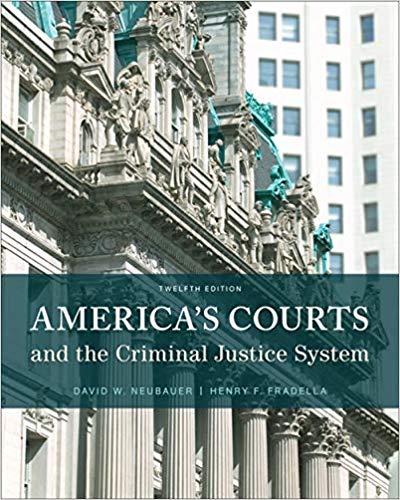
America's Courts and the Criminal Justice System 12th Edition by David W. Neubauer - Test Bank

America's Courts and the Criminal Justice System 12th Edition by David W. Neubauer - Test Bank   Instant Download - Complete Test Bank With Answers     Sample Questions Are Posted Below   Chapter 5 THE DYNAMICS OF COURTHOUSE JUSTICE TEST BANK MULTIPLE CHOICE 1. The _____ is responsible for transporting detained defendants from the …

$19.99

America’s Courts and the Criminal Justice System 12th Edition by David W. Neubauer – Test Bank


Instant Download – Complete Test Bank With Answers


Sample Questions Are Posted Below


Chapter 5
THE DYNAMICS OF COURTHOUSE JUSTICE
TEST BANK
MULTIPLE CHOICE
1. The _____ is responsible for transporting detained defendants from the jail to the courthouse.
a. bailiff c. sheriff’s deputy
b. bail bondsman d. clerk of court
ANS: C REF: The Courthouse and the People Who Work There OBJ: 1 KEY: Bloom’s: Remember
2.Who is the record keeper for the court, often responsible for summoning potential jurors?
a. law clerk
b. clerk of court
c. court reporter
d. secretary
ANS: B REF: The Courtroom Work Group OBJ: 1/4 KEY: Bloom’s: Remember
3.Assembly-line justice, discretion, and the courtroom work group are all concepts used to explain what?
a. the difference between law in action and law on the books c. the difference between judges and magistrates
b. courthouse discretion d. legal ethics
ANS: A REF: Dynamics of Courthouse Justice OBJ: 1/4 KEY: Bloom’s: Remember
4.The claim that increasing plea bargains and declining trials are a recent phenomenon is a weakness of what explanation?
a. assembly-line justice
b. discretion
c. courtroom work group
d. none of these is correct
ANS: A REF: Dynamics of Courthouse Justice OBJ: 6 KEY: Bloom’s: Remember
5. Which of the following is not a member of the courtroom work group?
a. prosecutor c. judge
b. defendant d. defense attorney
ANS: B REF: The Courtroom Work Group OBJ: 4 KEY: Bloom’s: Remember
6. According to the chapter, which of the following best explains why few cases receive individual treatment?
a. discretion
b. speedy-trial laws
c. assembly-line justice
d. the dynamics of the courtroom work group
ANS: C REF: Assembly-Line Justice OBJ: 2 KEY: Bloom’s: Remember
7. What happens with most complaints about attorney misconduct?
a. the complainant receives a settlement
b. the defendant loses in court
c. the attorney is disbarred
d. they are dismissed due to insufficient evidence
ANS: D REF: Legal Ethics OBJ: 5 KEY: Bloom’s: Remember
8. Which of the following courtroom actors works mostly behind the scenes?
a. law clerks
b. bailiffs
c. lawyers
d. court administrators
ANS: D REF: The Courthouse and the People Who Work There OBJ: 2 KEY: Bloom’s: Remember
9. Which of the following is not a major subcomponent of discretion?
a. legal judgments c. judicial restraints
b. policy priorities d. personal philosophies
ANS: C REF: Discretion OBJ: 3 KEY: Bloom’s: Remember
10.A discretionary decision based on decision makers’ values and attitudes reflects
a. legal judgments. c. personal philosophies.
b. policy priorities. d. judicial restraints.
ANS: C REF: Discretion OBJ: 3 KEY: Bloom’s: Remember
11. Although a prosecutor may believe that a given defendant violated the law, s/he may decide against moving forward with prosecution based on a belief that no jury would come back with a guilty verdict.  This represents a discretionary decision based on
a. legal judgment. c. personal philosophy.
b. policy priority. d. judicial restraint.
ANS: A REF: Discretion OBJ: 3 KEY: Bloom’s: Remember
12. How are newcomers to a courtroom taught formal requirements of the job and informal rules of behavior?
a. training
b. mutual interdependence
c. discretion
d. socialization
ANS: D REF: The Courtroom Work Group OBJ: 4 KEY: Bloom’s: Remember
13. A judge who accepts a guilty plea agreement reached by the defense attorney and the prosecutor provides an example of
a. discretion. c. routine administration of justice.
b. mutual interdependence. d. assembly-line justice.
ANS: B REF: The Courtroom Work Group OBJ: 4 KEY: Bloom’s: Remember
14. Maverick defense attorneys
a. most often get the best plea bargains for their clients.
b. work cooperatively with prosecutors to resolve cases quickly.
c. generally have few sanctions imposed on them.
d. are seldom able to negotiate the most lenient sentences.
ANS: D REF: The Courtroom Work Group OBJ: 4 KEY: Bloom’s: Remember
15. Women make up what percent of judges in the U.S. (approximately)?
a. 10%
b. 20%
c. 40%
d. 30%
ANS: D REF: The Courtroom Work Group OBJ: 4 KEY: Bloom’s: Remember
16.The American Bar Association recommends that all felony cases reach disposition within
a. six months of arrest. c. one year of arrest.
b. six months of filing. d. one year of filing.
ANS: D REF: The Problem of Delay OBJ: 6 KEY: Bloom’s: Remember
17. What 13th Century document attempted to address the problem of delay in justice?
a. Declaration of the Rights of Man c. English Constitution
b. Magna Carta d. Code of Wales
ANS: B REF: The Problem of Delay OBJ: 6 KEY: Bloom’s: Remember
18. What amendment provides for the right to a speedy and public trial?
a. Fourth c. Sixth
b. Fifth d. Seventh
ANS: C REF: The Problem of Delay OBJ: 6 KEY: Bloom’s: Remember
19. What concept is directly related to the reality that the criminal courthouse is not a single organization but rather a collection of separate institutions that gather in a common workplace?
a. discretion
b. mutual interdependence
c. assembly-line justice
d. legal ethics
ANS: B REF: The Courtroom Work Group OBJ: 4 KEY: Bloom’s: Remember
20. What concept stresses the importance of the patterned interactions of judges, prosecutors, and defense attorneys?
a. The courthouse dynamics concept.
b. The courtroom workgroup concept.
c. The plea bargaining concept.
d. The assembly-line justice concept.
ANS: D REF: Dynamics of Courthouse Justice OBJ: 4 KEY: Bloom’s: Remember
21. The law on the books approach to delay focuses on
a. courthouse dynamics. c. plea bargaining.
b. the courtroom work group. d. resources and procedures.
ANS: D REF: Law on the Books Approach to Court Delay OBJ: 8 KEY: Bloom’s: Remember
22.The court case Barker v. Wingo is concerned with what constitutional guarantee?
a. the right to an attorney
b. freedom from unreasonable search and seizure
c. free speech
d. the right to a speedy trial
ANS: D REF: Law on the Books Approach to Court Delay OBJ: 6 KEY: Bloom’s: Remember
23. In Barker v. Wingo, the Court held that the right to a speedy trial
a. was violated by a five year delay.
b. is a relative, not an absolute, right.
c. was an absolute constitutional mandate.
d. is a right of the prosecution but not the defense.
ANS: B REF: Law on the Books Approach to Court Delay OBJ: 8 KEY: Bloom’s: Remember
24. The Speedy Trial Act of 1974 (amended in 1979) allows how many days from arrest to indictment in federal courts?
a. 30 c. 60
b. 45 d. 75
ANS: A REF: Law on the Books Approach to Court Delay OBJ: 8 KEY: Bloom’s: Remember
25. The Speedy Trial Act of 1974 (amended in 1979) allows how many days from indictment to trial?
a. 20 c. 50
b. 30 d. 70
ANS: D REF: Law on the Books Approach to Court Delay OBJ: 8 KEY: Bloom’s: Remember
26.Most state speedy trial laws are designed to protect
a. defendants. c. the prosecutor.
b. the state. d. judicial integrity.
ANS: A REF: The Problem of Delay OBJ: 7 KEY: Bloom’s: Remember
27. Various researchers have found that the passage of speedy trial laws in many states has led to
a. a much more rapid handling of cases.
b. a decrease in the speed of case flow.
c. little change in disposition time.
d. the hiring of considerably more judges and attorneys.
ANS: C REF: The Problem of Delay OBJ: 7 KEY: Bloom’s: Remember
28. Which of the following is a law in action approach to court delay?
a. implementing speedy trial laws
b. adding court resources
c. streamlining court procedures
d. trying to achieve better coordination among members of the courtroom work group
ANS: D REF: Law in Action Approach to Court Delay OBJ: 8 KEY: Bloom’s: Remember
29.Researchers agree that law in action approaches to court delay are
a. less effective than law on the books approaches.
b. more effective than law on the books approaches.
c. equally effective as law on the books approaches.
d. not comparable to law on the books approaches.
ANS: B REF: Law in Action Approaches to Court Delay OBJ: 8 KEY: Bloom’s: Remember
30.Which of the following statements is true regarding legal ethics?
a. Lawyers are not allowed to mislead the court.
b. Lawyers cannot knowingly allow witnesses for their side to perjure themselves.
c. Before an individual may be admitted to the bar, s/he must pass a separate test on legal ethics.
d. All of these statements are true.
ANS: D REF: Legal Ethics OBJ: 5 KEY: Bloom’s: Remember
31. What factors often influence discretionary decision making by members of the courtroom work group?
a. legal judgments
b. policy priorities
c. personal philosophies
d. legal judgments, policy priorities, and personal philosophies
ANS: D REF: Discretion OBJ: 3 KEY: Bloom’s: Remember
32.The concept of assembly-line justice stresses
a. the high volume of cases in courthouses.
b. the emphasis on moving the docket.
c. the low volume of cases in courthouses.
d. the high volume of cases in courthouses and the emphasis on moving the docket.
ANS: D REF: Assembly-Line Justice OBJ: 2 KEY: Bloom’s: Remember
33. What are important because they provide necessary boundaries on conflict represented by the adversary system?
a. courtroom workgroups c. bail  bondsmen
b. defense attorneys d. legal ethics
ANS: D REF: Legal Ethics OBJ: 5 KEY: Bloom’s: Remember
34.Which of the following are negative consequences of delay in the courts?
a. Delay works to the disadvantage of the prosecutor. c. Delay jeopardizes the rights of defendants.
b. Delay works to the advantage of the judge. d. All of these are negative consequences of delay in the courts.
ANS: C REF: The Problem of Delay OBJ: 6 KEY: Bloom’s: Remember
35.Speedy-trial laws reflect
a. A law on the books approach to problem solving.
b. A law in action approach to problem solving.
c. A legal ethics approach to problem solving.
d. A bail bonds approach to problem solving.
ANS: A REF: Law on the Books Approach to Court Delay OBJ: 7 KEY: Bloom’s: Remember
36.Law in action approaches to solving the problem of delay can prove effective because
a. They focus on coordinating the activities of the key actors in the courthouse.
b. They ignore activities of the key actors in the courthouse.
c. They override the activities of juries in the courthouse.
d. They assist the activities of the key actors in the courthouse.
ANS: A REF: Law in Action Approach to Court Delay OBJ: 8 KEY: Bloom’s: Remember
37.What is the term used to explain why few cases receive individual treatment?
a. courthouse dynamics. c. plea bargaining.
b. the courtroom work group. d. assembly-line justice.
ANS: D REF: Assembly-Line Justice OBJ: 2 KEY: Bloom’s: Remember
CRITICAL THINKING SCENARIOS
CASE 5.1
Sixteen times Willie Barker’s murder case was set for trial, and sixteen times it was continued. At first the defense readily agreed, gambling that Barker’s codefendant would be found not guilty. Thus, some of the continuances were caused by the six separate trials before the codefendant was finally convicted. Other continuances were granted because of the illness of the police investigator. It was not until five years after arrest that Barker was convicted of murder.
38.What right did Barker’s lawyer argue was violated?
a. the Sixth Amendment right to a speedy trial.
b. the Seventh Amendment right to a speedy trial.
c. the Eighth Amendment right to a speedy trial.
d. the Fourth Amendment right to a speedy trial.
ANS: A REF: The Problem of Delay OBJ: 6 KEY: Bloom’s: Apply
39.The right to a speedy trial
a. was violated by a five year delay.
b. is a relative, not an absolute, right.
c. was an absolute constitutional mandate.
d. is a right of the prosecution but not the defense.
ANS: B REF: The Problem of Delay OBJ: 6 KEY: Bloom’s: Apply
40. The problems in prosecuting and convicting Barker indicate what is often needed in interpreting the law?
a. discretion c. Rule
b. rigidity d. Humility
ANS: A REF: The Problem of Delay OBJ: 3 KEY: Bloom’s: Apply
CASE 5.2
The regular participants in the day-to-day activities of a courtroom include the judge, prosecutor, and defense attorney. There actors in the courtroom often make decisions without reference to specific rules or facts. The decision made by these actors allow the courtroom process to flow smoothly enable the speedy processing of defendants.
41.What is the name of the concept that describes the network of ongoing relationships among courthouse actors?
a. courtroom security c. courtroom personnel
b. courtroom workgroup d. courtroom ethics
ANS: B REF: The Courtroom Work Group OBJ: 4 KEY: Bloom’s: Apply
42. What do we all the authority to make decisions without reference to specific rules or facts?
a. delay c. ethics
b. socialization d. discretion
ANS: D REF: Discretion OBJ: 3 KEY: Bloom’s: Apply
43.What is the name given to the process that treats defendants’ as objects to be processed?
a. socialization
b. delay
c. discretion
d. assembly-line justice
ANS: D REF: Assembly-Line Justice OBJ: 2 KEY: Bloom’s: Apply
CASE 5.3
Lawyers often suffer from a negative public image, which is one reason the legal profession places considerable emphasis on legal ethics. Ethics refers to the study and analysis of what constitutes good or bad conduct (Pollock 2012). Legal ethics represents a specific type of ethics.
44.Legal ethics are an example of what type of ethics?
a. Theoretical ethics.
b. Applied ethics.
c. Professional ethics.
d. Applied and professional ethics.
ANS: D REF: Legal Ethics OBJ: 5 KEY: Bloom’s: Apply
45.Legal ethics is of critical importance because
a. the American legal system is based on the adversarial system.
b. the American legal system is based on the confrontational system.
c. the American legal system is based on the legalistic system.
d. the American legal system is based on the acrimonious system.
ANS: A REF: Legal Ethics OBJ: 5 KEY: Bloom’s: Remember
TRUE/FALSE
1. In some courthouses civil and criminal cases are heard in the same courtroom during the same court session.
ANS: T REF: The Courthouse and the People Who Work There OBJ: 1 KEY: Bloom’s: Remember
2.The clerk of court is responsible for maintaining order in the courtroom.
ANS: F REF: The Courthouse and the People Who Work There OBJ: 1  KEY: Bloom’s: Remember
3.The bailiff is responsible for transporting detained defendants from jail to the courthouse.
ANS: F REF: The Courthouse and the People Who Work There OBJ: 1 KEY: Bloom’s: Remember
4.The clerk of court is responsible for overseeing jury selection.
ANS: T REF: The Courthouse and the People Who Work There OBJ: 1  KEY: Bloom’s: Remember
5. Bail bondsmen have their offices outside of courtrooms.
ANS: T REF: The Courthouse and the People Who Work There OBJ: 1 KEY: Bloom’s: Remember
6.The concept of assembly-line justice stresses the mutual interdependence of the courtroom workgroup.
ANS: F REF: Assembly-Line Justice OBJ: 2 KEY: Bloom’s: Remember
7. Interactions between members of the courtroom work group strictly follow the adversarial model.
ANS: F REF: The Courtroom Work Group OBJ: 4 KEY: Bloom’s: Remember
8. Law in action approaches to solving the problem of delay are ineffective because they focus on coordinating the activities of the key actors in the courthouse.
ANS: F REF: Law in Action Approach to Court Delay OBJ: 8 KEY: Bloom’s: Remember
9. The courtroom workgroup includes all who appear in the courtroom at any trial.
ANS: F REF: The Courtroom Work Group OBJ: 4 KEY: Bloom’s: Remember
10.Plea bargaining predates any of the “modern” problems of the courthouse.
ANS: T REF: Assembly-Line Justice OBJ: 2 KEY: Bloom’s: Remember
11. Legal ethics seek to ensure clients that their lawyers are working in their best interests.
ANS: T REF: Legal Ethics OBJ: 5 KEY: Bloom’s: Remember
12.Most cases end in a plea of guilty.
ANS: T REF: Assembly-Line Justice OBJ: 2 KEY: Bloom’s: Remember
13. The same differences of opinion about crime that characterize society as a whole likewise divide courthouse actors.
ANS: T REF: Discretion OBJ: 3 KEY: Bloom’s: Remember
14.Discretion is exercised at every key decision point within the criminal justice system.
ANS: T REF: Discretion OBJ: 3 KEY: Bloom’s: Remember
15. Delay is a problem because it wastes court resources.
ANS: T REF: The Problem of Delay OBJ: 6 KEY: Bloom’s: Remember
16. Speedy-trial laws are limited because they do not deal with discretion.
ANS: T REF: Law on the Books Approach to Court Delay OBJ: 7 KEY: Bloom’s: Remember
17.The shared decision making of the courtroom work group helps to diffuse responsibility.
ANS: T REF: The Courtroom Work Group OBJ: 4 KEY: Bloom’s: Remember
18. The most effective approaches to the problem of court delay are law on the books approaches.
ANS: F REF: Law in Action Approach to Court Delay OBJ: 8 KEY: Bloom’s: Remember
19. A law in action approach to court delay sets out specific times within which the prosecutor must indict and try the case.
ANS: F REF: Law on the Books Approach to Court Delay OBJ: 7 KEY: Bloom’s: Remember
20.Speedy-trial statutes exist in all 50 states.
ANS: T REF: Law on the Books Approach to Court Delay OBJ: 7 KEY: Bloom’s: Remember
21. The federal speedy-trial law is viewed as an important objective irrespective of whether the defendant’s interests are in jeopardy.
ANS: T REF: Law on the Books Approach to Court Delay OBJ: 7 KEY: Bloom’s: Remember
22.Speedy-trial laws reflect a law in action approach to problem solving.
ANS: F REF: Law on the Books Approach to Court Delay OBJ: 7 KEY: Bloom’s: Remember
23.Case scheduling is a simple process.
ANS: F REF: Law in Action Approach to Court Delay OBJ: 8 KEY: Bloom’s: Remember
24. The concept of assembly-line justice stresses the high volume of cases in courthouses and the emphasis on moving the docket.
ANS: T REF: Assembly-Line Justice OBJ: 2 KEY: Bloom’s: Remember
25. Judges, lawyers, clerks, court stenographers, law clerks, and bailiffs work inside the courtroom.
ANS: T REF: The Courthouse and the People Who Work There OBJ: 1 KEY: Bloom’s: Remember
COMPLETION
1. Clerks of court and court _____ work behind the scenes.
ANS: administrators
REF: The Courthouse and the People Who Work There OBJ: 1 KEY: Bloom’s: Remember
2. To one side of the bench sits the court _____, whose machine mysteriously makes a shorthand record of the proceedings.
ANS: stenographer
REF: The Courthouse and the People Who Work There OBJ: 1 KEY: Bloom’s: Remember
3.The _____ is responsible for maintaining order in the courtroom.
ANS: bailiff
REF: The Courthouse and the People Who Work There OBJ: 1 KEY: Bloom’s: Remember
4. _____ justice explains why few cases receive individual treatment.
ANS: Assembly-line
REF: Assembly-Line OBJ: 2 KEY: Bloom’s: Remember
5. The courtroom work group refers to the _____ participants.
ANS: regular
REF: The Courtroom Work Group OBJ: 4 KEY: Bloom’s: Remember
6. _____ is best defined as the lawful ability of an agent of government to exercise choice in making a decision.
ANS: Discretion
REF: Discretion OBJ: 3 KEY: Bloom’s: Remember
7. Because criminal laws are so broad and general they must be _____ enforced.
ANS: selectively
REF: Discretion OBJ: 3 KEY: Bloom’s: Remember
8. The _____ is the officer who presides in a court of law.
ANS: judge
REF: The Courthouse and the People Who Work There OBJ: 1/4 KEY: Bloom’s: Remember
9. Legal ethics is an example of applied and _____ ethics.
ANS: professional
REF: Legal Ethics OBJ: 5 KEY: Bloom’s: Remember
10. Assistant prosecutors are often judged not on how many cases they win, but on how few they ____.
ANS: lose
REF: The Courtroom Work Group OBJ: 4 KEY: Bloom’s: Remember
11. Newcomers to a job learn the formal and informal rules of behavior through ____.
ANS: socialization
REF: The Courtroom Work Group OBJ: 4 KEY: Bloom’s: Remember
12. The typical remedy for legal mistakes during the trial is a(n) _____ court reversal.
ANS: appellate
REF: Legal Ethics OBJ: 5 KEY: Bloom’s: Remember
13. State task forces consistently find evidence of _____ bias in four areas of the legal system:  domestic violence, sexual assault, divorce, and behavior toward female workers.
ANS: gender
REF: The Courtroom Work Group OBJ: 5 KEY: Bloom’s: Remember
14. In a general sense, the term _____ suggests abnormal or unacceptable time lapses in the processing of cases.
ANS: delay
REF: The Problem of Delay OBJ: 6 KEY: Bloom’s: Remember
15. Speedy-trial laws are not based on an analysis of why _____ occurs.
ANS: delay
REF: Law on the Books Approach to Court Delay OBJ: 7 KEY: Bloom’s: Remember
16. The _____ Amendment provides for the right to a speedy and public trial.
ANS: Sixth
REF: The Problem of Delay OBJ: 6 KEY: Bloom’s: Remember
17. In essence _____ crimes represent a group sense of justice.
ANS: normal
REF: The Courtroom Work Group OBJ: 4 KEY: Bloom’s: Remember
18. According to the _____ Trial Act of 1974 (amended in 1979), certain time periods, such as those associated with hearings or pretrial motions and the mental competency of the defendant, are considered excludable time.
ANS: Speedy
REF: Law on the Books Approach to Court Delay OBJ: 7 KEY: Bloom’s: Remember
19. Law in _____ approaches to solving the problem of delay can prove effective because they focus on coordinating the activities of the key actors in the courthouse.
ANS: action
REF: Law in Action Approach to Court Delay OBJ: 8 KEY: Bloom’s: Remember
20. _____ refers to the study and analysis of what constitutes good or bad conduct.
ANS: Ethics
REF: Legal Ethics OBJ: 5 KEY: Bloom’s: Remember
ESSAY
1.Identify the different people who work in the courthouse and describe their duties. How have changes in courtroom security changed the workplace for these people?
ANS:
Law enforcement personnel include court security staff who provide security throughout the courthouse, sheriff’s deputies transport prisoners and the bailiff who maintains order in the courtroom and handles evidence. A number of lawyers can be found in the courthouse including the prosecutor who prosecutes cases for the government, the public defender who represents indigent defendants, and private defense attorneys. Court personnel include the judge who presides over the courtroom, law clerks who perform research for the judge, clerk of court is the record keeper, court reporters make transcripts of the proceedings, secretaries handle routine work for the judge’s office, language translators, court administrators, and docket clerks who deals with case file management and distribution and maintains files and record. In addition to these individuals there are representatives who may be present in the courtroom from both corrections (probation officers, pretrial services representatives, and diversion representatives) and the public (bail agents, reporters, defendants, witnesses, and victims for example). Changes in courthouse security mean that entering the courthouse is similar to airport security and certain items are not allowed in the courthouse. This means added time to the day of anyone who works in a courthouse. Additionally, such security is a reminder that courthouse employees are at risk, adding stress to their lives.
REF: The Courthouse and the People Who Work There/Courthouse Security and Changing Technologies OBJ: 1 KEY: Bloom’s: Understand
2. Explain why discretionary decision making occurs in the criminal courts and provide some specific examples of prosecutorial discretion.
ANS:
Discretion is exercised at every key decision point within the criminal justice system.  After an arrest is made, a prosecutor may decide not to file charges.  If charges are filed, a judge has discretion in terms of the amount of bail that may be set.  If a case goes to trial, the jury will have discretion over whether to find a defendant guilty. These are just a few examples of discretionary decision making that may occur within the criminal courts.  Choices are made on the basis of legal judgments, policy priorities, and the values and attitudes of the actors involved.
For example, although a prosecutor may believe that a given defendant violated the law, s/he may decide against moving forward with prosecution based on a supposition that no jury would come back with a guilty verdict.  Other discretionary decisions may reflect policy choices; all crimes cannot be prosecuted because resources are limited.  More serious crimes will likely be prosecuted because they are considered a priority, while less serious offenses, such as disorderly conduct, may not.
REF: Discretion OBJ: 3 KEY: Bloom’s: Understand
3. One of the often-noted problems of courts is that it take too long for cases to reach disposition. What are the three reasons that delay is seen as a problem for the courts? Which one do you think is the biggest problem? Why?
ANS:
Court delay is seen as a problem for one of three reasons: because it works to the disadvantage of the prosecutor, it jeopardizes the rights of defendants, and it wastes resources. Support for the most important problem being the disadvantage of the prosecutor may identify that crime control is most important, the rights of defendants argument may focus on due process, and the wasted resources may identify the limited dollars and manpower available to the courts.
REF: The Problem of Delay OBJ: 6 KEY: Bloom’s: Understand
4. What is assembly-line justice? Discuss the strengths and weaknesses of the assembly-line justice explanation.
ANS:
The most commonly advanced reason that criminal courts do not administer justice according to the textbook image is assembly-line justice. Not only judges but also prosecutors, defense attorneys, and probation officers are in short supply. The deluge of cases is reflected in every aspect of the courts’ work, from overcrowded corridors and courtrooms to the long calendars that judges, prosecutors, and defense attorneys face each day. The court system remains grossly underfunded and understaffed today (Broccolina and Zorza 2008). The strengths of the explanation. The assembly-line justice explanation highlights some important features of the contemporary courthouse.
Because of the large volume of cases, overworked officials are often more interested in moving the steady stream of cases than in individually weighing each case on the scales of justice. Particularly in large cities, tremendous pressures exist to move cases and keep the docket current lest the backlog becomes worse and delays increase. Law on the books suggests a justice process with unlimited resources, whereas law in action stresses an administrative process geared toward disposing of a large volume of cases.
To cope with large caseloads, prosecutors, defense attorneys, and judges often apply several mass-production techniques such as specialization. Another mass-production technique is group processing. During the initial appearance, felony defendants are often advised of their rights in one large group rather than individually. In the lower courts, sentences are often fixed on the basis of the defendant’s membership in a given class rather than detailed consideration of the individual case. Weaknesses of the explanation. This orthodox explanation stresses that excessive caseloads are a modern problem. However, American courts have been faced with caseload pressures for more than a century. Plea bargaining predates any of the “modern” problems of the courthouse. The historical evidence must be ignored if one tries to explain how justice is administered in the courthouse simply in terms of too many cases resulting from the growth of big cities. Emphasizing excessive caseloads also fails to consider the types of cases trial courts must decide. Most trial court cases present no disputed questions of law or fact. Rather, most case dispositions reflect routine administration requiring only processing or approving. Most cases end with a plea of guilty not because the courthouse has too many cases but because the courts are confronted routine cases where the only major decision necessary is the sentence to be imposed. Cases studies clearly suggest that the criminal court process cannot be understood solely on the basis of excessive caseloads, because such an explanation omits too many important considerations—most especially organizational relationships and local legal culture (Heumann 1975; Lynch 1994; Nardulli 1979; Roach-Anleu 2000).
REF: Assembly-Line Justice OBJ: 2 KEY: Bloom’s: Understand
5. Who are the courtroom workgroup members? Why is it important that the members of the courtroom workgroup cooperate with each other?
ANS:
Judges, prosecutors, and defense attorneys are representatives from separate, independent sponsoring institutions. They are drawn together by a common task. As a result, courthouse regulars work together cooperatively on a daily basis in ways not envisioned by the formal adversary model (Jacob 1991; Lichtenstein 1984; Lynch and Evans 2002). Indeed, in problem-solving courts such cooperation forms the philosophical backbone for the courts’ existence (Worrall & Nugent-Borakove 2008). To understand the extent as well as the limits of this cooperation, we need to examine why courtroom work groups form in the first place and their impact on the administration of justice. Each of the courthouse regulars is a representative of a sponsoring institution, which hires and fires them, monitors their activities, and rewards their performance. None of these actors can perform his or her tasks independently; they must work together. These interactions are critical because none of the courthouse regulars can make decisions independently; each must consider the reactions of others.
Each member of the work group can achieve individual goals and accomplish separate tasks only through work-group participation. The actors share common interests in disposing of cases. Hence, cooperation—mutual interdependence—within the work group is viewed as leading to mutual benefits. Courtroom work groups reflect shared decision making. Judges retain the legal authority to make the major decisions, such as setting bail and imposing sentences, but they often rely on others. They routinely follow the bail recommendations of the prosecutor and accept guilty-plea agreements reached by the defense and prosecution. This does not mean that the judge is without power; the other actors must be sensitive to what the judge might do. Prosecutors (and defense attorneys) know the amount of bail a particular judge has set in past situations, so that is what they recommend in the current case. This shared decision making is highly functional because it diffuses responsibility. Judges, prosecutors, defense attorneys, and others are aware that the decisions they make could turn out to be wrong. The members of the courtroom work group share a sense that when one of their members looks bad, they all look bad. Decisions, therefore, are made jointly. The hallmark of work groups is regularity of behavior. This regularity is the product of shared norms about how each member should behave and what decisions are desirable. Courthouse workers can make their common worksite unpleasant, or, through cooperation, a predictable place to work. The greater the certainty, the less time and resources they need to spend on each case. Based on similarities among cases, members of the work group develop certain ideas about types of crimes and criminals. These are referred to as normal crimes (Sunow, 1965). Once a case has been classified as a normal crime it is usually disposed of on the basis of a set pattern. In essence, normal crimes represent a group sense of justice. Actors who violate these rules of personal and professional conduct can expect sanctions from the other members of the work group. A variety of rewards and sanctions are available.
REF: The Courtroom Work Group OBJ: 4 KEY: Bloom’s: Understand
6. What are legal ethics and why are they important to the legal system?
ANS:
Lawyers often suffer from a negative public image, which is one reason the legal profession places considerable emphasis on legal ethics. Ethics refers to the study and analysis of what constitutes good or bad conduct (Pollock 2012). Legal ethics represents a specific type of ethics. First, it is an example of applied ethics, in which ethical principles are applied to specific issues. Legal ethics is also an example of professional ethics, because it involves the behavior of a profession, in this case the legal profession. All ethical systems, legal ethics included, have a moral component. But morality and ethics are different. Whereas morality emphasizes a set of moral absolutes, legal ethics involves the difficult task of helping lawyers sort out the best option when perhaps no good options exist. Legal ethics is of critical importance because the American legal system is based on the adversarial system, which stresses verbal combat. At its basis, this system represents a fight between opposing viewpoints, and the use of legal ethics is one way to regulate this verbal combat to ensure a fair fight. Legal ethics emphasizes protecting clients by ensuring that they have competent attorneys to forcefully present their cases. Legal ethics also seeks to promote public respect for the legal system.
REF: Legal Ethics OBJ: 5 KEY: Bloom’s: Understand
7. Compare and contrast the law on the books and the law in action approaches to court delay. Which approach do you think is the most effective at addressing the problem of delay in courts? Why?
ANS:
The law on the books approach to court delay focuses on resources and procedures. A common response is to supplement resources although budget realities often prevent doing so today. Emphasis is also placed on streamlining procedures. Research has, however, indicated that the level of court resources was not associated with court delay (Church et al. 1978). Such findings explain why the law on the books approach is often ineffective in speeding up case dispositions and reducing excessive caseloads. Speedy-trial laws are a case in point. Speedy trial laws are federal or state statutes that specify time limits for bringing a case to trial after arrest.  They do not provide for any additional resources to aid the courts in complying. Potential difficulties arise because not all cases fit easily into the mandated time frames. Various studies find that such laws have had limited impact on court delay (Church et al. 1978; Mahoney et al. 1988; Nimmer 1978). This is primarily because most state laws fail to provide the court with adequate and effective enforcement mechanisms. The federal speedy-trial law has proven effective.  Researchers stress that law in action approaches to reducing court delay are ultimately more effective. Delay is related to the number of cases and the choices made by court actors in processing cases. Law in action approaches to court delay seek to alter practitioners’ attitudes regarding proper case disposition times. Improving case scheduling and coordination among courtroom work group members are two such approaches. The variability in courtroom workgroups has major consequences for how long it takes courts to dispose of cases. Research has found that some courts were characterized as hierarchical because there was a clear chain of command among judges, administrative staff, and courtroom staff. Courts with a hierarchical culture processed felony cases significantly faster than other courts (Ostrom et al. 2007).
REF: Law in Action Approach to Court Delay OBJ: 8 KEY: Bloom’s: Understand
8.What are the strengths and weaknesses of speedy-trial laws? Provide examples.
ANS:
Speedy-trial laws reflect a law on the books approach to problem solving. Although these laws have the advantage of calling attention to delay as a problem, they are limited because they provide no mechanisms to deal with discretion. Speedy trial laws are federal or state statutes that specify time limits for bringing a case to trial after arrest.  Some speedy trial laws specify specific time standards for periods from arrest to arraignment, trial and or sentencing. These laws supplement the provisions of the U.S. Constitution and 35 state constitutions which have speedy-trial guarantees.  These provisions, however, apply only when the delay has been “extensive.” Given the vagueness of these constitutional standards, legislatures have shown considerable interest in putting some teeth into the guarantee of a speedy trial. The best-known such effort is the Speedy Trial Act of 1974 (amended in 1979), which specifies time standards for the two primary stages in the federal court process. A span of 30 days is allowed from arrest to indictment, and 70 days from indictment to trial.
Certain time periods, such as those associated with hearings on pretrial motions and the mental competency of the defendant, are considered excludable time. Speedy-trial statutes exist in all 50 states (Herman and Chemerinsky 2006), but they have a different orientation from their federal counterpart. Most state laws are defendant-centered; that is, they are designed to protect defendants from suffering extensive delay, particularly if they are incarcerated prior to trial. By contrast, the federal law is designed to protect the interests of society; that is, a speedy trial is viewed as an important objective irrespective of whether the defendant’s interests are in jeopardy. Speedy trial laws are not based on an analysis of why delay occurs. They do not provide for any additional resources to aid the courts in complying. This can produce unforeseen consequences such as delaying civil cases in some federal courts. Potential difficulties also arise because not all cases fit easily into the mandated time frames. A major murder case or a large drug-smuggling case takes longer to prepare than an ordinary burglary prosecution. Various studies find that such laws have had limited impact in speeding up the flow of cases through the state criminal court process (Church et al. 1978; Mahoney et al. 1988; Nimmer 1978). The primary reason is that most state laws fail to provide the court with adequate and effective enforcement mechanisms. The federal speedy-trial law has proven effective. The average criminal case filed in the federal courts in the early 1970s took 7 months to reach a disposition. Without adequate resources, however, speedy trials are doomed to failure.
REF: Law on the Books Approach to Court Delay OBJ: 7 KEY: Bloom’s: Understand

Additional information

Add Review

Your email address will not be published. Required fields are marked *