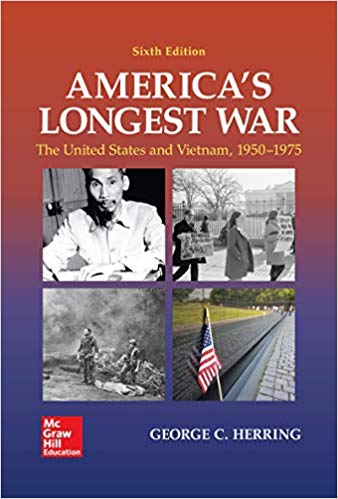
America's Longest War The United States And Vietnam, 1950-1975 6th Edition by George Herring -Test Bank

America's Longest War The United States And Vietnam, 1950-1975 6th Edition by George Herring -Test Bank   Instant Download - Complete Test Bank With Answers     Sample Questions Are Posted Below   America's Longest War, 6e (Herring) Chapter 5   On the Tiger's Back: The United States at War, 1965–1967   1) The United States' …

$19.99

America’s Longest War The United States And Vietnam, 1950-1975 6th Edition by George Herring -Test Bank


Instant Download – Complete Test Bank With Answers


Sample Questions Are Posted Below


America’s Longest War, 6e (Herring)

Chapter 5   On the Tiger’s Back: The United States at War, 1965–1967


1) The United States’ approach to fighting the Vietnam War

  1. A) related American military power to building an effective Vietnamese government.
  2. B) was consciously designed to inflict the maximum number of civilian deaths possible.
  3. C) assumed that applying its superior military power would achieve victory.
  4. D) was more political than military in nature.
  5. E) greatly overestimated North Vietnam’s military strength.


Answer:  C

Accessibility:  Keyboard Navigation


2) The Rolling Thunder bombing campaign

  1. A) had no impact on North Vietnam.
  2. B) inflicted about $600 million in damage to North Vietnam.
  3. C) severely crippled South Vietnam’s agriculture.
  4. D) completely disrupted the infiltration of men and supplies along the Ho Chi Minh Trail.
  5. E) crippled North Vietnam’s well-developed munitions industry through massive strikes.


Answer:  E

Accessibility:  Keyboard Navigation


3) The Johnson Administration’s decision to pursue a gradualist approach to the air war permitted North Vietnam to do all of the following EXCEPT

  1. A) establish a nuclear weapons program.
  2. B) build a powerful air defense system.
  3. C) implement alternative transportation systems.
  4. D) protect critical resources.
  5. E) persist in the war despite the damage the U.S. was inflicting.


Answer:  A

Accessibility:  Keyboard Navigation


4) The USSR began to provide North Vietnam with substantial military assistance beginning in 1965 because

  1. A) it hoped to tie the U.S. down in Southeast Asia so that unopposed Soviet forces could pursue opportunities in Europe and the Middle East.
  2. B) an American defeat in Southeast Asia would set the stage for a real thaw in the Cold War.
  3. C) Moscow wished to prevent America from establishing a strong position on the border of its close fraternal ally, China.
  4. D) assistance to North Vietnam would prove Soviet credibility in the face of hostile Chinese propaganda.
  5. E) None of these.


Answer:  D

Accessibility:  Keyboard Navigation


5) How did Beijing assist North Vietnam in its war with the U.S.?

  1. A) Its fighter aircraft intercepted American attack planes over the Tonkin Gulf.
  2. B) It sent “volunteers” to join People’s Army of Vietnam (PAVN) units fighting in South Vietnam.
  3. C) It provided huge amounts of supplies, munitions, as well as 320,000 troops.
  4. D) Chinese divisions engaged American Marines along the Vietnamese Demilitarized Zone (DMZ).
  5. E) It threatened to invade Taiwan.


Answer:  C

Accessibility:  Keyboard Navigation


6) The Rolling Thunder air war did which of the following?

  1. A) It resulted in the loss of over 950 American aircraft between 1965 and 1968.
  2. B) It only further stimulated the infiltration of men and supplies along the Ho Chi Minh Trail.
  3. C) It gave U.S. Special Ops the opportunity to liberate prisoners of war in Hanoi.
  4. D) Cost the United States $1.00 for each $10 of damage inflicted.
  5. E) Robbed Hanoi of a tremendous propaganda advantage.


Answer:  A

Accessibility:  Keyboard Navigation


7) Through his Search and Destroy strategy, General William Westmoreland

  1. A) abandoned the U.S. Army’s traditional, conventional approach to warfare in favor of a small-unit counterinsurgency strategy.
  2. B) sought to lure North Vietnamese units into populated areas where the U.S. could easily cause their destruction.
  3. C) pursued a typical, conventional strategy designed to eliminate the military threat to South Vietnam.
  4. D) avoided engaging enemy main force units in favor of police activities designed to uproot and destroy the NLF’s political apparatus.
  5. E) launched an entirely novel tank-led invasion across the DMZ into North Vietnam.


Answer:  C

Accessibility:  Keyboard Navigation


8) President Lyndon Johnson’s “many flags” campaign to secure troop commitments to Vietnam from America’s Pacific allies

  1. A) was a resounding success that resulted in large numbers of allied troops joining American forces in South Vietnam.
  2. B) met with sympathetic responses from Eastern European nations of the Warsaw Pact.
  3. C) was publicly supported by American allies, but did not result in the commitment of any soldiers.
  4. D) was a disappointment that resulted in the deployment of only 71,000 troops.
  5. E) sparked unrest and near mutiny among American troops.


Answer:  D

Accessibility:  Keyboard Navigation


9) American forces used which of the following in Vietnam?

  1. A) apple computers programmed to map directions for troops.
  2. B) nerve gasses such as Agent Orange designed to destroy civilians.
  3. C) massive air support including napalm and B-52 raids.
  4. D) huge amounts of submarine deployments.
  5. E) humvee vehicles to guard against IUDs.


Answer:  C

Accessibility:  Keyboard Navigation


10) From 1965 to 1968, North Vietnam

  1. A) matched American escalations by sending more troops south along the Ho Chi Minh Trail.
  2. B) sought to engage in traditional, set-piece battles in which its forces could decisively defeat the Americans.
  3. C) proved unable to match the massive American escalation that took place between 1965 and 1968.
  4. D) sought to minimize combat with the U.S. and South Vietnamese forces so as to keep its casualties down.
  5. E) None of these.


Answer:  A

Accessibility:  Keyboard Navigation


11) The principle index the United States used to chart success in Vietnam was

  1. A) the movement of the front line and the capture of key geographical objectives.
  2. B) a sophisticated measurement of the proportion of loyal to rebellious peasants.
  3. C) the strength and stability of the South Vietnamese government.
  4. D) the “body count.”
  5. E) the number of non-combatants arrested.


Answer:  D

Accessibility:  Keyboard Navigation


12) The American attrition strategy

  1. A) was so destructive that North Vietnam proved unable to replace its losses.
  2. B) quickly turned the tide and gave the United States the strategic advantage.
  3. C) permitted General Westmoreland to put the enemy on the defensive and thereby allowed him to shift forces to the key task of pacification.
  4. D) rapidly decimated the critical NLF political infrastructure.
  5. E) proved able to achieve no more than a stalemate.


Answer:  E

Accessibility:  Keyboard Navigation


13) With the Americanization of the war in 1965, the Army of the Republic of Vietnam (ARVN)

  1. A) became more dependent than ever on the U.S.
  2. B) underwent a period of intensive retooling from which it emerged stronger than ever.
  3. C) was divided into small units that were then integrated into the American command under a system pioneered during the Korean War.
  4. D) shrank dramatically in size to become a highly mobile, elite striking force.
  5. E) undertook a series of spoiler attacks into North Vietnam that threw the enemy off balance.


Answer:  A

Accessibility:  Keyboard Navigation


14) In 1966, Nguyen Cao Ky solidified his political position by

  1. A) having Nguyen Van Thieu assassinated.
  2. B) secretly negotiating with the NLF.
  3. C) holding and winning legitimate, free elections.
  4. D) sending South Vietnamese Marines to Da Nang to put down a Buddhist rebellion.
  5. E) All of these.


Answer:  D

Accessibility:  Keyboard Navigation


15) The Revolutionary Development (RD) program suffered from all of the following EXCEPT

  1. A) difficulties recruiting sufficient personnel.
  2. B) attacks on RD cadre by NLF guerrillas.
  3. C) bureaucratic problems and insufficient funding.
  4. D) boorish behavior by nearby ARVN units that undercut the program’s good work.
  5. E) the efforts of top South Vietnamese officials to turn the RD program into a conduit for lucrative diamond smuggling.


Answer:  E

Accessibility:  Keyboard Navigation


16) The Americanization of the war that began in 1965

  1. A) made an estimated 4 million Vietnamese refugees in their own country.
  2. B) fueled severe crime and corruption.
  3. C) led to an explosion of prostitution and to the creation of seedy bar districts.
  4. D) undermined South Vietnam’s fragile economy.
  5. E) All of these.


Answer:  E

Accessibility:  Keyboard Navigation


17) North Vietnam’s diplomatic position—the Four Points—conditioned negotiations on

  1. A) the rapid withdrawal of U.S. forces from all of Southeast Asia, the deployment of U.N. peacekeepers, free elections, and amnesty for all NLF members.
  2. B) a development loan of $2 billion dollars, the deployment of U.N. peacekeepers, American acceptance of Peaceful Coexistence, and the end of the strategic hamlet program.
  3. C) the withdrawal of American troops from South Vietnam.
  4. D) the immediate reunification of Vietnam.
  5. E) All of these.


Answer:  C

Accessibility:  Keyboard Navigation


18) Antiwar liberals opposed American participation in the war for all of the following reasons EXCEPT

  1. A) their belief that the employment of weapons such as napalm was inhumane.
  2. B) their conviction that America had betrayed its bedrock principles by supporting a corrupt and repressive regime in South Vietnam.
  3. C) their conclusion that U.S. escalation violated a number of international agreements including the United Nations Charter and the 1954 Geneva Accords.
  4. D) their doubts in the validity of the domino theory on which the Johnson Administration justified intervention.
  5. E) their conviction that war and military action was morally wrong under any circumstances.


Answer:  E

Accessibility:  Keyboard Navigation


19) According to the author, the antiwar movement

  1. A) compelled a debate that eventually led policymakers and the public to consider withdrawing.
  2. B) almost single-handedly forced the U.S. to deescalate its involvement in Vietnam.
  3. C) turned the American people against the war and thus encouraged a wavering North Vietnamese government to press on toward victory.
  4. D) had no impact whatsoever on the course of the war.
  5. E) divided America to the point that a civil war nearly erupted in the summer of 1967.


Answer:  A

Accessibility:  Keyboard Navigation


20) In the summer of 1967, General William Westmoreland and the Joint Chiefs of Staff

  1. A) admitted that their program had failed and consequently called for a return to the enclave strategy.
  2. B) asked for 200,000 additional troops, a limited call up of the reserves, and an escalation of the war.
  3. C) demanded a declaration of war designed to rally the American people behind continued involvement.
  4. D) asked President Johnson to seek a diplomatic solution to the war.
  5. E) resigned to protest the President’s refusal to call up the reserves or provide the troops they believed necessary to achieve victory.


Answer:  B

Accessibility:  Keyboard Navigation


21) By the summer of 1967, the chief opponent within the Johnson Administration to the continuation of the Vietnam War was

  1. A) Secretary of State Henry Kissinger.
  2. B) Vice President Hubert Humphrey.
  3. C) Assistant Secretary of State Chester Bowles.
  4. D) Secretary of Defense Robert McNamara.
  5. E) Senator Ted Kennedy.


Answer:  D

Accessibility:  Keyboard Navigation


22) The San Antonio peace formula

  1. A) conditioned America’s willingness to negotiate on the prior withdrawal of all North Vietnamese forces from South Vietnam.
  2. B) indicated Washington’s willingness to pull all of its ground troops out of South Vietnam in exchange for the start of meaningful negotiations.
  3. C) made clear America’s willingness to stop the bombing campaign “with the understanding” that meaningful discussions would follow.
  4. D) amounted to a complete repudiation of Washington’s prior goal of maintaining a non-Communist South Vietnam.
  5. E) was designed to appease the antiwar movement at home and did not reflect a meaningful change in America’s bargaining position.


Answer:  C

Accessibility:  Keyboard Navigation


23) The CIA’s Operation CHAOS

  1. A) was illegal and a violation of the agency’s charter.
  2. B) uncovered links between Hanoi and the peace movement.
  3. C) provided overwhelming evidence that most major antiwar groups were under the direct control of the USSR.
  4. D) was an ugly but necessary action during time of war.
  5. E) effectively broke the back of the NLF’s political organization in the Mekong Delta.


Answer:  A

Accessibility:  Keyboard Navigation


24) Waging Peace Please read the exchange of letters between American President Lyndon Johnson and North Vietnamese President Ho Chi Minh that took place in February 1967:


http://www.fordham.edu/halsall/mod/1967-vietnam-letters1.html.


  1. What recent North Vietnamese statements spurred President Johnson to initiate this peace initiative? What difficulties did Johnson believe were inherent in the North Vietnamese proposal?
  2. What proposal did President Johnson make to break the diplomatic logjam and to start meaningful negotiations between North Vietnam and the United States?
  3. In his response to President Johnson, which nation did President Ho Chi Minh cast as the aggressor in the Vietnam War? In general, how did he characterize the conflict? Explain.
  4. Was there any common ground in the two leaders’ proposals? Whose proposal do you find more reasonable? Why?
  5. If you were President of North Vietnam, would you have pursued a more conciliatory diplomatic line than President Ho Chi Minh? Explain.


Accessibility:  Keyboard Navigation

Additional information

Add Review

Your email address will not be published. Required fields are marked *