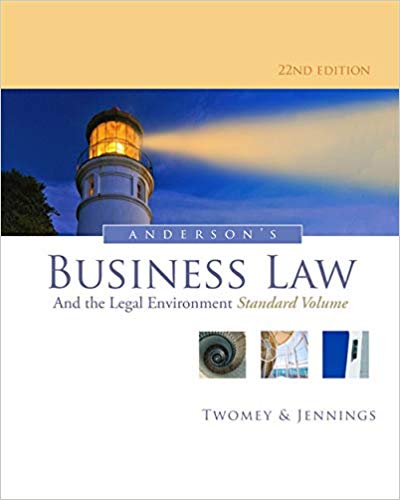
Anderson's Business Law and the Legal Environment Standard Volume, 22nd Edition by David P. Twomey - Test Bank

Anderson's Business Law and the Legal Environment Standard Volume, 22nd Edition by David P. Twomey - Test Bank   Instant Download - Complete Test Bank With Answers     Sample Questions Are Posted Below   Chapter 4—THE CONSTITUTION AS THE FOUNDATION OF THE LEGAL ENVIRONMENT   TRUE/FALSE   In a federal system, a central government …

$19.99

Anderson’s Business Law and the Legal Environment Standard Volume, 22nd Edition by David P. Twomey – Test Bank


Instant Download – Complete Test Bank With Answers


Sample Questions Are Posted Below


Chapter 4—THE CONSTITUTION AS THE FOUNDATION OF THE LEGAL ENVIRONMENT


TRUE/FALSE


  1. In a federal system, a central government is given power to act nationally, while states administer to local concerns.


ANS:  T                    MSC:  AACSB Analytic


  1. A constitution is the written document that establishes the structure of the government and its relationship to the people.


ANS:  T                    MSC:  AACSB Analytic


  1. The United States utilizes a tripartite division of government.


ANS:  T                    MSC:  AACSB Analytic


  1. The powers given by the federal government to the states are described as delegated powers.


ANS:  F                    MSC:  AACSB Analytic


  1. Some of the powers delegated to the national government still may be exercised by the states.


ANS:  T                    MSC:  AACSB Analytic


  1. The power of the states to adopt laws to protect the general welfare of the people is called police power.


ANS:  T                    MSC:  AACSB Analytic


  1. Ex post facto laws can be adopted by either states or the national government.


ANS:  F                    MSC:  AACSB Analytic


  1. The Constitution took certain powers away from the national government and gave them to the state governments.


ANS:  F                    MSC:  AACSB Analytic


  1. Silence of Congress indicates that Congress is unwilling to make changes to an existing law.


ANS:  F                    MSC:  AACSB Analytic


  1. When there is a direct conflict between a federal and a state law, federal law prevails under the supremacy clause.


ANS:  T                    MSC:  AACSB Analytic


  1. ”Preemption” means that the federal regulatory scheme is controlling.


ANS:  T                    MSC:  AACSB Analytic


  1. The Constitution may be amended, but it always has been interpreted in the same way.


ANS:  F                    MSC:  AACSB Analytic


  1. Changes to the Constitution have been brought about by interpretation, amendment, and practice.


ANS:  T                    MSC:  AACSB Analytic


  1. Under the “bedrock view,” the purpose of a constitution is to state certain fundamental principles for all time.


ANS:  T                    MSC:  AACSB Analytic


  1. For the past century, the United States Supreme Court has generally followed the “living document” view in interpreting the Constitution.


ANS:  T                    MSC:  AACSB Analytic


  1. The greatest change to the Constitution has been made by the United States Supreme Court through interpretation.


ANS:  T                    MSC:  AACSB Analytic


  1. Many changes have been made to the Constitution by the constitutional method of amending.


ANS:  F                    MSC:  AACSB Analytic


  1. One of the characteristics of the “living” Constitution is limited government.


ANS:  F                    MSC:  AACSB Analytic


  1. When it comes to the constitution, stability is more important than flexibility.


ANS:  F                    MSC:  AACSB Analytic


  1. The living Constitution has as a characteristic a strong president.


ANS:  T                    MSC:  AACSB Analytic


  1. When we speak of government regulation of business we ordinarily mean state government regulation, not federal government intervention.


ANS:  F                    MSC:  AACSB Analytic


  1. Administrative agencies are, in effect, a fourth branch of the government.


ANS:  T                    MSC:  AACSB Analytic


  1. Because the power to regulate interstate commerce has been interpreted broadly, Congress has great power to adopt regulatory laws affecting the economy.


ANS:  T                    MSC:  AACSB Analytic


  1. Pursuant to the commerce clause, the United States Supreme Court has the power “to regulate commerce with foreign nations, and among the several states, and with the Indian tribes.”


ANS:  F                    MSC:  AACSB Analytic


  1. When the federal government deregulates an industry, the states automatically have the power to regulate the same industry.


ANS:  F                    MSC:  AACSB Analytic


  1. The states may coin money as long as it is backed by gold.


ANS:  F                    MSC:  AACSB Analytic


  1. The Fifth and Fourteenth Amendments prohibit the national and state governments from depriving any person of property without due process of law.


ANS:  T                    MSC:  AACSB Analytic


  1. The Constitution prohibits state governments from denying any person the equal protection of the law.


ANS:  T                    MSC:  AACSB Analytic


  1. The Constitution prohibits discrimination based on reasonable classification.


ANS:  F                    MSC:  AACSB Analytic


  1. The purpose of the first ten amendments to the Constitution was to enlarge the power of the federal government.


ANS:  F                    MSC:  AACSB Analytic


  1. All current rights against governmental intrusion are expressly stated in the Constitution.


ANS:  F                    MSC:  AACSB Analytic


  1. The Bill of Rights provides protection for corporations.


ANS:  T                    MSC:  AACSB Analytic


MULTIPLE CHOICE


  1. A system in which a central government is given power to administer to national concerns and individual states administer to local concerns is called:
a. bicameral.
b. constitutional.
c. federal.
d. tripartite.


ANS:  C                    MSC:  AACSB Analytic


  1. The U.S. Constitution:
a. is unwritten.
b. was brought over from England in its entirety.
c. is a written document that specifies the structure of the government.
d. prohibits the states from having their own constitutions.


ANS:  C                    MSC:  AACSB Analytic


  1. The legislative branch of government has the function of:
a. making laws.
b. executing the laws.
c. interpreting the laws.
d. all of the above.


ANS:  A                    MSC:  AACSB Analytic


  1. Judges of the United States:
a. are appointed by the president, with the approval of the Senate.
b. are appointed by the Senate, with the approval of the president.
c. cannot be impeached.
d. are elected by the public.


ANS:  A                    MSC:  AACSB Analytic


  1. A law to declare war:
a. can be enacted by both state and federal governments.
b. can be enacted only by the national government.
c. can be enacted only by state governments.

ddd.   is prohibited by the U.S. Constitution.


ANS:  B                    MSC:  AACSB Analytic


  1. The power to tax income:
a. is possessed only by the federal government.
b. is possessed only by state governments.
c. may be exercised concurrently by both state and federal governments.
d. is controlled exactly like the power to wage war.


ANS:  C                    MSC:  AACSB Analytic


  1. Federal supremacy refers to:
a. the power of the President.
b. the power of the Supreme Court to make decisions.
c. the power of the federal government to legislate in certain areas.
d. all of the above.


ANS:  C                    MSC:  AACSB Analytic


  1. Federal law __________ conflicting state regulation when a federal law regulates that particular subject.
a. coincides with
b. is subordinate to
c. parallels
d. preempts


ANS:  D                    MSC:  AACSB Analytic


  1. The U.S. Constitution is a document that:
a. is clear in allocating the rights and responsibilities of people and our government.
b. can be interpreted only according to the bedrock principles of 1776.
c. can be interpreted only in accordance with current values.
d. must be interpreted to accommodate both stability and flexibility.


ANS:  D                    MSC:  AACSB Analytic


  1. The U.S. Constitution has been amended:
a. only expressly.
b. only by interpretation.
c. only by practice.
d. by all of the ways listed above.


ANS:  D                    MSC:  AACSB Analytic


  1. The greatest changes to the written Constitution have been brought about by:
a. departure by treaty.
b. judicial interpretation.
c. constitutional amendment.
d. amendment by practice.


ANS:  B                    MSC:  AACSB Analytic


  1. When the president negotiates a treaty with a foreign country and submits it to the Senate for approval, the president’s action is:
a. an express Constitutional amendment.
b. an amendment by judicial interpretation.
c. an amendment by practice.
d. the power of manifest destiny.


ANS:  C                    MSC:  AACSB Analytic


  1. The “living” Constitution has which of the following characteristics?
a. strong federal government
b. strong president
c. various administrative agencies with significant power
d. all of the above


ANS:  D                    MSC:  AACSB Analytic


  1. Which of the following is not characteristic of the “living” Constitution?
a. strong government
b. strong President
c. administrative agencies
d. states’ powers equal to federal powers


ANS:  D                    MSC:  AACSB Analytic


  1. Which of the following is true about administrative agencies?
a. Administrative agencies exercise powers guaranteed to them in the U.S. Constitution.
b. Administrative agencies exercise powers allocated to them by the president.
c. Administrative agencies make decisions that are rarely reviewed by the courts.
d. Administrative agencies make decisions that are effectively reviewed by voters.


ANS:  C                    MSC:  AACSB Analytic


  1. The commerce clause of the Constitution:
a. prohibits the U.S. government from engaging in interstate commerce.
b. prohibits the U.S. government from regulating interstate commerce.
c. has been expanded by Supreme Court interpretations to give the U.S. government the power to regulate the general welfare of the nation.
d. was declared unconstitutional in 1937.


ANS:  C                    MSC:  AACSB Analytic


  1. Within the past five years, the U.S Supreme Court has:
a. placed some limitations on the commerce clause.
b. increased Congressional authority for all activities that have economic impact.
c. given states the ability to override the federal government on interstate commerce issues.
d. all of the above


ANS:  A                    MSC:  AACSB Analytic


  1. Which of the following statements regarding the commerce clause is FALSE?
a. If the federal government establishes safety device regulations for interstate carriers, a state cannot require different devices.
b. States may not use their tax power for the purpose of discriminating against interstate commerce.
c. The commerce clause empowers Congress to regulate interstate commerce, but not commerce with foreign nations.
d. A state cannot refuse to allow an interstate waste collector to conduct business within the state on the grounds that the state already has enough waste collectors.


ANS:  C                    MSC:  AACSB Analytic


  1. Which of the following powers is not reserved solely to the national government?
a. power to regulate interstate commerce
b. power to tax
c. power to coin money
d. power to borrow money on the credit of the United States


ANS:  B                    MSC:  AACSB Analytic


  1. The due process clause:
a. allows the U.S. government to take private property without due process.
b. allows a state to take private property without due process.
c. provides a guarantee of protection against loss of rights or property without the chance to be heard.
d. does not apply to state governments.


ANS:  C                    MSC:  AACSB Analytic


  1. The concept of equal protection of the law:
a. applies to both state and federal governments.
b. prohibits any classifications whatsoever.
c. applies only to conduct by private parties.
d. does not permit reasonable classifications.


ANS:  A                    MSC:  AACSB Analytic


  1. The equal protection clause:
a. requires all persons to be treated equally even if reasonable grounds for different classifications exist.
b. allows laws that discriminate on the basis of moral standards.
c. requires that a statute be sustained unless it is clearly arbitrary or capricious.
d. allows laws that discriminate on the basis of cultural patterns.


ANS:  C                    MSC:  AACSB Analytic


  1. Which of the following is not protected under the privileges and immunities clause?
a. right to go to another state and make a contract
b. right to go to another state and vote in local elections
c. right to go to another state and purchase property
d. right to go to another state and open a business


ANS:  B                    MSC:  AACSB Analytic


  1. Under the U.S. Constitution:
a. “persons” are expressly protected.
b. particular rights of “persons” are expressly protected.
c. certain rights of “persons” have been implied by the Supreme Court.
d. both b and c.


ANS:  D                    MSC:  AACSB Analytic


CASE


  1. A school district supplied school bus service for all children 12 years of age or under who lived at least one mile from school. This service was provided for transportation to and from school. Joanna was a 13-year-old student who lived in that school district. Joanna’s home was 1.2 miles from school. Her parents brought suit against the school district alleging that Joanna was entitled to school bus service and the failure to provide such service denied her the equal protection of the law. Discuss the probable outcome of the lawsuit.


ANS:

The lawsuit probably will be unsuccessful. The equal protection clause does not require that all persons be treated equally. It requires a reasonable classification of individuals. If there is a rational basis for the classification, it will be permitted. In this case, if there is a rational basis for holding that 13-year-old children are old enough to transport themselves to school, then the regulation will be upheld.


MSC:  AACSB Reflective Thinking | AACSB Analytic


  1. The head of the Department of Transportation reviewed a film that demonstrated the effectiveness of air bags in automobiles. He then passed a rule that Ford Motor Company must retrofit, without charge to the automobile owner, all of its 1985 models as an experiment on the safety of the air bag. Ford refused to do so. The DOT held a hearing and decided to fine Ford $1 million for violating its regulation. A notification of this decision was mailed to Ford. What constitutional issues does this case raise?


ANS:

Adjudicating Ford’s responsibility without a chance for Ford to argue its case violates due process. Requiring Ford to spend its money to add air bags to cars it has already sold also violates due process. Further, it violates equal protection to single out Ford instead of imposing an equal obligation on the entire automobile industry. There is no reasonable basis for applying such a regulation only to Ford.


MSC:  AACSB Reflective Thinking | AACSB Analytic


  1. California passed a law prohibiting any transporting of nuclear waste in the state unless the company doing so is a resident or is owned by residents of California. What constitutional issues does this law raise?


ANS:

Regulation of the production of nuclear energy and the disposal of nuclear waste is an area that has been preempted by federal law. Nuclear waste must often be transported if it is to be effectively stored. The appropriate federal agencies have established rules and regulations. To allow the states to have control would result in a patchwork of various laws throughout the country on a matter of national concern when uniformity is desirable. The commerce clause is interpreted to give the federal government power over matters affecting the general welfare of the nation, such as the production of nuclear energy and its related activities. Consequently, this area is preempted under the supremacy clause. It would further violate the commerce clause of the U.S. Constitution to allow a state to favor its local industries and discriminate against out-of-state businesses.


MSC:  AACSB Reflective Thinking | AACSB Analytic

Additional information

Add Review

Your email address will not be published. Required fields are marked *