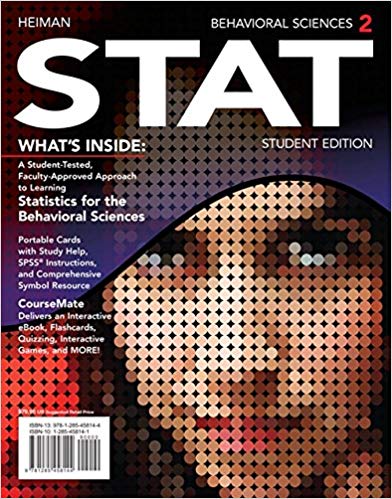
Behavioral Sciences STAT 2nd Edition by Gary Heiman - Test Bank

Behavioral Sciences STAT 2nd Edition by Gary Heiman - Test Bank   Instant Download - Complete Test Bank With Answers     Sample Questions Are Posted Below       Multiple Choice Which of the following is not one of the things the relative frequency of z-scores allows us to calculate for corresponding raw scores? …

$19.99

Behavioral Sciences STAT 2nd Edition by Gary Heiman – Test Bank


Instant Download – Complete Test Bank With Answers


Sample Questions Are Posted Below


Multiple Choice

  1. Which of the following is not one of the things the relative frequency of z-scores allows us to calculate for corresponding raw scores?
    1. Relative frequency
    2. Percentile
    3. Comparison against other variables
    4. Values in terms of goodness or badness


ANSWER:           d

DIFFICULTY:    Moderate

REFERENCES:  p. 69

Understanding z-Scores

KEYWORDS:     relative frequency


  1. Chris wants to calculate a z­score for his own The average height in the class is 66 inches, and Chris’s height

is 62 inches. Chris calculated his z­score to be +1.5. What’s wrong with his calculation?

  1. The z-score is an inappropriate calculation
  2. The z-score should be a higher
  3. He didn’t have the standard
  4. The z-score should be a negative


ANSWER:           d

DIFFICULTY:    Moderate

REFERENCES:  p. 70

Understanding z-Scores

KEYWORDS:     z-score


  1. Pat’s last statistics test score was If the instructor tells Pat the grade distribution was approximately normal, the

class mean was 67, and the standard deviation was 3, which of the following is correct?

  1. A score of 72 is never
  2. Pat should be worried about this score, because many other students did
  3. Pat should be fairly happy about this score, because many students did not do as
  4. Pat should be ecstatic, because this is obviously one of the highest grades in the


ANSWER:           c

DIFFICULTY:    Difficult

REFERENCES:  p. 70

Understanding z-Scores

KEYWORDS:     z-score


  1. A z­score communicates a raw score’s
    1. absolute
    2. distance from the mean in standard
    3. direction from the standard


ANSWER:                         b DIFFICULTY:                   Easy REFERENCES:  p. 70

Understanding z-Scores

KEYWORDS:     z-score


  1. In sampling distributions, all the samples contain sets of raw scores
    1. with the same
    2. from the same
    3. with the same
    4. that are representative of the population


ANSWER:           b

DIFFICULTY:    Moderate

REFERENCES:  pp. 72-73

Using the z-Distribution to Interpret Scores

KEYWORDS:     sampling distribution


  1. In a z-distribution, the standard deviation will always be
    1. greater than
    2. less than
    3. equal to
    4. equal to


ANSWER:                         c DIFFICULTY:                   Easy REFERENCES:  p. 73

Using the z-Distribution to Interpret Scores

KEYWORDS:     standard deviation


  1. To evaluate a person for possible brain damage, a neuropsychologist gives the person a visual memory test and a

reading test. To compare the person’s performance across these two tests, what should the neuropsychologist do?

  1. Graph the raw score distribution for each test on the same
  2. Calculate a z-score for each
  3. Calculate z-scores for the sample
  4. Find the simple frequency of the person’s raw score for each


ANSWER:                         b DIFFICULTY:                   Easy REFERENCES:  p. 73

Using the z-Distribution to Interpret Scores

KEYWORDS:     compare variabless


  1. A z-score of zero always means
    1. the raw score does not
    2. the raw score exists, but is
    3. the raw score almost never
    4. the raw score is equal to the


ANSWER:                         d DIFFICULTY:                   Easy REFERENCES:  p. 73

Using the z-Distribution to Interpret Scores

KEYWORDS:     z-score


  1. Given a normal distribution, as z­scores’ absolute values increase, those z-scores and the raw scores that correspond to them occur
    1. more
    2. less
    3. more frequently at first and then less
    4. less frequently at first and then more


ANSWER:           b DIFFICULTY:    Easy REFERENCES:  pp. 73-74

Using the z-Distribution to Interpret Scores

KEYWORDS:     z-score


  1. The distribution of z-scores is always
    1. positively
    2. negatively
    3. the same shape as the distribution of raw
    4. more spread out than the distribution of raw


ANSWER:           c

DIFFICULTY:    Moderate

REFERENCES:  p. 74

Using the z-Distribution to Compare Different Variables

KEYWORDS:     distribution


  1. When two normal z-distributions are plotted on the same graph, what can we say about the relative frequency of each z-score?
    1. It will always be the
    2. It will always be
    3. It depends on the raw score
    4. It depends on the raw score standard


ANSWER:           a DIFFICULTY:    Easy REFERENCES:  pp. 74-75

Using the z-Distribution to Compare Different Variables

KEYWORDS:     relative frequency


  1. We can use the standard normal curve as our model for
    1. perfectly normal distributions
    2. perfectly normal distributions only, when transformed to z-scores.
    3. any approximately normal distribution, when transformed to z-scores.
    4. any approximately normal distribution, when transformed to


ANSWER:                         c DIFFICULTY:                   Easy REFERENCES:  p. 75

Using the z-Distribution to Compute Relative Frequency

KEYWORDS:     standard normal curve


  1. For any approximately normal distribution, how can we find the relative frequency of the scores?
    1. Convert the raw scores to z-scores and then use the standard normal
    2. Draw a graph of the raw scores and approximate the area under the
    3. Convert the raw scores to z-scores and then use the standard error of the
    4. Draw a graph of the raw scores and then use the standard error of the


ANSWER:                         a DIFFICULTY:                   Easy REFERENCES:  p. 75

Using the z-Distribution to Compute Relative Frequency

KEYWORDS:     approximate normal distribution


  1. z-scores can be calculated from
    1. any
    2. interval or ratio
    3. nominal or ordinal
    4. the


ANSWER:           b

DIFFICULTY:    Moderate

REFERENCES:  p. 75

Using the z-Distribution to Compute Relative Frequency

KEYWORDS:     z-score


  1. The mean of the sampling distribution of means is always
    1. greater than the population
    2. less than the population
    3. equal to the population
    4. the population mean divided by the square root of


ANSWER:                         c DIFFICULTY:                   Easy REFERENCES:  p. 80

Using z-Scores to Describe Sample Means

KEYWORDS:     sampling distribution of means


  1. Which of the following statements accurately describes the sampling distribution of means?
    1. The distribution of several sample means when an infinite number of samples of the same size N are selected from one raw score
    2. The distribution of all possible sample means when a given finite number of samples of the same size N are selected from one raw score
    3. The distribution of all possible sample means when an infinite number of samples of variously sized Ns are selected from several raw score
    4. The distribution of all possible sample means when an infinite number of samples of the same size N are selected from one raw score


ANSWER:           d

DIFFICULTY:    Moderate

REFERENCES:  pp. 80-81

Using z-Scores to Describe Sample Means

KEYWORDS:     sampling distribution of means


  1. Sampling distributions of means are always
    1. approximately normally
    2. positively
    3. negatively
    4. more variable than the population from which the samples were


ANSWER:           a

DIFFICULTY:    Moderate

REFERENCES:  pp. 80-81

Using z-Scores to Describe Sample Means

KEYWORDS:     sampling distribution of means


  1. Your relative standing informs you
    1. of how your scores compares with the sample or population from which it is
    2. of the significance of your
    3. whether your score is from a sample or a
    4. of surprisingly very


ANSWER:                         a DIFFICULTY:                   Easy REFERENCES:  p. 69

Understanding z-Scores

KEYWORDS:     relative standing


  1. Sally’s z-score on a given measure is -2.5, where the population mean is 5 and the standard deviation is 5. What is Sally’s raw score?
  2. 1.25
  3. 14 c. 3.5 d. 8.75

ANSWER:           a

DIFFICULTY:    Difficult

REFERENCES:  p. 71

Understanding z-Scores

KEYWORDS:     Computing raw score from z-score


  1. You should first transform X to z in all of the following cases except if you seek
    1. X that marks a given relative frequency beyond X in
    2. percentile of an X above the
    3. percentile of an X below the
    4. relative frequency of scores beyond X in


ANSWER:           a

DIFFICULTY:    Difficult

REFERENCES:  p. 78

Using the z-Distribution to Compute Relative Frequency

KEYWORDS:     using the z-table


  1. Another term for the standard deviation of the sampling distribution of means is known as
    1. the standard error of the
    2. the central limit
    3. relative
    4. the sampling distribution of


ANSWER:                         a DIFFICULTY:                   Easy REFERENCES:  p. 81

Using z-Scores to Describe Sample Means

KEYWORDS:     the standard error of the mean


  1. The central limit theorem is particularly helpful in terms of understanding the basic nature of
    1. normal
    2. statistical
    3. measurement
    4. statistical


ANSWER:                         a DIFFICULTY:                   Easy REFERENCES:  p. 80

Using z-Scores to Describe Sample Means


  1. Suppose the population mean of some measure is 6 and the population standard deviation is For a sample of 36, what is the standard error of the mean?
    1. 2
    2. 1 1/6 d. 1/2

ANSWER:           a

DIFFICULTY:    Moderate

REFERENCES:  p. 81

Using z-Scores to Describe Sample Means

KEYWORDS:     standard error of the mean


Subjective Short Answer

  1. For a distribution with = 50 and  = 5, find the z-score for a raw score of

ANSWER:           3

DIFFICULTY:    Moderate

REFERENCES:  p. 70

Understanding z-Scores

KEYWORDS:     z-score


  1. The sample mean for a recent introductory psychology test was 78, and the sample variance was If a student

received a score of 82, what was this student’s z-score?

ANSWER:           1.33

DIFFICULTY:    Moderate

REFERENCES:  p. 70

Understanding z-Scores

KEYWORDS:     z-score


  1. For the following set of scores, what is the z-score for a raw score of 23?


22, 23, 19, 25, 26, 22, 19, 25
22, 20, 21, 23, 23, 24, 18, 20,
22, 24, 21, 21, 20, 24, 22, 21,
23              

ANSWER:          0.50

DIFFICULTY:    Difficult

REFERENCES:  p. 70

Understanding z-Scores

KEYWORDS:     z-score


  1. For a distribution with = 50 and  = 5, find the z-score for a raw score of

ANSWER:                         0 DIFFICULTY:                   Easy REFERENCES:  p. 70

Understanding z-Scores

KEYWORDS:     z-score


  1. Jason’s z-score for his time in the 10-K race was − If the raw score standard deviation was 5 and the mean running time for the competitors was 55 minutes, what was his raw score?

ANSWER:           40 minutes DIFFICULTY:                     Moderate REFERENCES:  p. 71

Understanding z-Scores

KEYWORDS:     raw score


  1. For a distribution with = 50 and  = 5, find the raw score for z­score of –1.2.

ANSWER:           44.00

DIFFICULTY:    Moderate

REFERENCES:  p. 71

Understanding z-Scores

KEYWORDS:     raw score


  1. For a distribution with = 50 and  = 5, find the raw score for z-score of +2.6.

ANSWER:           63.00

DIFFICULTY:    Moderate

REFERENCES:  p. 71

Understanding z-Scores

KEYWORDS:     raw score


  1. The sample mean for a recent introductory psychology test was 78, and the sample variance was If a student’s z– score = 2.0, what was this student’s raw test score?

ANSWER:           72

DIFFICULTY:    Moderate

REFERENCES:  p. 71

Understanding z-Scores

KEYWORDS:     raw score


  1. If raw scores ranging from 1 to 50 represented all the corresponding negative z-scores on the distribution, and raw scores ranging from 50 to 100 represented all the corresponding positive z-scores, what would be the total relative frequency of 50 to 100?

ANSWER:           0.50

DIFFICULTY:    Moderate

REFERENCES:  p. 73

Using the z-Distribution to Interpret Scores

KEYWORDS:     relative frequency


  1. If there were 500 students in Jamal’s class, approximately how many actual students scored higher than Jamal on

the quiz if Jamal had a z-score of −1?

ANSWER:           420

DIFFICULTY:    Difficult

REFERENCES:  p. 73

Using the z-Distribution to Interpret Scores

KEYWORDS:     z-score

  1. Using the appropriate values from the z-table, find the area for scores greater than z = +0.89. ANSWER: 1867

DIFFICULTY:    Easy

REFERENCES:  p. 77

Using the z-Distribution to Compute Relative Frequency

KEYWORDS:     area


  1. What raw score is at the 34th percentile (34.13 to be exact) when the mean of the distribution is 50 and the standard deviation is 4?

ANSWER:           46

DIFFICULTY:    Moderate

REFERENCES:  p. 77

Using the z-Distribution to Compute Relative Frequency

KEYWORDS:     raw score


  1. For a z-score of 53, what is the area between the mean and the z-score? ANSWER: 0.4943

DIFFICULTY:    Moderate

REFERENCES:  pp.77-78

Using the z-Distribution to Compute Relative Frequency

KEYWORDS:     area


  1. For a z-score of 63, what is the area beyond the z-score in the tail?

ANSWER:           0.2643

DIFFICULTY:    Moderate

REFERENCES:  pp. 77-78

Using the z-Distribution to Compute Relative Frequency

KEYWORDS:     area


  1. For a z-score of 80, what is the area beyond the z-score in the tail?

ANSWER:          0.0026

DIFFICULTY:    Moderate

REFERENCES:  pp.77-78

Using the z-Distribution to Compute Relative Frequency

KEYWORDS:     area


  1. What is the area below a z-score of 40?

ANSWER:           0.9192

DIFFICULTY:    Moderate

REFERENCES:  pp.77-78

Using the z-Distribution to Compute Relative Frequency

KEYWORDS:     area


  1. What is the area above a z­score of –0.48?

ANSWER:           0.6844

DIFFICULTY:    Moderate

REFERENCES:  pp.77-78

Using the z-Distribution to Compute Relative Frequency

KEYWORDS:     area


  1. What is the area above a z-score of 96?

ANSWER:           0.0250

DIFFICULTY:    Moderate

REFERENCES:  pp.77-78

Using the z-Distribution to Compute Relative Frequency

KEYWORDS:     area


  1. If your sense of direction, relative to a sample of college students, gave you a z-score of +1.5, what is your percentile?

ANSWER:           93rd

DIFFICULTY:    Difficult

REFERENCES:  pp.77-78

Using the z-Distribution to Compute Relative Frequency

KEYWORDS:     percentile


  1. If only the upper 30% of a normally distributed class passed a quiz for which the mean was 70 and the standard deviation was 10, what was the lowest score a student could have received and still have passed?

ANSWER:          75.2

DIFFICULTY:    Difficult

REFERENCES:  pp.77-78

Using the z-Distribution to Compute Relative Frequency

KEYWORDS:     percentile


  1. For the following set of scores, what is the percentile for a score of 24?


22, 23, 19, 25, 26, 22, 19, 25
22, 20, 21, 23, 23, 24, 18, 20,
22, 24, 21, 21, 20, 24, 22, 21,
23              

ANSWER:           84th

DIFFICULTY:    Difficult

REFERENCES:  pp.77-78

Using the z-Distribution to Compute Relative Frequency

KEYWORDS:     percentile


  1. A sampling distribution of means for samples of students taking the SAT exam has a population mean of 500 and a standard error of What proportion of sample means would fall between the population mean and a sample mean of 800?

ANSWER:           0.4332

DIFFICULTY:    Difficult

REFERENCES:  pp.77-78

Using the z-Distribution to Compute Relative Frequency

KEYWORDS:     sample mean


  1. Barbara’s z-score is -1.5. What does this score tell us relative to the mean of the population from which these scores originated?

ANSWER:           Her score is 1.5 standard deviations below the mean.

DIFFICULTY:    Moderate

REFERENCES:  p. 71

Understanding z-Scores

KEYWORDS:     z-scores


  1. What is the standard deviation of any z-distribution? ANSWER: 1

DIFFICULTY:    Easy

REFERENCES:  p. 73

Using the z-Distribution to Interpret Scores

KEYWORDS:     z-scores


  1. Consider the z-scores (in parentheses) for the following individuals: Frank (0.5), Zoe (-1.2), Jimmy (2.9), and Lilly (- 3). Which of these individuals would have (a) the lowest score, (b) highest score, (c) and most common score in the distribution?

ANSWER:           (a) Lilly’s score is lowest; (b) Jimmy’s score is the highest; and (c) Frank’s score is most common.

DIFFICULTY:    Moderate

REFERENCES:  p. 74

Using the z-Distribution to Compare Different Variables

KEYWORDS:     z-distribution


  1. What percentage of scores in a normal distribution fall outside of the range of +3 SDs from the mean?

ANSWER:           .0013%+.0013%=.0026%

DIFFICULTY:    Moderate

REFERENCES:  p. 76

Using the z-Distribution to Compute Relative Frequency

KEYWORDS:     z-distribution


  1. Suppose a standardized test given to ninth-graders in Texas has a mean score of Suppose at a given school in Texas, the ninth-graders have a mean score of 105. Why is this discrepancy present, and is it problematic?

ANSWER:           The discrepancy in scores is not at all necessarily problematic.  The sampling distribution of means suggests that different means on a given measure will be found.  The central limit theorem suggests that, with a given population, the distribution of scores will be normal.

DIFFICULTY:    Moderate

REFERENCES:  pp. 79-80

Using z-Scores to Describe Sample Means

KEYWORDS:     sampling distribution of means; central limit theorem


  1. Suppose you know that a population standard deviation for a given measure is For a sample of 169 subjects who have taken this measure, would would the standard error of the mean be?

ANSWER:           18/13 = 1.38

DIFFICULTY:    Moderate

REFERENCES:  p. 81

Using z-Scores to Describe Sample Means

KEYWORDS:     standard error of the mean


  1. Briefly note the three basic procedures used to describe a sample mean from any underlying raw score

ANSWER:           The three basic steps are to (1) create a sampling distribution of means; (2) Compute the z-score for the sample mean; and (3) use the z-table to determine the relative frequency of the z-score.

DIFFICULTY:    Difficult

REFERENCES:  p. 84

Using z-Scores to Describe Sample Means


  1. Suppose you have a z-score value of You also know the values of the mean of the sampling distribution and the standard error of the mean, both of which are 5. Would would be the sample mean?

ANSWER:           3=(? – 5)/5


sample mean = 20 DIFFICULTY:                          Difficult REFERENCES:  p. 82

Using z-Scores to Describe Sample Means

KEYWORDS:     z-score for a sample mean

Additional information

Add Review

Your email address will not be published. Required fields are marked *