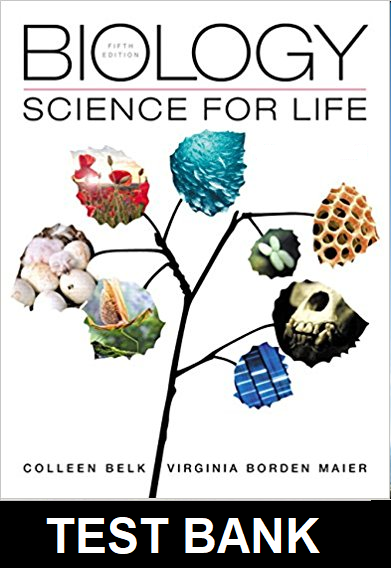
Biology Science for Life 5th Edition by Belk - Test Bank

Biology Science for Life 5th Edition by Belk - Test Bank   Instant Download - Complete Test Bank With Answers     Sample Questions Are Posted Below   Biology: Science for Life with Physiology, 5e (Belk) Chapter 5   Life in the Greenhouse: Photosynthesis and Climate Change   1) Almost all scientists support the idea that …

$19.99

Biology Science for Life 5th Edition by Belk – Test Bank


Instant Download – Complete Test Bank With Answers


Sample Questions Are Posted Below


Biology: Science for Life with Physiology, 5e (Belk)

Chapter 5   Life in the Greenhouse: Photosynthesis and Climate Change


1) Almost all scientists support the idea that the global warming observed over the past 100 years has been caused by elevated levels of gases in the atmosphere. Which gas is primarily responsible for this problem?

  1. A) carbon dioxide
  2. B) nitrous oxide
  3. C) oxygen
  4. D) ozone

Answer:  A

Section:  5.1

Skill:  Knowledge/Comprehension (Remember/Understand)

Learning Outcome:  5.1


2) Which human activity has directly contributed to global warming?

  1. A) burning of coal
  2. B) building of greenhouses
  3. C) planting of trees
  4. D) development of solar energy

Answer:  A

Section:  5.1

Skill:  Knowledge/Comprehension (Remember/Understand)

Learning Outcome:  5.1


3) Which gas is considered a greenhouse gas?

  1. A) water vapor
  2. B) carbon monoxide
  3. C) gaseous nitrogen
  4. D) nitrous oxide

Answer:  A

Section:  5.1

Skill:  Knowledge/Comprehension (Remember/Understand)

Learning Outcome:  5.1


4) What situation would be most similar to the greenhouse effect?

  1. A) heating up the air inside a car by parking it in the sun
  2. B) warming the air for a hot-air balloon with a propane burner
  3. C) burning kerosene in a heater to warm up the air inside a cold house
  4. D) growing plants in your office to reduce indoor air pollution

Answer:  A

Section:  5.1

Skill:  Application/Analysis (Apply/Analyze)

Learning Outcome:  5.1


5) How does the greenhouse effect work?

  1. A) Rocks, soil, and water on Earth’s surface absorb sunlight energy and radiate it as heat.
  2. B) Sunlight energy passes through the transparent water of the oceans and heats up the Earth’s core.
  3. C) Some sunlight that hits Earth radiates toward space, but some is held by the atmosphere.
  4. D) All the sunlight energy striking Earth bounces off the planet and radiates into space.

Answer:  C

Section:  5.1

Skill:  Comprehension/Application (Understand/Apply)

Learning Outcome:  5.1


6) Which statement describes the greenhouse effect?

  1. A) Most life on Earth relies upon the hospitable temperatures resulting from the greenhouse effect.
  2. B) The greenhouse effect is a dangerous phenomenon that should be stopped as soon as possible.
  3. C) The greenhouse effect results from the presence of oxygen in the atmosphere.
  4. D) Global warming is likely the result of a lessening of the greenhouse effect.

Answer:  A

Section:  5.1

Skill:  Knowledge/Comprehension (Remember/Understand)

Learning Outcome:  5.1


7) The planet Mercury is closer to the sun than the planet Venus. However, temperatures on Venus are hotter than temperatures on Mercury. Why would this be the case?

  1. A) Mercury has a thicker atmosphere than Venus that blocks heat from the sun.
  2. B) Mercury spins more quickly than Venus, so its surface cannot heat up as quickly.
  3. C) Venus has a thicker atmosphere than Mercury that traps heat from the sun.
  4. D) Venus is cooled by high concentrations of water vapor in its atmosphere.

Answer:  C

Section:  5.1

Skill:  Application/Analysis (Apply/Analyze)

Learning Outcome:  5.1


8) How would Earth change if the greenhouse effect didn’t exist at all?

  1. A) Earth would radiate most of its heat energy into space.
  2. B) All incoming sunlight energy would be absorbed.
  3. C) Earth would be an extremely hot planet that never cools down.
  4. D) Animals and plants would survive comfortably and average temperatures would never change.

Answer:  A

Section:  5.1

Skill:  Application/Analysis (Apply/Analyze)

Learning Outcome:  5.1


9) Which definition describes “heat”?

  1. A) the rate that molecules are moving within a substance
  2. B) the resistance to temperature change within a substance
  3. C) the ability of a substance to transfer energy between its molecules
  4. D) the total amount of energy associated with the movement of molecules in a substance

Answer:  D

Section:  5.1

Skill:  Knowledge/Comprehension (Remember/Understand)

Learning Outcome:  5.2


10) What does temperature measure?

  1. A) the potential energy in a substance
  2. B) how fast the molecules in a substance are moving
  3. C) the energy lost from a substance to its surroundings
  4. D) how much heat is being absorbed by a substance

Answer:  B

Section:  5.1

Skill:  Knowledge/Comprehension (Remember/Understand)

Learning Outcome:  5.2


11) Which item would probably contain the most heat?

  1. A) a cup of coffee that is 140 degrees F
  2. B) a person that is 98.6 degrees F
  3. C) a large lake filled with water that is 72 degrees F
  4. D) a smoldering campfire ember that is 400 degrees F

Answer:  C

Section:  5.1

Skill:  Comprehension/Application (Understand/Apply)

Learning Outcome:  5.2


12) What happens when water is heated?

  1. A) It’s broken into hydrogen and oxygen atoms.
  2. B) New hydrogen bonds are created between water molecules.
  3. C) Hydrogen bonds between water molecules are broken.
  4. D) Hydrogen atoms jump from one water molecule to another water molecule.

Answer:  C

Section:  5.1

Skill:  Comprehension/Application (Understand/Apply)

Learning Outcome:  5.2


13) What process occurs as individual water molecules move fast enough to rise into the air as water vapor?

  1. A) condensation
  2. B) combustion
  3. C) evaporation
  4. D) precipitation

Answer:  C

Section:  5.1

Skill:  Knowledge/Comprehension (Remember/Understand)

Learning Outcome:  5.2

14) Which process of the water cycle releases heat into the atmosphere?

  1. A) condensation
  2. B) runoff
  3. C) evaporation
  4. D) ground-water discharge

Answer:  A

Section:  5.1

Skill:  Knowledge/Comprehension (Remember/Understand)

Learning Outcome:  5.2


15) Why is water so important in controlling Earth’s climate?

  1. A) Water vapor is one of the greenhouse gases that allows the release of heat into space.
  2. B) The water in oceans and lakes stores the energy radiated by the sun and releases it slowly.
  3. C) Water warms up quickly when very little energy is added to it.
  4. D) The evaporation of water from oceans and lakes cools the temperature of the continents.

Answer:  B

Section:  5.1

Skill:  Analysis (Analyze)

Learning Outcome:  5.2


16) Why does sweating cool your body?

  1. A) The water in sweat, as it is secreted from skin glands, is cooler than your body temperature.
  2. B) Heat energy from your skin is used to evaporate the water in the sweat.
  3. C) Water in sweat contains hydrogen bonds that react with skin cells and removes excess heat from the skin.
  4. D) Sweat contains a combination of chemicals that react with salt on the skin to create a heat-absorbing substance.

Answer:  B

Section:  5.1

Skill:  Analysis (Analyze)

Learning Outcome:  5.2


17) How might global warming affect the precipitation?

  1. A) Deserts will receive more rainfall.
  2. B) Storms will increase in intensity.
  3. C) Months of snowfall in higher latitudes will increase.
  4. D) Rainfall near oceans will decrease.

Answer:  B

Section:  5.1

Skill:  Application/Analysis (Apply/Analyze)

Learning Outcome:  5.2

18) During what time of the day would the most hydrogen bonds reform between water molecules in a lake?

  1. A) in the late morning
  2. B) at noon
  3. C) in the late afternoon
  4. D) at night

Answer:  D

Section:  5.1

Skill:  Analysis (Analyze)

Learning Outcome:  5.2


19) Which item emits carbon dioxide into the atmosphere?

  1. A) green plants
  2. B) volcanoes
  3. C) soil
  4. D) water

Answer:  B

Section:  5.2

Skill:  Knowledge/Comprehension (Remember/Understand)

Learning Outcome:  5.3


20) During the water cycle, water evaporates from plants through a process called transpiration. Which similar process occurs during the carbon cycle?

  1. A) Carbon dioxide is absorbed by soils.
  2. B) Carbon-based sugars are ingested by animals.
  3. C) Carbon dioxide is respired by animals.
  4. D) Carbon dioxide is absorbed by plants and converted to sugars.

Answer:  C

Section:  5.2

Skill:  Comprehension/Application (Understand/Apply)

Learning Outcome:  5.3


21) Which substance is a fossil fuel?

  1. A) vegetable oil
  2. B) coal
  3. C) hydrogen gas
  4. D) wood

Answer:  B

Section:  5.2

Skill:  Knowledge/Comprehension (Remember/Understand)

Learning Outcome:  5.4


22) What is the basis for fossil fuels?

  1. A) carbon-rich remains of plants and microorganisms
  2. B) underground deposits of carbon dioxide
  3. C) accumulations of partially decomposed dinosaurs
  4. D) timber from old-growth forests

Answer:  A

Section:  5.2

Skill:  Knowledge/Comprehension (Remember/Understand)

Learning Outcome:  5.4

23) What unconsumed macromolecule from dead organisms eventually formed fossil fuels?

Answer:  carbohydrates

Section:  5.2

Skill:  Knowledge/Comprehension (Remember/Understand)

Learning Outcome:  5.4


24) How many years ago did the plants that formed fossil fuels actually live?

  1. A) 300,000,000,000
  2. B) 300,000,000
  3. C) 300,000
  4. D) 30,000

Answer:  B

Section:  5.2

Skill:  Knowledge/Comprehension (Remember/Understand)

Learning Outcome:  5.4


25) What human activities release the majority of the carbon dioxide found in the atmosphere?

  1. A) exhaling (cellular respiration waste products)
  2. B) adding decomposing garbage to landfills
  3. C) burning wood for cooking fires
  4. D) burning fossil fuels

Answer:  D

Section:  5.2

Skill:  Comprehension/Application (Understand/Apply)

Learning Outcome:  5.4


26) What can happen to the carbon dioxide in the atmosphere?

  1. A) It can be released into space from the atmosphere.
  2. B) It can be converted to glucose by plants.
  3. C) It can be converted into carbon monoxide by the oceans.
  4. D) It can react with nitrogen to form fossil fuels.

Answer:  B

Section:  5.2

Skill:  Application/Analysis (Apply/Analyze)

Learning Outcome:  5.3


27) How does carbon move through the carbon cycle?

  1. A) Carbon flows one way from volcanoes to plants to consumers and then to the atmosphere.
  2. B) Carbon is recycled among plants, animals, water, soil, and the atmosphere.
  3. C) Carbon dioxide (CO2) is the only carbon-containing compound involved in the carbon cycle.
  4. D) Exhaled carbon dioxide becomes trapped in the atmosphere, adding to the greenhouse effect.

Answer:  B

Section:  5.2

Skill:  Application/Analysis (Apply/Analyze)

Learning Outcome:  5.3

28) What are the largest reservoirs of carbon dioxide and heat on Earth?

  1. A) the atmosphere
  2. B) the oceans
  3. C) animal bodies
  4. D) fossil fuels

Answer:  B

Section:  5.2

Skill:  Knowledge/Comprehension (Remember/Understand)

Learning Outcome:  5.3


29) According to scientists, how do the levels of carbon dioxide in the atmosphere today compare to the past 400,000 years?

  1. A) There’s more atmospheric carbon dioxide today.
  2. B) There’s less atmospheric carbon dioxide today.
  3. C) There have been no changes in atmospheric carbon dioxide levels.
  4. D) Atmospheric carbon dioxide levels have fluctuated randomly.

Answer:  A

Section:  5.2

Skill:  Comprehension/Application (Understand/Apply)

Learning Outcome:  5.4


30) According to the graph, by how many parts per million has the concentration of atmospheric carbon dioxide changed between 1980 and 2010?

  1. A) about 20 ppm
  2. B) about 50 ppm
  3. C) about 80 ppm
  4. D) about 110 ppm

Answer:  B

Section:  5.2

Skill:  Comprehension/Application (Understand/Apply)

Learning Outcome:  5.4

31) How do scientists estimate the atmospheric levels of carbon dioxide that existed on Earth hundreds or thousands of years ago?

  1. A) They deduce it from the carbon dioxide content of fossil fuels.
  2. B) They measure it from bubbles of gas trapped in Antarctic ice.
  3. C) They estimate it from the relative numbers of carbon-based life forms that existed over time.
  4. D) They measure it from erupting volcanoes, bubbling hot springs, and seeping hydrothermal vents.

Answer:  B

Section:  5.2

Skill:  Comprehension/Application (Understand/Apply)

Learning Outcome:  5.4


32) What relationship has been shown by the data from Antarctic ice cores?

  1. A) a positive correlation between carbon dioxide concentration and ice core temperature
  2. B) a negative correlation between carbon dioxide concentration and ice core temperature
  3. C) no correlation between carbon dioxide concentration and ice core temperature
  4. D) a confusing relationship between carbon dioxide concentration and ice core temperature

Answer:  A

Section:  5.2

Skill:  Application/Analysis (Apply/Analyze)

Learning Outcome:  5.4


33) What process converts carbon dioxide and water into glucose and oxygen?

  1. A) photosynthesis
  2. B) cellular respiration
  3. C) glycolysis
  4. D) fermentation

Answer:  A

Section:  5.3

Skill:  Knowledge/Comprehension (Remember/Understand)

Learning Outcome:  5.5


34) Into what type of energy does the process of photosynthesis transform solar energy?

  1. A) chemical
  2. B) mechanical
  3. C) heat
  4. D) kinetic

Answer:  A

Section:  5.3

Skill:  Knowledge/Comprehension (Remember/Understand)

Learning Outcome:  5.5


35) Inside which specialized organelle does photosynthesis occur?

Answer:  chloroplast

Section:  5.3

Skill:  Knowledge/Comprehension (Remember/Understand)

Learning Outcome:  5.6

36) How many membranes surround each chloroplast?

  1. A) 1
  2. B) 2
  3. C) 3
  4. D) 4

Answer:  B

Section:  5.3

Skill:  Knowledge/Comprehension (Remember/Understand)

Learning Outcome:  5.6


37) Which chloroplast structure increases the amount of surface area that is available for photosynthesis?

  1. A) stroma
  2. B) chlorophyll
  3. C) envelope
  4. D) thylakoid

Answer:  D

Section:  5.3

Skill:  Knowledge/Comprehension (Remember/Understand)

Learning Outcome:  5.6


38) What is the thick fluid found inside chloroplasts?

  1. A) grana
  2. B) stroma
  3. C) chlorophyll
  4. D) thylakoids

Answer:  B

Section:  5.3

Skill:  Knowledge/Comprehension (Remember/Understand)

Learning Outcome:  5.6


39) According to the graph, which wavelengths of light are best absorbed by the chlorophyll pigments found in green leaves?

  1. A) 520 nm
  2. B) 560 nm
  3. C) 620 nm
  4. D) 680 nm

Answer:  D

Section:  5.3

Skill:  Comprehension/Application (Understand/Apply)

Learning Outcome:  5.6


40) Which equation represents photosynthesis?

  1. A) 6CO2+ 6O2 + sunlight → C6H12O6 + 6H2O
  2. B) 6H2O + 6CO2+ sunlight → C6H12O6+ 6O2
  3. C) C6H12O6+ 6O2+ sunlight → 6CO2 + 6H2O
  4. D) O2+ H2O + sunlight → C6H12O6+ CO2

Answer:  B

Section:  5.3

Skill:  Knowledge/Comprehension (Remember/Understand)

Learning Outcome:  5.5


41) What does the glucose molecule supply to cells?

Answer:  energy

Section:  5.3

Skill:  Knowledge/Comprehension (Remember/Understand)

Learning Outcome:  5.5


42) What is the first step of photosynthesis?

  1. A) Calvin cycle
  2. B) light reactions
  3. C) citric acid cycle
  4. D) electron transport chain

Answer:  B

Section:  5.3

Skill:  Knowledge/Comprehension (Remember/Understand)

Learning Outcome:  5.6

43) Where do the light reactions of photosynthesis occur?

  1. A) stroma
  2. B) outer chloroplast membrane
  3. C) thylakoids
  4. D) rubisco

Answer:  C

Section:  5.3

Skill:  Knowledge/Comprehension (Remember/Understand)

Learning Outcome:  5.6


44) What happens first after chlorophyll absorbs light energy?

  1. A) Water splits into H+and O2.
  2. B) Hydrogen ions combine with electrons to produce NADPH.
  3. C) Electrons are released and move to a higher energy level.
  4. D) Carbon dioxide is converted to sugar.

Answer:  C

Section:  5.3

Skill:  Comprehension/Application (Understand/Apply)

Learning Outcome:  5.6


45) When is oxygen produced during the light reactions?

  1. A) NADP+is converted to NADPH.
  2. B) CO2splits apart at the end of the light reactions.
  3. C) Electrons reach the end of the electron transport chain.
  4. D) Water is split to provide replacement electrons to chlorophyll.

Answer:  D

Section:  5.3

Skill:  Comprehension/Application (Understand/Apply)

Learning Outcome:  5.6


46) What energy molecule is produced during the light reactions and helps to power the Calvin cycle?

  1. A) ATP
  2. B) glucose
  3. C) sucrose
  4. D) NADP+

Answer:  A

Section:  5.3

Skill:  Knowledge/Comprehension (Remember/Understand)

Learning Outcome:  5.6


47) Where does the Calvin cycle of photosynthesis occur?

  1. A) stroma
  2. B) outer chloroplast membrane
  3. C) thylakoids
  4. D) rubisco

Answer:  A

Section:  5.3

Skill:  Knowledge/Comprehension (Remember/Understand)

Learning Outcome:  5.7

48) What is the initial carbon-containing starting product in the Calvin cycle?

  1. A) glyceraldehyde 3-phosphate
  2. B) glucose
  3. C) ribulose bisphosphate
  4. D) rubisco

Answer:  C

Section:  5.3

Skill:  Knowledge/Comprehension (Remember/Understand)

Learning Outcome:  5.7


49) What is the abbreviated name of the enzyme ribulose biphosphate carboxylase oxygenase that catalyzes the reaction between carbon dioxide and ribulose bisphosphate?

Answer:  rubisco

Section:  5.3

Skill:  Knowledge/Comprehension (Remember/Understand)

Learning Outcome:  5.7


50) Excess amounts of which sugar are used by plants to make glucose?

  1. A) G3P
  2. B) RuBP
  3. C) NADPH
  4. D) fructose

Answer:  A

Section:  5.3

Skill:  Comprehension/Application (Understand/Apply)

Learning Outcome:  5.7


51) What is the role of NADP in photosynthesis?

  1. A) pick up and drop off electrons
  2. B) phosphorylate ADP to ATP
  3. C) convert carbon dioxide to rubisco
  4. D) absorb sunlight energy

Answer:  A

Section:  5.3

Skill:  Comprehension/Application (Understand/Apply)

Learning Outcome:  5.6


52) Which process occurs during photosynthesis?

  1. A) The light reactions produce NADP from sunlight energy.
  2. B) Carbon dioxide reacts with 5-carbon molecules during the Calvin cycle.
  3. C) ATP is released at the end of the Calvin cycle.
  4. D) Water captures the electrons released from excited chlorophyll pigments.

Answer:  B

Section:  5.3

Skill:  Comprehension/Application (Understand/Apply)

Learning Outcome:  5.7


53) In plant leaves, what are the tiny pores that allow carbon dioxide to enter and oxygen to exit?

Answer:  stomata

Section:  5.4

Skill:  Knowledge/Comprehension (Remember/Understand)

Learning Outcome:  5.8

54) What cells regulate gas exchange by opening and closing the stomata?

Answer:  guard

Section:  5.4

Skill:  Knowledge/Comprehension (Remember/Understand)

Learning Outcome:  5.8


55) During which process does water vapor exit plant stomata?

  1. A) condensation
  2. B) combustion
  3. C) evaporation
  4. D) transpiration

Answer:  D

Section:  5.4

Skill:  Knowledge/Comprehension (Remember/Understand)

Learning Outcome:  5.8


56) What happens during photorespiration?

  1. A) The Calvin cycle produces twice as much glyceraldehyde 3-phosphate (G3P).
  2. B) The enzyme rubisco uses oxygen as its substrate for the reaction with ribulose bisphosphate.
  3. C) Ribulose bisphosphate (RuBP) is broken down into glycolate.
  4. D) A second wave of light reactions occurs to replace the Calvin cycle.

Answer:  B

Section:  5.4

Skill:  Comprehension/Application (Understand/Apply)

Learning Outcome:  5.9


57) What gas do plants release during photorespiration?

  1. A) water vapor
  2. B) oxygen
  3. C) carbon dioxide
  4. D) carbon monoxide

Answer:  C

Section:  5.4

Skill:  Knowledge/Comprehension (Remember/Understand)

Learning Outcome:  5.9


58) When can photorespiration occur in plants?

  1. A) when stomata are closed
  2. B) when oxygen levels inside the leaf are low
  3. C) when the plant is undergoing transpiration
  4. D) during the Calvin cycle

Answer:  A

Section:  5.4

Skill:  Comprehension/Application (Understand/Apply)

Learning Outcome:  5.9

59) Which types of plants undergo the most photorespiration?

  1. A) C2plants
  2. B) C3plants
  3. C) C4plants
  4. D) CAM plants

Answer:  B

Section:  5.4

Skill:  Knowledge/Comprehension (Remember/Understand)

Learning Outcome:  5.9


60) Which plants are best adapted for very dry, hot environments such as deserts?

  1. A) C2plants
  2. B) C3plants
  3. C) C4plants
  4. D) CAM plants

Answer:  D

Section:  5.4

Skill:  Knowledge/Comprehension (Remember/Understand)

Learning Outcome:  5.9


61) What characteristic gives C3 and C4 plants their names?

  1. A) the sequence in which the carbon-containing molecules were discovered
  2. B) the botanically assigned geographic coordinates where the plants are located
  3. C) the first stable carbon compounds that are produced during the second portion of photosynthesis
  4. D) the first carbon compounds that are produced during the light reactions of each type of plant

Answer:  C

Section:  5.4

Skill:  Comprehension/Application (Understand/Apply)

Learning Outcome:  5.9


62) Which plant is most likely to be a C4 plant?

  1. A) switchgrass
  2. B) clover
  3. C) rose
  4. D) cactus

Answer:  A

Section:  5.4

Skill:  Knowledge/Comprehension (Remember/Understand)

Learning Outcome:  5.9


63) What is the role of a CAM plant?

  1. A) It uses 4-carbon sugars to pump carbon dioxide molecules to the Calvin cycle.
  2. B) It is often used in agriculture because of its ability to conserve water.
  3. C) It slows water loss by opening stomata only at night.
  4. D) It tends to grow very slowly because of its inability to undergo the Calvin cycle.

Answer:  C

Section:  5.4

Skill:  Comprehension/Application (Understand/Apply)

Learning Outcome:  5.9


64) Which types of plant stores carbon dioxide as an organic acid in its vacuoles?

  1. A) C2plants
  2. B) C3plants
  3. C) C4plants
  4. D) CAM plants

Answer:  D

Section:  5.4

Skill:  Comprehension/Application (Understand/Apply)

Learning Outcome:  5.9


65) How can deforestation increase global warming?

  1. A) It can decrease the total amount of photosynthesis as C3plants are harvested.
  2. B) It can increase the number of C4plants, thereby increasing photorespiration.
  3. C) It can cause runoff to become more acidic, thereby blocking the uptake of carbon dioxide.
  4. D) It can increase the uptake of carbon dioxide by encouraging the growth of faster growing plants.

Answer:  A

Section:  5.4

Skill:  Application/Analysis (Apply/Analyze)

Learning Outcome:  5.10


66) How might global warming affect an animal species that has narrow temperature requirements?

  1. A) It may cause the expansion of the species’ range.
  2. B) It may cause the extinction of the species.
  3. C) It may reduce the diseases that threaten the species.
  4. D) It may have no effect on the species.

Answer:  B

Section:  5.5

Skill:  Application/Analysis (Apply/Analyze)

Learning Outcome:  5.10


67) How have ocean waters been affected by increased amounts of carbon dioxide in the atmosphere?

  1. A) more acidic
  2. B) more basic
  3. C) closer to neutral in pH
  4. D) richer in aquatic species

Answer:  A

Section:  5.5

Skill:  Application/Analysis (Apply/Analyze)

Learning Outcome:  5.10


68) Which activity could help you to slow the rate of global warming?

  1. A) only buy food in plastic containers
  2. B) drive faster than the speed limit
  3. C) replace an old refrigerator with a new one
  4. D) mow the grass more frequently

Answer:  C

Section:  5.5

Skill:  Application (Apply)

Learning Outcome:  5.10

69) Which person could exert the most influence to speed the reduction of greenhouse gas emissions?

  1. A) individual
  2. B) business owner
  3. C) nonprofit corporation
  4. D) policymaker

Answer:  D

Section:  5.5

Skill:  Application (Apply)

Learning Outcome:  5.10


70) What effect would a decrease in the amount of greenhouse gases in Earth’s atmosphere have?

  1. A) cooler average global temperatures
  2. B) warmer average global temperatures
  3. C) no change in average global temperatures
  4. D) cooler temperatures in the northern hemisphere and warmer temperatures in the southern hemisphere

Answer:  A

Section:  5.5

Skill:  Comprehension/Application (Understand/Apply)

Learning Outcome:  5.10

Additional information

Add Review

Your email address will not be published. Required fields are marked *