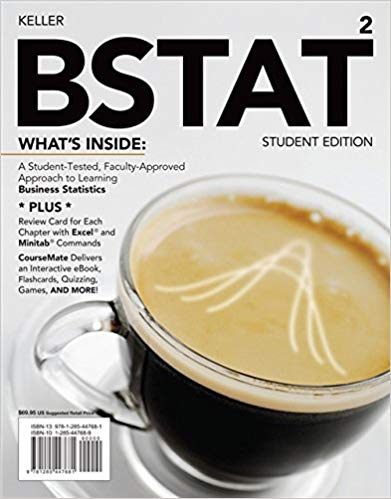
BSTAT2 2nd Edition By Gerald Keller - Test Bank

BSTAT2 2nd Edition By Gerald Keller - Test Bank   Instant Download - Complete Test Bank With Answers     Sample Questions Are Posted Below   CHAPTER 5:  PROBABILITY TRUE/FALSE 1.The relative frequency approach to probability uses long term frequencies, often based on past data. ANS: T NAT: Analytic; Probability Concepts 2.Predicting the outcome of …

$19.99

BSTAT2 2nd Edition By Gerald Keller – Test Bank


Instant Download – Complete Test Bank With Answers


Sample Questions Are Posted Below


CHAPTER 5:  PROBABILITY
TRUE/FALSE
1.The relative frequency approach to probability uses long term frequencies, often based on past data.
ANS: T NAT: Analytic; Probability Concepts
2.Predicting the outcome of a football game is using the subjective approach to probability.
ANS: T NAT: Analytic; Probability Concepts
3.You think you have a 90% chance of passing your next advanced financial accounting exam. This is an example of subjective approach to probability.
ANS: T NAT: Analytic; Probability Concepts
4.P(A) + P(B) = 1 for any events A and B that are mutually exclusive.
ANS: F NAT: Analytic; Probability Concepts
5.The collection of all the possible outcomes of a random experiment is called a sample space.
ANS: T NAT: Analytic; Probability Concepts
6.If events A and B cannot occur at the same time, they are called mutually exclusive.
ANS: T NAT: Analytic; Probability Concepts
7.If either event A or event B must occur, they are called mutually exclusive.
ANS: F NAT: Analytic; Probability Concepts
8.If either event A or event B must occur, then A and B are mutually exclusive and collectively exhaustive events.
ANS: T NAT: Analytic; Probability Concepts
9.If P(A) = 0.4 and P(B) = 0.6, then A and B must be collectively exhaustive.
ANS: F NAT: Analytic; Probability Concepts
10.If P(A) = 0.4 and P(B) = 0.6, then A and B must be mutually exclusive.
ANS: F NAT: Analytic; Probability Concepts
11.The probability of the intersection is called a joint probability.
ANS: T NAT: Analytic; Probability Concepts
12.Two or more events are said to be independent when the occurrence of one event has no effect on the probability that another will occur.
ANS: T NAT: Analytic; Probability Concepts
13.The union of events A and B is the event that occurs when either A or B or both occur. It is denoted as ‘A or B’.
ANS: T NAT: Analytic; Probability Concepts
14.If A and B are independent events with P(A) = 0.35 and P(B) = 0.55, then P(A|B) is 0.35/0.55 = .64.
ANS: F NAT: Analytic; Probability Concepts
15.Two events A and B are said to be independent if P(A|B) = P(B).
ANS: F NAT: Analytic; Probability Concepts
16.The conditional probability of event B given event A is denoted by P(A|B).
ANS: F NAT: Analytic; Probability Concepts
17.If A and B are independent events with P(A) = .40 and P(B) = .50, then P(A and B) = .20.
ANS: T NAT: Analytic; Probability Concepts
18.The intersection of two events A and B is the event that occurs when both A and B occur.
ANS: T NAT: Analytic; Probability Concepts
19.Two events A and B are independent if P(A and B) = 0.
ANS: F NAT: Analytic; Probability Concepts
20.The union of events A and B is the event that occurs when either A or B occurs but not both.
ANS: F NAT: Analytic; Probability Concepts
21.If A and B are independent, then P(A|B) = P(A) or P(B|A) = P(B).
ANS: T NAT: Analytic; Probability Concepts
22.If P(A) = .30, P(B) = .60, and P(A and B) = .20, then P(A|B) = .40.
ANS: F NAT: Analytic; Probability Concepts
23.Suppose the probability that a person owns both a cat and a dog is 0.10. Also suppose the probability that a person owns a cat but not a dog is 0.20. The marginal probability that someone owns a cat is 0.30.
ANS: T NAT: Analytic; Probability Concepts
24.Julius and Gabe go to a show during their Spring break and toss a balanced coin to see who will pay for the tickets. The probability that Gabe will pay three days in a row is 0.125.
ANS: T NAT: Analytic; Probability Concepts
25.If the event of interest is A, the probability that A will not occur is the complement of A.
ANS: T NAT: Analytic; Probability Concepts
26.Assume that A and B are independent events with P(A) = 0.30 and P(B) = 0.50. The probability that both events will occur simultaneously is 0.80.
ANS: F NAT: Analytic; Probability Concepts
27.Two events A and B are said to be independent if P(A) = P(A|B).
ANS: T NAT: Analytic; Probability Concepts
28.When A and B are mutually exclusive, P(A or B) can be found by adding P(A) and P(B).
ANS: T NAT: Analytic; Probability Concepts
29.Two events A and B are said to be independent if P(A|B) = P(B).
ANS: F NAT: Analytic; Probability Concepts
30.If A and B are two independent events with P(A) = 0.9 and P(B|A) = 0.5, then P(A and B) = 0.45.
ANS: T NAT: Analytic; Probability Concepts
31.Two events A and B are said to be independent if P(A|B) = P(B|A).
ANS: F NAT: Analytic; Probability Concepts
32.The probability of the union of two mutually exclusive events A and B is 0.
ANS: F NAT: Analytic; Probability Concepts
33.Two events A and B are said to be mutually exclusive if P(A and B) = 1.0.
ANS: F NAT: Analytic; Probability Concepts
34.If P(A and B) = 1, then A and B must be mutually exclusive.
ANS: F NAT: Analytic; Probability Concepts
35.Events A and B are either independent or mutually exclusive.
ANS: F NAT: Analytic; Probability Concepts
36.If P(B) = .7 and P(B|A) = .4, then P(A and B) must be .28.
ANS: F NAT: Analytic; Probability Concepts
37.If P(B) = .7 and P(A|B) = .7, then P(A and B) = 0.
ANS: F NAT: Analytic; Probability Concepts
38.Conditional probabilities are also called likelihood probabilities.
ANS: T NAT: Analytic; Probability Concepts
39.Prior probability of an event is the probability of the event before any information affecting it is given.
ANS: T NAT: Analytic; Probability Concepts
40.Posterior probability of an event is the revised probability of the event after new information is available.
ANS: T NAT: Analytic; Probability Concepts
41.Prior probability is also called likelihood probability.
ANS: F NAT: Analytic; Probability Concepts
42.In general, a posterior probability is calculated by adding the prior and likelihood probabilities.
ANS: F NAT: Analytic; Probability Concepts
43.We can use the joint and marginal probabilities to compute conditional probabilities, for which a formula is available.
ANS: T NAT: Analytic; Probability Concepts
44.In problems where the joint probabilities are given, we can compute marginal probabilities by adding across rows and down columns.
ANS: T NAT: Analytic; Probability Concepts
45.If joint, marginal, and conditional probabilities are available, only joint probabilities can be used to determine whether two events are dependent or independent.
ANS: F NAT: Analytic; Probability Concepts
46.Suppose we have two events A and B. We can apply the addition rule to compute the probability that at least one of these events occurs.
ANS: T NAT: Analytic; Probability Concepts
47.Posterior probabilities can be calculated using the addition rule for mutually exclusive events.
ANS: F NAT: Analytic; Probability Concepts
48.Prior probabilities can be calculated using the multiplication rule for mutually exclusive events.
ANS: F NAT: Analytic; Probability Concepts
49.We can apply the multiplication rule to compute the probability that two events occur at the same time.
ANS: T NAT: Analytic; Probability Concepts
MULTIPLE CHOICE
50.Of the last 500 customers entering a supermarket, 50 have purchased a wireless phone. If the relative frequency approach for assigning probabilities is used, the probability that the next customer will purchase a wireless phone is
a. 0.10
b. 0.90
c. 0.50
d. None of these choices.
ANS: A NAT: Analytic; Probability Concepts
51.If A and B are mutually exclusive events with P(A) = 0.75, then P(B):
a. can be any value between 0 and 1.
b. can be any value between 0 and 0.75.
c. cannot be larger than 0.25.
d. equals 0.25.
ANS: C NAT: Analytic; Probability Concepts
52.If you roll a balanced die 50 times, you should expect an even number to appear:
a. on every other roll.
b. exactly 50 times out of 100 rolls.
c. 25 times on average, over the long term.
d. All of these choices are true.
ANS: D NAT: Analytic; Probability Concepts
53.An approach of assigning probabilities which assumes that all outcomes of the experiment are equally likely is referred to as the:
a. subjective approach
b. objective approach
c. classical approach
d. relative frequency approach
ANS: C NAT: Analytic; Probability Concepts
54.The collection of all possible outcomes of an experiment is called:
a. a simple event
b. a sample space
c. a sample
d. a population
ANS: B NAT: Analytic; Probability Concepts
55.Which of the following is an approach to assigning probabilities?
a. Classical approach
b. Relative frequency approach
c. Subjective approach
d. All of these choices are true.
ANS: B NAT: Analytic; Probability Concepts
56.A sample space of an experiment consists of the following outcomes: 1, 2, 3, 4, and 5. Which of the following is a simple event?
a. At least 3
b. At most 2
c. 3
d. 15
ANS: C NAT: Analytic; Probability Concepts
57.Which of the following is a requirement of the probabilities assigned to outcome Oi?
a. P(Oi)  0 for each i
b. P(Oi)  1 for each i
c. 0  P(Oi)  1 for each i
d. P(Oi) = 1 for each i
ANS: C NAT: Analytic; Probability Concepts
58.If an experiment consists of five outcomes with P(O1) = 0.10, P(O2) = 0.20, P(O3) = 0.30, P(O4) = 0.25, then P(O5) is
a. 0.75
b. 0.15
c. 0.50
d. Cannot be determined from the information given.
ANS: B NAT: Analytic; Probability Concepts
59.If two events are collectively exhaustive, what is the probability that one or the other occurs?
a. 0.00
b. 0.50
c. 1.00
d. Cannot be determined from the information given.
ANS: D NAT: Analytic; Probability Concepts
60.If two events are collectively exhaustive, what is the probability that both occur at the same time?
a. 0.00
b. 0.50
c. 1.00
d. Cannot be determined from the information given.
ANS: D NAT: Analytic; Probability Concepts
61.If two events are mutually exclusive, what is the probability that one or the other occurs?
a. 0.00
b. 0.50
c. 1.00
d. Cannot be determined from the information given.
ANS: D NAT: Analytic; Probability Concepts
62.If two events are mutually exclusive, what is the probability that both occur at the same time?
a. 0.00
b. 0.50
c. 1.00
d. Cannot be determined from the information given.
ANS: A NAT: Analytic; Probability Concepts
63.If two events are mutually exclusive and collectively exhaustive, what is the probability that both occur?
a. 0.00
b. 0.50
c. 1.00
d. Cannot be determined from the information given.
ANS: A NAT: Analytic; Probability Concepts
64.If the two events are mutually exclusive and collectively exhaustive, what is the probability that one or the other occurs?
a. 0.00
b. 0.50
c. 1.00
d. Cannot be determined from the information given.
ANS: C NAT: Analytic; Probability Concepts
65.If events A and B are mutually exclusive and collectively exhaustive, what is the probability that event A occurs?
a. 0.25
b. 0.50
c. 1.00
d. Cannot be determined from the information given.
ANS: D NAT: Analytic; Probability Concepts
66.If two equally likely events A and B are mutually exclusive and collectively exhaustive, what is the probability that event A occurs?
a. 0.00
b. 0.50
c. 1.00
d. Cannot be determined from the information given.
ANS: B NAT: Analytic; Probability Concepts
67.If event A and event B cannot occur at the same time, then A and B are said to be
a. mutually exclusive
b. independent
c. collectively exhaustive
d. None of these choices.
ANS: A NAT: Analytic; Probability Concepts
68.The collection of all possible events is called
a. an outcome
b. a sample space
c. an event
d. None of these choices.
ANS: B NAT: Analytic; Probability Concepts
69.The probability of the intersection of two events A and B is denoted by P(A and B) and is called the:
a. marginal probability
b. joint probability
c. conditional probability of A given B
d. conditional probability of B given A
ANS: B NAT: Analytic; Probability Concepts
70.The intersection of events A and B is the event that occurs when:
a. either A or B occurs but not both
b. neither A nor B occur
c. both A and B occur
d. All of these choices are true.
ANS: C NAT: Analytic; Probability Concepts
71.The probability of event A gives event B is denoted by
a. P(A and B)
b. P(A or B)
c. P(A|B)
d. P(B|A)
ANS: C NAT: Analytic; Probability Concepts
72.Which of the following is equivalent to P(A|B)?
a. P(A and B)
b. P(B|A)
c. P(A)/P(B)
d. None of these choices.
ANS: C NAT: Analytic; Probability Concepts
73.Which of the following best describes the concept of marginal probability?
a. It is a measure of the likelihood that a particular event will occur, regardless of whether another event occurs.
b. It is a measure of the likelihood that a particular event will occur, if another event has already occurred.
c. It is a measure of the likelihood of the simultaneous occurrence of two or more events.
d. None of these choices.
ANS: A NAT: Analytic; Probability Concepts
74.If two events are independent, what is the probability that they both occur?
a. 0
b. 0.50
c. 1.00
d. Cannot be determined from the information given
ANS: D NAT: Analytic; Probability Concepts
75.If the outcome of event A is not affected by event B, then events A and B are said to be
a. mutually exclusive
b. independent
c. collectively exhaustive
d. None of these choices.
ANS: B NAT: Analytic; Probability Concepts
76.If A and B are disjoint events with P(A) = 0.70, then P(B):
a. can be any value between 0 and 1
b. can be any value between 0 and 0.70
c. cannot be larger than 0.30
d. cannot be determined with the information given
ANS: C NAT: Analytic; Probability Concepts
77.If P(A) = 0.65, P(B) = 0.58, and P(A and B) = 0.76, then P(A or B) is:
a. 1.23
b. 0.47
c. 0.18
d. 0.11
ANS: B NAT: Analytic; Probability Concepts
78.Suppose P(A) = 0.60, P(B) = 0.85, and A and B are independent. The probability of the complement of the event (A and B) is:
a. .4  .15 = .060
b. 0.40 + .15 = .55
c. 1  (.40 + .15) = .45
d. 1  (.6  .85) = .490
ANS: D NAT: Analytic; Probability Concepts
79.Which of the following statements is correct if the events A and B have nonzero probabilities?
a. A and B cannot be both independent and disjoint
b. A and B can be both independent and disjoint
c. A and B are always independent
d. A and B are always disjoint
ANS: A NAT: Analytic; Probability Concepts
80.A and B are disjoint events, with P(A) = 0.20 and P(B) = 0.30. Then P(A and B) is:
a. 0.50
b. 0.10
c. 0.00
d. 0.06
ANS: C NAT: Analytic; Probability Concepts
81.If P(A) = 0.35, P(B) = 0.45, and P(A and B) = 0.25, then P(A|B) is:
a. 1.4
b. 1.8
c. 0.714
d. 0.556
ANS: D NAT: Analytic; Probability Concepts
82.If A and B are independent events with P(A) = 0.60 and P(A|B) = 0.60, then P(B) is:
a. 1.20
b. 0.60
c. 0.36
d. cannot be determined with the information given
ANS: D NAT: Analytic; Probability Concepts
83.If A and B are independent events with P(A) = 0.20 and P(B) = 0.60, then P(A|B) is:
a. 0.20
b. 0.60
c. 0.40
d. 0.80
ANS: A NAT: Analytic; Probability Concepts
84.If P(A) = 0.25 and P(B) = 0.65, then P(A and B) is:
a. 0.25
b. 0.40
c. 0.90
d. cannot be determined from the information given
ANS: D NAT: Analytic; Probability Concepts
Cars
Suppose X = the number of cars owned by a family in the U.S. The probability distribution of X is shown in the table below.
X 0 1 2 3
Probability 0.56 0.23 0.12 0.09
85.{Car Narrative}What is the chance that a family owns more than one car?
a. 0.23
b. 0.21
c. 0.44
d. None of these choices.
ANS: B NAT: Analytic; Probability Concepts
86.{Cars Narrative} Suppose you choose two families at random. What is the chance that they each own one car? (That means family A owns a car and family B owns a car.)
a. 0.23
b. 0.23 + 0.23 = 0.46
c. 0.23 + 0.23  (0.23)*(0.23) = .4071
d. (0.23)*(0.23) = 0.0529
ANS: D NAT: Analytic; Probability Concepts
87.If the events A and B are independent with P(A) = 0.35 and P(B) = 0.45, then the probability that both events will occur simultaneously is:
a. 0
b. 0.16
c. 0.80
d. Not enough information to tell.
ANS: B NAT: Analytic; Probability Concepts
88.Two events A and B are said to be mutually exclusive if:
a. P(A|B) = 1
b. P(A|B) = P(A)
c. P(A and B) =1
d. P(A and B) = 0
ANS: D NAT: Analytic; Probability Concepts
89.If P(A) = 0.84, P(B) = 0.76, and P(A or B) = 0.90, then P(A and B) is:
a. 0.06
b. 0.14
c. 0.70
d. 0.83
ANS: C NAT: Analytic; Probability Concepts
90.If A and B are any two events with P(A) = .8 and P(B|A) = .4, then P(A and B) is:
a. .40
b. .32
c. 1.20
d. None of these choices.
ANS: B NAT: Analytic; Probability Concepts
91.If A and B are any two events with P(A) = .8 and P(B|Ac) = .7, then P(Ac and B) is
a. 0.56
b. 0.14
c. 1.50
d. None of these choices.
ANS: B NAT: Analytic; Probability Concepts
92.If P(A) = 0.84, P(B) = 0.76, and P(A or B) = 0.90, then P(A and B) is:
a. 0.06
b. 0.14
c. 0.70
d. 0.83
ANS: C NAT: Analytic; Probability Concepts
93.A posterior probability value is a prior probability value that has been:
a. modified on the basis of new information.
b. multiplied by a conditional probability value.
c. divided by a conditional probability value.
d. added to a conditional probability value.
ANS: A NAT: Analytic; Probability Concepts
94.Initial estimates of the probabilities of events are known as:
a. joint probabilities
b. posterior probabilities
c. prior probabilities
d. conditional probabilities
ANS: C NAT: Analytic; Probability Concepts
COMPLETION
95.A random experiment is an action or process that leads to one of several possible ____________________.
ANS: outcomes
NAT: Analytic; Probability Concepts
96.The outcomes of a sample space must be ____________________, which means that all possible outcomes must be included.
ANS: exhaustive
NAT: Analytic; Probability Concepts
97.The outcomes of a sample space must be ____________________, which means that no two outcomes can occur at the same time.
ANS: mutually exclusive
NAT: Analytic; Probability Concepts
98.A(n) ____________________ of a random experiment is a list of all possible outcomes of the experiment.
ANS: sample space
NAT: Analytic; Probability Concepts
99.The outcomes of a sample space must be ____________________ and ____________________.
ANS:
exhaustive; mutually exclusive
mutually exclusive; exhaustive
NAT: Analytic; Probability Concepts
100.There are ____________________ requirements of probabilities for the outcomes of a sample space.
ANS:
two
2
NAT: Analytic; Probability Concepts
101.An individual outcome of a sample space is called a(n) ____________________ event.
ANS: simple
NAT: Analytic; Probability Concepts
102.A(n) ____________________ is a collection or set of one or more simple events in a sample space.
ANS: event
NAT: Analytic; Probability Concepts
103.The probability of an event is the ____________________ of the probabilities of the simple events that constitute the event.
ANS: sum
NAT: Analytic; Probability Concepts
104.No matter which approach was used to assign probability (classical, relative frequency, or subjective) the one that is always used to interpret a probability is the ____________________ approach.
ANS: relative frequency
NAT: Analytic; Probability Concepts
105.The ____________________ of events A and B is the event that occurs when both A and B occur.
ANS: intersection
NAT: Analytic; Probability Concepts
106.The probability of an intersection of two events is called a(n) ____________________ probability.
ANS: joint
NAT: Analytic; Probability Concepts
107.Suppose two events A and B are related. The ____________________ probability of A is the probability that A occurs, regardless of whether event B occurred or not.
ANS: marginal
NAT: Analytic; Probability Concepts
108.If two events are mutually exclusive, their joint probability is ____________________.
ANS:
zero
0
NAT: Analytic; Probability Concepts
109.A conditional probability of A given B is written in probability notation as ____________________.
ANS: P(A|B)
NAT: Analytic; Probability Concepts
110.If A and B are independent, then P(A|B) = ____________________.
ANS: P(A)
NAT: Analytic; Probability Concepts
111.The ____________________ of two events A and B is the event that occurs when either A or B or both occur.
ANS: union
NAT: Analytic; Probability Concepts
112.If A and B are mutually exclusive, their joint probability is ____________________.
ANS:
0
zero
NAT: Analytic; Probability Concepts
113.P(A|B) is the conditional probability of ____________________ given ____________________.
ANS: A; B
NAT: Analytic; Probability Concepts
114.If P(A|B) = P(A) then events A and B are ____________________.
ANS: independent
NAT: Analytic; Probability Concepts
115.The ____________________ rule says that P(Ac) = 1  P(A).
ANS: complement
NAT: Analytic; Probability Concepts
116.The ____________________ rule is used to calculate the joint probability of two events.
ANS: multiplication
NAT: Analytic; Probability Concepts
117.If A and B are ____________________ events, the joint probability of A and B is the product of the probabilities of those two events.
ANS: independent
NAT: Analytic; Probability Concepts
118.The ____________________ rule is used to calculate the probability of the union of two events.
ANS: addition
NAT: Analytic; Probability Concepts
119.If A and B are ____________________ then the probability of the union of A and B is the sum of their individual probabilities.
ANS: mutually exclusive
NAT: Analytic; Probability Concepts
120.The first set of branches of a probability tree represent ____________________ probabilities.
ANS: marginal
NAT: Analytic; Probability Concepts
121.The second set of branches of a probability tree represent ____________________ probabilities.
ANS: conditional
NAT: Analytic; Probability Concepts
122.When you multiply a first level branch with a second level branch on a probability tree you get a(n) ____________________ probability.
ANS: joint
NAT: Analytic; Probability Concepts
123.If two events are complements, their probabilities sum to ____________________.
ANS:
one
1
NAT: Analytic; Probability Concepts
124.If two events are mutually exclusive their joint probability is ____________________.
ANS:
zero
0
NAT: Analytic; Probability Concepts
SHORT ANSWER
125.Alana, Eva, and Stephanie, three candidates for the presidency of a college’s student body, are to address a student forum. The forum’s organizer is to select the order in which the candidates will give their speeches, and must do so in such a way that each possible order is equally likely to be selected.
a. What is the random experiment?
b. List the outcomes in the sample space.
c. Assign probabilities to the outcomes.
d. What is the probability that Stephanie will speak first?
e. What is the probability that Alana will speak before Stephanie does?
ANS:
a. The random experiment is to observe the order in which the three candidates give their speeches.
b. S = {ABC, ACB, BAC, BCA, CAB, CBA}, where A = Alana, B = Eva, and C = Stephanie.
c. The probability assigned to each outcome is 1/6.
d. P(CAB, CBA) = 1/3
e. P(ABC, ACB, BAC) = 1/2
NAT: Analytic; Probability Concepts
126.There are three approaches to determining the probability that an outcome will occur: classical, relative frequency, and subjective. For each situation that follows, determine which approach is most appropriate.
a. A Russian will win the French Open Tennis Tournament next year.
b. The probability of getting any single number on a balanced die is 1/6.
c. Based on the past, it’s reasonable to assume the average book sales for a certain textbook is 6,500 copies per month.
ANS:
a. subjective
b. classical
c. relative frequency
NAT: Analytic; Probability Concepts
Hobby Shop Sales
Sales records of a hobby shop showed the following number of radio controlled trucks sold weekly for each of the last 50 weeks.
Number of Trucks Sold Number of Weeks
0 20
1 15
2 10
3   4
4   1
127.{Hobby Shop Sales Narrative} Define the random experiment of interest to the store.
ANS:
The random experiment consists of observing the number of trucks sold in any given week.
NAT: Analytic; Probability Concepts
128.{Hobby Shop Sales Narrative} List the outcomes in the sample space.
ANS:
S = {0, 1, 2, 3, 4}
NAT: Analytic; Probability Concepts
129.{Hobby Shop Sales Narrative} What approach would you use in determining the probabilities for next week’s sales? Assign probabilities to the outcomes.
ANS:
The relative frequency approach was used.
Number of Trucks Prob.
0 0.40
1 0.30
2 0.20
3 0.08
4 0.02
NAT: Analytic; Probability Concepts
130.{Hobby Shop Sales Narrative} What is the probability of selling at least two trucks in any given week?
ANS:
P{2, 3, 4} = 0.30
NAT: Analytic; Probability Concepts
131.{Hobby Shop Sales Narrative} What is the probability of selling between 1 and 3 (inclusive) trucks in any given week?
ANS:
P{1,2,3} = 0.58
NAT: Analytic; Probability Concepts
Mutual Fund Price
An investor estimates that there is a 75% chance that a particular mutual fund’s price will increase to $100 per share over the next three weeks, based past data.
132.{Mutual Fund Price Narrative} Which approach was used to produce this figure?
ANS:
The relative frequency approach
NAT: Analytic; Probability Concepts
133.{Mutual Fund Price Narrative} Interpret the 75% probability.
ANS:
We interpret the 75% figure to mean that if we had an infinite number of funds with exactly the same economic and market characteristics as the one the investor will buy, 75% of them will increase in price to $100 over the next three weeks.
NAT: Analytic; Probability Concepts
134.The sample space of the toss of a balanced coin is S = {1, 2, 3, 4, 5, 6}. If the die is balanced, each simple event (outcome) has the same probability. Find the probability of the following events:
a. Rolling an odd number
b. Rolling a number less than or equal to 3
c. Rolling a number greater than or equal to 5
d. Rolling a number between 2 and 5, inclusive.
ANS:
a. 3/6
b. 3/6
c. 2/6
d. 4/6
NAT: Analytic; Probability Concepts
Equity Loan Rates
A survey of banks estimated the following probabilities for the interest rate being charged on a equity loan based on a 30-year loan, based on past records.
Interest Rate 6.0% 6.5% 7.0% 7.5% >7.5%
Probability 0.20 0.23 0.25 0.28 .04
135.{Equity Loan Rates Narrative} If a bank is selected at random from this distribution, what is the probability that the interest rate charged on a home loan exceeds 7.0%?
ANS:
0.32
NAT: Analytic; Probability Concepts
136.{Equity Loan  Rates Narrative} What is the most common interest rate?
ANS:
7.5%, since it occurred 28% of the time.
NAT: Analytic; Probability Concepts
137.{Equity Loan  Rates Narrative} What approach was used in estimating the probabilities for the interest rates?
ANS:
relative frequency approach
NAT: Analytic; Probability Concepts
Tea and Seltzer
Suppose 55 percent of adults drink tea, 45 percent drink seltzer, and 10 percent drink both.
138.{Tea and Seltzer Narrative} What is the probability that a randomly chosen adult does not drink seltzer?
ANS:
.55
NAT: Analytic; Probability Concepts
139.{Tea and Seltzer Narrative} What is the probability that a randomly chosen adult drinks seltzer or tea or both?
ANS:
.90
NAT: Analytic; Probability Concepts
140.{Tea and Seltzer Narrative} What is the probability that a randomly chosen adult doesn’t drink tea or seltzer?
ANS:
.10
NAT: Analytic; Probability Concepts
Club Members
A survey of a club’s members indicates that 50% own a home, 80% own a car, and 90% of the homeowners who subscribe also own a car.
141.{Club Members Narrative} What is the probability that a subscriber owns both a car and a house?
ANS:
.45
NAT: Analytic; Probability Concepts
142.{Club Members Narrative} What is the probability that a club member owns a car or a house, or both?
ANS:
.85
NAT: Analytic; Probability Concepts
143.{Club Members Narrative} What is the probability that a club member owns neither a car nor a house?
ANS:
.15
NAT: Analytic; Probability Concepts
Business Majors
Suppose 30% of business majors major in accounting. You take a random sample of 3 business majors.
144.{Business Majors Narrative} What is the chance that they all major in accounting?
ANS:
.027
NAT: Analytic; Probability Concepts
145.{Business Majors Narrative} What is the chance that at least one majors in accounting?
ANS:
.657
NAT: Analytic; Probability Concepts
146.{Business Majors Narrative} What is the chance that exactly one majors in accounting?
ANS:
.441
NAT: Analytic; Probability Concepts
147.{Business Majors Narrative} What is the chance that none of them major in accounting?
ANS:
.343
NAT: Analytic; Probability Concepts
Drunk Drivers
Five hundred accidents that occurred on a Saturday night were analyzed. Two items noted were the number of vehicles involved and whether alcohol played a role in the accident. The numbers are shown below:
Number of Vehicles Involved
Did alcohol play a role? 1 2 3 Totals
Yes   75 125 50 250
No   50 225 75 350
Totals 125 350 125 600
148.{Drunk Drivers Narrative} What proportion of accidents involved more than one vehicle?
ANS:
475/600 or .79
NAT: Analytic; Probability Concepts
149.{Drunk Drivers Narrative} What proportion of accidents involved alcohol and single vehicle?
ANS:
75/600 or ..125
NAT: Analytic; Probability Concepts
150.{Drunk Drivers Narrative} What proportion of accidents involved alcohol or a single vehicle?
ANS:
300/600 or .50
NAT: Analytic; Probability Concepts
151.{Drunk Drivers Narrative} Given alcohol was involved, what proportion of accidents involved a single vehicle?
ANS:
75/250 or .30
NAT: Analytic; Probability Concepts
152.{Drunk Drivers Narrative} If multiple vehicles were involved, what proportion of accidents involved alcohol?
ANS:
175/475 or .37
NAT: Analytic; Probability Concepts
153.{Drunk Drivers Narrative} If 3 vehicles were involved, what proportion of accidents involved alcohol?
ANS:
50/125 or .40
NAT: Analytic; Probability Concepts
154.{Drunk Drivers Narrative} If alcohol was not involved, what proportion of the accidents were single vehicle?
ANS:
50/350 or .142
NAT: Analytic; Probability Concepts
155.{Drunk Drivers Narrative} If alcohol was not involved, what proportion of the accidents were multiple vehicle?
ANS:
300/350 or .857
NAT: Analytic; Probability Concepts
156.Suppose A and B are two independent events for which P(A) = 0.20 and P(B) = 0.60.
a. Find P(A|B).
b. Find P(B|A).
ANS:
a. 0.20
b. 0.60
NAT: Analytic; Probability Concepts
GPA and Class
A college professor classifies his students according to their grade point average (GPA) and their class rank. GPA is on a 0.0-4.0 scale, and class rank is defined as the under class (freshmen and sophomores) and the upper class (juniors and seniors). One student is selected at random.
GPA
Class Under 2.0 2.0 – 3.0 Over 3.0
Under 0.05 0.25 0.10
Upper 0.10 0.30 0.20
157.{GPA and Class Narrative} If the student selected is in the upper class, what is the probability that her GPA is between 2.0 and 3.0?
ANS:
0.50
NAT: Analytic; Probability Concepts
158.{GPA and Class Narrative} If the GPA of the student selected is over 3.0, what is the probability that the student is in the lower class?
ANS:
0.333
NAT: Analytic; Probability Concepts
159.{GPA and Class Narrative} What is the probability that the student is in the upper class?
ANS:
0.60
NAT: Analytic; Probability Concepts
160.{GPA and Class Narrative} What is the probability that the student has GPA over 3.0?
ANS:
0.30
NAT: Analytic; Probability Concepts
161.{GPA and Class Narrative} What is the probability that the student is in the lower class?
ANS:
0.40
NAT: Analytic; Probability Concepts
162.{GPA and Class Narrative} What is the probability that the student is in the lower class and has GPA over 3.0?
ANS:
0.10
NAT: Analytic; Probability Concepts
163.{GPA and Class Narrative} What is the probability that the student is in the upper class and has GPA under 2.0?
ANS:
10
NAT: Analytic; Probability Concepts
164.{GPA and Class Narrative} Are being in the upper class and having a GPA over 3.0 related? Explain.
ANS:
Yes, since the product of the probabilities of the two events is not equal to the joint probability.
NAT: Analytic; Probability Concepts
Marital Status
An insurance company has collected the following data on the gender and marital status of 600 customers.
Marital Status
Gender Single Married Divorced
Male 50 250 30
Female 100 100 40
Suppose that a customer is selected at random.
165.{Marital Status Narrative} Develop the joint probability table.
ANS:
Gender Single Married Divorced
Male .083 .417 .100
Female .167 .167 .067
NAT: Analytic; Probability Concepts
166.{Marital Status Narrative} Find the probability that the customer selected is a married female.
ANS:
0.167
NAT: Analytic; Probability Concepts
167.{Marital Status Narrative} Find the probability that the customer selected is
a. female and single
b. married if the customer is male.
c. not single
ANS:
a. 0.167
b. 0.695
c. 0.750
NAT: Analytic; Probability Concepts
Financial Consultants
A Financial Consultant has classified his clients according to their gender and the composition of their investment portfolio (primarily bonds, primarily stocks, or a balanced mix of bonds and stocks). The proportions of clients falling into the various categories are shown in the following table:
Portfolio Composition
Gender Bonds Stocks Balanced
Male 0.18 0.20 0.25
Female 0.12 0.10 0.15
One client is selected at random, and two events A and B are defined as follows:
A: The client selected is male.
B: The client selected has a balanced portfolio.
168.{Financial Consultants Narrative} Find the following probabilities:
a. P(A)
b. P(B)
ANS:
a. 0.63
b. 0.40
NAT: Analytic; Probability Concepts
169.{Financial Consultants Narrative} Express each of the following events in words:
a. A or B
b. A and B
ANS:
a. The client selected either is male or has a balanced portfolio or both.
b. The client selected is male and has a balanced portfolio.
NAT: Analytic; Probability Concepts
170.{Financial Consultants Narrative} Find P(A and B).
ANS:
0.25
NAT: Analytic; Probability Concepts
171.{Financial Consultants Narrative} Express each of the following probabilities in words:
a. P(A|B)
b. P(B|A)
ANS:
a. The probability that the client selected is male, if the client has a balanced portfolio.
b. The probability that the client selected has a balanced portfolio, if the client is male.
NAT: Analytic; Probability Concepts
172.{Financial Consultants Narrative} Find the following probabilities:
a. P(A|B)
b. P(B|A)
ANS:
a. 0.625
b. 0.3968
NAT: Analytic; Probability Concepts
173.Suppose A and B are two independent events for which P(A) = 0.20 and P(B) = 0.60.
a. Find P(A and B).
b. Find P(A or B).
ANS:
a. 0.12
b. 0.68
NAT: Analytic; Probability Concepts
College Professorship
A Ph.D. graduate has applied for a job with two colleges: A and B. The graduate feels that she has a 60% chance of receiving an offer from college A and a 50% chance of receiving an offer from college B. If she receives an offer from college B, she believes that she has an 80% chance of receiving an offer from college A. Let A = receiving an offer from college A, and let B = receiving an offer from college B.
174.{College Professorship Narrative} What is the probability that both colleges will make her an offer?
ANS:
(.5)(.8) = 0.40
NAT: Analytic; Probability Concepts
175.{College Professorship Narrative} What is the probability that at least one college will make her an offer?
ANS:
6 + .5  .4 = 0.7
NAT: Analytic; Probability Concepts
176.{College Professorship Narrative} If she receives an offer from college B, what is the probability that she will not receive an offer from college A?
ANS:
1  0.8 = 0.2.
NAT: Analytic; Probability Concepts
177.Suppose P(A) = 0.50, P(B) = 0.40, and P(B|A) = 0.30.
a. Find P(A and B).
b. Find P(A or B).
c. Find P(A|B).
ANS:
a. 0.15
b. 0.75
c. 0.375
NAT: Analytic; Probability Concepts
178.A survey of a magazine’s subscribers indicates that 50% own a house, 80% own a car, and 90% of the homeowners also own a car. What proportion of subscribers:
a. own both a car and a house?
b. own a car or a house, or both?
c. own neither a car nor a house?
ANS:
a. 0.45
b. 0.85
c. 0.15
NAT: Analytic; Probability Concepts
179.Suppose A and B are two mutually exclusive events for which P(A) = 0.30 and P(B) = 0.40.
a. Find P(A and B).
b. Find P(A or B).
c. Are A and B independent events? Explain using probabilities.
ANS:
a. 0
b. 0.70
c. No. P(A and B) = 0 because they are mutually exclusive events. If they were independent events, you would have P(A and B) = P(A) * P(B) = 0.12.
NAT: Analytic; Probability Concepts
180.Suppose P(A) = 0.30, P(B) = 0.50, and P(B|A) = 0.60.
a. Find P(A and B).
b. Find P(A or B).
c. Find P(A|B).
ANS:
a. 0.18
b. 0.62
c. 0.36
NAT: Analytic; Probability Concepts
181.Is it possible to have two events for which P(A) = 0.40, P(B) = 0.50, and P(A or B) = 0.30? Explain.
ANS:
Yes. In this situation, if P(A and B) = 0.60 it works.
NAT: Analytic; Probability Concepts
182.A pharmaceutical firm has discovered a new diagnostic test for a certain disease that has infected 1% of the population. The firm has announced that 95% of those infected will show a positive test result, while 98% of those not infected will show a negative test result.
a. What proportion of people don’t have the disease?
b. What proportion who have the disease test negative?
c. What proportion of those who don’t have the disease test positive?
d. What proportion of test results are incorrect?
e. What proportion of test results are correct?
ANS:
a. 0.99
b. 0.05
c. 0.02
d. 0.0203
e. 0.9797
NAT: Analytic; Probability Concepts
Gender and Marital Status
An insurance company has collected the following data on the gender and marital status of 300 customers.
Marital Status
Gender Single Married Divorced
Male 25 125 30
Female 50   50 20
Suppose that a customer is selected at random.
183.{Gender and Marital Status Narrative} Find the probability that the customer selected is female or divorced.
ANS:
0.50
NAT: Analytic; Probability Concepts
184.{Gender and Marital Status Narrative} Are gender and marital status mutually exclusive? Explain using probabilities.
ANS:
No, since P(female and married) = 0.167 > 0. (Any other combination shows this also.)
NAT: Analytic; Probability Concepts
185.{Gender and Marital Status Narrative} Is marital status independent of gender? Explain using probabilities.
ANS:
No, since P(married / male) = 0.694  P(married) = 0.583. (Any other combination shows this also.)
NAT: Analytic; Probability Concepts
Construction Bids
A construction company has submitted bids on two separate state contracts, A and B. The company feels that it has a 60% chance of winning contract A, and a 50% chance of winning contract B. Furthermore, the company believes that it has an 80% chance of winning contract A if it wins contract B.
186.{Construction Bids Narrative} What is the probability that the company will win both contracts?
ANS:
P(B and A) = P(B) * P(A|B) = (.50)(.80) = .40
NAT: Analytic; Probability Concepts
187.{Construction Bids Narrative} What is the probability that the company will win at least one of the two contracts?
ANS:
P(A or B) = P(A) + P(B)  P(A and B) = .60 + .50  .40 = .70
NAT: Analytic; Probability Concepts
188.{Construction Bids Narrative} If the company wins contract B, what is the probability that it will not win contract A?
ANS:
P(Ac|B) = 1  P(A|B) = 1  .80 = .20
NAT: Analytic; Probability Concepts
189.{Construction Bids Narrative} What is the probability that the company will win at most one of the two contracts?
ANS:
1  P(A and B) = 0.60
NAT: Analytic; Probability Concepts
190.{Construction Bids Narrative} What is the probability that the company will win neither contract?
ANS:
1  P(A or B) = 0.30
NAT: Analytic; Probability Concepts
Condo Sales and Interest Rates
The probability that condo sales will increase in the next 6 months is estimated to be 0.30. The probability that the interest rates on condo loans will go up in the same period is estimated to be 0.75. The probability that condo sales or interest rates will go up during the next 6 months is estimated to be 0.90.
191.{Condo Sales and Interest Rates Narrative} What is the probability that both condo sales and interest rates will increase during the next six months?
ANS:
0.15
NAT: Analytic; Probability Concepts
192.{Condo Sales and Interest Rates Narrative} What is the probability that neither condo sales nor interest rates will increase during the next six months?
ANS:
0.10
NAT: Analytic; Probability Concepts
193.{Condo Sales and Interest Rates Narrative} What is the probability that condo sales will increase but interest rates will not during the next six months?
ANS:
0.15
NAT: Analytic; Probability Concepts
Certification Test
A standard certification test was given at three locations. 1,000 candidates took the test at location A, 600 candidates at location B, and 400 candidates at location C. The percentages of candidates from locations A, B, and C who passed the test were 70%, 68%, and 77%, respectively. One candidate is selected at random from among those who took the test.
194.{Certification Test Narrative} What is the probability that the selected candidate passed the test?
ANS:
(.5)(.7) + (.3)(.68) + (.2)(.77) = 0.708
NAT: Analytic; Probability Concepts
195.{Certification Test Narrative} If the selected candidate passed the test, what is the probability that the candidate took the test at location B?
ANS:
(.3)(.68) / .708 = 0.288
NAT: Analytic; Probability Concepts
196.{Certification Test Narrative} What is the probability that the selected candidate took the test at location C and failed?
ANS:
(.2)(.23) = 0.046
NAT: Analytic; Probability Concepts
Cysts
After researching cysts of a particular type, a doctor learns that out of 10,000 such cysts examined, 1,500 are malignant and 8,500 are benign. A diagnostic test is available which is accurate 80% of the time (whether the cyst is malignant or not). The doctor has discovered the same type of cyst in a patient.
197.{Cysts Narrative} In the absence of any test, what is the probability that the cyst is malignant?
ANS:
M = Malignant, P(M) = .15
NAT: Analytic; Probability Concepts
198.{Cysts Narrative} In the absence of any test, what is the probability that the cyst is benign?
ANS:
B = Benign, P(B) = .85
NAT: Analytic; Probability Concepts
199.{Cysts Narrative} What is the probability that the patient will test positive?
ANS:
P(+) = P(+ and M) + P(+ and B) = P(+/M) · P(M) + P(+/B) · P(B)
= (.80)(.15) + (.20)(.85) = .29
NAT: Analytic; Probability Concepts
200.{Cysts Narrative} What is the probability that the patient will test negative?
ANS:
P() = 1  P(+) = 1  .29 = .71 or
P() = P( and M) + P( and B) = P(/M) · P(M) + P(/B) · P(B)
= (.20)(.15) + (.80)(.85) = .71
NAT: Analytic; Probability Concepts
201.{Cysts Narrative} What is the probability that the patient has a benign tumor if he or she tests positive?
ANS:
P(B/+) = P(+ and B) / P(+) = P(+/B) · P(B) / P(+) = (.20)(.85) / (.29) = .586
NAT: Analytic; Probability Concepts
202.{Cysts Narrative} What is the probability that the patient has a malignant cyst if he or she tests negative?
ANS:
P(M/) = P( and M) / P() = P(/M) · P(M) / P() = (.20)(.15) / (.71) = .042
NAT: Analytic; Probability Concepts
Messenger Service
Three messenger services deliver to a small town in Oregon. Service A has 60% of all the scheduled deliveries, service B has 30%, and service C has the remaining 10%. Their on-time rates are 80%, 60%, and 40% respectively. Define event O as a service delivers a package on time.
203.{Messenger Service Narrative} Calculate P(A and O).
ANS:
P(A and O) = P(A)P(O|A) = (.60)(.80) = 0.48
NAT: Analytic; Probability Concepts
204.{Messenger Service Narrative} Calculate P(B and O).
ANS:
P(B and O) = P(B) P(O|B) = (.30)(.60) = 0.18
NAT: Analytic; Probability Concepts
205.{Messenger Service Narrative} Calculate P(C and O).
ANS:
P(C and O) = P(C)P(O |C) = (.10)(.40) = 0.04
NAT: Analytic; Probability Concepts
206.{Messenger Service Narrative} Calculate the probability that a package was delivered on time.
ANS:
P(O) = P(A and O) + P(B and O) + P(C and O) = .48 + .18 + .04 = 0.70
NAT: Analytic; Probability Concepts
207.{Messenger Service Narrative} If a package was delivered on time, what is the probability that it was service A?
ANS:
P(A|O) = P(A and O) / P(O) = 0.48 / 0.70 = 0.686
NAT: Analytic; Probability Concepts
208.{Messenger Service Narrative} If a package was delivered on time, what is the probability that it was service B?
ANS:
P(B|O) = P(B and O) / P(O) = 0.18 / 0.70 = 0.257
NAT: Analytic; Probability Concepts
209.{Messenger Service Narrative} If a package was delivered on time, what is the probability that it was service C?
ANS:
P(C|O) = P(C and O) / P(O) = 0.04 / 0.70 = 0.057
NAT: Analytic; Probability Concepts
210.{Messenger Service Narrative} If a package was delivered 40 minutes late, what is the probability that it was service A?
ANS:
P(A|Oc) = P(A and Oc) / P(Oc) = (0.60)(0.20) / 0.30 = 0.40
NAT: Analytic; Probability Concepts
211.{Messenger Service Narrative} If a package was delivered 40 minutes late, what is the probability that it was service  B?
ANS:
P(B|Oc) = P(B and Oc) / P(Oc) = (0.30)(0.40) / 0.30 = 0.40
NAT: Analytic; Probability Concepts
212.{Messenger Service Narrative} If a package was delivered 40 minutes late, what is the probability that it was service C?
ANS:
P(C|Oc) = P(C and Oc) / P(Oc) = (0.10)(0.60) / 0.30 = 0.20
NAT: Analytic; Probability Concepts

Additional information

Add Review

Your email address will not be published. Required fields are marked *