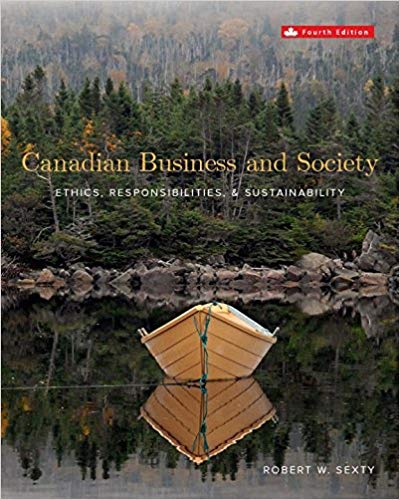
Canadian Business & Society Ethics, Responsibilities And Sustainability 4Th Edition By Robert Sexty - Test Bank

Canadian Business & Society Ethics, Responsibilities And Sustainability 4Th Edition By Robert Sexty - Test Bank   Instant Download - Complete Test Bank With Answers     Sample Questions Are Posted Below   Chapter 05 Ethics of Business: The Theoretical Basis     True / False Questions Ethics is a recent concern for business. FALSE …

$19.99

Canadian Business & Society Ethics, Responsibilities And Sustainability 4Th Edition By Robert Sexty – Test Bank


Instant Download – Complete Test Bank With Answers


Sample Questions Are Posted Below


Chapter 05

Ethics of Business: The Theoretical Basis


True / False Questions

  1. Ethics is a recent concern for business.
    FALSE


Difficulty: Easy
Learning Objective: 05-01 Define the ethics of business.
Topic: 05-01 Introducing the Ethics of Business

  1. The perspective that businesspersons are less ethical than others has been a result of the traditional view of the free enterprise system.
    TRUE


Difficulty: Easy
Learning Objective: 05-01 Define the ethics of business.
Topic: 05-01 Introducing the Ethics of Business

  1. Business ethics is not concerned with rules and guidelines for morally right behaviour.
    FALSE


Difficulty: Easy
Learning Objective: 05-01 Define the ethics of business.
Topic: 05-01 Introducing the Ethics of Business


  1. Adam, a manager, is concerned with how to translate the rules and principles that guide morally appropriate behaviour into decisions that will affect his firm’s product development. He is concerning himself with the ethics of business.
    TRUE


Difficulty: Medium
Learning Objective: 05-01 Define the ethics of business.
Topic: 05-01 Introducing the Ethics of Business

  1. Assessment of the ethical implications of business decisions is a three-stage process.
    FALSE


Difficulty: Medium
Learning Objective: 05-02 Understand the different approaches managers and businesspersons take to assessing the ethical implications of their decisions.
Topic: 05-02 Assessment of Ethical Implications in Business Decisions

  1. Moral standards are the means by which actions are judged.
    TRUE


Difficulty: Easy
Learning Objective: 05-02 Understand the different approaches managers and businesspersons take to assessing the ethical implications of their decisions.
Topic: 05-02 Assessment of Ethical Implications in Business Decisions

  1. Value judgments are based on how society interprets the goals of the firm.
    FALSE


Difficulty: Easy
Learning Objective: 05-02 Understand the different approaches managers and businesspersons take to assessing the ethical implications of their decisions.
Topic: 05-02 Assessment of Ethical Implications in Business Decisions


  1. When Julio was a child, he witnessed the suffering his father experienced after being laid off. Today, as a manager, he is determined to never layoff a worker if he can help it. This conviction represents the influence of individual morals on ethical decision-making.
    TRUE


Difficulty: Medium
Learning Objective: 05-03 Identify the influences on ethical behaviour and define ethical relativism.
Topic: 05-03 Influences on Ethical Behaviour

  1. Kim is surprised when doing business in another country that the workers seemed to believe that they have a right to have their jobs. His experience in Canada was always that employees didn’t feel they “owned” their positions. This experience represents the influence of national and ethnic cultures on ethical behaviour.
    FALSE


Difficulty: Medium
Learning Objective: 05-03 Identify the influences on ethical behaviour and define ethical relativism.
Topic: 05-03 Influences on Ethical Behaviour

  1. Francois was shocked by the hiring practice of his closest competitive rival. He would never have thought of directly recruiting his competitor’s employees, but that is precisely what his rival was doing to him. “Fine,” thought Francois, “If he does it, so will I.” This experience represents the influence of colleagues and peers on ethical behaviour.
    FALSE


Difficulty: Medium
Learning Objective: 05-03 Identify the influences on ethical behaviour and define ethical relativism.
Topic: 05-03 Influences on Ethical Behaviour

  1. Most of the influences on ethical standards have a theoretical basis of ethical assessment.
    FALSE


Difficulty: Easy
Learning Objective: 05-03 Identify the influences on ethical behaviour and define ethical relativism.
Topic: 05-03 Influences on Ethical Behaviour


  1. The Competition Act makes some questionable market practices illegal and thus discourages some managers from becoming involved in such practices.
    TRUE


Difficulty: Easy
Learning Objective: 05-03 Identify the influences on ethical behaviour and define ethical relativism.
Topic: 05-03 Influences on Ethical Behaviour

  1. Some managers assess the moral implications of a decision by its economic consequences and a moral justification is based on the workings of a market system.
    TRUE


Difficulty: Easy
Learning Objective: 05-03 Identify the influences on ethical behaviour and define ethical relativism.
Topic: 05-03 Influences on Ethical Behaviour

  1. Adam Smith’s Wealth of Nations advocated managers and corporations to take selfish actions and be motivated by personal gains in business dealings.
    FALSE


Difficulty: Easy
Learning Objective: 05-03 Identify the influences on ethical behaviour and define ethical relativism.
Topic: 05-03 Influences on Ethical Behaviour

  1. Cultural relativism is a type of ethical relativism.
    TRUE


Difficulty: Easy
Learning Objective: 05-03 Identify the influences on ethical behaviour and define ethical relativism.
Topic: 05-03 Influences on Ethical Behaviour

  1. Ethical relativism is a form of ethical assessment that is consistent with Level 3.
    FALSE


Difficulty: Medium
Learning Objective: 05-03 Identify the influences on ethical behaviour and define ethical relativism.
Topic: 05-03 Influences on Ethical Behaviour


  1. The economic efficiency ethic judges moral implications by economic consequences.
    TRUE


Difficulty: Easy
Learning Objective: 05-03 Identify the influences on ethical behaviour and define ethical relativism.
Topic: 05-03 Influences on Ethical Behaviour

  1. Altruists are ultra-moral.
    TRUE


Difficulty: Easy
Learning Objective: 05-04 Describe the seven common theoretical bases for ethical conduct.
Topic: 05-10 Self-Interest Ethic (Ethical Egoism)

  1. The self-interest ethic means that individuals or corporations derive their standards for judging the ethical implications of their actions from the corporate culture in which they work.
    FALSE


Difficulty: Medium
Learning Objective: 05-04 Describe the seven common theoretical bases for ethical conduct.
Topic: 05-10 Self-Interest Ethic (Ethical Egoism)

  1. Kaler’s gradations of self-interest would identify egoism as non-moral.
    TRUE


Difficulty: Easy
Learning Objective: 05-04 Describe the seven common theoretical bases for ethical conduct.
Topic: 05-10 Self-Interest Ethic (Ethical Egoism)


  1. The personal virtue ethic applies to the application of personal traits, such as honesty, to ethical decision-making. Because a corporation isn’t a person, this model only describes the behaviour of individual leaders and not the corporation itself.
    FALSE


Difficulty: Medium
Learning Objective: 05-04 Describe the seven common theoretical bases for ethical conduct.
Topic: 05-10 Self-Interest Ethic (Ethical Egoism)

  1. The ethic of caring is concerned with equality, not equity.
    FALSE


Difficulty: Easy
Learning Objective: 05-04 Describe the seven common theoretical bases for ethical conduct.
Topic: 05-10 Self-Interest Ethic (Ethical Egoism)

  1. “Do unto others as you would have them do unto you.” The Golden Rule is reflective of the personal values approach to ethical analysis.
    FALSE


Difficulty: Easy
Learning Objective: 05-04 Describe the seven common theoretical bases for ethical conduct.
Topic: 05-10 Self-Interest Ethic (Ethical Egoism)

  1. A cost-benefit analysis is done on the preferred option in utilitarian analysis and if this is seen as beneficial, no further analysis is required.
    FALSE


Difficulty: Medium
Learning Objective: 05-04 Describe the seven common theoretical bases for ethical conduct.
Topic: 05-10 Self-Interest Ethic (Ethical Egoism)


  1. Ethical dilemmas should be resolved by the impartial application of some general principle. This is the viewpoint of the ethic of individual rights.
    FALSE


Difficulty: Easy
Learning Objective: 05-04 Describe the seven common theoretical bases for ethical conduct.
Topic: 05-10 Self-Interest Ethic (Ethical Egoism)

  1. The ethic of justice is solely based on one value, that of fairness.
    FALSE


Difficulty: Easy
Learning Objective: 05-04 Describe the seven common theoretical bases for ethical conduct.
Topic: 05-10 Self-Interest Ethic (Ethical Egoism)

  1. According to Hosmer, ethics remain the same and do not differ among people, cultures, or countries, but morals and values do differ among people, cultures, or countries.
    TRUE


Difficulty: Medium
Learning Objective: 05-05 Outline a sequence of moral reasoning.
Topic: 05-17 Moral Reasoning

  1. The Inter-conventional level is one of Kohlberg’s stages of moral development.
    FALSE


Difficulty: Easy
Learning Objective: 05-05 Outline a sequence of moral reasoning.
Topic: 05-17 Moral Reasoning

  1. Universal ethical principles orientation is situated in the post-conventional level of Kohlberg’s stages of moral development.
    TRUE


Difficulty: Easy
Learning Objective: 05-05 Outline a sequence of moral reasoning.
Topic: 05-17 Moral Reasoning


  1. Moral reasoning is a systematic approach to considering the implications of a moral issue.
    TRUE


Difficulty: Easy
Learning Objective: 05-05 Outline a sequence of moral reasoning.
Topic: 05-17 Moral Reasoning

  1. Managers seldom confuse ethics, morals, and values.
    FALSE


Difficulty: Easy
Learning Objective: 05-05 Outline a sequence of moral reasoning.
Topic: 05-17 Moral Reasoning

  1. In terms of the implications of a decision, after the fact (as justifications) is typical of Approach 2.
    FALSE


Difficulty: Medium
Learning Objective: 05-05 Outline a sequence of moral reasoning.
Topic: 05-17 Moral Reasoning

  1. “Just do the right thing” is a suitable guide for determining acceptable moral behaviour.
    FALSE


Difficulty: Easy
Learning Objective: 05-06 Appreciate the challenges of ethics in business.
Topic: 05-19 Ethics in Business: Some Challenges

  1. “It’s easy to be ethical” is not a myth. It takes a conscious effort, and a system of checks and balances, but it is achievable by all human beings.
    FALSE


Difficulty: Medium
Learning Objective: 05-06 Appreciate the challenges of ethics in business.
Topic: 05-19 Ethics in Business: Some Challenges


  1. It is a myth that “people are less ethical than they used to be.” Ethical behaviour today is not that different than in the past.
    TRUE


Difficulty: Easy
Learning Objective: 05-06 Appreciate the challenges of ethics in business.
Topic: 05-19 Ethics in Business: Some Challenges

  1. Implicit prejudice is a bias that emerges from unconscious beliefs such as stereotyping.
    TRUE


Difficulty: Easy
Learning Objective: 05-06 Appreciate the challenges of ethics in business.
Topic: 05-19 Ethics in Business: Some Challenges

  1. Technological advances in society do not lead to new ethical challenges.
    FALSE


Difficulty: Easy
Learning Objective: 05-06 Appreciate the challenges of ethics in business.
Topic: 05-19 Ethics in Business: Some Challenges


Multiple Choice Questions

  1. Michael is worried about a new product that his company plans to market. He thinks that the marketing campaign planned for the product will lead customers to think that the alternate product in the market is inferior, when the products are not substantively different. The potential ethical implications relate to which aspect of the business operation?
    A.Suppliers
    B. Consumers
    C. Competitors
    D. Competitors and Suppliers only
    E. Suppliers, Consumers, and Competitors


Difficulty: Medium
Learning Objective: 05-01 Define the ethics of business.
Topic: 05-01 Introducing the Ethics of Business


  1. NTU Restaurants is a leader in the food services sector. Jane applies for a job as a server and is told that she will be working in the kitchen, despite having many years of experience waiting tables. She notices that all the servers are young people, many of whom have no experience in the industry. Jane considers filing a human rights complaint. The ethical implications in this example relate to which aspect of business operations for NTU Restaurants?
    A.Employees
    B. Society at large
    C. Government
    D. Employees, society at large, and the government
    E. Only the management team


Difficulty: Medium
Learning Objective: 05-01 Define the ethics of business.
Topic: 05-01 Introducing the Ethics of Business

  1. A food manufacturer is relocating operations to a facility where the product may come into contact with peanuts. Although this manufacturer has never marketed its product as peanut free, the CEO is aware that, amongst parents of children with peanut allergies, their company’s product is considered safe. The CEO is aware that this may raise ethical concerns. The CEO is operating at which level of ethical assessment?
    A.Level one
    B. Level two- value judgment
    C. Level two – moral standards
    D. Level three
    E. Level four


Difficulty: Medium
Learning Objective: 05-02 Understand the different approaches managers and businesspersons take to assessing the ethical implications of their decisions.
Topic: 05-02 Assessment of Ethical Implications in Business Decisions


  1. The manager of OIL Corporation is considering whether to locate a retail gasoline station across the street from a small, independent retailer. OIL Corporation feels that its ethical obligation is to focus on maximizing profit for shareholders. The manager intuitively feels that opening this location will be good for shareholders and that this is a worthy goal for the corporation. The manager is operating at which level of ethical assessment?
    A.Level one
    B. Level two- value judgment
    C. Level two – moral standards
    D. Level three
    E. None of the answers


Difficulty: Medium
Learning Objective: 05-02 Understand the different approaches managers and businesspersons take to assessing the ethical implications of their decisions.
Topic: 05-02 Assessment of Ethical Implications in Business Decisions

  1. The financial analyst for a mining company is asked to estimate the return on investment for a new business opportunity. She informs the CEO that she thinks that ethical issues require consideration because the company’s behaviour will be judged on the basis of environmental impact. Ethical judgments, she suggests, should be made applying which level of ethical assessment?
    A.Level one
    B. Level two- value judgment
    C. Level two – moral standards
    D. Level three
    E. Level four


Difficulty: Medium
Learning Objective: 05-02 Understand the different approaches managers and businesspersons take to assessing the ethical implications of their decisions.
Topic: 05-02 Assessment of Ethical Implications in Business Decisions


  1. The partnership had reached a point where both Jane and Jack decided to terminate their relationship. Every day at work, they argues in the presence of customers and other employees. Jack was so annoyed that he was prepared to walk away and personally saw nothing wrong with that. He knew Jane was prepared to leave him with their joint debts and just walk away and he thought that he should do it before she did. Because of the debts held by the company, however, he knew that he couldn’t just walk away. Jack is influenced by ___________ in determining what behaviour is ethical in his particular circumstance.
    A.individual morals
    B. the legal system
    C. colleagues or peers
    D. All responses are correct
    E. None of the answers


Difficulty: Hard
Learning Objective: 05-03 Identify the influences on ethical behaviour and define ethical relativism.
Topic: 05-03 Influences on Ethical Behaviour

  1. The students were frustrated. Every time they asked their professor to give an ethical assessment, she would reply, “It depends”. The professor felt that there were no rules or standards to guide behaviour and that every decision depends on the circumstances. The professor is applying:
    A.ethical relativism.
    B. cultural relativism.
    C. individual rights.
    D. personal virtues ethic.
    E. ethic of caring.


Difficulty: Easy
Learning Objective: 05-03 Identify the influences on ethical behaviour and define ethical relativism.
Topic: 05-03 Influences on Ethical Behaviour


  1. Immanuel is expanding his business and will be contracting with a factory in Vietnam to produce product that he will sell globally from his Canadian head office. He is sensitive to the different cultures and will attempt to ensure that his business practice reflects this awareness. He knows that what is morally appropriate in Canada may not be morally appropriate in Vietnam. Immanuel is applying:
    A.ethical relativism.
    B. cultural relativism.
    C. individual rights.
    D. personal virtues ethic.
    E. ethic of caring.


Difficulty: Easy
Learning Objective: 05-03 Identify the influences on ethical behaviour and define ethical relativism.
Topic: 05-03 Influences on Ethical Behaviour

  1. James thinks that he should not consider the needs or interests of others before making ethical decisions. On Kaler’s scale of gradations of self-interest and morality, James would be considered:
    A.ultra-moral.
    B. ordinarily moral.
    C. quasi-moral.
    D. quasi-egoism.
    E. egoism.


Difficulty: Easy
Learning Objective: 05-04 Describe the seven common theoretical bases for ethical conduct.
Topic: 05-10 Self-Interest Ethic (Ethical Egoism)


  1. LZY Corporation has been accused of misleading advertising. The product displayed in their television advertisement does not look like the product consumers purchase in stores. The claim is made that LZY Corporation is not a good corporate citizen in that the advertising is deceptive and corporations should be honest in their advertising. This complaint implies an application of the _________ principle of ethical analysis.
    A.self-interest
    B. personal virtues
    C. ethic of caring
    D. utilitarian
    E. None of the answers – individuals are ethical, not corporations.


Difficulty: Medium
Learning Objective: 05-04 Describe the seven common theoretical bases for ethical conduct.
Topic: 05-10 Self-Interest Ethic (Ethical Egoism)

  1. Daniel was considering whether or not he should submit the copy for the annual shareholder’s report. He believes that the information does not fully disclose the truth regarding a planned merger. He wonders to himself: “What would my mom say if she found out what I was condoning?” Daniel is applying which principle of ethical analysis?
    A.Self-interest
    B. Personal virtues
    C. Ethic of caring
    D. Utilitarian
    E. Mother knows best


Difficulty: Medium
Learning Objective: 05-04 Describe the seven common theoretical bases for ethical conduct.
Topic: 05-10 Self-Interest Ethic (Ethical Egoism)


  1. It isn’t enough just to be honest. It is also important that managers and corporations act with compassion. To relocate a factory without considering the harm that would cause to one’s community would be unethical. This position supports the _________ principle of ethical analysis.
    A.self-interest
    B. personal virtues
    C. ethic of caring
    D. utilitarian
    E. economic efficiency


Difficulty: Medium
Learning Objective: 05-04 Describe the seven common theoretical bases for ethical conduct.
Topic: 05-10 Self-Interest Ethic (Ethical Egoism)

  1. “It doesn’t seem fair that I have to pay employees even if they don’t work on the statutory holiday,” lamented Wesley, “but, I guess that I have no choice.” This example shows the influence of a(n) _________ ethic on decision-making.
    A.economic efficiency
    B. personal virtues
    C. ethic of caring
    D. utilitarian
    E. government requirements


Difficulty: Hard
Learning Objective: 05-04 Describe the seven common theoretical bases for ethical conduct.
Topic: 05-10 Self-Interest Ethic (Ethical Egoism)


  1. The decision to relocate production to a developing nation is complex. There will be certain harms to the current employees in Canada, as well as to the community in which the Canadian factory is located. There are also significant benefits. Some stakeholders, such as the stockholders, will feel these benefits more than others. The future employees in the developing nation will certainly benefit from the relocation. Other options are considered and it is determined that the benefits of relocation outweigh the negatives. The decision is made on the basis of the _______ principle of ethical reasoning.
    A.universal rule
    B. personal virtues
    C. ethic of caring
    D. utilitarian
    E. economic efficiency


Difficulty: Medium
Learning Objective: 05-04 Describe the seven common theoretical bases for ethical conduct.
Topic: 05-10 Self-Interest Ethic (Ethical Egoism)

  1. The decision to relocate the factory to Mexico was difficult, but the shareholders overwhelmingly agreed with the move. The production manager and the other managerial staff were all offered comparable positions in Canada, but the production workers themselves were laid off. The manager argued that managerial staff should be treated differently than the production employees. The manager’s decision violated the principle of:
    A.self-interest.
    B. personal virtues.
    C. economic efficiency.
    D. utilitarian.
    E. universal rule ethic.


Difficulty: Medium
Learning Objective: 05-04 Describe the seven common theoretical bases for ethical conduct.
Topic: 05-10 Self-Interest Ethic (Ethical Egoism)


  1. Samantha has applied to work at a local movie theatre. She asks to work the night shift, because that is when her boyfriend works. She is told that she cannot work the night shift because she is female. She reminds the employer that discrimination on the basis of sex is illegal. The manager agrees and Samantha is given her choice of shifts. The manager made the decision on the basis of the ________ ethic.
    A.individual rights
    B. personal virtues
    C. ethic of caring
    D. utilitarian
    E. justice


Difficulty: Easy
Learning Objective: 05-04 Describe the seven common theoretical bases for ethical conduct.
Topic: 05-10 Self-Interest Ethic (Ethical Egoism)

  1. The hamlet of Smallville had one small store that provided all the basic necessities to the residents. The chain that owned the store decided to shut down the store as the hamlet was too small to allow the store to generate sufficient profits. The people of the town were upset and claimed that the damage that it caused them outweighed the harm caused to the chain by the reduced income. The store was closed. The store management applied the principle of _________ ethic to this decision.
    A.self-interest
    B. personal virtues
    C. justice
    D. utilitarian
    E. economic efficiency


Difficulty: Medium
Learning Objective: 05-04 Describe the seven common theoretical bases for ethical conduct.
Topic: 05-10 Self-Interest Ethic (Ethical Egoism)


  1. Dave is unhappy with the downsizing decision made by his firm. He has been employed for many years with the company and he thought that his seniority would have protected him. He believes that he is the only long-term employee to be released and wonders why the policy didn’t apply to him. Dave’s concern is regarding _________ justice.
    A.Procedural
    B. Corrective
    C. Retributive
    D. Distributive
    E. None of the answers


Difficulty: Medium
Learning Objective: 05-04 Describe the seven common theoretical bases for ethical conduct.
Topic: 05-10 Self-Interest Ethic (Ethical Egoism)

  1. Students who cheat on this test will receive an “F.” This policy, if enacted at your university, would be consistent with the ________ justice principle.
    A.Procedural
    B. Corrective
    C. Retributive
    D. Distributive
    E. None of the answers


Difficulty: Medium
Learning Objective: 05-04 Describe the seven common theoretical bases for ethical conduct.
Topic: 05-10 Self-Interest Ethic (Ethical Egoism)

  1. There are very few parking places near the campus entrances. The university institutes a lottery to equalize the chances for all students and faculty to gain the benefit of parking in these lots. It is seen as fairer that way, even though the other parking spaces on campus are allocated on a ‘first come, first served’ basis. The lottery system is consistent with the ________ justice principle.
    A.Procedural
    B. Corrective
    C. Retributive
    D. Distributive
    E. None of the answers


Difficulty: Medium
Learning Objective: 05-04 Describe the seven common theoretical bases for ethical conduct.
Topic: 05-10 Self-Interest Ethic (Ethical Egoism)


  1. “What’s in it for me?” asked David. David is most concerned with the reward that he will receive for moral behaviour. David is most probably in the ________ stage of moral development, according to Kohlberg.
    A.Pre-conventional, stage 1
    B. Pre-conventional, stage 2
    C. Conventional, stage 3
    D. Conventional, stage 4
    E. None of the answers


Difficulty: Easy
Learning Objective: 05-05 Outline a sequence of moral reasoning.
Topic: 05-17 Moral Reasoning

  1. “I will follow the law and allow the employee to have parental leave,” said the human resource manager. “The law is there for a reason and I have a duty to uphold the law.” The human resource manager is most probably operating at the _________ stage of moral development.
    A.Mutual interpersonal expectations, relationships, and conformity orientation
    B. Law and order orientation
    C. Social contract orientation
    D. Universal ethical principles orientation
    E. Punishment and obedience orientation


Difficulty: Medium
Learning Objective: 05-05 Outline a sequence of moral reasoning.
Topic: 05-17 Moral Reasoning

  1. Ignoring the ethical implications of a decision is amoral according to which approach?
    A.Approach 1
    B. Approach 2
    C. Approach 3
    D. Approach 4


Difficulty: Easy
Learning Objective: 05-05 Outline a sequence of moral reasoning.
Topic: 05-17 Moral Reasoning


  1. Which is the most appropriate of the approach to consider ethical implications?
    A.Approach 1
    B. Approach 2
    C. Approach 3
    D. Approach 4


Difficulty: Easy
Learning Objective: 05-05 Outline a sequence of moral reasoning.
Topic: 05-17 Moral Reasoning

  1. When ethical principles are chosen as a basis of what is considered right, regardless of society’s views, the __________ orientation has been used.
    A.Law and order
    B. Mutual interpersonal
    C. Social contract
    D. Universal ethical principles
    E. Exchange


Difficulty: Easy
Learning Objective: 05-05 Outline a sequence of moral reasoning.
Topic: 05-17 Moral Reasoning

  1. According to Kohlberg’s stages of moral development, it is believed that most managers use _________ and _________.
    A.exchange; obedience
    B. conformity; obedience
    C. conformity; law and order
    D. law and order; social contract
    E. social contract; universal ethical principles


Difficulty: Medium
Learning Objective: 05-05 Outline a sequence of moral reasoning.
Topic: 05-17 Moral Reasoning


  1. Challenges to ethics in business include the following ‘myths’, except:
    A.‘Just do the right thing.’
    B. It is easy to be ethical.
    C. ‘Bad apples’ are the cause of unethical behaviour.
    D. People are less ethical than they used to be.
    E. Most people are amoral.


Difficulty: Medium
Learning Objective: 05-06 Appreciate the challenges of ethics in business.
Topic: 05-19 Ethics in Business: Some Challenges

  1. Which implicit bias exists when an individual shows preference towards an association to which they are a member?
    A.Prejudice
    B. Favouritism
    C. Overclaiming credit
    D. Conflict of interest
    E. None of the answers


Difficulty: Easy
Learning Objective: 05-06 Appreciate the challenges of ethics in business.
Topic: 05-19 Ethics in Business: Some Challenges


Short Answer Questions
 

  1. Discuss the three levels of assessing ethical implications.

Level 1- Assumes an awareness of moral or ethical implications of business decisions or actions. This may not be the case, as some managers behave in an amoral manner. Managers with an amoral approach to ethics disregard all moral responsibilities when making decisions. In order to assess ethical implications there must be an awareness of ethics.

Level 2 – The ethical implications of business decisions or actions can be assessed by individual and/or societal influences that are described as value judgments of purpose and moral standards of behaviour. Value judgments are subjective evaluations of what is considered important and are based on how managers intuitively feel about the goodness or rightness of various goals. Moral standards are defined as the means by which individuals judge their actions and the actions of others based upon accepted behaviour in society. Both types of influences can vary by culture, country, and time. Level 2 is that most commonly used by managers, and most individuals.

Level 3 – Represents a more systematic analysis or assessment of ethical implications. The assessment is based on the use of fundamental ethical principles to evaluate the outcomes from decisions or corporate actions. A conscious effort is made to identify and analyze the distribution of benefits and harms to all stakeholders affected.


Difficulty: Hard
Learning Objective: 05-02 Understand the different approaches managers and businesspersons take to assessing the ethical implications of their decisions.
Topic: 05-02 Assessment of Ethical Implications in Business Decisions

  1. Summarize the influences on ethical behaviour.

The influences on ethical behaviour are summarized in five categories: individual influences, corporate or organizational influences, economic efficiency influences, government and the legal system influences, and societal influences.


Difficulty: Easy
Learning Objective: 05-03 Identify the influences on ethical behaviour and define ethical relativism.
Topic: 05-03 Influences on Ethical Behaviour


  1. Explain how economic efficiency influences a corporation.

The corporation’s success is measured by its economic efficiency and competitive effectiveness, which leads to social betterment. Society benefits or the public good is increased, when there is an improved use of scarce resources. This does not mean cutting corners and producing poor-quality products or providing unsafe working conditions for employees. But it does involve the substitution of capital for labour and making use of the economies of scale, scope, and experience. Abuses will be avoided if effective markets exist, and economic efficiency differs from self-interest in that business must operate within market constraints.


Difficulty: Hard
Learning Objective: 05-03 Identify the influences on ethical behaviour and define ethical relativism.
Topic: 05-03 Influences on Ethical Behaviour

  1. Identify the four forms of justice.

Procedural—This involves the impartial application of rules or procedures.

Corrective—Stakeholders are compensated appropriately for wrongs that are suffered.

Retributive—This form is concerned that punishment should fit the offence.

Distributive—There is concern for how all stakeholders are treated. This form of justice is often applicable in business situations.


Difficulty: Easy
Learning Objective: 05-04 Describe the seven common theoretical bases for ethical conduct.
Topic: 05-10 Self-Interest Ethic (Ethical Egoism)


  1. Describe what is meant by the universal rules ethic in term of how it applies to managers or corporations.

The universal rules ethic ensures that managers or corporations have the same moral obligations in morally similar situations. Managers should behave in such a way that the action they take under the circumstances can be an appropriate decision or rule of behaviour for others in a similar situation. One way to express this principle is, “What individuals believe is right for themselves, they should believe is right for all others.” Persons should be treated as an end in themselves worthy of dignity and respect and never as a means to one’s own ends. An advantage of the ethic is that it eliminates self-interest.


Difficulty: Medium
Learning Objective: 05-04 Describe the seven common theoretical bases for ethical conduct.
Topic: 05-10 Self-Interest Ethic (Ethical Egoism)

  1. Discuss Kohlberg’s pre-conventional level stages.

Stage 1—Punishment and obedience orientation. There is obedience to rules and authority and concern for possible punishment if caught. Good or bad is decided in terms of the power to determine the rules. Authority is exercised and fear used as an influencer.

Stage2—Individual instrumental purpose and exchange orientation. The individual focuses on what he or she will get out of an exchange; that is, the reward involved or “what is in it for me.” What is right is defined in terms of whether something serves one’s own needs. The situation is evaluated on the basis of fairness to one’s self or self-satisfaction.


Difficulty: Medium
Learning Objective: 05-05 Outline a sequence of moral reasoning.
Topic: 05-17 Moral Reasoning


  1. Discuss Kohlberg’s post-conventional level stages.

The post-conventional level involves universal and humankind orientation. Concepts of rights and justice are considered when determining what is right. There is an increased capacity to consciously use principled judgment; that is, ethical principles. Rules and laws are questioned as the only basis for making moral decisions.

Stage 5—Social contract orientation. Laws and morals may be in conflict, and another basis more appropriate for determining what is considered right is necessary. Societal standards apply that are established through consensus.

Stage 6—Universal ethical principles orientation. Ethical principles are chosen as a basis for what is considered right regardless of society’s views. Decisions are based upon one’s conscience, and logical ethical principles are used


Difficulty: Medium
Learning Objective: 05-05 Outline a sequence of moral reasoning.
Topic: 05-17 Moral Reasoning

  1. Compare implicit prejudice bias to overclaiming credit bias.

Implicit prejudice is a bias that emerges from unconscious beliefs such as stereotyping. Associations are made that may not always be valid. Overclaiming credit is a bias that favours one’s self. Many people hold positive views of themselves and believe that they are entitled to more than they deserve.


Difficulty: Easy
Learning Objective: 05-06 Appreciate the challenges of ethics in business.
Topic: 05-19 Ethics in Business: Some Challenges

  1. What is meant by the term “roboethics”?

Roboethics is a new field of study and research that deals with the social, ethical, and legal implications of robotics technology. The field will attempt to create of an integrity frame-work that can be included in the design of robots.


Difficulty: Easy
Learning Objective: 05-06 Appreciate the challenges of ethics in business.
Topic: 05-19 Ethics in Business: Some Challenges


  1. What are the three myths pertaining to business ethics?

The first myth is “It’s easy to be ethical.” Ethical decisions and theories are complex even when discussed in applied situations. Another myth is “Unethical behaviour in business is simply the result of ‘bad apples’.” The first reaction is to look for a culprit who can be punished and removed. Most people are followers when it comes to ethics, and they engage in unethical conduct when directed by a boss. Ethics can be taught and the behaviour of adults influenced. Finally, it is a myth that “People are less ethical than they used to be.” Ethical behaviour today is not that different than in the past. There is a tendency to remember recent unethical behaviour or events and forget those of the past.


Difficulty: Medium
Learning Objective: 05-06 Appreciate the challenges of ethics in business.
Topic: 05-19 Ethics in Business: Some Challenges

Additional information

Add Review

Your email address will not be published. Required fields are marked *