Subtotal: $720.00

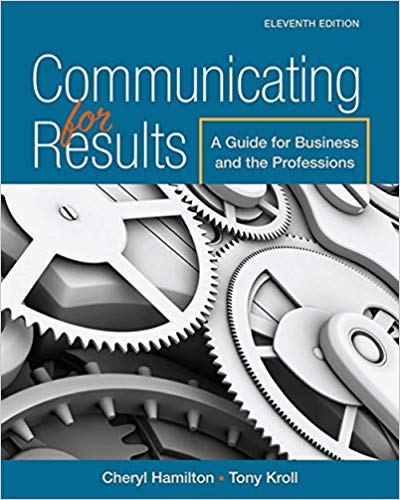
Communicating for Results 11th Edition by Cheryl Hamilton - Test Bank

Communicating for Results 11th Edition by Cheryl Hamilton - Test Bank   Instant Download - Complete Test Bank With Answers     Sample Questions Are Posted Below   1. To keep discussions to a minimum, arrange the chairs in a circle.​   a. True   b. False   ANSWER:   False POINTS:   1 REFERENCES:   List and discuss …

$19.99

Communicating for Results 11th Edition by Cheryl Hamilton – Test Bank


Instant Download – Complete Test Bank With Answers


Sample Questions Are Posted Below


1. To keep discussions to a minimum, arrange the chairs in a circle.​

  a. True
  b. False


ANSWER:   False
POINTS:   1
REFERENCES:   List and discuss the major types of nonverbal communication in the workplace and the cultural differences found for each type.


2. The face is responsible for most meaning in nonverbal messages. ​

  a. True
  b. False


ANSWER:   True
POINTS:   1
REFERENCES:   List and discuss the major types of nonverbal communication in the workplace and the cultural differences found for each type.


3. Use of touch to communicate is referred to as haptics.​

  a. True
  b. False


ANSWER:   True
POINTS:   1
REFERENCES:   List and discuss the major types of nonverbal communication in the workplace and the cultural differences found for each type.


4. If a person gives someone the “middle finger,” that is an example of an illustrator. ​

  a. True
  b. False


ANSWER:   False
POINTS:   1
REFERENCES:   List and discuss the major types of nonverbal communication in the workplace and the cultural differences found for each type.


5. In general, members of collectivistic cultures need more space while members of individualistic cultures need less space.​

  a. True
  b. False


ANSWER:   False
POINTS:   1
REFERENCES:   List and discuss the major types of nonverbal communication in the workplace and the cultural differences found for each type.


6. The intentional body movements and gestures that communicate an exact meaning are called​

  a. ​Emblems
  b. ​Adaptors
  c. ​Illustrators
  d. ​Regulators


ANSWER:   a
POINTS:   1
REFERENCES:   List and discuss the major types of nonverbal communication in the workplace and the cultural differences found for each type.


7. As far as nonverbal communication goes, the most expressive part of the face is the​

  a. ​Lips
  b. ​Mouth
  c. ​Eyes
  d. ​Brow


ANSWER:   c
POINTS:   1
REFERENCES:   List and discuss the major types of nonverbal communication in the workplace and the cultural differences found for each type.


8. Unlike the formal level, in the informal level​

  a. ​Rules are openly known and easily stated.
  b. ​Rules and their rationales are deliberately taught.
  c. ​Rules are unconsciously learned by imitation and taken for granted.
  d. ​Rules are unimportant.


ANSWER:   c
POINTS:   1
REFERENCES:   Define and explain the term nonverbal communication and how it differs in each of the three cultural levels: technical, formal, and informal.


9. When a person is trying to control the flow of a conversation, that is done through the use of ​

  a. ​Emblems
  b. ​Adaptors
  c. ​Illustrators
  d. ​Regulators


ANSWER:   d
POINTS:   1
REFERENCES:   List and discuss the major types of nonverbal communication in the workplace and the cultural differences found for each type.


10. Jeanie always flips her hair behind her ear when she talks in a group. This is an example of a/an:​

  a. ​Emblem
  b. ​Adaptor
  c. ​Illustrator
  d. ​Regulator


ANSWER:   b
POINTS:   1
REFERENCES:   List and discuss the major types of nonverbal communication in the workplace and the cultural differences found for each type.


11. Clothing and personal appearance can be found in which category of nonverbal communication? ​

  a. ​Objectives
  b. ​Haptics
  c. ​Chronemics
  d. ​Proxemics


ANSWER:   a
POINTS:   1
REFERENCES:   List and discuss the major types of nonverbal communication in the workplace and the cultural differences found for each type.


12. Which of the following is an example of a Regulator? ​

  a. ​A businesswoman rubs the back of her neck and says “I don’t know” during business negotiations.
  b. ​A businesswoman breaks off eye contact to signal the end of a meeting.
  c. ​While explaining how to get to the post office, a woman points in the correct direction.
  d. ​When speaking before the boss, an employee nervously rubs his nose.


ANSWER:   b
POINTS:   1


13. Which of the following is NOT a suggested way to minimize culture shock during business travel?​

  a. ​Take language and culture training
  b. ​Have a sense of humor
  c. ​Be well rested
  d. ​Use English because it’s internationally recognized


ANSWER:   d
POINTS:   1
REFERENCES:   Describe the role that nonverbal symbols and culture shock play in international business transactions and what can be done to minimize any negative effects.


14. Being vocally expressive, moving around rather than staying behind a barrier such as a desk, and making eye contact are all examples of​

  a. ​Signs of power
  b. ​Illustrators
  c. ​Nonverbal status symbols
  d. ​Immediacy behaviors


ANSWER:   d
POINTS:   1
REFERENCES:   Describe the role that nonverbal symbols and culture shock play in international business transactions and what can be done to minimize any negative effects.


15. ​Which of the following is a visual immediacy behavior?

  a. ​Citing personal experience during a conversation.
  b. ​Using good volume, pitch, emphasis and rate.
  c. ​Smiling appropriately at individuals as well as the whole group.
  d. ​Sitting quietly behind a barrier such as a desk.


ANSWER:   c
POINTS:   1
REFERENCES:   Identify how to improve your nonverbal skills through immediacy behaviors, expectancy violations theory, and effective habits.


16. Expectancy violations theory ​

  a. ​Says that a sense of closeness and interaction with colleagues comes from nonverbal interactions
  b. ​Deals with how people respond when they don’t get the kind of nonverbal behavior they think they will get.
  c. ​Explains that when people don’t get the nonverbal behavior they are used to, they feel confused and will withdraw.
  d. ​Says that we get the messages that we expect to get based on status.


ANSWER:   b
POINTS:   1
REFERENCES:   Identify how to improve your nonverbal skills through immediacy behaviors, expectancy violations theory, and effective habits.


17. When the text says we should work to cultivate more effective nonverbal habits; it suggests all of the following EXCEPT: ​

  a. ​Consider the context and cultural background of the nonverbal behavior.
  b. ​Watch yourself on videotape and observe your nonverbal behaviors.
  c. ​Role play using hypothetical situations.
  d. ​Ask your family and friends if you can videotape their behavior and take notes


ANSWER:   c
POINTS:   1
REFERENCES:   Identify how to improve your nonverbal skills through immediacy behaviors, expectancy violations theory, and effective habits.


18. The text shared that the choice of color can affect the physical environment in the following true story:​

  a. ​Studies show hospitals use white walls so patients will relax.
  b. ​The public reported that yellow granules in soap powder didn’t clean clothes as well as blue granules.
  c. ​When schoolrooms painted the walls brown the children grew more disruptive.
  d. ​Restaurants who want customers to eat and leave quickly may choose green for their décor.


ANSWER:   b
POINTS:   1
REFERENCES:   List and discuss the major types of nonverbal communication in the workplace and the cultural differences found for each type.


19. Which of the following statements is NOT true about eye contact? ​

  a. ​Eye contact by a U.S. speaker shows interest and attentiveness.
  b. ​Listeners tend to maintain less eye contact than speakers.
  c. ​Eye contact can signal that it is ok to talk.
  d. ​Maintaining overly long eye contact can make people from some cultures uncomfortable.


ANSWER:   b
POINTS:   1
REFERENCES:   List and discuss the major types of nonverbal communication in the workplace and the cultural differences found for each type.


20. Intentional movements that add or clarify verbal meaning are: ​

  a. Emblem​
  b. ​Adaptor
  c. ​Illustrator
  d. ​Regulator


ANSWER:   c
POINTS:   1
REFERENCES:   List and discuss the major types of nonverbal communication in the workplace and the cultural differences found for each type.


21. Compare the relationship between culture and nonverbal communication in terms of technical, formal, and informal culture. What are the major differences of each, how is each level learned or taught in the culture, and how flexible are the rules?​

ANSWER:   At the technical level, the rules for cultural and nonverbal behaviors are openly known and easily stated by most citizens of a particular culture. The rules and their rationales are deliberately taught. When a technical rule or behavior is broken unintentionally, little emotion is involved in pointing out and correcting the mistake.

At the formal level, the rules are clearly stated and known, but the reasons for the rules are not. Formal rules are extremely important, and people who question them are not viewed as team players. Formal rules based on tradition change slowly, but they do change.

At the informal level, neither rules for behavior nor reasons for the rules are taught. Rules are unconsciously learned by imitation (modeling) and taken for granted. People are not always aware that these behaviors are dictated by rules, but violations can lead to discomfort or withdrawal.

POINTS:   5
REFERENCES:   Define and explain the term nonverbal communication and how it differs in each of the three cultural levels: technical, formal, and informal.


22. Of the three cultural levels: technical, formal, and informal, which level is most prominent in business? ​

ANSWER:   The majority of business-related nonverbal behaviors are at the informal level. The United States has relatively few formal rules and allows a fairly wide variation before a violation occurs. An informal U.S. rule might be a formal or technical rule in another nation. Different cultures and subcultures in the United States make assumptions about nonverbal meanings dangerous. Informal distance and personal space rules (proxemics) vary from culture to culture, family to family, and person to person. Reactions to time (chronemics) occur at all three culture levels, but business life is regulated at the informal level. ​
POINTS:   5
REFERENCES:   Define and explain the term nonverbal communication and how it differs in each of the three cultural levels: technical, formal, and informal.


23. What is the meaning of “culture shock” and how can it be minimized?​

ANSWER:   Employees on business in another country often experience culture shock, which is confusion because they cannot understand or be understood by the people of their host culture.  Culture shock can be minimized in the following ways:  1. Learn the language and culture. 2. Have a sense of humor. 3. Be rested. 4. Listen with an open mind. 5. Enlist a local “cultural translator” or friend for perspective. 6. Keep a positive attitude. 7. Realize that different does not mean wrong…
POINTS:   5
REFERENCES:   Describe the role that nonverbal symbols and culture shock play in international business transactions and what can be done to minimize any negative effects.


24. Discuss the steps to take to improve your nonverbal skills by building effective habits ​

ANSWER:   Effective habits can be created not only by using immediacy behaviors but also by adopting specific approaches.  1. Develop awareness of nonverbal differences.2. Do not judge others according to your own nonverbal meanings. 3. Do not assign nonverbal meanings out of context (i.e., specific situation, environment, cultural background, and personal frame of reference). 4. Observe your nonverbal behavior on videotape, ask for feedback, or use role playing.​
POINTS:   5
REFERENCES:   Identify how to improve your nonverbal skills through immediacy behaviors, expectancy violations theory, and effective habits.


25. Why is nonverbal communication relevant to business communication?​

ANSWER:   The nonverbal communication that is most relevant to business includes facial expressions and eye contact, posture and gestures, touch, clothing and appearance, distance and personal space, physical environment, and time. Nonverbal status symbols (e.g., clothing, office size, manipulation of time) influence how people perceive us and are key factors in professional advancement. Differences between U.S. nonverbal messages and those of other countries affect international business dealings. Use caution when interpreting others’ nonverbal behaviors because overreacting to nonverbal messages will cause just as many misunderstandings as ignoring them.​
POINTS:   5
REFERENCES:   List and discuss the major types of nonverbal communication in the workplace and the cultural differences found for each type.


Additional information

Add Review

Your email address will not be published. Required fields are marked *