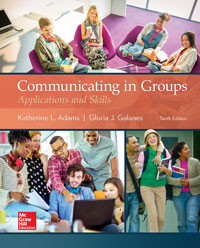
Communicating in Groups Applications and skills Adams and Galanes 10e - Test Bank

Communicating in Groups Applications and skills Adams and Galanes 10e - Test Bank   Instant Download - Complete Test Bank With Answers     Sample Questions Are Posted Below   Chapter 06 Working with Diversity in the Small Group     Multiple Choice Questions (p. 116)Diversity includes A. gender. B. sexual orientation. C. generational difference. D. racial/ethnic background. E. all of …

$19.99

Communicating in Groups Applications and skills Adams and Galanes 10e – Test Bank


Instant Download – Complete Test Bank With Answers


Sample Questions Are Posted Below


Chapter 06

Working with Diversity in the Small Group


Multiple Choice Questions

  1. (p. 116)Diversity includes
    A. gender.
    B. sexual orientation.
    C. generational difference.
    D. racial/ethnic background.
    E. all of the answers are correct.


  1. (p. 116)An important point to remember about diversity is that
    A. it makes it almost impossible to work together in groups.
    B. people are not that much different after all.
    C. you can’t expect other group members to change their needs, styles, or cultures to match yours.
    D. it is very frustrating.
    E. it is the source of all tension and conflict in small groups.


  1. (p. 117)Saul is part of a group that has members from different racial/ethnic backgrounds, different generations, different genders, and different socioeconomic statuses. This group would be classified as
    A. unique.
    B. complex.
    C. heterogeneous.
    D. homogeneous.
    E. impossible.


  1. (p. 117) _____ refers to groups that are composed of members who are similar or alike in member characteristics.
    A. Homogeneity
    B. Millennial
    C. Heterogeneity
    D. Builders
    E. Group oriented


  1. 5.(p. 121–122)A person who enters the learning cycle through active experimentation
     learns by trying out different things until she or he finds one that works.
    B. is a visual learner.
    C. loves to act out roles in group drama.
    D. tends to learn better by sitting back and observing the actions of others.
    E. none of the answers is correct.


  1. (p. 121–122)Shanika likes to really think about information, write about it, and talk to other group members about the information; she most likely prefers which of the following learning styles?
    A. concrete experience
    B. active experimentation
    C. abstract conceptualization
    D. reflective observation
    E. consideration discussion


  1. (p. 123)Don is outgoing, gets along well with others, and is open to new ideas, but he is often viewed as not being serious. His personality is most closely aligned with which of the following Myers-Briggs Type Indicators?
    A. extraversion
    B. introversion
    C. sensing
    D. intuiting
    E. perceiving


  1. (p. 125)According to the Myers-Briggs Type Indicator, the perceiver personality type tends to
    A. pay close attention to details.
    B. be logical, analytical, and organized.
    C. be spontaneous and flexible.
    D. be highly decisive.
    E. be considerate of others’ feelings.


  1. (p. 127)“Culture” is defined as
    A. a system of beliefs, values, symbols, and rules that are shared by an identifiable group of people.
    B. the complex structure of individuals, small groups, and organizations that make up a human society.
    C. inherited tendencies that make human societies more complex than those of other mammals.
    D. cultivation of tastes, morality, and artistic sensitivities.
    E. products of acquired skills and technologies such as languages, books, and houses.


  1. (p. 127)In collectivist cultures
    A. people are more shy.
    B. people rarely speak up and get their ideas heard.
    C. group harmony takes priority.
    D. people collect allies in order to win conflicts in groups.
    E. people mostly value strong leaders.


  1. (p. 128–129)If you come from a culture that emphasizes high power distance, you
    A. will be likely to seek a group leader who lets others in the group make most of the decisions.
    B. will value hierarchical structure and an authoritarian leader.
    C. will want a leader who stays far above the group’s conflicts.
    D. are likely to work better with people from individualist cultures.
    E. none of the answers is correct.


  1. (p. 128–129)Dao is from a culture that emphasizes hierarchy—many members of Dao’s culture believe that one has an assigned “place” in society. Dao’s culture most likely follows
    A. low power distance.
    B. high power distance.
    C. high individualism.
    D. high collectivism.
    E. low collectivism.


  1. (p. 128–130)In a low-context culture, the meaning of a message is conveyed primarily by the speaker’s
    A. gestures.
    B. situation.
    C. vocal intonations.
    D. pitch and force changes.
    E. words.


  1. (p. 131)Major ethnic and racial groups in the United States include all of the following EXCEPT
    A. African Americans.
    B. Asian Americans.
    C. European Americans.
    D. Hispanic Americans.
    E. none of the answers is correct.


  1. (p. 128)Most Hispanic cultures tend to be which of the following?
    A. individualistic
    B. collectivist
    C. self-focused
    D. individual-based
    E. none of the answers is correct.


  1. (p. 135)Women tend to place more emphasis on _____ than men do.
    A. tasks
    B. goals
    C. accomplishments
    D. relationships
    E. individual achievements


  1. (p. 137–139)Groups may be diverse not only culturally but also in terms of age. Individuals who are significantly influenced by the Vietnam War and are willing to challenge tradition are likely
    A. builders.
    B. boomers.
    C. gen-Xers.
    D. n-gens.
    E. millenniums.


  1. (p. 143–144)A fantasy
    A. is about how to complete a work.
    B. has a lot of exaggerations about a group’s assignment.
    C. is an outrageous story that one student tells.
    D. is about something other than the here and now of the group.
    E. all of the answers are correct.


  1. (p. 143)Symbolic convergence theory means that
    A. people tend to meet, or converge, in groups.
    B. members of a group share everything to promote group harmony.
    C. humans create shared meaning through their talk.
    D. every member of the group gets an equal opportunity to speak.
    E. one person, usually the leader, brings everybody together during a conflict.


  1. (p. 142–147)Which of the following is NOT an idea for bridging differences in a group?
    A. Appreciate the value of diversity.
    B. Stand your ground when defending your way of seeing things.
    C. Talk openly about how you will integrate your differences.
    D. Form a group identity around your differences.
    E. Openly acknowledge differences.


Fill in the Blank Questions

  1. (p. 116)_____ in a group refers to differences among members.
    Diversity


  1. (p. 117)Homogeneity and _____ are terms typically used to capture the degree of variance in group composition.
    heterogeneity


  1. (p. 119–120)Members are _____ when their primary motivation for being in a group is the goal or business that the group must complete.
    task-oriented


  1. (p. 119–120)Relationally oriented individuals value _____ more than they do task accomplishment.
    relationships


  1. (p. 121)The _____ is a learning style model that demonstrates several important differences in how individuals process information and learn.
    Kolb Learning Cycle


  1. (p. 121–122)The _____ learning style describes those individuals who learn well from events they actually observe or activities in which they actually participate.
    concrete experience


  1. (p. 122)The _____ learning style describes learners who process a considerable amount of information by reading and solitary study.
    abstract conceptualization


  1. (p. 123)_____ people tend to direct their energy toward the outer, observable world.
    Extraverted


  1. (p. 123)_____ people work independently, like working on ideas, and are careful before acting.
    Introverted


  1. (p. 130)In a _____ culture, the verbal part of the message carries the most meaning.
    low-context


  1. (p. 130)In a _____ culture, the situation or context carries most of the meaning.
    high-context


  1. (p. 135)Gender differences in _____ involve how much somebody talks, interrupts others, claims personal space, or otherwise calls attention to him- or herself in the conversation.
    forcefulness


  1. (p. 139)Confidence, willingness to challenge “old ways” of doing things, and taking on big causes are found among the _____ generation.
    boomer


  1. (p. 139)_____ are individuals, born between 1901 and 1945, influenced by the Great Depression and World War II.
    Builders


  1. (p. 142–143)_____ communication is open to multiple perspectives, shows a willingness to see the world from another’s standpoint, and shifts perspective if necessary.
    Mindful


True/False Questions

  1. (p. 120–122)According to the Kolb Learning Cycle, individuals who learn best by directly observing events or participating in activities possess the concrete experience learning style.
    TRUE


  1. (p. 121–122)The reflective observation learning style describes individuals who process a considerable amount of information by reading and solitary study.
    FALSE


  1. (p. 125)Perceivers are like sponges; they tend to gather as much information as possible before coming to any conclusions.
    TRUE


  1. (p. 126)Cognitive/informational diversity refers to differences in knowledge, skills, experience, and the way information is processed.
    TRUE


  1. (p. 127)A co-culture is a smaller identifiable group contained within a larger cultural grouping and has its own norms and patterns of communication.
    TRUE


  1. (p. 127–128)Members of a highly collectivist culture value independence and rights of individuals more than conformance and harmony.
    FALSE


  1. (p. 127–128)The dominant culture of the United States is collectivist.
    FALSE


  1. (p. 128–130)In a low-context culture, the words used convey more meaning than the situation or context.
    TRUE


  1. (p. 127–128)Asian cultures tend to be both collectivist and high context.
    TRUE


  1. (p. 131–132)Unlike European Americans, African Americans tend to look others straight in the eye while listening to what others have to say.
    FALSE


  1. (p. 135)Women generally place more emphasis on relationships and are more likely to show, by their communication behavior, that they care and want to help.
    TRUE


  1. (p. 135)Either-or thinking is the best way to understand gender differences within a group.
    FALSE


  1. (p. 138–140)Gen-Xers are sometimes referred to as the echo boom generation.
    FALSE


  1. (p. 143)Group members not discussing the present task of the group but rather discussing an apparently unrelated topic are engaging in fantasy.
    TRUE


  1. (p. 143)“Agreement” means that members have “come together” on what certain events, ideas, words, and so forth will mean.
    FALSE


  1. (p. 145)Openly acknowledging and talking about differences is an effective way to manage diversity.
    TRUE


Essay Questions

  1. (p. 120–122)Name and describe the four main learning styles enumerated in the Kolb Learning Cycle. What can each learning style preference contribute to the functioning of a small group?

Answers will vary.


  1. (p. 123–125)Having read the principles behind the Myers-Briggs Type Indicator, describe which personality type you believe you possess. What are the strengths of this personality type and how can those strengths contribute to the functioning of a group? How might you avoid allowing the weaknesses of this personality type hinder group functioning?

Answers will vary.


  1. (p. 127–131)Describe three dimensions of culture, and explain how these affect communication between people.

Answers will vary.


  1. (p. 127–129)Describe the differences between beliefs of members of “collectivist” and “individualist” cultures.

Answers will vary.


  1. (p. 131–133)Describe four ways in which a group can encounter racial and ethnic differences in their interaction.

Answers will vary.


  1. (p. 133–137)Four areas characterize general differences between male and female communication. List them and give one example from your group’s communication.

Answers will vary.


  1. (p. 137–141)Describe the characteristics, strengths, and weaknesses of the four dominant generations.

Answers will vary.


  1. (p. 143–144)Describe the concepts of fantasy, fantasy chain, and fantasy theme. Provide an example of how a fantasy evolves into a fantasy theme. How can this help create group identity?

Answers will vary.


  1. (p. 127 & 138)What might you do to help improve how well you understand a group member from a co-culture that is unfamiliar to you? Examples are dairy farmers, police officers, drug dealers, or orthopedic surgeons.

Answers will vary.


  1. (p. 145–148)When communicating in a group, what are the principles for bridging differences among group members? Briefly explain the reasoning behind each tip as being of value to effective group functioning with diverse members.

Answers will vary.


Additional information

Add Review

Your email address will not be published. Required fields are marked *