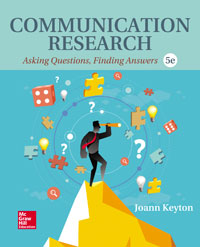
Communication Research Asking Questions Finding Answers Joann Keyton 5e - Test Bank

Communication Research Asking Questions Finding Answers Joann Keyton 5e - Test Bank   Instant Download - Complete Test Bank With Answers     Sample Questions Are Posted Below   Communication Research: Asking Questions, Finding Answers, 5e (Keyton) Chapter 5   Measurement   1) Measurement is: A) the same as evaluation. B) identifying variables as independent or …

$19.99

Communication Research Asking Questions Finding Answers Joann Keyton 5e – Test Bank


Instant Download – Complete Test Bank With Answers


Sample Questions Are Posted Below


Communication Research: Asking Questions, Finding Answers, 5e (Keyton)

Chapter 5   Measurement


1) Measurement is:

  1. A) the same as evaluation.
  2. B) identifying variables as independent or dependent.
  3. C) collecting data through a questionnaire, or counting the number of instances a particular event occurs.
  4. D) the same as interpretation.
  5. E) everything the researcher does to arrive at the numerical estimate.


Answer:  E

Accessibility:  Keyboard Navigation


2) Measurement allows researchers to make comparisons among:

  1. A) individuals in the research project.
  2. B) multiple studies using the same measurement device.
  3. C) variables in one study.
  4. D) all of the above.
  5. E) none of the above.


Answer:  D

Accessibility:  Keyboard Navigation


3) A variable measured with discrete data means that the data identify participants as belonging to

  1. A) one of at least two categories of the same variable.
  2. B) one of several categories of multiple variables.
  3. C) some position on a continuum of scores.
  4. D) a ranked position as compared to other participants.
  5. E) some position on a continuum of scores, including zero.


Answer:  A

Accessibility:  Keyboard Navigation


4) Continuous level data:

  1. A) reflect differing degrees, amounts, or frequencies.
  2. B) range from some minimum to maximum quantity.
  3. C) reflect different categories of a variable.
  4. D) are only produced from participants’ answers to items on a questionnaire.
  5. E) A and B.


Answer:  E

Accessibility:  Keyboard Navigation


5) A Likert-type scale:

  1. A) is a discrete measurement.
  2. B) has a true zero.
  3. C) distinguishes which element is highest, next highest, and so on.
  4. D) has a response set which must be balanced at the ends of the continuum.
  5. E) is any measurement that uses numbers as the response.


Answer:  D

Accessibility:  Keyboard Navigation


6) A semantic differential scale:

  1. A) asks participants to locate the meaning they ascribe to a stimulus.
  2. B) is a form of continuous level measurement.
  3. C) is anchored by two opposite or bipolar adjectives.
  4. D) does not include descriptors for the intermediate positions.
  5. E) all of the above.


Answer:  E

Accessibility:  Keyboard Navigation


7) A threat to validity or reliability is:

  1. A) any data-related problem that could lead you to draw a false conclusion from the data.
  2. B) not really an issue if you’re not going to publish your research.
  3. C) generated by research participants only.
  4. D) generated by researchers only.
  5. E) generated only when participants drop out of a study that collects data over a long period of time.


Answer:  A

Accessibility:  Keyboard Navigation


8) Choose the research term that describes the ranking of preferences for political candidates.

  1. A) Discrete data
  2. B) Interval data
  3. C) Ordinal data
  4. D) Ratio data


Answer:  C

Accessibility:  Keyboard Navigation


9) Choose the research term that describes the score on communication competence questionnaire.

  1. A) Discrete data
  2. B) Interval data
  3. C) Ordinal data
  4. D) Ratio data


Answer:  B

Accessibility:  Keyboard Navigation


10) Choose the research term that describes the sex.

  1. A) Discrete data
  2. B) Interval data
  3. C) Ordinal data
  4. D) Ratio data


Answer:  A

Accessibility:  Keyboard Navigation


11) Choose the research term that describes the employment status.

  1. A) Discrete data
  2. B) Interval data
  3. C) Ordinal data
  4. D) Ratio data


Answer:  A

Accessibility:  Keyboard Navigation


12) Choose the research term that describes the ranking of television markets.

  1. A) Discrete data
  2. B) Interval data
  3. C) Ordinal data
  4. D) Ratio data


Answer:  C

Accessibility:  Keyboard Navigation


13) Choose the research term that describes the number of times the audience asks a speaker questions.

  1. A) Discrete data
  2. B) Interval data
  3. C) Ordinal data
  4. D) Ratio data


Answer:  D

Accessibility:  Keyboard Navigation


14) Choose the research term that describes “measures what you want it to measure and not something else.”

  1. A) Reliability
  2. B) Split-Half reliability
  3. C) Test-Retest reliability
  4. D) Validity


Answer:  D

Accessibility:  Keyboard Navigation


15) Choose the research term that describes the degree of similarity in measurements captured at different points in time.

  1. A) Reliability
  2. B) Split-Half reliability
  3. C) Test-Retest reliability
  4. D) Validity


Answer:  C

Accessibility:  Keyboard Navigation


16) Choose the research term that describes the relationship between the concept being measured and the process of measuring it.

  1. A) Criterion-related validity
  2. B) Face validity
  3. C) Internal reliability
  4. D) Internal validity


Answer:  D

Accessibility:  Keyboard Navigation


17) Choose the research term that describes “measuring the core concept that was intended to be measured and not something else.”

  1. A) Construct validity
  2. B) Content validity
  3. C) Criterion-related validity
  4. D) Face validity


Answer:  A

Accessibility:  Keyboard Navigation


18) Choose the research term that describes “reflects true differences among individuals’ scores.”

  1. A) Reliability
  2. B) Split-Half reliability
  3. C) Test-Retest reliability
  4. D) Validity


Answer:  D

Accessibility:  Keyboard Navigation

19) Choose the research term that describes the following concept: just by looking at the measuring device we believe it will measure what it is supposed to measure.

  1. A) Construct validity
  2. B) Content validity
  3. C) Criterion-related validity
  4. D) Face validity


Answer:  D

Accessibility:  Keyboard Navigation


20) Choose the research term that describes the following concept: achieved when one measurement can be linked to some other external measure.

  1. A) Construct validity
  2. B) Content validity
  3. C) Criterion-related validity
  4. D) Face validity


Answer:  C

Accessibility:  Keyboard Navigation


21) Choose the research term that describes the following concept: a reliability coefficient indicates the degree to which this concept occurred.

  1. A) Internal reliability
  2. B) Internal validity
  3. C) Reliability
  4. D) Split-Half reliability


Answer:  A

Accessibility:  Keyboard Navigation


22) Choose the research term that describes the easiest type of validity to establish.

  1. A) Construct validity
  2. B) Content validity
  3. C) Criterion-related validity
  4. D) Face validity


Answer:  D

Accessibility:  Keyboard Navigation


23) Choose the research term that describes the degree to which the measuring device represents the full range of characteristics associated with the construct of interest.

  1. A) Construct validity
  2. B) Content validity
  3. C) Criterion-related validity
  4. D) Face validity


Answer:  B

Accessibility:  Keyboard Navigation

24) Choose the research term that describes “the measurement is stable, trustworthy, or dependable.”

  1. A) Reliability
  2. B) Split-Half reliability
  3. C) Test-Retest reliability
  4. D) Validity


Answer:  A

Accessibility:  Keyboard Navigation


25) Choose the research term that describes the degree to which multiple items invoke the same response from the participant.

  1. A) Face validity
  2. B) Internal reliability
  3. C) Internal validity
  4. D) Reliability


Answer:  B

Accessibility:  Keyboard Navigation


26) Choose the research term that describes “using half of the measuring items for one measurement; the other half at another measurement.”

  1. A) Reliability
  2. B) Split-Half reliability
  3. C) Test-Retest reliability
  4. D) Validity


Answer:  B

Accessibility:  Keyboard Navigation


27) Choose the research term that describes “can be threatened when researcher selects participants through convenience.”

  1. A) Internal validity
  2. B) Morality or attrition
  3. C) Maturation
  4. D) External validity
  5. E) Ecological validity


Answer:  D

Accessibility:  Keyboard Navigation

28) Choose the research term that describes “can be threatened by the researcher’s influence on participants.”

  1. A) Internal validity
  2. B) Morality or attrition
  3. C) Maturation
  4. D) External validity
  5. E) Ecological validity


Answer:  A

Accessibility:  Keyboard Navigation


29) Choose the research term that describes the participants change over time.

  1. A) Internal validity
  2. B) Morality or attrition
  3. C) Maturation
  4. D) External validity
  5. E) Ecological validity


Answer:  C

Accessibility:  Keyboard Navigation


30) Choose the research term that describes “can be threatened when researchers used questionnaires that are dated.”

  1. A) Internal validity
  2. B) Morality or attrition
  3. C) Maturation
  4. D) External validity
  5. E) Ecological validity


Answer:  A

Accessibility:  Keyboard Navigation


31) Choose the research term that describes “participants drop out of study that occurs over a long-time period.”

  1. A) Internal validity
  2. B) Morality or attrition
  3. C) Maturation
  4. D) External validity
  5. E) Ecological validity


Answer:  B

Accessibility:  Keyboard Navigation

32) Choose the research term that describes “particularly problematic when researcher uses university students as participants to generalize results to other populations and samples.”

  1. A) Internal validity
  2. B) Morality or attrition
  3. C) Maturation
  4. D) External validity
  5. E) Ecological validity


Answer:  E

Accessibility:  Keyboard Navigation


33) Discrete data are sometimes referred to as nominal data or categorical data.


Answer:  TRUE

Accessibility:  Keyboard Navigation


34) Discrete data reflect amounts of the variable.


Answer:  FALSE

Accessibility:  Keyboard Navigation


35) Generally, reliability can be improved.


Answer:  TRUE

Accessibility:  Keyboard Navigation


36) In practice, perfect reliability is easily achieved.


Answer:  FALSE

Accessibility:  Keyboard Navigation


37) Measurements must be both valid and reliable.


Answer:  TRUE

Accessibility:  Keyboard Navigation


38) A measurement can be reliable, but not valid.


Answer:  TRUE

Accessibility:  Keyboard Navigation


39) The quality of data interpretation cannot be better than the quality of data collected.


Answer:  TRUE

Accessibility:  Keyboard Navigation


40) Explain the difference between measurement as a description and an evaluation.


Answer:  Answers will vary

Accessibility:  Keyboard Navigation

41) Explain the difference between discrete and continuous data and give examples of both.


Answer:  Answers will vary

Accessibility:  Keyboard Navigation


42) Define and give examples of the three criteria the categories of discrete data must meet.


Answer:  Answers will vary

Accessibility:  Keyboard Navigation


43) Describe the essential elements of a Likert-type scale. Give an example. Explain the types of error and bias that can affect the internal reliability of a questionnaire.


Answer:  Answers will vary

Accessibility:  Keyboard Navigation


44) Explain the relationship between validity and reliability.


Answer:  Answers will vary

Accessibility:  Keyboard Navigation

Additional information

Add Review

Your email address will not be published. Required fields are marked *