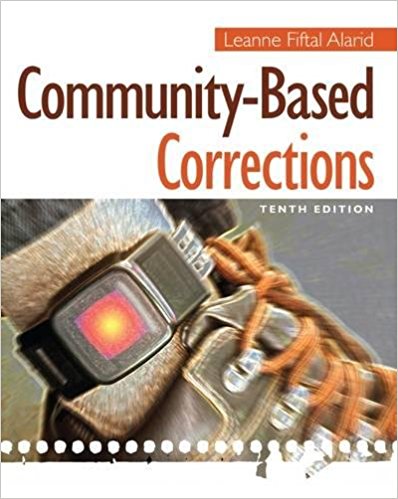
Community Based Corrections 10th Edition by Alarid - Test Bank

Community Based Corrections 10th Edition by Alarid - Test Bank   Instant Download - Complete Test Bank With Answers     Sample Questions Are Posted Below   1. Management that an officer maintains over offenders committed to his or her custody is: a. punishment b. conditions c. supervision d. constructive custody ANSWER: c REFERENCES: Classification: The …

$19.99

Community Based Corrections 10th Edition by Alarid – Test Bank


Instant Download – Complete Test Bank With Answers


Sample Questions Are Posted Below


1. Management that an officer maintains over offenders committed to his or her custody is:
a. punishment b. conditions
c. supervision d. constructive custody
ANSWER: c
REFERENCES: Classification: The First Step in Supervision
LEARNING OBJECTIVES: COBC.ALAR.13.1 – 3
2. The first step in the supervision process is:
a. Investigation b. Classification
c. Intimidation d. Initial interview
ANSWER: b
REFERENCES: Classification: The First Step in Supervision
LEARNING OBJECTIVES: COBC.ALAR.13.1 – 3
3. A procedure that consists of assessing the risks posed by an offender, identifying the supervision issues, and
selecting an appropriate supervision strategy is known as:
a. actuarial evaluation b. needs assessment
c. categorization d. classification
ANSWER: d
REFERENCES: Classification: The First Step in Supervision
LEARNING OBJECTIVES: COBC.ALAR.13.1 – 3
4. Measuring an offender’s propensity to commit further criminal activity is known as:
a. a review of the conditions b. risk assessment
c. needs analysis d. classification
ANSWER: b
REFERENCES: Risk Assessments
LEARNING OBJECTIVES: COBC.ALAR.13.2 – 5
5. Number of arrests, prior convictions, and a history of abuse are known as _____ factors.
a. Quantitative b. Generalized
c. Dynamic d. Static
ANSWER: d
REFERENCES: Risk Assessments
LEARNING OBJECTIVES: COBC.ALAR.13.2 – 5Powered by Cognero Page 1Chapter_5__Classification_and_Supervision
6. Employment status, substance abuse, and lack of housing are all considered _____ factors.
a. Dynamic b. Static
c. Inverse d. Quantitative
ANSWER: a
REFERENCES: Risk Assessments
LEARNING OBJECTIVES: COBC.ALAR.13.2 – 5
7. The __________ is a 54-item scale that assigns a numerical value to many of the same factors identified in the
presentence report. It is completed by an officer who interviews the offender.
a. LSI-R b. OIA
c. MMPI d. COMPAS
ANSWER: a
REFERENCES: Risk Assessments
LEARNING OBJECTIVES: COBC.ALAR.13.2 – 5
8. Using a validated quantitative instrument to identify characteristics, conditions, or behavioral problems that limit an
offender’s motivation or that might be linked with criminal behavior is known as:
a. risk analysis b. needs assessment
c. treatment supervision d. personality inventory
ANSWER: b
REFERENCES: Identifying Treatment Needs
LEARNING OBJECTIVES: COBC.ALAR.13.2 – 5
9. Which of the following is an example of a static factor?
a. education b. employment status
c. substance abuse d. history of abuse
ANSWER: d
REFERENCES: Risk Assessments
LEARNING OBJECTIVES: COBC.ALAR.13.2 – 5
10. Mixing low-risk offenders with high-risk offenders in the same program has been found to __________ (on)
recidivism.
a. decrease
b. increase
c. have no impact
d. be more effective than separating offenders based on risk level
ANSWER: b
REFERENCES: Risk Assessments
LEARNING OBJECTIVES: COBC.ALAR.13.2 – 5Powered by Cognero Page 2Chapter_5__Classification_and_Supervision
11. A ________ issue is an identified problem, offender characteristic, or pattern of conduct that requires intervention
to overcome or change.
a. surveillance b. needs
c. risk d. supervision
ANSWER: d
REFERENCES: The Supervision Cae Plan
LEARNING OBJECTIVES: COBC.ALAR.13.2 – 5
12. __________ is the process of determining whether probationers and parolees are continuing to meet the conditions
imposed by the court or the parole board.
a. supervision b. surveillance
c. intensive probation d. investigation
ANSWER: b
REFERENCES: The Supervision Case Plan
LEARNING OBJECTIVES: COBC.ALAR.13.2 – 5
13. The best predictor of future behavior is:
a. past behavior b. substance abuse
c. a history of abuse d. mental illness
ANSWER: a
REFERENCES: Identifying Treatment Needs
LEARNING OBJECTIVES: COBC.ALAR.13.2 – 5
14. A(n) _________ is an individualized, written document that clarifies how each court-ordered condition is to be
fulfilled by the offender and the supervising officer in the context of the risks and needs posed.
a. collateral contact b. case plan
c. PSI d. LSI-R
ANSWER: b
REFERENCES: Implementing the Case Plan: Surveillance
LEARNING OBJECTIVES: COBC.ALAR.13.2 – 5
15. Verification of the probationer or parolee’s situation and whereabouts by means of the officer speaking with a third
party who knows the offender personally such as a family member, friend or employer.
a. collateral contact b. field contact
c. office contact d. face-to-face contact
ANSWER: a
REFERENCES: Implementing the Case Plan: Surveillance
LEARNING OBJECTIVES: COBC.ALAR.13.2 – 5Powered by Cognero Page 3Chapter_5__Classification_and_Supervision
16. At the lowest level of supervision, there may be no requirement that the probationer personally visit or contact a
probation officer. Rather, the probationer may be required to call in and leave a message on a voice-recorded line, or
mail-in a verification of address and employment. This level of supervision is known as _________ supervision
a. minimum b. medium
c. close d. administrative
ANSWER: d
REFERENCES: Levels of Supervision
LEARNING OBJECTIVES: COBC.ALAR.13.2 – 5
17. _____ refers to the number of individuals or cases on probation or parole officer can supervise effectively.
a. Caseload b. Treatment load
c. Client load d. Risk assessment
ANSWER: a
REFERENCES: Caseload and Workload Standards
LEARNING OBJECTIVES: COBC.ALAR.13.4 – 5
18. The American Probation and Parole Association recommends that a workload standard of about __________ hours
per month is more reasonable than caseload size:
a. 280 b. 120
c. 75 d. 160
ANSWER: b
REFERENCES: Caseload and Workload Standards
LEARNING OBJECTIVES: COBC.ALAR.13.4 – 5
19. On average, intensive supervision probation and parole caseloads have _____ offenders.
a. 30-40
b. 18-29
c. 10-15
d. 45-60
ANSWER: b
REFERENCES: Caseload and Workload Standards
LEARNING OBJECTIVES: COBC.ALAR.13.2 – 5
20. The average caseload of regular probationers in the United States consists of _____ adults.
a. 127 b. 175
c. 65 d. 232
ANSWER: a
REFERENCES: Caseload and Workload Size
LEARNING OBJECTIVES: COBC.ALAR.13.4 – 5Powered by Cognero Page 4Chapter_5__Classification_and_Supervision
21. The __________ are considered the basis by which correctional treatment programs should operate,
a. Peter Principle
b. Parkinson’s Law Principles
c. Principles of Effective Correctional Intervention
d. Medical Principles
ANSWER: c
REFERENCES: Implementing the Case Plan: Treatment Strategies
LEARNING OBJECTIVES: COBC.ALAR.13.4 – 5
22. According to the principles of effective intervention, treatment services should occupy _____ percent of each day
for three to nine months.
a. 40-70 b. 10-20
c. 80-90 d. Less than 10
ANSWER: a
REFERENCES: Implementing the Case Plan: Treatment Strategies
LEARNING OBJECTIVES: COBC.ALAR.13.4 – 5
23. According to the Principles of Effective Correctional Intervention, program level should be matched with client
aptitudes or propensities according to gender, age, cultural background, and:
a. substance abuse history
b. mental health status
c. risk level
d. crime committed
ANSWER: c
REFERENCES: Implementing the Case Plan: Treatment Strategies
LEARNING OBJECTIVES: COBC.ALAR.13.4 – 5
24. Because of its ability for establishing and maintaining self-esteem and personal dignity, efforts should be prioritized
by all probation and parole officers in assisting the offender in:
a. finding a job
b. improving marital relationships
c. remembering to report to the officer as directed
d. submitting regular monthly reports
ANSWER: a
REFERENCES: Employment Assistance
LEARNING OBJECTIVES: COBC.ALAR.13.4 – 5Powered by Cognero Page 5Chapter_5__Classification_and_Supervision
25. Women on community supervision have typically entered the system because of a crime they committed alongside a
male partner (boyfriend, husband, or brother) or they acted alone out of _______ need.
a. financial b. educational
c. vocational d. psychological
ANSWER: a
REFERENCES: Working with Female Offenders
LEARNING OBJECTIVES: COBC.ALAR.13.5 – 4
26. __________ involves the creation of a positive climate of sincerity and understanding by a community supervision
officer. It is often used for getting offenders to recognize their problems.
a. Motivational interviewing b. Cognitive-behavioral therapy
c. Effective intervention d. Electric shock therapy
ANSWER: a
REFERENCES: Motivational Interviewing
LEARNING OBJECTIVES: COBC.ALAR.13.4 – 5
27. The effectiveness of Neighborhood-Based Supervision rests in part on the officer being able to secure the assistance
and cooperation of _________ agencies and individuals within his or her beat.
a. psychological b. vocational
c. community d. educational
ANSWER: c
REFERENCES: Evaluation of Neighborhood-Based vs. Traditional Community Supervision
LEARNING OBJECTIVES: COBC.ALAR.13.5 – 4
28. The recidivism rates between neighborhood based and traditional community supervision are:
a. similar
b. significantly different
c. significantly higher than recidivism rates for offenders supervised outside the state of conviction
d. significantly lower than recidivism rates for offenders supervised outside the state of conviction
ANSWER: a
REFERENCES: Evaluation of Neighborhood-Based vs. Traditional Community Supervision
LEARNING OBJECTIVES: COBC.ALAR.13.6 – 5Powered by Cognero Page 6Chapter_5__Classification_and_Supervision
29. The __________ was the original agreement providing for the supervision of probationers and parolees in states
other than where they were convicted.
a. Interstate Compact
b. Sending State Agreement
c. Interstate Compact for Adult Offender Supervision
d. Receiving State Compact
ANSWER: a
REFERENCES: Supervision Outside the State
LEARNING OBJECTIVES: COBC.ALAR.13.6 – 5
30. The state where an offender is convicted is referred to as the __________ state.
a. sending b. receiving
c. compact d. collateral
ANSWER: a
REFERENCES: Supervision Outside the State
LEARNING OBJECTIVES: COBC.ALAR.13.6 – 5
31. The first step in community supervision is classification.
a. True
b. False
ANSWER: True
REFERENCES: Classification: The First Step in Supervision
LEARNING OBJECTIVES: COBC.ALAR.13.1 – 3
32. Classification consists of the supervising officer using an objective assessment scale to compute the risks posed by
the offender, identifying offender needs requiring intervention, and selecting the appropriate supervision and
treatment strategies.
a. True
b. False
ANSWER: True
REFERENCES: Classification: The First Step in Supervision
LEARNING OBJECTIVES: COBC.ALAR.13.1 – 3
33. No matter whether the programs were treatment oriented or supervision oriented, mixing low-risk offenders with
high-risk offenders in the same program has been shown to decrease recidivism.
a. True
b. False
ANSWER: False
REFERENCES: Identifying Treatment Needs
LEARNING OBJECTIVES: COBC.ALAR.13.2 – 5Powered by Cognero Page 7Chapter_5__Classification_and_Supervision
34. Age is a dynamic risk factor.
a. True
b. False
ANSWER: False
REFERENCES: Risk Assessments
LEARNING OBJECTIVES: COBC.ALAR.13.2 – 5
35. Criminal history is a static risk factor.
a. True
b. False
ANSWER: True
REFERENCES: Risk Assessments
LEARNING OBJECTIVES: COBC.ALAR.13.2 – 5
36. To identify treatment needs, an officer must conduct a needs assessment.
a. True
b. False
ANSWER: True
REFERENCES: Identifying Treatment Needs
LEARNING OBJECTIVES: COBC.ALAR.13.2 – 5
37. Surveillance is an important element of supervision that provides a means of ascertaining whether probationers and
parolees are continuing to meet the conditions imposed by the court or the parole board.
a. True
b. False
ANSWER: True
REFERENCES: The Supervision Case Plan
LEARNING OBJECTIVES: COBC.ALAR.13.1 – 3
38. Methods of surveillance include unannounced and announced home visits, curfew, electronic monitoring, and
collection of urine samples for drug testing.
a. True
b. False
ANSWER: True
REFERENCES: Implementing the Case Plan: Surveillance
LEARNING OBJECTIVES: COBC.ALAR.13.3 – 5Powered by Cognero Page 8Chapter_5__Classification_and_Supervision
39. At the lowest level of supervision, there may be no requirement that the probationer personally visit or contact a
probation officer, referred to as administrative supervision or banked probation.
a. True
b. False
ANSWER: True
REFERENCES: Levels of Supervision
LEARNING OBJECTIVES: COBC.ALAR.13.4 – 5
40. One of the principles of effective supervision is developing various levels of supervision to differentiate offenders
who need closer supervision from those who require less.
a. True
b. False
ANSWER: True
REFERENCES: Levels of Supervision
LEARNING OBJECTIVES: COBC.ALAR.13.3 – 5
41. According to the principles of effective intervention, treatment should be intensive and occupy 40-70% of each day
for 3 to 9 months.
a. True
b. False
ANSWER: True
REFERENCES: Implementing the Case Plan: Treatment Strategies
LEARNING OBJECTIVES: COBC.ALAR.13.3 – 5
42. According to the principles of effective intervention, clients should be taught to replace criminal networks with
prosocial ones.
a. True
b. False
ANSWER: False
REFERENCES: Implementing the Case Plan: Treatment Strategies
LEARNING OBJECTIVES: COBC.ALAR.13.3 – 5
43. Central to the concept of evidence-based practices is the concept that it does not matter how large the caseload is as
long as it is properly classified.
a. True
b. False
ANSWER: False
REFERENCES: Caseload and Workload Standards
LEARNING OBJECTIVES: COBC.ALAR.13.4 – 5Powered by Cognero Page 9Chapter_5__Classification_and_Supervision
44. The American Probation and Parole Association has recommended a workload standard of about 200 hours per
month.
a. True
b. False
ANSWER: False
REFERENCES: Caseload and Workload Standards
LEARNING OBJECTIVES: COBC.ALAR.13.4 – 5
45. Cognitive-Behavioral Therapy (CBT) helps offenders replace unhealthy thinking processes and criminal behavior
with a sense of responsibility, empathy, and prosocial behavior.
a. True
b. False
ANSWER: True
REFERENCES: Cognitive-Behavioral Therapy
LEARNING OBJECTIVES: COBC.ALAR.13.3 – 5
46. The single most important element in preventing recidivism for adult probationers and parolees is having strong
family ties.
a. True
b. False
ANSWER: False
REFERENCES: Employment Assistance
LEARNING OBJECTIVES: COBC.ALAR.13.4 – 5
47. Women under community supervision have usually entered the criminal justice system because of a crime they
committed alongside a male partner.
a. True
b. False
ANSWER: True
REFERENCES: Working with Female Offenders
LEARNING OBJECTIVES: COBC.ALAR.13.6 – 5
48. The elements of Neighborhood-Based Supervision include assignment of offenders according to type of offense
perpetrated, required church participation, required full time employment for all offenders, and total abstention form
alcohol for all probationers.
a. True
b. False
ANSWER: False
REFERENCES: Evidence of Neighborhood-Based vs. Traditional Community Supervision
LEARNING OBJECTIVES: COBC.ALAR.13.5 – 4Powered by Cognero Page 10Chapter_5__Classification_and_Supervision
49. According to the Interstate Compact, the sending state retains the ultimate authority to modify the conditions of
probation, revoke probation, or terminate probation.
a. True
b. False
ANSWER: True
REFERENCES: Supervision Outside the State
LEARNING OBJECTIVES: COBC.ALAR.13.6 – 5
50. Probation departments provide both an investigative and a ________ function in the criminal justice system.
ANSWER: supervisory
REFERENCES: Introduction
LEARNING OBJECTIVES: COBC.ALAR.13.1 – 3
51. ___________________ provides a measure of the probationer or parolee’s degree of propensity to violence,
dangerousness to the public, and also measures the offender’s propensity to engage in future criminal activity.
ANSWER: Risk assessment
REFERENCES: Risk Assessments
LEARNING OBJECTIVES: COBC.ALAR.13.1 – 3
52. __________ factors include things that do not change, such as age, race, and criminal history.
ANSWER: Static
REFERENCES: p. 95
LEARNING OBJECTIVES: COBC.ALAR.13.2 – 5
53. _____ factors include things like substance abuse, unemployment, and lack of education
ANSWER: Dynamic
REFERENCES: Risk Assessments
LEARNING OBJECTIVES: COBC.ALAR.13.4 – 5
54. ____________ probation is for offenders who have committed minor crimes, who have satisfied their financial
obligations, or have been in compliance for two years, and can be transferred down to this level.
ANSWER: administrative
REFERENCES: Levels of Supervision
LEARNING OBJECTIVES: COBC.ALAR.13.4 – 5
55. The standard recommended by the American Probation and Parole Association for the assignment and evaluation of
duties performed by a probation officer is the __________ standard rather than the caseload standard.
ANSWER: workload
REFERENCES: Caseload and Workload Standards
LEARNING OBJECTIVES: COBC.ALAR.13.4 – 5Powered by Cognero Page 11Chapter_5__Classification_and_Supervision
56. The _____ provide a theoretical perspective of evidence-based correctional practices and provides standards by
which correctional treatment programs should operate.
ANSWER: principles of effective interventio
REFERENCES: Implementing the Case Plan: Treatment Strategies
LEARNING OBJECTIVES: COBC.ALAR.13.3 – 5
57. Because of its impact on an offender’s selfconcept and the high correlation between it and the number of
probationers and parolees who return to prison, every probation and parole officer should work with the offender to
find ___________.
ANSWER: employment
REFERENCES: Employment Assistance
LEARNING OBJECTIVES: COBC.ALAR.13.4 – 5
58. In neighborhood based supervision, probation officers conduct supervision and implement a case plan by being more
visible and having strong ______ presence.
ANSWER: community
REFERENCES: Evaluations of Neighborhood-Based vs. Traditional Community Supervision
LEARNING OBJECTIVES: COBC.ALAR.13.5 – 4
59. Between neighborhood-based probationers and those supervised under traditional community supervision, recidivism
rates are _____.
ANSWER: similar
REFERENCES: Evaluations of Neighborhood-Based vs. Traditional Community Supervision
LEARNING OBJECTIVES: COBC.ALAR.13.2 – 5
60. The _____ is an agreement that allows probationers and parolees to be supervised across state lines.
ANSWER: interstate compact
REFERENCES: Supervision Outside the State
LEARNING OBJECTIVES: COBC.ALAR.13.2 – 5
61. The __________ state is the state that undertakes supervision from the sending state.
ANSWER: receiving
REFERENCES: Supervision Outside the State
LEARNING OBJECTIVES: COBC.ALAR.13.6 – 5
62. Women on community supervision have typically entered the system because __________ crimes.
ANSWER: drug
REFERENCES: Working with Female Offenders
LEARNING OBJECTIVES: COBC.ALAR.13.4 – 5Powered by Cognero Page 12Chapter_5__Classification_and_Supervision
63. Explain how neighborhood-based supervision (NBS) is different from traditional community supervision and then
argue for the use of neighborhood-based probation supervision over traditional methods. In what situations might
NBS be most useful?
ANSWER: In neighborhood-based supervision (NBS), the probation officers conduct the
supervision and implement the case plan by being more visible and having a strong
community presence. The elements of NBS include assignment of offenders according
to zip code or type of offense (or both), developing community partnerships with police,
treatment providers, and faith-based initiatives. Cases are assigned to officers
according to geographic beat areas in a community, which is ideal for using geographic
information systems (GIS) technology. NBS sites started in Boston; Phoenix; Tucson;
Dallas/Ft. Worth; Waco, Texas; and Spokane, Washington. Preliminary evaluations of
these sites compared probationers supervised in the NBS program, which had smaller
caseloads, with probationers supervised using traditional probation. An evaluation of
one site indicated that probationers supervised in the NBS program perceived more
support and help from their probation officer in finding employment and in making
connections to treatment providers than did probationers supervised on traditional
caseloads. NBS officers had more autonomy and a closer connection with police and
the community than traditional probation officers, but relationships with treatment
service providers were similar for both groups. NBS probationers were more likely to
be violated for technical violations than traditional probationers, yet both groups
committed a similar number of new crimes while on supervision. Overall recidivism
rates between the two groups were not significantly different (Lutze, Smith, and
Lovrich, 2004). Evaluations of the other sites need to be completed to obtain a more
complete picture of NBS.
REFERENCES: Evaluation of Neighborhood-Based vs. Traditional Community Supervision
LEARNING OBJECTIVES: COBC.ALAR.13.5 – 4
64. How does assessing client needs in education, employment, treatment, and so on help develop the program plan?
How much should a client be expected to do while on supervision?
ANSWER: The officer must also identify those characteristics, conditions, or behavioral problems
that limit the offender’s motivation or may lead to a return to criminal behavior. Such
treatment needs include drug or alcohol abuse, mental illness, anger management
issues, or deficiencies in education or vocational skills. Treatment activities are defined
as actions taken by the supervising officer intended to bring about a change in the
offender’s conduct or condition for the purpose of rehabilitation and reintegration into
the law-abiding community. Together, both risk and needs assessments can (and
should) define the types of correctional services that are made available to offenders.
The principles of effective intervention state that offenders should participate in
treatment every day occupying 40 to 70 percent of the day for 3 to 9 months.
Obviously, this depends upon the needs assessment and the importance of the
treatment program must be weighed against the need for fulltime employment. The
importance of carefully gathering and evaluating the offender’s history cannot be
overstated, for past behavior is, at the moment, the best predictor we have of future
behavior.
REFERENCES: Classification: The First Step in Supervision
LEARNING OBJECTIVES: COBC.ALAR.13.1 – 3Powered by Cognero Page 13Chapter_5__Classification_and_Supervision
65. Discuss the use of various risk prediction scales. How might risk assessment best be used in community supervision?
ANSWER: Risk assessment provides a measure of the probationer or parolee’s degree of
dangerousness to the public and also measures the offender’s propensity to engage in
future criminal activity. Probation and parole jurisdictions have developed some form of
risk prediction scale to assist them in developing supervision plans and in caseload
classification. These instruments differ in some respects, but all of them place
offenders in groups with a known statistical probability of committing new crimes or
violating the conditions of supervision. The first generation assessments relied on
interviewing the offender and using case-by-case anecdotal information to make the
decision about risk. The second generation assessments include Client Management
Classification (CMC), the Correctional Offender Management Profiles for Alternative
Sentences (COMPAS), the Wisconsin Client Management Classification, and the
Salient Factor Score. These assessments primarily use static questions about previous
behavior, which has already happened and cannot be altered. More recent third
generation assessments are the Offender Inventory Assessment (OIA) and the Level
of Service Inventory-Revised (LSI-R). These assessments include both static and
dynamic factors, which aid in measuring both negative and positive offender change
over time. Research findings have led to one risk principle, which is to reserve the most
intensive treatment programs for the highest risk offenders, in part, because this target
population will benefit exponentially more from the intervention than the low-risk
offenders (Hanley, 2002).
REFERENCES: Risk Assessments
LEARNING OBJECTIVES: COBC.ALAR.13.2 – 5
66. Discuss the concept of caseload and workload computation. Why might workload be a better method of allocating
probation or parole officer resources?
ANSWER: Central to the concept of evidence-based practices is a manageable caseload. A
probation or parole officer’s caseload is defined as the number of individuals or cases
one officer can supervise effectively. In practice, caseloads vary widely because not
every offender requires the same amount of supervision. The more intensive the
supervision, the lower the caseload number. The American Probation and Parole
Association has long recommended a “workload standard” of about 120 hours per
month. The workload standard is more accurate, particularly if an officer has offenders
of varying supervision levels. Workload is calculated by first assuming the number of
hours required to supervise each client based on their level of supervision (maximum,
medium, or minimum). A maximum supervision case may require, for example, four
hours of the officer’s time per month. A medium supervision case may require two
hours per month, whereas a minimum supervision case may only require one hour or
less per month of the officer’s time. Given these calculations, one officer could
effectively supervise 30 maximum supervision cases, 60 medium cases, and as many
as 120 minimum cases. Development of a workload standard would allow for
comparison between jurisdictions and improve the next step of case planning.
REFERENCES: Caseload and Workload Standards
LEARNING OBJECTIVES: COBC.ALAR.13.4 – 5Powered by Cognero Page 14Chapter_5__Classification_and_Supervision
67. Explain the history and function of the original Interstate Compact and the more recent Interstate Compact for Adult
Offender Supervision.
ANSWER: Prior to 1937, probationers or parolees could not be supervised outside the state where
he or she was convicted. This prevented many offenders from being supervised in the
places that would offer the best chance for success on probation or parole. To address
this issue, a group of states entered into a statutory agreement to supervise
probationers and parolees for each other. Known as the Interstate Compact, it was
originally signed by 25 states in 1937, and by 1951, it had been ratified by all states, as
well as Puerto Rico and the Virgin Islands. In 1955, the Interstate Compact on
Juveniles was established as well.
The compacts identify the sending state (the state of conviction) and the receiving state
(the state that undertakes the supervision). The receiving state informs the sending
state on a quarterly basis of the probationer’s progress, but the sending state retains
ultimate authority to modify the conditions of probation, revoke probation, or terminate
probation. It is also generally held that the sending state alone has authority to
determine upon which basis a violator may be returned. The reasons for return cannot
be challenged by the receiving state.
The three main problems with interstate compacts were liability, monitoring
compliance, and slow processing speed. Since probation supervision styles varied from
state to state, each state had different thresholds and policies for when a probationer
was considered to be in violation. Because of these ongoing problems, the National
Institute of Corrections (NIC) determined that the best resolution was to provide a new
way to administer interstate compacts. The result of the NIC study was the creation of
the Interstate Compact for Adult Offender Supervision in 2000. This revised compact
developed an interstate commission that is composed of one commissioner
representative from each participating state. The commission is a national organization
empowered to create and enforce the same rules for all states, collect national
statistics, coordinate training and education, and notify victims of public safety. With
this new structure and oversight commission, correctional administrators are hopeful
that the problems with interstate compacts will be a thing of the past. As of 2004, all
states except for Virginia and Mississippi were members.
REFERENCES: Supervision Outside the State
LEARNING OBJECTIVES: COBC.ALAR.13.6 – 5Powered by Cognero Page 15Chapter_5__Classification_and_Supervision


Additional information

Add Review

Your email address will not be published. Required fields are marked *