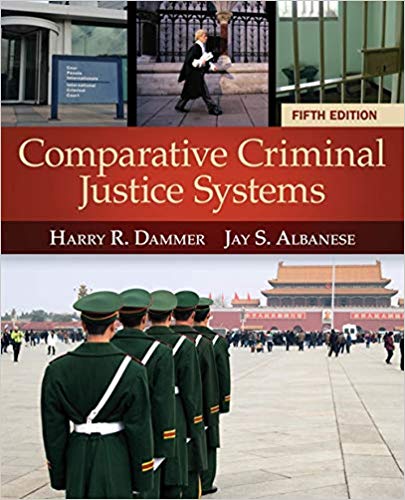
Comparative Criminal Justice Systems 5th Edition by Harry R. Dammer - Test Bank

Comparative Criminal Justice Systems 5th Edition by Harry R. Dammer - Test Bank   Instant Download - Complete Test Bank With Answers     Sample Questions Are Posted Below   Chapter 8 – After Conviction:  The Sentencing Process     Multiple Choice   The United States has experienced a boom in building prisons and implementing …

$19.99

Comparative Criminal Justice Systems 5th Edition by Harry R. Dammer – Test Bank


Instant Download – Complete Test Bank With Answers


Sample Questions Are Posted Below


Chapter 8 – After Conviction:  The Sentencing Process


Multiple Choice


  1. The United States has experienced a boom in building prisons and implementing longer sentences for drug crimes and crimes of violence. This illustrates the United States tendency toward which of the following as a purpose of punishment?
  2. Retribution
  3. Rehabilitation
  4. Deterrence
  5. Incapacitation


ANS: D                       REF: 191                     OBJ: 1


  1. Which of the following is not one of the purposes of criminal sanctions?
  2. Retribution
  3. Incapacitation
  4. Just Deserts
  5. Restoration


ANS: C                       REF: 191                     OBJ: 1


  1. Which of the purposes of criminal sanctions is practiced in all of our model countries?
  2. Restoration
  3. Rehabilitation
  4. Incapacitation
  5. Retribution


ANS: B                       REF: 193                     OBJ: 1


  1. Which country is the only one of our model countries that uses deterrence?
  2. England
  3. China
  4. France
  5. Saudi Arabia


ANS: D                       REF: 193                     OBJ: 1


  1. Which of the following is not an example of a noncustodial sanction?
  2. Branding
  3. Fines
  4. Confiscation
  5. Community Service


ANS: A                       REF: 196                     OBJ: 2

  1. The noncustodial sanction most closely resembling incarceration is:
  2. Probation
  3. House arrest
  4. Exile
  5. Restitution


ANS: B                       REF: 201                     OBJ: 2


  1. What is the most common form of supervising offenders in the community?
  2. House arrest
  3. Parole
  4. Probation
  5. Work release


ANS: C                       REF: 200                     OBJ: 2


  1. Which of the following is not one of the “get tough on crime” strategies?
  2. Three strikes laws
  3. Sentencing Guidelines
  4. Use of precedents
  5. Truth- in- sentencing laws


ANS: C                       REF: 205                     OBJ: 4


  1. The international trend relative to the death penalty is:

A: Increased use

  1. Abolition
  2. There is no international movement
  3. Abolition except in the cases of ordinary crimes


ANS: B                       REF: 207                     OBJ: 5


  1. The World Millennium Study conducted by Gallup reflects that:
  2. The majority of the people in the world support the death penalty
  3. The majority of the people in the world do not support the death penalty
  4. The majority of the people in the world are not sure how they feel about the death penalty
  5. The majority of the people in the world feel that the death penalty should be implemented only in cases of murder.


ANS: A                       REF: 209                     OBJ: 5


  1. A researcher compares the number of prison admissions over a ten-year period for a number of countries. His research method is referred to as a:
  2. Stock design
  3. Flow design
  4. Decade design
  5. Comparative design


ANS: B                       REF: 203                     OBJ: 4


  1. According to international reports such as Amnesty International, which country executes more people than all other countries combined?
  2. United States
  3. Saudi Arabia
  4. China
  5. Libya


ANS: C                       REF: 206                     OBJ: 5


  1. Which of the following is not one of the possible reasons for why the United

States appears to be moving towards abolition of the death penalty?

  1. The decrease in the violent crime rate in the United States
  2. Changing public attitudes towards the death penalty
  3. Increase in the number of exonerations in death penalty cases
  4. Pressure from the international community to abolish


ANS: A                       REF: 208                     OBJ: 5


  1. Which of the following is not one of the limits of International Prison Data?
  2. Non- standard definitions
  3. Incarceration figures do not account for sentence length
  4. Failure of countries to report or accurately report crime data
  5. Lack of staff and methodology to handle all of the crime data


ANS: D                       REF: 205                     OBJ: 4


  1. Penal populism is mainly only a problem in which of our model countries?
  2. England
  3. France
  4. Germany
  5. China


ANS: A                       REF: 205                     OBJ: 4


Sentence Completion


  1. __________________ involves the offender being transformed into a law abiding person through programs of medical, psychological, economic, or educational improvement.


ANS: Rehabilitation

REF: 191                     OBJ: 1


  1. ________________ involves denying the offender the opportunity to commit further crimes, usually through prison or exile.


ANS: Incapacitation

REF: 191                     OBJ: 1


  1. Restoration involves the ____________, _________________, and _____________ working together to restore the victim and he community to its previous state.


ANS: community, victim, offender

REF: 192                     OBJ: 1


  1. In China, prisoners are subject to institutions called ___________, which are believed to promote “thought reform through labor.”


ANS: laogai

REF: 193                     OBJ: 1


  1. In most systems, a mixture of ______________, ________________, and ___________ factors is at work and needs to be analyzed to understand the criminal justice process.


ANS: social, economic, political

REF: 194                     OBJ: 1


  1. _________________ is any sentence in which a person’s body is subjected to physical pain, such as flogging, mutilation, electric shock, or branding.


ANS: Corporal punishment

REF: 195                     OBJ: 2


  1. _______________ refers to a variety of forms of detention, including combined or split sentences, jail, and any period of incarceration short of life imprisonment.


ANS: Deprivation of liberty

ANS: 195                    OBJ: 2


  1. In Islamic law _______________ is considered a proper sanction only for recidivists, people who have not changed as a result of the more direct corporal punishments.


ANS: imprisonment

REF: 196                     OBJ: 3


  1. ___________ are not popular in the United States as punishment for felonies or serious misdemeanors, despite their extensive use for minor crimes.


ANS: Fines

REF: 197                     OBJ: 2


  1. Confiscation and _____________ is the governmental seizure of property derived from or used in criminal activity.


ANS: forfeiture

REF: 199                     OBJ: 2


  1. One form of restitution used in Islamic countries is called ________, which is paid directly to the victim or his or her family as compensation.


ANS: diyya

REF: 199                     OBJ: 2


12.___________ designs measure data at one point in time, whereas _________ designs measure data over a period of time.


ANS: Stock, flow

REF: 203                     OBJ: 4


  1. ___________________ expands the surveillance capacity of supervision.


ANS: Electronic monitoring

REF: 201                     OBJ: 2


  1. When a country separates inmates, it typically uses the term ____________ to describe the facility used to house unconvincted inmates.


ANS: remand prisons

REF: 203                     OBJ: 2


  1. The penalty of _________ has been a sentencing option since the beginning of civilization.


ANS: death

REF: 206                     OBJ: 5


TRUE/ FALSE


  1. Deterrence involves denying the offender the opportunity to commit further crimes, usually through prison or exile.


ANS: F                        REF: 191                     OBJ: 1


  1. A recent trend in sentencing in a number of countries, which in some ways is one of the oldest sentencing methods, is called truth in sentencing.


ANS: F                        REF: 192                     OBJ: 1


  1. In China, it is important that criminal offenders be persuaded to reform not for themselves but for the good of their family, village, and especially society.


ANS: T                        REF: 192                     OBJ: 1


  1. Sentencing practices have generally become less humane over the years.


ANS: F                        REF: 194                     OBJ: 2


  1. In recent years many countries, especially those in Europe, have actually made an effort to reduce sentencing severity for a number of crimes.


ANS: T                        REF: 194                     OBJ: 2


  1. The methods of corporal punishment most commonly used today are flogging, and in rare cases amputation.


ANS: T                        REF: 195                     OBJ: 2


  1. Of all the forms of supervising offenders in the community, house arrest is the most common.


ANS: F                        REF: 200                     OBJ: 2


  1. From a humanitarian standpoint, minimization of short-term imprisonment of non-dangerous offenders increases the possibility of rehabilitation through work programs, counseling, and restitution plans.


ANS: T                        REF: 197                     OBJ: 2


  1. Day fines were created in response to the concern that fines exact a heavier toll on the poor than on the wealthy.


ANS: T                        REF: 198                     OBJ: 2


  1. In the United States, probation began with the innovative work of Cesare Beccaria, a Boston boot maker who was the first person to post bail for defendants under authority of the Boston Police Court.


ANS: F                        REF: 200                     OBJ: 2


  1. Technically in the United States, there is no difference between jails and prisons.


ANS: F                        REF: 203                     OBJ: 2


  1. The World Prison Population List provides the number of prisoners in 218 independent countries and territories as of May 2011.


ANS: T                        REF: 203                     OBJ: 4


  1. Female prison populations around the world have grown by 16%, and this is said to be related to the international fight against HIV.


ANS: F                        REF: 204                     OBJ: 4


  1. Penal populism is a term given to criminal justice policies that are designed to appeal to the public appetite for punitiveness with little concern for program effectiveness or the clear understanding of community views.


ANS: T                        REF: 204                     OBJ: 4


  1. Japan and the United States are two democratic, industrialized nations that continue to use the death penalty.


ANS: T                        REF:  208                    OBJ: 5


Short Answers


  1. What are the five purposes of criminal sanctions?


ANS:

  1. Retribution- the offender should pay back society for the harm he or she has done
  2. Rehabilitation- the offender should be transformed in to a law abiding person through programs of medical, psychological, economic, or educational improvement.
  3. Deterrence- The offender, or other possible offenders, through various methods, such as certainty of punishment, should come to the conclusion that crime is not worth the risk of the resulting punishment.
  4. Incapacitation- the offender, usually through prison or exile, should be denied the opportunity to commit further crimes.
  5. Restoration- the community, victim, and offender are involved in the sentencing process with the aim of restoring the victim and the community to its previous state.


REF: 191                     OBJ: 1


  1. Discuss the concern about the rising international imprisonment rates of women and minority groups worldwide.


ANS:

  1. Women and Incarceration- The second World Female Imprisonment List, published by Roy Walmsley, revealed that as of 2012 more than 625,000 women and girls are in prison around the world and that the female prison population has grown 16% since 2006. The rise in imprisonment for females is believed to be directly related to the international fight against drugs. Over 31,000 women across Europe and Central Asia are imprisoned for drug offenses, representing 28 percent of all women in prisons in these regions.
  2. Minorities and Incarceration- in the United States 60% of its prison population is Black or Hispanic. This is a problem because Blacks and Hispanics make up only 13 and 16 % of the U.S. population respectively. England and Wales, France, and Germany also have experienced an increase in minority incarceration in recent years. Other countries also have a high percentage of foreigners who are incarcerated. The reason for such high numbers is controversial and undetermined. Some say it is because of societal racism, some say certain communities commit more crime, and others say people go to prison because of a combination of social and economic factors.


REF: 204                     OBJ: 4


  1. List and define the six most common forms of punishments used in the world today


ANS:


  1. Corporal punishment- any sentence in which a person’s body is subjected to physical pain, such as flogging, mutilation, electric shock, or branding.
  2. Life imprisonment- any sentence in which a person is deprived of liberty in an institution of any kind for the duration of his or her natural life.
  3. Deprivation of liberty- a variety of forms of detention, including combined or split sentences, jail and any period of incarceration short of life imprisonment.
  4. Control in freedom- includes probation, electronic monitoring, any conditional sentence with supervision requirements, and other forms of controlled liberty that have special requirements.
  5. Warnings- also called admonitions; suspended sentences, conditional sentences and dismissals, formal and informal warnings with findings of guilt, and conditional discharges.
  6. Fines- all sentences that involve paying a sum of money


REF: 195                     OBJ: 2


  1. What are the limits of international prison data and what are some of the ways researches have suggested as possible ways to improve methods of collection and presentation of international prison data?


ANS:

  1. Underreporting or failure to report by many countries
  2. Non-standardization of definitions
  3. Incarceration figures to not account for sentence length


  1. The use of stock and flow designs to measure the number of prison admissions overtime
  2. Incarceration rate should be determined by dividing the number of persons sentenced to prison by the number convicted during that same year
  3. We should compare the prison population to the number of prosecutions in the country
  4. We should also take into account changes in criminal procedure.

REF: 205                     OBJ: 4


Essays


  1. Discuss the three reasons for the United States’ turn toward abolition of the death penalty.


ANS:

  1. S. has received some pressure from the international community to reconsider its stance on the death penalty. Includes being formally accused of human rights violations or having limits placed on trade and international business operations. Also, of concern is the impact that continued support for the death penalty would have on the fight against transnational crime, including terrorism. Europeans countries have begun to refuse to extradite criminals who have escaped to their countries as long as penalty of death is a possibility in the United States.
  2. May also be spurred by recent news of offenders who have had their convictions overturned or sentences commuted because of inequities in the system or legal mistakes found in the investigation or trial. Between 2000 and 2011 there was an average of five such exonerations per year.
  3. It appears the American public’s attitude toward the death penalty has begun to change. The Gallup poll shows that 61 % supported the DP, which is down from 80% in 1994.


REF: 209                     OBJ: 5


  1. Define and discuss the different types of noncustodial sanctions.


ANS:


  • Noncustodial sanctions- alternatives to incarceration are legal sanctions handed out to offenders that do not require time served in a correctional facility.
  • The calls for such alternatives became intense in the latter part of the nineteenth century, when European criminologists voiced widespread disillusionment with the practice of increased imprisonment.


  1. Monetary payments-
  2. Fines- penalty imposed on a convicted offender by a court or, in some countries, by another arm of the criminal justice system, requiring, that he or she pay a specified sum of money.
  3. Day fine- created in response to the idea that fines exact a heavier toll on the poor than on the rich. Day fines are based on the amount of money an offender earns in a day’s work. Day fines take into account the differing economic circumstances of offenders who have committed the same crime.
  4. Confiscation and Forfeiture- the governmental seizure of property derived from or used in criminal activity. Under criminal law, forfeiture is imposed as a consequence of conviction and requires that the offender relinquish various assets related to the crime.
  5. Restitution and Community Service- when an offender is required or volunteers to participate in community service or to pay money to make reparation for harm resulting from a criminal offense, then restitution is being made. In community service, the offender is asked to personally “pay back” the community by performing a set number of hours of unpaid work for a non-profit agency.


  1. Community Supervision
  2. Probation- given in lieu of imprisonment, the offender is given the chance to remain within the community and demonstrate a willingness to abide by its laws- May also require other obligations such as treatment programs or restitution.
  3. House arrest- offenders are sentenced to terms of incarceration, but they serve those terms in their own homes. 3 levels- curfew, allowed to leave home for certain hours for work, school, sessions, religious reasons, etc., person must be home at all times except for special conditions or appointments.
  4. Electronic Monitoring-One of the largest growing approaches to noncustodial supervision. Aims to expand the capacity of surveillance in the community. EM is ordinarily combined with house arrest and is used to enforce restrictions. Has also been used in other ways: Intensive supervision programs, gang supervision, pretrial detainees, and narcotic surveillance.


  1. Exile- rarely used today except in some indigenous cultures in remote areas of the world.
  2. Warnings- provided at the adjudication stage by the judge and usually are accompanied by the threat of incarceration if criminal behavior does not stop. In the United States, warning are used extensively in the juvenile justice system.


REF: 200                     OBJ: 2


  1. Discuss the background of restoration and restorative justice and also cite examples of restorative justice around the world.


ANS:


  • Restorative justice is a revitalized paradigm that calls for participation by the offender, victim, and community in the sentencing process and allows the offender to atone for the offense and be restored to community life. The offender must understand the harm caused by his/her offense, accept responsibility for it, and repair the harm done.
  • Its roots are in Judeo Christian religious thought, dating back to ancient Middle Eastern civilization – penitence, expiation, and forgiveness are central concepts of Judeo- Christian morality
  • Ex’s- United Nations- Economic and Social Council adopted the “Basic Principles on the Use of Restorative Justice Programmes in Criminal Matters.”
  • Australia, New Zealand, and North America have used variations of this idea for quite some time


REF: 192               OBJ: 1


Additional information

Add Review

Your email address will not be published. Required fields are marked *