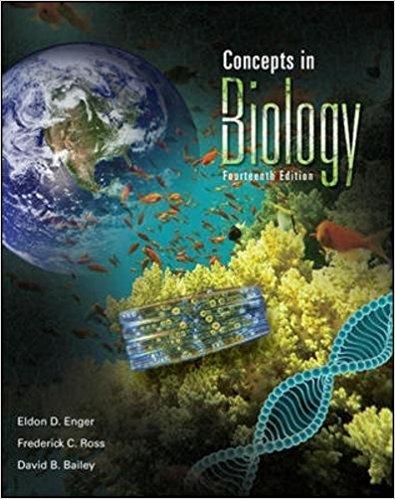
Concepts In Biology 14th Edition by Eldon Enger, Frederick Ross, David Bailey -Test Bank

Concepts In Biology 14th Edition by Eldon Enger, Frederick Ross, David Bailey -Test Bank   Instant Download - Complete Test Bank With Answers     Sample Questions Are Posted Below   Chapter 05 Enzymes, Coenzymes, and Energy     Multiple Choice Questions Enzyme inhibition A.refers to the interference with a chemical reaction caused by an …

$19.99

Concepts In Biology 14th Edition by Eldon Enger, Frederick Ross, David Bailey -Test Bank


Instant Download – Complete Test Bank With Answers


Sample Questions Are Posted Below


Chapter 05

Enzymes, Coenzymes, and Energy


Multiple Choice Questions

  1. Enzyme inhibition
    A.refers to the interference with a chemical reaction caused by an enzyme.
    B. is the tendency to stop a chemical reaction caused by two different enzymes interfering with each other.
    C. is caused by a chemical that prevents the enzyme from acting on the natural substrate.
    D. is the ability of an enzyme to decrease the need for activation energy.


Bloom’s Level: 1. Remember
Learning Outcome: List what environmental factors are able to alter enzyme activity.
Section: 05.05
Topic: Metabolism

  1. The point on the enzyme where the enzyme causes the substrate to change is called the
    A.attachment site.
    B. active site.
    C. binding site.
    D. enzyme-substrate complex.


Bloom’s Level: 1. Remember
Learning Outcome: Contrast active site and binding site.
Section: 05.02
Topic: Metabolism


  1. A given enzyme works on
    A.any number of different substrates.
    B. one of two possible substrates.
    C. no substrate.
    D. one type of substrate.


Bloom’s Level: 1. Remember
Learning Outcome: Contrast active site and binding site.
Learning Outcome: Explain why enzymes are so important to all organisms.
Section: 05.02
Topic: Metabolism

  1. A type of molecule that helps certain enzymes function is a(n)
    A.deactivator.
    B. antibiotic.
    C. vitamin.
    D. All of these answers are true.


Bloom’s Level: 1. Remember
Learning Outcome: Contrast cofactors, vitamins, and coenzymes.
Section: 05.03
Topic: Metabolism

  1. The amount of energy needed to start two reactants to form a product is
    A.reaction energy.
    B. kinetic energy.
    C. activation energy.
    D. potential energy.


Bloom’s Level: 1. Remember
Learning Outcome: Define the term activation energy.
Section: 05.01
Topic: Metabolism


  1. The optimum condition for an enzyme
    A.is 60°C.
    B. is where it works best.
    C. cannot be determined.
    D. All of these answers are true.


Bloom’s Level: 1. Remember
Learning Outcome: List what environmental factors are able to alter enzyme activity.
Section: 05.04
Topic: Metabolism

  1. A molecule occupies the active site of an enzyme so that there can be no normal enzyme-substrate complex formed. This is called
    A.enzyme completion.
    B. denaturation.
    C. enzyme inhibition.
    D. enzyme specificity.


Bloom’s Level: 2. Understand
Learning Outcome: Describe enzymatic competition.
Section: 05.05
Topic: Metabolism

  1. As the concentration of an enzyme increases for a given substrate,
    A.the reaction rate increases similarly.
    B. the turnover number decreases at the same rate that the enzyme concentration increases.
    C. the rate of the reaction decreases to a point.
    D. there is no change in the reaction.


Bloom’s Level: 5. Evaluate
Learning Outcome: Describe what happens when an enzyme and a substrate combine.
Section: 05.04
Topic: Metabolism


  1. An enzyme is also known as
    A.an inorganic protein.
    B. an organic catalyst.
    C. a metal ion.
    D. an inhibitor.


Bloom’s Level: 1. Remember
Learning Outcome: Describe to which group of organic molecules enzymes belong.
Learning Outcome: Explain why enzymes are so important to all organisms.
Section: 05.01
Section: 05.02
Topic: Metabolism

  1. When you boil egg white (albumin is protein) you have
    A.inhibited the protein.
    B. denatured the protein.
    C. competed with the protein.
    D. optimized the protein.


Bloom’s Level: 2. Understand
Learning Outcome: Define the term denature.
Section: 05.04
Topic: Metabolism

  1. Enzymes are
    A.fats.
    B. sugars.
    C. starches.
    D. proteins.


Bloom’s Level: 1. Remember
Learning Outcome: Describe to which group of organic molecules enzymes belong.
Section: 05.01
Section: 05.02
Topic: Metabolism


  1. Enzyme competition occurs when
    A.one type of enzyme reacts with one type of substrate.
    B. an enzyme does not react with a substrate.
    C. three different types of enzymes react with one type of substrate.
    D. an enzyme stops a reaction.


Bloom’s Level: 2. Understand
Learning Outcome: Describe enzymatic competition.
Section: 05.05
Topic: Metabolism

  1. It is FALSE that enzymes
    A.are catalysts.
    B. are proteins.
    C. lower the activation energy of a reaction.
    D. are used up in a reaction.


Bloom’s Level: 1. Remember
Learning Outcome: Describe to which group of organic molecules enzymes belong.
Section: 05.01
Section: 05.02
Topic: Metabolism

  1. The number of molecules with which an enzyme reacts is the
    A.end product.
    B. optimum.
    C. substrate.
    D. turnover number.


Bloom’s Level: 1. Remember
Learning Outcome: Describe what happens when an enzyme and a substrate combine.
Section: 05.02
Section: 05.04
Topic: Metabolism


  1. An enzyme poison ____ enzyme function.
    A.balances
    B. prevents
    C. helps
    D. competes with


Bloom’s Level: 2. Understand
Learning Outcome: List what environmental factors are able to alter enzyme activity.
Section: 05.05
Topic: Metabolism

  1. An increase in enzyme or substrate concentration will
    A.increase the amount of reaction.
    B. decrease the amount of reaction.
    C. not change the amount of product produced.
    D. interfere with the reaction.


Bloom’s Level: 2. Understand
Learning Outcome: Describe what happens when an enzyme and a substrate combine.
Section: 05.02
Topic: Metabolism

  1. The substrate is
    A.the material changed by an enzyme.
    B. a coenzyme.
    C. the material formed by an enzyme.
    D. always a protein.


Bloom’s Level: 1. Remember
Learning Outcome: Describe what happens when an enzyme and a substrate combine.
Section: 05.01
Section: 05.02
Topic: Metabolism


  1. An enzyme is about the same as a(n)
    A.catalyst.
    B. inhibitor.
    C. substrate.
    D. end product.


Bloom’s Level: 1. Remember
Learning Outcome: Describe what happens when an enzyme and a substrate combine.
Section: 05.01
Section: 05.02
Topic: Metabolism

  1. Denature means to permanently change a(n)
    A.amino acid.
    B. protein.
    C. fat.
    D. carbohydrate.


Bloom’s Level: 1. Remember
Learning Outcome: Define the term denature.
Section: 05.04
Topic: Metabolism

  1. Several enzymes that fit the same substrate are
    A.the same as the substrate.
    B. not able to function.
    C. in competition for the same substrate.
    D. able to interact and form one complex of enzymes.


Bloom’s Level: 1. Remember
Learning Outcome: Describe what happens when an enzyme and a substrate combine.
Section: 05.02
Topic: Metabolism


  1. Every enzyme functions best at
    A.high pH.
    B. low pH.
    C. optimum pH.
    D. neutral pH.


Bloom’s Level: 1. Remember
Learning Outcome: List what environmental factors are able to alter enzyme activity.
Section: 05.04
Topic: Metabolism

  1. The reason why an enzyme fits a specific substrate is due to its
    A.inhibitor.
    B. three-dimensional shape.
    C. acid side chain.
    D. nuclear membrane.


Bloom’s Level: 1. Remember
Learning Outcome: Contrast active site and binding site.
Section: 05.02
Topic: Metabolism

  1. Using an enzyme in a chemical reaction will reduce the need for
    A.a coenzyme.
    B. an inhibitor.
    C. activation energy.
    D. end products.


Bloom’s Level: 2. Understand
Learning Outcome: Define the term activation energy.
Section: 05.01
Topic: Metabolism


  1. Which of the following is an example of an enzyme-substrate complex?
    A.glucose
    B. glucase
    C. vitamin D
    D. sucrose-sucrase


Bloom’s Level: 1. Remember
Learning Outcome: Describe what happens when an enzyme and a substrate combine.
Section: 05.02
Topic: Metabolism

  1. The turnover number involves the rate of change in the
    A.enzyme.
    B. end product.
    C. coenzyme.
    D. substrate.


Bloom’s Level: 2. Understand
Learning Outcome: Define the term turnover number.
Section: 05.04
Topic: Metabolism

  1. A protein that increases the rate of a chemical reaction is
    A.a substrate.
    B. a coenzyme.
    C. an enzyme.
    D. an inhibitor.


Bloom’s Level: 1. Remember
Learning Outcome: Describe to which group of organic molecules enzymes belong.
Section: 05.01
Section: 05.02
Topic: Metabolism


  1. The material that is changed by the enzyme is the
    A.coenzyme.
    B. inhibitor.
    C. catalyst.
    D. substrate.


Bloom’s Level: 1. Remember
Learning Outcome: Describe what happens when an enzyme and a substrate combine.
Section: 05.02
Topic: Metabolism

  1. An example of an enzyme is
    A.maltose.
    B. fructose.
    C. hydrogen peroxide.
    D. dehydrogenase.


Bloom’s Level: 1. Remember
Learning Outcome: Describe to which group of organic molecules enzymes belong.
Learning Outcome: Describe what happens when an enzyme and a substrate combine.
Section: 05.02
Topic: Metabolism

  1. The active site is a part of the
    A.enzyme.
    B. inhibitor.
    C. substrate.
    D. end product.


Bloom’s Level: 1. Remember
Learning Outcome: Contrast active site and binding site.
Section: 05.02
Topic: Metabolism


  1. If lipase breaks lipids into fatty acids and glycerol, then lipase can
    A.cause an additional breakdown of the fatty acid.
    B. cause the formation of lipids.
    C. work on amino acids.
    D. denature proteins.


Bloom’s Level: 2. Understand
Learning Outcome: Describe what happens when an enzyme and a substrate combine.
Section: 05.02
Section: 05.04
Topic: Metabolism

  1. The rate of an enzyme reaction is the
    A.optimum number.
    B. substrate number.
    C. turnover number.
    D. activation number.


Bloom’s Level: 2. Understand
Learning Outcome: Define the term turnover number.
Section: 05.04
Topic: Metabolism

  1. When a protein is denatured, the turnover number will
    A.increase.
    B. remain the same.
    C. decrease.
    D. change with the pH.


Bloom’s Level: 3. Apply
Learning Outcome: Define the term denature.
Section: 05.04
Topic: Metabolism


  1. An inhibitor will result in the production of
    A.more product.
    B. the same amount of product.
    C. less product.
    D. The answer depends upon the inhibitor.


Bloom’s Level: 1. Remember
Learning Outcome: Describe why enzymes work in some situations and not in others.
Section: 05.05
Topic: Metabolism

  1. A method of controlling the synthesis rate of molecules is called
    A.negative-feedback control.
    B. tertiary control.
    C. enzyme-inhibition control.
    D. depression-feedback control.


Bloom’s Level: 1. Remember
Learning Outcome: Define the terms negative and positive feedback.
Section: 05.06
Topic: Metabolism

  1. This mechanism is active when the end product of an enzyme-controlled biochemical pathway reaches a high enough concentration to interfere with one of the enzymes essential to the functioning of that pathway.
    A.end-product control
    B. negative-feedback control
    C. negative by-product control
    D. inhibition control


Bloom’s Level: 2. Understand
Learning Outcome: Define the terms negative and positive feedback.
Section: 05.06
Topic: Metabolism


  1. Chemical messengers in the cell that control the amounts of enzyme produced is/are
    A.DNA.
    B. gene regulator proteins.
    C. inhibitors.
    D. coenzymes.


Bloom’s Level: 1. Remember
Learning Outcome: Explain the role played by gene-regulator proteins in enzyme action.
Section: 05.05
Topic: Metabolism

  1. As the amount of substrate is increased in an enzyme-substrate reaction,
    A.the amount of enzyme also increases proportionally.
    B. enzymes work faster.
    C. the amount of product increases.
    D. enzymes become denatured faster.


Bloom’s Level: 5. Evaluate
Learning Outcome: Describe enzymatic competition.
Section: 05.05
Topic: Metabolism

  1. To denature an enzyme is to
    A.activate the enzyme.
    B. change the protein structure of the enzyme.
    C. increase the enzyme’s turnover number.
    D. attach the enzyme to the substrate.


Bloom’s Level: 1. Remember
Learning Outcome: Define the term denature.
Section: 05.04
Topic: Metabolism


  1. An inhibitor
    A.denatures an enzyme.
    B. attaches itself to the product, thereby preventing the product from functioning.
    C. attaches itself to the enzyme, thereby preventing the enzyme from forming the enzyme-substrate complex.
    D. renders the enzyme inactive by attaching positively charged hydrogen ions to the enzyme’s side chains.


Bloom’s Level: 1. Remember
Learning Outcome: List what environmental factors are able to alter enzyme activity.
Section: 05.05
Topic: Metabolism

  1. You could increase the amount of product produced over a given amount of time in an enzyme-mediated reaction by
    A.adding ice.
    B. adding an inhibitor.
    C. adding more enzyme.
    D. boiling the enzyme.


Bloom’s Level: 5. Evaluate
Learning Outcome: Describe what happens when an enzyme and a substrate combine.
Section: 05.02
Topic: Metabolism

  1. Acetyl can be a substrate for a number of different reactions involving different enzymes and resulting in different products. This situation can be described as
    A.enzymatic inhibition.
    B. negative-feedback inhibition.
    C. substrate competition.
    D. enzymatic competition.


Bloom’s Level: 5. Evaluate
Learning Outcome: Describe what happens when an enzyme and a substrate combine.
Section: 05.04
Section: 05.05
Topic: Metabolism


  1. It is FALSE that
    A.coenzymes are needed in many reactions to enable the enzyme to function as a catalyst.
    B. water-soluble vitamins like thiamine, riboflavin, and niacin can be converted to coenzymes.
    C. coenzymes are nonprotein molecules.
    D. coenzymes remain unchanged during a reaction.


Bloom’s Level: 5. Evaluate
Learning Outcome: Contrast cofactors, vitamins, and coenzymes.
Section: 05.03
Topic: Metabolism

  1. Enzymatic competition results when
    A.several substrates can combine with one enzyme.
    B. one enzyme can bring about the formation of several substrates.
    C. several types of enzymes can combine with a given substrate.
    D. one enzyme can produce several types of products.


Bloom’s Level: 1. Remember
Learning Outcome: Describe enzymatic competition.
Section: 05.05
Topic: Metabolism

  1. An enzyme’s name is NOT likely to include
    A.the type of reaction the enzyme facilitates.
    B. the location in the body where the enzyme is commonly found.
    C. the substrate the enzyme works on.
    D. -ase.


Bloom’s Level: 1. Remember
Learning Outcome: Describe to which group of organic molecules enzymes belong.
Section: 05.02
Topic: Metabolism


  1. The enzyme that facilitates a reaction adding a phosphate group to a three-carbon sugar while removing a hydrogen would most likely be named
    A.triose phosphate dehydrogenase.
    B. phosphoglyceromutase.
    C. pyruvate kinase.
    D. phosphofructokinase.


Bloom’s Level: 2. Understand
Learning Outcome: Describe to which group of organic molecules enzymes belong.
Section: 05.02
Section: 05.06
Topic: Metabolism

  1. The induced fit hypothesis states that
    A.a single enzyme can adjust its shape to fit with several types of substrate.
    B. a substrate will adjust its shape to fit the shape of the enzyme.
    C. an enzyme can adjust itself to a substrate as they come together.
    D. the enzyme and substrate have no set shape until they unite.


Bloom’s Level: 1. Remember
Learning Outcome: Relate the shape of an enzyme to its ability to help in a chemical reaction.
Section: 05.02
Topic: Metabolism

  1. An enzyme can
    A.reduce the rate of a chemical reaction.
    B. increase the rate of a chemical reaction as much as two times.
    C. increase the rate of a chemical reaction as much as ten times.
    D. increase the rate of a chemical reaction as much as several thousand times.


Bloom’s Level: 1. Remember
Learning Outcome: Describe what happens when an enzyme and a substrate combine.
Section: 05.01
Section: 05.02
Topic: Metabolism


  1. Enzymes are most directly involved with
    A.metabolic processes.
    B. generative processes.
    C. responsive processes.
    D. control processes.


Bloom’s Level: 2. Understand
Learning Outcome: Describe what happens when an enzyme and a substrate combine.
Learning Outcome: Explain why enzymes are so important to all organisms.
Section: 05.02
Section: 05.06
Topic: Metabolism

  1. The enzyme salivary amylase in the mouth breaks down starch into the simple sugar glucose. The mouth has a pH of 7. Salivary amylase will
    A.also break down starch in the stomach, which has a pH of 2.
    B. be able to break down proteins to amino acids in the stomach.
    C. not be able to break down starch in a test tube. It needs to be in the mouth.
    D. work at temperatures lower than body temperature (37°C).


Bloom’s Level: 5. Evaluate
Learning Outcome: Describe why enzymes work in some situations and not in others.
Learning Outcome: List what environmental factors are able to alter enzyme activity.
Section: 05.04
Topic: Metabolism

  1. Enzyme inhibitors
    A.slow enzyme-controlled reactions because the inhibitor prevents the substrate from attaching to the active site of the enzyme.
    B. are used to speed up enzyme-controlled reactions by inhibiting molecules that get in the way of the enzyme.
    C. are able to lower the temperature and slow down reactions.
    D. lower the pH and stop enzyme-controlled reactions.


Bloom’s Level: 1. Remember
Learning Outcome: List what environmental factors are able to alter enzyme activity.
Section: 05.05
Topic: Metabolism


  1. The enzyme salivary amylase in the mouth breaks down starch into the simple sugar glucose. The mouth has a pH of 7. Salivary amylase will
    A.also break down starch in the stomach, which has a pH of 2.
    B. be able to break down proteins to amino acids in the stomach.
    C. be able to break down starch in a test tube. It doesn’t need to be in the mouth.
    D. only work at body temperature.


Bloom’s Level: 5. Evaluate
Learning Outcome: Describe why enzymes work in some situations and not in others.
Learning Outcome: List what environmental factors are able to alter enzyme activity.
Section: 05.04
Topic: Metabolism

  1. The pH of the solution in which an enzyme-controlled reaction takes place
    A.is not important, since enzymes work well at a variety of pH levels.
    B. is important, because changing the pH changes the shape of the enzyme.
    C. is important, because changing the pH increases the temperature and the enzyme is denatured.
    D. alters the substrate and, therefore, prevents the enzyme from attaching to the substrate.


Bloom’s Level: 2. Understand
Learning Outcome: List what environmental factors are able to alter enzyme activity.
Section: 05.04
Topic: Metabolism

  1. “I gave it a kick and you better believe it got going!” This statement sounds like
    A.whatever needed the kick was very stable to begin with.
    B. the kick served as activation energy.
    C. the kicker served as a catalyst.
    D. All of the choices are true.


Bloom’s Level: 2. Understand
Learning Outcome: Define the term activation energy.
Section: 05.01
Section: 05.02
Topic: Metabolism


  1. In order for an enzyme to do its job, the substrate must fit into the
    A.coenzyme.
    B. repressor site.
    C. active site.
    D. substrate complex.


Bloom’s Level: 1. Remember
Learning Outcome: Relate the shape of an enzyme to its ability to help in a chemical reaction.
Section: 05.02
Topic: Metabolism

  1. “Before you just dump that enzyme-active presoak into the washing machine, be sure to ____________ so it will do a better job.”
    A.rub it into the stained area to increase enzyme-substrate contact
    B. turn up the water temperature to boiling to get the enzyme molecules moving faster
    C. add chlorine bleach to the enzyme
    D. dilute the enzyme with water


Bloom’s Level: 2. Understand
Learning Outcome: Describe what happens when an enzyme and a substrate combine.
Learning Outcome: Describe why enzymes work in some situations and not in others.
Section: 05.02
Section: 05.04
Topic: Metabolism

  1. Enzymes belong to which group of organic molecules?
    A.carbohydrates
    B. lipids
    C. nucleic acids
    D. proteins


Bloom’s Level: 1. Remember
Learning Outcome: Describe to which group of organic molecules enzymes belong.
Section: 05.01
Section: 05.02
Topic: Metabolism


  1. An enzyme that works in the stomach may not work in the small intestine because
    A.the pH of the stomach contents is different than that found in the intestine.
    B. the temperature is so different that the enzyme will be inhibited from taking action.
    C. enzymatic competition will result in the denaturation of the substrate.
    D. there will not be enough collisions to result in enzyme-substrate formation.


Bloom’s Level: 2. Understand
Learning Outcome: List what environmental factors are able to alter enzyme activity.
Section: 05.04
Topic: Metabolism

  1. “As I turned the temperature down, I found that there was a lower turnover number.” This means
    A.there were fewer substrates in the reaction.
    B. fewer enzymes were synthesized.
    C. that the enzyme was operating at its optimum.
    D. the number of end products produced decreased.


Bloom’s Level: 2. Understand
Learning Outcome: Define the term turnover number.
Section: 05.04
Topic: Metabolism

  1. Which type of enzyme is most likely to be involved in the loss of fat during exercise?
    A.carbohydrase
    B. lipase
    C. protease
    D. trypsin


Bloom’s Level: 1. Remember
Learning Outcome: Describe what happens when an enzyme and a substrate combine.
Learning Outcome: Explain why enzymes are so important to all organisms.
Section: 05.06
Topic: Metabolism


  1. Enzymatic competition involves
    A.one type of enzyme and several substrates.
    B. one type of substrate and several different types of enzymes.
    C. one type of substrate and several different types of enzymes that all work on this same substrate.
    D. no substrates, just two different enzymes acting on each other.


Bloom’s Level: 2. Understand
Learning Outcome: Describe enzymatic competition.
Section: 05.05
Topic: Metabolism

  1. The importance of enzymatic competition is that
    A.different end products can be formed at different times when needed.
    B. it reduces the amount of enzymes in the cell to an optimum.
    C. it guarantees that all enzymes will form enzyme-substrate complexes.
    D. no substrates will go unchanged by an enzyme.


Bloom’s Level: 1. Remember
Learning Outcome: Describe enzymatic competition.
Section: 05.05
Topic: Metabolism

  1. Physicians become very concerned when a person’s body temperature rises above 40°C (104°F) since
    A.many enzymes essential to life will be negatively affected, i.e., denatured or slowed in their actions.
    B. nerve impulses will stop completely at this temperature.
    C. the patient will lose the ability to communicate.
    D. cell respiration will increase to the point of exhaustion.


Bloom’s Level: 2. Understand
Learning Outcome: List what environmental factors are able to alter enzyme activity.
Section: 05.04
Topic: Metabolism


  1. If a cofactor is not protein but another kind of organic molecule it is called a(n)
    A.regulator lipid.
    B. coenzyme.
    C. substrate.
    D. catalyst.


Bloom’s Level: 2. Understand
Learning Outcome: Contrast cofactors, vitamins, and coenzymes.
Section: 05.03
Topic: Metabolism

  1. Anti-viral drugs used to control certain viruses work by
    A.causing the virus to replicate out of control
    B. inhibiting the enzyme necessary for viral replication
    C. making the virus more permeable to the drug
    D. none of these


Bloom’s Level: 2. Understand
Learning Outcome: List what environmental factors are able to alter enzyme activity.
Section: 05.05
Topic: Metabolism

  1. These types of compounds are a group of unrelated organic molecules, either water-soluble or fat-soluble, used in the manufacture of final products by acting as coenzymes.
    A.phosphates
    B. acids
    C. vitamins
    D. enzymes


Bloom’s Level: 1. Remember
Learning Outcome: Contrast cofactors, vitamins, and coenzymes.
Section: 05.02
Topic: Metabolism


  1. Coenzymes such as ___________ are used to carry electrons to and from many kinds of oxidation/reduction reactions.
    A.NAD+
    B. Vitamin H
    C. purines
    D. zinc


Bloom’s Level: 1. Remember
Learning Outcome: Contrast cofactors, vitamins, and coenzymes.
Section: 05.02
Topic: Metabolism

  1. Which of the following statements concerning photosynthesis and aerobic cellular respiration is false?
    A.Both are biochemical pathways.
    B. Both involve many enzyme-controlled reactions linked together.
    C. Both involve the transfer of energy.
    D. Photosynthesis occurs exclusively in plants and aerobic cellular respiration occurs exclusively in animals.


Bloom’s Level: 5. Evaluate
Learning Outcome: Explain why enzymes are so important to all organisms.
Section: 05.06
Topic: Metabolism

  1. Which of the following pairs of terms go together?
    A.anabolism—anaerobic cellular respiration
    B. catabolism—aerobic cellular respiration
    C. anabolism—aerobic cellular respiration
    D. catabolism—photosynthesis


Bloom’s Level: 2. Understand
Learning Outcome: Explain why enzymes are so important to all organisms.
Section: 05.06
Topic: Metabolism


  1. The proton pump is responsible for the production of
    A.ATPs.
    B. oxygen.
    C. ADP.
    D. All of these answers are true.


Bloom’s Level: 1. Remember
Learning Outcome: Describe how the proton pump mechanism generates ATP.
Section: 05.06
Topic: Metabolism

  1. The proton pump involves the movement of
    A.ADP.
    B. hydrogen ions.
    C. ATP.
    D. All of these answers are true.


Bloom’s Level: 1. Remember
Learning Outcome: Describe how the proton pump mechanism generates ATP.
Section: 05.06
Topic: Metabolism

  1. ATP contains ____ high-energy phosphate bonds.
    A.one
    B. two
    C. three
    D. four


Bloom’s Level: 1. Remember
Learning Outcome: Explain the importance of ATP.
Section: 05.06
Topic: Metabolism


  1. Which statement below is FALSE regarding this chemical equation? ADP + P ® ATP
    A.This reaction is known as phosphorylation.
    B. This reaction occurs in photosynthesis and cellular respiration.
    C. This reaction represents energy being released into the environment for cellular use.
    D. This reaction represents the formation of a high-energy phosphate bond.


Bloom’s Level: 5. Evaluate
Learning Outcome: Explain the importance of ATP.
Section: 05.06
Topic: Metabolism

  1. ATP, ADP, and AMP differ in the
    A.type of sugar subunits they contain.
    B. number of sugar subunits they contain.
    C. number of adenine bases they contain.
    D. number of phosphate groups they contain.


Bloom’s Level: 1. Remember
Learning Outcome: Explain the importance of ATP.
Section: 05.06
Topic: Metabolism

  1. The electron transport system uses ____ atoms.
    A.hydrogen
    B. carbon
    C. nitrogen
    D. All of these answers are true.


Bloom’s Level: 1. Remember
Learning Outcome: Describe how the proton pump mechanism generates ATP.
Learning Outcome: Explain the importance of ATP.
Section: 05.06
Topic: Metabolism


  1. NAD carries ____ to the electron transport system.
    A.energy
    B. oxygen
    C. hydrogen electrons
    D. water


Bloom’s Level: 1. Remember
Learning Outcome: Describe how the proton pump mechanism generates ATP.
Section: 05.06
Topic: Metabolism

  1. Which of the following molecules is LEAST like the other three in terms of function?
    A.NAD
    B. ATP
    C. FAD
    D. NADP


Bloom’s Level: 2. Understand
Learning Outcome: Describe how the proton pump mechanism generates ATP.
Section: 05.06
Topic: Metabolism

  1. NAD is a(n)
    A.enzyme.
    B. electron carrier.
    C. product of photosynthesis.
    D. oxygen carrier.


Bloom’s Level: 1. Remember
Learning Outcome: Describe how the proton pump mechanism generates ATP.
Section: 05.06
Topic: Metabolism


  1. The proton pump is the process of
    A.producing glyceraldehyde-3-phosphate in the stroma.
    B. forming ATP by creating a hydrogen ion gradient across a membrane.
    C. converting fats and proteins into carbohydrates.
    D. cellular respiration in plants.


Bloom’s Level: 1. Remember
Learning Outcome: Describe how the proton pump mechanism generates ATP.
Section: 05.06
Topic: Metabolism

Additional information

Add Review

Your email address will not be published. Required fields are marked *