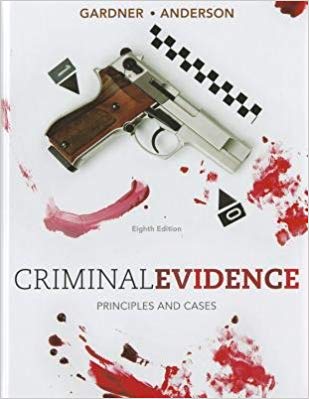
Criminal Evidence Principles and Cases 8th Edition by Gardner - Test Bank

Criminal Evidence Principles and Cases 8th Edition by Gardner - Test Bank   Instant Download - Complete Test Bank With Answers     Sample Questions Are Posted Below   CHAPTER 5       MULTIPLE CHOICE   In general, to be deemed a competent witness, the witness must, among other things, have personal knowledge of …

$19.99

Criminal Evidence Principles and Cases 8th Edition by Gardner – Test Bank


Instant Download – Complete Test Bank With Answers


Sample Questions Are Posted Below


CHAPTER 5


MULTIPLE CHOICE


  1. In general, to be deemed a competent witness, the witness must, among other things,
  2. have personal knowledge of the matters.
  3. be 21 years of age or older.
  4. have at least a sixth grade education.
  5. not be biased about the case.


ANS: A          LO : 1          REF: p. 114


  1. To be deemed a competent witness, the witness must have the capacity to
  2. speak the English language.
  3. observe, remember, narrate, and understand the obligation to be truthful.
  4. be a citizen of the United States.
  5. be capable of reading and writing in any language.


ANS: B          LO: 1          REF: p. 114


  1. Adult witnesses are
  2. presumed incompetent unless shown to be competent.
  3. presumed competent unless shown to be incompetent.
  4. always subjected to voir dire before being allowed to testify.
  5. presumed competent if they are at least 21 years of age.


ANS:  B           LO: 1          REF: p. 115


  1. Children may testify only if
  2. they are a minimum of ten years of age.
  3. a psychologist testifies that they are aware of the obligation to tell the truth.
  4. the judge allows them to testify after the child is questioned (voir dire).
  5. they have competed the first grade.


ANS: C           LO: 2          REF: p. 115 | 116


  1. The 1670 jury trial of ____________ in England was an important milestone in establishing the independence of juries from influence by the government.
  2. Benjamin Franklin.
  3. Sir Walter Raleigh
  4. Robert Palmer
  5. William Penn


ANS:  D          LO: 1          REF: p. 120


  1. A subpoena duces tecum is a subpoena that orders the person to
  2. bring certain items or records with them to court.
  3. appear with an attorney.
  4. waive their privilege against self-incrimination.
  5. not discuss their testimony with anyone.


ANS:  A          LO: 4          REF: p. 121


  1. A criminal defendant’s right to compel the appearance of witnesses at trial is found in the __________ Amendment.
  2. Fourth
  3. Fifth
  4. Sixth
  5. Eighth


ANS:  C          LO: 4          REF: p. 121


  1. A criminal defendant’s right to confront and cross-examine witnesses is found in the __________ Amendment.
  2. Fourth
  3. Fifth
  4. Sixth
  5. Seventh


ANS:  C          LO: 4          REF: p. 121 | 122


  1. Defendants who decide to testify at their trial
  2. may not be cross-examined because they have a privilege against self-incrimination.
  3. may not be prosecuted for perjury even if they lie.
  4. may be cross-examined.
  5. do not have to take an oath to tell the truth.


ANS:  C          LO: 4          REF: p. 122 | 123


  1. In general, only ____________ witnesses may testify as to their opinions or conclusions.
  2. ordinary
  3. expert
  4. prosecution
  5. defense


ANS:  B          LO: 4          REF: p. 123 | 124


  1. An ordinary witness may give an opinion about
  2. things which are in the common knowledge of most people.
  3. things they have been told by another
  4. their own competence to be a witness.
  5. whether their testimony is relevant.


ANS:  A          LO: 3 | 5     REF: p. 125 | 126


  1. Questioning of a witness by the party that called that witness is called ____________ examination.
  2. cross
  3. central
  4. straight
  5. direct


ANS: D           LO: 5          REF: p. 127 | 128


  1. Questioning of a witness by the opponent of the party that called that witness is called ____________-examination.
  2. cross
  3. didact
  4. critical
  5. skeptical


ANS:  A          LO: 5          REF: p. 128 | 129


  1. If a party believes that a question posed by the opponent is improper, that party must make a/n ____________ to that question.
  2. exception
  3. objection
  4. proposition
  5. request to omit


ANS:  B          LO: 7          REF: p. 130 | 131


  1. After a witness is subject to cross-examination, the party that called them originally may ask further questions under ____________ examination.
  2. recross
  3. following
  4. redirect
  5. didactic


ANS:  C          LO: 7          REF: p. 133


  1. As fact finders, the jury alone determines the ______ given to all evidence.
  2. exceptions
  3. legality
  4. weight
  5. sequence


ANS:  C          LO: 6          REF: p. 136


  1. As fact finders, the jury determines whether sufficient ___________exists to justify a verdict of guilty.
  2. evidence
  3. convincing
  4. bias
  5. objectivity


ANS:  A          LO: 6          REF: p. 136


  1. The trial judge determines the _____________ of a witness.
  2. recross
  3. competence
  4. redirect
  5. didactic


ANS:  B          LO: 3          REF: p. 133 | 134


  1. By using_______________, “the cross-examiner intends to afford the jury a basis to infer that the witness’ character is such that he would be less likely than the average trustworthy citizen to be truthful in his testimony.”
  2. evidence
  3. convincing
  4. impeachment
  5. objectivity


ANS:  C          LO: 3          REF: p. 129


  1. Expert testimony based on handwriting analysis is generally ___________in both federal and state courts under Federal Rules of Evidence 702 and similar state rules
  2. inadmissible
  3. excluded
  4. subjective
  5. admissible


ANS:  D          LO: 5 | 6          REF: p. 125


TRUE/FALSE


  1. Adult witnesses are presumed to be competent witnesses.


ANS:  T           LO: 1          REF: p. 114


  1. Unless they are the victim of a crime or an eyewitness, a child under the age of twelve can never be a competent witness.


ANS:  F           LO: 2          REF: p. 115


  1. At common law, no child under the age of fourteen was eligible or competent to testify as a witness.


ANS:  T           LO: 2          REF: p. 115


  1. Voir dire is a French term meaning to incriminate oneself.


ANS:  F           LO: 1          REF: p. 116


  1. Many jurisdictions have set up special procedures to protect child victims who testify at the trial of their alleged abuser.


ANS:  T          LO: 2          REF: p. 117


  1. In a jury trial, voir dire of witnesses is conducted by the foreperson of the jury.


ANS:  F           LO: 1          REF: p. 116


  1. In a jury trial, it is the province of the jury to determine the credibility of the witnesses and the weight to be given to their testimony.


ANS: T            LO: 3          REF: P. 136


  1. The term “demeanor of a witness” refers to the conduct and/or appearance of a witness while testifying.


ANS: T           LO: 3          REF: p. 120


  1. One of the purposes of the right to a jury trial is to protect people against overzealous prosecutors and biased judges


ANS:  T           LO: 3          REF: p.121


  1. The right to confront and cross-examine witnesses is found in the Fifth Amendment.


ANS:  F           LO: 4          REF: p. 128 | 129


  1. The privilege against self-incrimination gives the defendant a right to testify at his or her trial.


ANS:  F          LO: 4          REF: p. 122 | 123


  1. Under the Sixth Amendment, a defendant who lies on the witness stand cannot be prosecuted for perjury.


ANS:  F          LO: 4          REF: p.120


  1. The right to subpoena witnesses is found in the Sixth Amendment.


ANS:  T           LO: 5          REF: p.121


  1. The general rule is that ordinary (non-expert) witnesses may not give their conclusions or opinions.


ANS:  T           LO: 1          REF: p. 123 | 124


  1. A police officer can never be an expert witness.


ANS:  F           LO: 5          REF: p.125


  1. The first witnesses to testify in a criminal case are prosecution witnesses.


ANS: T          LO: 1          REF: p. 126


  1. Upon being called as a witness, a witness will first be subject to direct examination by the party that called them.


ANS: T          LO: 1          REF: p. 127 | 128

  1. Defendants who testify at their criminal trial may not be cross-examined by the prosecution.


ANS: F          LO: 4          REF: p. 128 | 129


  1. After direct examination, a witness is subject to cross-examination by the opposing party.


ANS:   T          LO: 7          REF: p.129


  1. If a party does not want a witness to answer a question, that party must object to the question.


ANS:   T          LO: 7          REF: p. 130 | 131


FILL-IN-THE-BLANK


  1. Adults are generally ___________ to be competent witnesses.


ANS:   Presumed                                LO: 1               REF: p.114 | 115


  1. Children and other witnesses whose competence is questioned will usually be subjected to a(n) ____________ examination.


ANS: voir dire                       LO: 2              REF: p.116


  1. To be deemed a competent witness, the witness must generally have ____________ knowledge of the matters to which they testify.


ANS: personal                                   LO: 3               REF: p.114 | 115


  1. Voir dire is a French term that means “to speak the _____________.”


ANS:   truth                                         LO: 3               REF: p.116


  1. Under the Sixth Amendment, the defendant has a right to ____________ and cross-examine witnesses.


ANS:   confront                                   LO: 4               REF: p.121


  1. A subpoena duces ____________ commands a witness to appear and bring certain things with them.


ANS:   tecum                                      LO: 4               REF: p.121


  1. To be admissible, testimony must be relevant, competent, and ____________.


ANS:   material                                   LO: 5               REF: p.122 | 123


  1. In a jury trial, it is the duty of the ____________ to assess the credibility of the witnesses and the weight to be given to the testimony.


ANS:   jury                                          LO: 3               REF: p.136


  1. The conduct or attitude of a witness is called their “_____________.”


ANS: demeanor                                LO: 3               REF: p. 120


  1. Defendants who testify at their trial waive their ____________ against self-incrimination.


ANS:   privilege                                  LO: 4               REF: p. 128 | 129


  1. In ____________ Arkansas, the U.S. Supreme Court dealt with the admissibility of hypnotically refreshed testimony.


ANS:   Rock                                        LO: 5               REF: p.122


  1. A defendant’s right to testify does not include the right to commit ____________.


ANS:   perjury                                     LO: 4               REF: p. 122 | 123


  1. ___________ means implanting false memories


ANS: taint                                           LO: 7               REF: p. 118


  1. The use of falsehoods to ___________ key witnesses can reverse a conviction on

Appeal


ANS:  impeach                                   LO: 7               REF: p. 129


  1. The first line of defense an opposing party seeks to use is _______________


ANS: objection                                  LO: 7               REF: p.130


ESSAY


  1. What are the three basic requirements for a person to qualify as a competent witness? Be sure to provide examples.


ANS: In order to be a witness, a person must satisfy the following requirements: Requirement of personal knowledge: The witness must have some personal knowledge of the matter before the court.  Requirement to declare that testimony is truthful: Most witnesses take an oath swearing that they will tell the truth.  Requirement of competency:  In addition to competency as having personal knowledge, a witness most also demonstrate competency to function as a witness.  Students’ responses to the examples should reflect accurate understanding of the three aforementioned qualifiers.


LO: 1              REF: p. 114


  1. Describe and discuss the Sixth Amendment rights of defendants with regard to witnesses.


ANS: The Sixth Amendment of the U.S. Constitution provides that “In all criminal prosecutions, the accused shall enjoy the right to have compulsory process for obtaining witnesses in his favor.”  The Sixth Amendment also provides that “The accused shall enjoy the right … to be confronted with the witnesses against him.” The witness not only testifies in open court in the presence of the accused but is also subject to cross-examination by the opposing party.


LO: 4               REF: p. 121 | 122


  1. Discuss, define, compare, and contrast the law on the permissibility of ordinary and expert witnesses to give their opinions. Be sure to provide examples.


ANS: Most witnesses are ordinary (or lay) witnesses who are called to testify about the firsthand information they have regarding the case before the court. Their testimony is typically limited to what they have seen, heard (although hearsay is in most instances excluded), smelled, felt, and, on rare occasions, tasted. Law enforcement officers appear in most instances as ordinary witnesses, although some officers also appear as expert witnesses when they qualify, testifying about fingerprinting, traffic matters, weapons, and so on.

An expert witness is a person who has had special training, education, or experience. Because of this experience and background, the expert witness may be able to assist the jury and the court in resolving the issues before them. The party that offers a witness as an expert must lay a foundation (that is, ask a series of questions) establishing the witness as an expert in the field in which the expert will testify and offer opinions.  Student examples should be based on the qualifiers that distinguish lay and expert witnesses.


LO: 5               REF: p. 125 | 126

  1. Discuss the objections which attorneys may make to both questions and answers directed to witnesses in a criminal trial.


ANS: The trial judge has considerable discretion in ruling on objections and in determining what is relevant, material, and competent. The trial judge will not be overruled by a higher court unless there is an abuse of discretion or plain error.  Objections are classified as follows:

  • Objections to the substance of the question: These objections concern the answer called for by the question. Usual objections in this area are irrelevant, immaterial, incompetent, and hearsay.
  • Objections to the form of the question: These objections concern the manner in which the question is worded. In most instances, the question may be rephrased and asked again in a form in which both the question and answer are admissible. Usual objections to the form of a question are that the question is leading, argumentative, calls for speculation, or misstates a fact in evidence.
  • Objections to the answer: If an attorney is slow in objecting, the attorney usually pays the penalty and is told to object faster. In this situation and others, a lawyer can object to an answer and ask that the answer be stricken from the record because: (1) the answer is unresponsive to the question (most often when the witness volunteers additional information beyond the scope of the question asked), (2) the answer contains an inadmissible opinion, or (3) the answer includes inadmissible hearsay statements.


LO: 7               REF: p. 130 | 131 | 132


  1. List the three elements that all evidence must be in order to be allowed into a trial.


ANS:  All evidence must be relevant, material, and competent. Therefore, to introduce facts, testimony, or a physical object as evidence, it must be shown that the evidence addresses a material fact, the evidence is relevant to that fact and lastly, the evidence is able to affect the probable truth or falsity of that fact by being competent.  A fact is material if it will affect the result of a trial. Evidence is relevant if it has a tendency to make a material fact more or less probable.  Competency directly relates to the foundation of personal knowledge as required under the Federal Rule of Evidence 602.


LO: 6               REF: p. 132 | 133


  1. Discuss the purposes of redirect examination.


ANS:  To restore the credibility of a witness who has been impeached on cross-examination by explanations of matters on which the cross-examiner sought to impeach the witness and to restore the credibility of a witness by pointing out prior consistent statements when the impeachment was made by means of prior   inconsistent statements.


LO: 3               REF: p. 133

  1. Discuss the functions of impeaching a witnesses’ testimony.


ANS: The functions of impeachment may be classified as follows.  First, to attack the witness’ credibility and qualifications to testify truthfully because of prior criminal conviction (and in some jurisdictions and some instances, a showing of prior bad conduct). Rule 609 of the Federal Rules of Evidence limits evidence of prior criminal convictions to crimes with a penalty in excess of one year of imprisonment, or crimes involving dishonesty or false statement, regardless of the punishment; secondly, to attack the testimony given by the witness on direct examination by a showing of prior inconsistent statements and lastly to attack the witness’ credibility by showing bias, prejudice, or ulterior motives of the witness.


LO: 3               REF: p. 129 | 130


  1. List the objections to the form of the questions asked in a trial.


ANS:

  • Leading question (suggests the answer that is wanted)
  • Calls for speculation
  • Argumentative
  • Misstates facts in evidence
  • Assumes facts not in evidence
  • Vague and ambiguous
  • Repetitive or cumulative


LO: 7               REF: p. 130 | 131


Additional information

Add Review

Your email address will not be published. Required fields are marked *