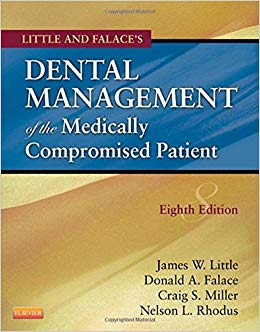
Dental Management of the Medically Compromised Patient 8E by Little - Test Bank

Dental Management of the Medically Compromised Patient 8E by Little - Test Bank   Instant Download - Complete Test Bank With Answers     Sample Questions Are Posted Below   Little: Dental Management of the Medically Compromised Patient, 8th Edition   Chapter 05: Cardiac Arrhythmias   Test Bank   MULTIPLE CHOICE   Which of the …

$19.99

Dental Management of the Medically Compromised Patient 8E by Little – Test Bank


Instant Download – Complete Test Bank With Answers


Sample Questions Are Posted Below


Little: Dental Management of the Medically Compromised Patient,

8th Edition


Chapter 05: Cardiac Arrhythmias


Test Bank


MULTIPLE CHOICE


  1. Which of the following is the most common type of persistent arrhythmia?
A. sinus arrhythmia
B. premature atrial complexes
C. atrial fibrillation
D. ventricular flutter and fibrillation


ANS:   C

The most common type of persistent arrhythmia is atrial fibrillation (AF), which affects approximately 2.6 million people. It is characterized by rapid, disorganized, and ineffective atrial contractions that occur at a rate of 350 to 600 beats per minute. To manage their arrhythmias, more than 500,000 people in North America have implanted pacemakers.


PTS:    1                      REF:    p. 67


  1. Which of the following sequences correctly depicts the normal pattern of sequential depolarization of the structures of the heart? (1) right and left bundle branches, (2) sinoatrial (SA) node, (3) subendocardial Purkinje network, (4) bundle of His, (5) atrioventricular (AV) node
A. 5, 2, 4, 1, 3
B. 2, 5, 4, 1, 3
C. 2, 3, 4, 1, 5
D. 2, 5, 3, 1, 4


ANS:   B

The normal pattern of sequential depolarization involves the structures of the heart in the following order: sinoatrial (SA) node, atrioventricular (AV) node, bundle of His, right and left bundle branches, subendocardial Purkinje network. The electrocardiogram (ECG) is a recording of this electrical activity. The primary anatomic pacemaker for the heart is the SA node, a crescent-shaped structure 9 to 15 mm long that is located at the junction of the superior vena cava and the right atrium.


PTS:    1                      REF:    p. 67


  1. Tachycardia in an adult is defined as a heart rate greater then ___ beats per minute, with otherwise normal findings on the ECG.
A. 100
B. 125
C. 150
D. 175


ANS:   A

Tachycardia in an adult is a heart rate greater than 100 beats per minute. The rate usually is between 100 and 180 beats per minute. This condition most often is a physiologic response to exercise, anxiety, stress, or emotion. Pathophysiologic causes include fever, hypertension, hypoxia, infection, anemia, hyperthyroidism, and heart failure. Drugs that may cause sinus tachycardia include atropine, epinephrine, alcohol, nicotine, and caffeine.


PTS:    1                      REF:    p. 69


  1. Which of the following is a disorder of repolarization?
A. Mobitz type I (Wenckebach)
B. Wolff-Parkinson-White syndrome
C. long QT syndrome
D. torsades de pointes


ANS:   C

Long QT syndrome is a disorder of the conduction system in which the recharging of the heart during repolarization (i.e., the QT interval) is delayed. It is caused by a genetic mutation in myocardial ion channels and by certain drugs, or it may be the result of a stroke. Mobitz type I (Wenckebach) is a form of second-degree heart block. Wolff-Parkinson-White syndrome is tachycardia involving the AV junction. Torsades de pointes is a variant of ventricular tachycardia.


PTS:    1                      REF:    pp. 69


  1. Which of the following is an advantage of implantable cardioverter-defibrillators (ICDs) in contrast to pacemakers?
A. ICDs generally are smaller than pacemakers.
B. ICDs are capable of providing antitachycardia pacing (ATP) and ventricular bradycardia pacing, while pacemakers are not capable of providing such pacing.
C. ICDs have batteries that last much longer than pacemakers.
D. ICDs do not require antibiotic prophylaxis prior to dental treatment whereas pacemakers do.


ANS:   B

ICDs are capable not only of delivering a shock but of providing antitachycardia pacing (ATP) and ventricular bradycardia pacing. ICDs generally are larger than pacemakers, and their batteries do not last as long as those of a pacemaker. Antibiotic prophylaxis for dental treatment is not recommended for either a pacemaker or a cardioverter-defibrillator.


PTS:    1                      REF:    pp. 74


  1. Which of the following dental devices has produced electromagnetic interference (EMI) with pacemakers and ICDs in studies performed in vitro?
A. battery-operated curing lights
B. electrical pulp testers and apex locators
C. handpieces
D. electric toothbrushes


ANS:   A

In studies performed in vitro, electrosurgery units, ultrasonic bath cleaners, ultrasonic scaling devices, and battery-operated curing lights have produced EMI with pacemakers and ICDs. Amalgamators, electrical pulp testers and apex locators, handpieces, electric toothbrushes, microwave ovens, and x-ray units did not cause any significant EMI with the pacemakers and ICDs tested.


PTS:    1                      REF:    pp. 74


  1. Which of the following is classified as a significant arrhythmia according to the ACC/AHA guidelines?
A. pathologic Q waves
B. left bundle branch block
C. high-grade AV block
D. ST-T wave abnormalities


ANS:   C

Patients with high-grade AV block, symptomatic ventricular arrhythmias in the presence of cardiovascular disease, and supraventricular arrhythmias with an uncontrolled ventricular rate are at major risk for complications and are not candidates for elective dental care. The presence of pathologic Q waves is a clinical predictor of intermediate risk for perioperative complications. Left ventricular hypertrophy, left bundle branch block, and ST-T wave abnormalities are associated with minor perioperative risk.


PTS:    1                      REF:    p. 76


  1. If a vasoconstrictor in local anesthetic is deemed necessary, patients in the low to intermediate risk category and those taking nonselective beta blockers can safely be given up to ____ cartridge(s) containing 1:100,000 epinephrine.
A. one
B. two
C. three
D. zero—epinephrine is an absolute contraindication


ANS:   B

These patients can safely be given up to 0.036 mg epinephrine, which is the amount in two cartridges containing 1:100,000 epinephrine. Greater quantities of vasoconstrictor may well be tolerated, but increasing quantities are associated with increased risk for adverse cardiovascular effects.


PTS:    1                      REF:    p. 77

Additional information

Add Review

Your email address will not be published. Required fields are marked *