Earths Climate Past and Future 3rd Edition by Ruddiman - Test Bank Instant Download - Complete Test Bank With Answers Sample Questions Are Posted Below 1. How many icehouse eras have existed since 450 million years ago? A) 10 B) 5 C) 3 D) 1 E) …


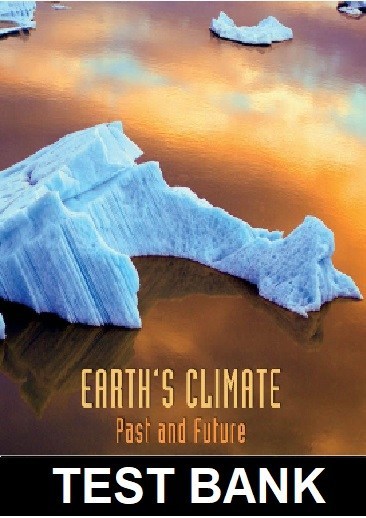
Earths Climate Past and Future 3rd Edition by Ruddiman - Test Bank Instant Download - Complete Test Bank With Answers Sample Questions Are Posted Below 1. How many icehouse eras have existed since 450 million years ago? A) 10 B) 5 C) 3 D) 1 E) …
$19.99
Earths Climate Past and Future 3rd Edition by Ruddiman – Test Bank
Instant Download – Complete Test Bank With Answers
Sample Questions Are Posted Below
| 1. | How many icehouse eras have existed since 450 million years ago? | |
| A) | 10 | |
| B) | 5 | |
| C) | 3 | |
| D) | 1 | |
| E) | none | |
| 2. | What allows lithospheric slabs to move? | |
| A) | wind strength and direction | |
| B) | a soft, easily deformed layer of the mantle just below the lithosphere | |
| C) | flow of material in the outer core | |
| D) | formation and location of mountain uplift | |
| E) | incoming solar radiation | |
| 3. | The paleomagnetic signature of minerals in rocks can help determine which of the following? | |
| A) | the age of the rock | |
| B) | the paleolatitude of rock | |
| C) | the paleolongitude of the rock | |
| D) | All of the answers are correct. | |
| E) | Both A and B are correct. | |
| 4. | How is the polar position hypothesis tested? | |
| A) | Paleogeography is compared to the geologic record of ice sheet existence. | |
| B) | Paleogeography is compared to paleomagnetic data. | |
| C) | It is modeled. | |
| D) | It cannot be tested because we cannot observe it in a laboratory. | |
| E) | Both B and D are correct. | |
| 5. | A negative magnetic anomaly indicates: | |
| A) | a time period of reversed polarity in geologic record. | |
| B) | the position of a continent. | |
| C) | that Earth’s magnetic field at the time the rock formed was aligned similar to that of today’s magnetic field. | |
| D) | None of the answers is correct. | |
| E) | Both B and C are correct. | |
| 6. | The solid Earth is differentiated into layers. Which of the following is a correct statement about these layers? | |
| A) | The continental crust includes part of both the lithosphere and asthenosphere. | |
| B) | The density of oceanic crust is greater than that of continental crust. | |
| C) | The density of the crust is greater than that of the mantle. | |
| D) | The lithosphere is partially molten, whereas the asthenosphere is a hard, ridged layer. | |
| E) | All of the answers are correct. | |
| 7. | Tectonic plates: | |
| A) | are either oceanic or continental, but never both. | |
| B) | move at rates between 1–10 meters per year. | |
| C) | are rigid slabs of lithosphere. | |
| D) | All of the answers are correct. | |
| E) | Both C and D are correct. | |
| 8. | Transform plate margins: | |
| A) | are characterized by faults with compressional motion. | |
| B) | offset mid-ocean ridge segments. | |
| C) | are well-represented by the San Andreas fault. | |
| D) | All of the answers are correct. | |
| E) | Both B and C are correct. | |
| 9. | Which of the following characteristics would you expect at convergent plates’ margins that contains oceanic crust on one plate and continental crust on the other? | |
| A) | mountains forming | |
| B) | earthquakes, with increasing depth toward the oceanic plate | |
| C) | a spreading center | |
| D) | All of the characteristics are expected. | |
| E) | None of the answers is correct. | |
| 10. | Magnetic lineations on the ocean floor: | |
| A) | match the pattern of magnetic-reversal history from basalt sequences on land. | |
| B) | are true stripes of black and white color variations on the ocean floor. | |
| C) | can be used to reconstruct the rate of seafloor spreading. | |
| D) | All of the answers are correct. | |
| E) | Both A and C are correct. | |
| 11. | Examine the following figure and determine which of the following statements about seafloor spreading is correct.
|
|
| A) | The spreading rate is uniform everywhere in the world’s oceans during the last 5 Myr. | |
| B) | The only ocean crust from before 160 Myr ago that exists today is located in the western Pacific. | |
| C) | Plate motion occurs at the same rate but in opposite directions perpendicular to the ridge. | |
| D) | All of the answers are correct. | |
| E) | None of the answers is correct. | |
| 12. | Modern ice sheets exist at high latitudes because of: | |
| A) | cold temperatures caused by high angles of incoming solar radiation. | |
| B) | low albedos resulting from the low reflectivity of snow and sea ice. | |
| C) | sufficient moisture supply to maintain ice sheets despite any melting that occurs along ice margins. | |
| D) | All of the answers are correct. | |
| E) | Both A and C are correct. | |
| 13. | The polar position hypothesis: | |
| A) | maintains that ice sheets should appear on continents that were located at polar or near polar positions in the geologic past. | |
| B) | maintains that no ice sheets should appear on continents located outside of the polar regions. | |
| C) | only partially explains the sequence of icehouse and greenhouse intervals in the last 500 Myr. | |
| D) | All of the answers are correct. | |
| E) | Both A and C are correct. | |
| 14. | New evidence suggests that the continental-scale glaciation in North Africa 445 Myr ago was brief, perhaps only ~1 Myr in duration. The best logical control on this geologically brief glacial episode could be: | |
| A) | changes in atmospheric CO2 because of abrupt changes in the burial rate of organic carbon. | |
| B) | changes in atmospheric CO2 because of changes in the rate of chemical weathering. | |
| C) | cooler temperatures because of a weaker Sun. | |
| D) | changes in the rate of seafloor spreading. | |
| E) | change in the paleogeographic position of North Africa. | |
| 15. | Model simulation of climate during the time Pangaea existed requires input decisions for which of the following boundary conditions? | |
| A) | sea level | |
| B) | geographic distribution of land and sea | |
| C) | distribution of land elevations | |
| D) | CO2 level in the atmosphere | |
| E) | All of the answers are correct. | |
| 16. | Model simulations of climate on Pangaea indicate that the climate was likely one with: | |
| A) | little seasonal temperature contrasts across the latitudes. | |
| B) | arid conditions in the low-latitude continental interior. | |
| C) | strong monsoonal conditions in the high latitudes. | |
| D) | All of the answers are correct. | |
| E) | None of the answers is correct. | |
| 17. | The BLAG spreading rate hypothesis proposes how: | |
| A) | Pangaea formed. | |
| B) | continents move into polar positions. | |
| C) | plate tectonic-control processes controlled CO2 atmosphere and ocean input, and thus influenced long-term global climate trends. | |
| D) | hot spots form. | |
| E) | Both A and B are correct. | |
| 18. | Under which conditions would you expect greater CO2 input to the atmosphere and ocean? | |
| A) | fast seafloor spreading | |
| B) | fast subduction | |
| C) | during times of higher rates of hot spot volcanism | |
| D) | All of the above conditions are correct. | |
| E) | Both A and B are correct. | |
| 19. | Chemical weathering increases when: | |
| A) | there is an increase in the rate of physical weathering. | |
| B) | continental collisions create high uplifted plateaus. | |
| C) | global climate is cooler and drier. | |
| D) | All of the answers are correct. | |
| E) | Both A and B are correct. | |
| 20. | Why is chemical weathering faster in the eastern Andes than in the Amazon lowlands? | |
| A) | The eastern Andes are wetter than the Amazon lowlands. | |
| B) | The eastern Andes have more fresh rock exposed than do the Amazon lowlands. | |
| C) | The eastern Andes cover a larger geographic area than the Amazon lowlands. | |
| D) | All of the answers are correct. | |
| E) | None of the above is correct; chemical weathering is actually slower in the eastern Andes than in the Amazon lowlands. | |
| 21. | What evidence did Alfred Wegener present to support his hypothesis of the mobility of continents? | |
| A) | magnetic reversals of oceanic crust | |
| B) | paleomagnetism of continental rock | |
| C) | radiometric age of ocean crust | |
| D) | similar shapes of widely separated continental margins | |
| E) | All of the answers are correct. | |
| 22. | Which of the following relationships is correct? | |
| A) | continental crust—thick, high density | |
| B) | continental crust—thick, low density | |
| C) | continental crust—thin, high density | |
| D) | oceanic crust—thick, high density | |
| E) | oceanic crust—thin, low density | |
| 23. | Which of the following regions is the site of a convergent plate margin? | |
| A) | San Andreas fault, western California | |
| B) | Tibetan Plateau | |
| C) | west coast of South America | |
| D) | Both B and C are correct. | |
| E) | All of the regions are sites. | |
| 24. | What is one direct result of the circulation of molten iron in Earth’s core? | |
| A) | Earth’s magnetic field | |
| B) | subduction of ocean crust | |
| C) | the movement of lithospheric plates | |
| D) | volcanoes on Earth’s surface | |
| E) | All of the answers are correct. | |
| 25. | What geologic material is used to establish the changing latitude of portions of Earth’s crust prior to 175 million years ago? | |
| A) | carbon-rich deposits | |
| B) | continental basalts | |
| C) | deep ocean sediments | |
| D) | All of the answers are correct. | |
| E) | None of the answers is correct. | |
| 26. | How long ago did the last switch from reversed to normal in Earth’s magnetic polarity occur? | |
| A) | 0 Myr ago | |
| B) | 0.78 Mry ago | |
| C) | 2.75 Myr ago | |
| D) | 3.4 Myr ago | |
| E) | 5 Myr ago | |
| 27. | Which of the following modern landmasses was NOT part of the supercontinent Gondwana? | |
| A) | Africa | |
| B) | Antarctica | |
| C) | Arabia | |
| D) | Australia | |
| E) | Europe | |
| 28. | During what time period was the African landmass positioned over the South Pole? | |
| A) | 300–250 Myr ago | |
| B) | 450–380 Myr ago | |
| C) | 240–125 Myr ago | |
| D) | 750–500 Myr ago | |
| E) | All of the answers are correct. | |
| 29. | Which of the following statements about icehouse eras of the last 500 million years is correct? | |
| A) | Each time continents were in polar position, ice sheets were present. | |
| B) | Ice sheets have only been present when continents were in polar position. | |
| C) | The polar position hypothesis explains all of Earth’s history of glaciation. | |
| D) | Both A and B are correct. | |
| E) | All of the answers are correct. | |
| 30. | Pangaea: | |
| A) | did not include the Australian landmass. | |
| B) | formed around 250 million years ago. | |
| C) | was roughly symmetrical around the equator. | |
| D) | Both B and C are correct. | |
| E) | All of the answers are correct. | |
| 31. | What does evidence about ice sheets and vegetation during the time of Pangaea suggest? | |
| A) | Glaciation was extensive at high latitudes. | |
| B) | Hard freezes occurred nearer to the equator than they do today. | |
| C) | The climate was somewhat cooler than today. | |
| D) | Wet conditions prevailed across the entire landmass. | |
| E) | None of the answers is correct. | |
| 32. | What factor partially accounts for aridity in the low-latitude interior of Pangaea? | |
| A) | cooler oceans around the margins of the landmass | |
| B) | large areas of land located under the dry descending limb of the Hadley circulation | |
| C) | small area of land cover in the tropics | |
| D) | Both A and C are correct. | |
| E) | All of the answers are correct. | |
| 33. | What evidence supports model simulations of widespread Pangaean aridity? | |
| A) | Abundant evaporite deposits from the time of Pangaea. | |
| B) | Deep coal deposits formed in the interior of the landmass from Pangaean times. | |
| C) | Relatively small ice sheets formed at mid- to high-latitudes at the time. | |
| D) | Widespread fossils of plants, common in desert areas today, from the period. | |
| E) | All of the answers are correct. | |
| 34. | What does the occurrence of oxidized sedimentary rocks suggest about Pangaean climate? | |
| A) | Dry conditions prevailed along the coasts. | |
| B) | Monsoons were relatively weak. | |
| C) | Prevailing wind direction remained constant throughout the seasons. | |
| D) | Seasonal changes in moisture were strong. | |
| E) | None of the answers is correct. | |
| 35. | In what tectonic setting is the expulsion of CO2 to the atmosphere least important? | |
| A) | along the margins of converging plates | |
| B) | along transform plate boundaries | |
| C) | at divergent plate boundaries | |
| D) | at volcanic hot spots | |
| E) | Both A and C are correct. | |
| 36. | What is the role of chemical weathering under the BLAG hypothesis? | |
| A) | It is a negative feedback on atmospheric CO2 changes. | |
| B) | Increases in atmospheric CO2 due to fast seafloor spreading ultimately lead to increased CO2 removal by chemical weathering. | |
| C) | Warmer temperatures during times of increased volcanic activity cause an increase in the rate of chemical weathering. | |
| D) | All of the answers are correct. | |
| E) | None of the answers are correct. | |
| 37. | How is the spreading rate hypothesis informed by geological evidence from the last 100 million years? | |
| A) | Evidence of relatively high rates of seafloor spreading coincides with evidence for a lack of polar ice sheets. | |
| B) | Generally cooler conditions prevailed when volcanic activity was high. | |
| C) | Ice sheets were large when the hypothesis predicts high atmospheric CO2. | |
| D) | Both A and C are correct. | |
| E) | All of the answers are correct. | |
| 38. | Under the uplift weathering hypothesis, what is the main factor that influences the global rate of chemical weathering? | |
| A) | mean temperature | |
| B) | precipitation rates | |
| C) | the amount of fresh rock exposed at Earth’s surface | |
| D) | the atmospheric concentration of CO2 | |
| E) | the rate of seafloor spreading | |
| 39. | What does evidence from moraines in the Wind River Basin of Wyoming suggest about chemical weathering? | |
| A) | Chemical weathering takes place very slowly on glacially deposited material. | |
| B) | CO2 is released from rocks when chemical weathering is fast. | |
| C) | Newly exposed rocks resist chemical weathering for thousands of years before beginning to break down. | |
| D) | Rates of chemical weathering decrease exponentially with time after rocks are exposed at the surface. | |
| E) | None of the answers are correct. | |
| 40. | Why does the exposure rate of fresh rock increase in areas of uplift? | |
| A) | Earthquakes are common in mountainous areas. | |
| B) | High mountains have increased precipitation rates on their slopes. | |
| C) | High-elevation surfaces can support the growth of glaciers. | |
| D) | Mass wasting occurs predominantly on steep slopes. | |
| E) | All of the answers are correct. | |
| 41. | The BLAG hypothesis is based on the assumption that the globally averaged rate of seafloor spreading has remained constant through time. | |
| A) | True | |
| B) | False | |
| 42. | The polar position hypothesis does not explain the lack of glaciations between 425 and 325 million years ago. | |
| A) | True | |
| B) | False | |
| 43. | The fragmentation of rock leads to a reduction in rock surface area subject to chemical weathering. | |
| A) | True | |
| B) | False | |
| 44. | The land area covered by large plateau features formed from continental collision has been relatively constant through time. | |
| A) | True | |
| B) | False | |
| 45. | Cooling of global climate due to uplift weathering, and the corresponding decrease in chemical weathering on lowland continental surfaces, could act as a negative feedback on atmospheric CO2 removal. | |
| A) | True | |
| B) | False | |
| 46. | Describe the characteristics of lithospheric plates, and discuss evidence for their movement over time. |
| 47. | How might periods of glaciation over the last 500 million years be related to continental movements? Give specific examples from Earth’s history. |
| 48. | Describe the arrangement of landmasses during the time of Pangaea. What evidence has been used to produce an understanding of Pangaean climate? |
| 49. | How does the rate of seafloor spreading influence the CO2 concentration of the atmosphere? What does evidence suggest about the rate of seafloor spreading 100 million years ago? |
| 50. | In what ways could uplift of the land surface influence the CO2 concentration of the atmosphere? |
Answer Key
| 1. | C |
| 2. | B |
| 3. | E |
| 4. | A |
| 5. | A |
| 6. | B |
| 7. | C |
| 8. | E |
| 9. | A |
| 10. | E |
| 11. | B |
| 12. | C |
| 13. | D |
| 14. | A |
| 15. | E |
| 16. | B |
| 17. | C |
| 18. | D |
| 19. | E |
| 20. | B |
| 21. | D |
| 22. | B |
| 23. | D |
| 24. | A |
| 25. | B |
| 26. | B |
| 27. | E |
| 28. | B |
| 29. | B |
| 30. | D |
| 31. | E |
| 32. | B |
| 33. | A |
| 34. | D |
| 35. | B |
| 36. | D |
| 37. | A |
| 38. | C |
| 39. | D |
| 40. | E |
| 41. | B |
| 42. | A |
| 43. | B |
| 44. | B |
| 45. | A |
| 46. | |
| 47. | |
| 48. | |
| 49. | |
| 50. |

$30.00 Original price was: $30.00.$20.00Current price is: $20.00.

$30.00 Original price was: $30.00.$20.00Current price is: $20.00.

$30.00 Original price was: $30.00.$20.00Current price is: $20.00.

$30.00 Original price was: $30.00.$20.00Current price is: $20.00.
$30.00 Original price was: $30.00.$20.00Current price is: $20.00.

$30.00 Original price was: $30.00.$20.00Current price is: $20.00.
511 SW 10th Ave 1206, Portland, OR, United States