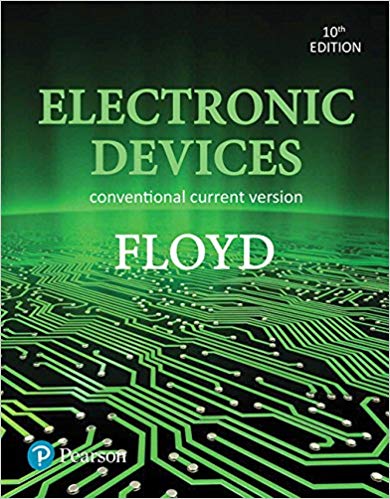
Electronic Devices 10th Edition by Thomas L. Floyd - Test Bank

Electronic Devices 10th Edition by Thomas L. Floyd - Test Bank   Instant Download - Complete Test Bank With Answers     Sample Questions Are Posted Below   Exam Name___________________________________ TRUE/FALSE. Write 'T' if the statement is true and 'F' if the statement is false. 1) The dc load line is a straight line drawn …

$19.99

Electronic Devices 10th Edition by Thomas L. Floyd – Test Bank


Instant Download – Complete Test Bank With Answers


Sample Questions Are Posted Below


Exam
Name___________________________________
TRUE/FALSE. Write ‘T’ if the statement is true and ‘F’ if the statement is false.
1) The dc load line is a straight line drawn from IC(sat) to VCC. 1)
2) The Q-point can be anywhere along the dc load line. 2)
3) Voltage-divider bias requires two power supplies. 3)
4) Base bias is more stable than voltage-divider bias. 4)
5) Collector feedback bias uses a form of negative feedback. 5)
6) IC and IE are nearly the same in a properly biased transistor. 6)
7) VBE of properly biased pnp transistor is a positive value. 7)
8) RIN(BASE) will increase if IE decreases. 8)
MULTIPLE CHOICE. Choose the one alternative that best completes the statement or answers the question.
9) Assume the output of an amplifier has both peaks clipped. This can be caused by
A) power supply voltage is too high B) too little gain
C) Q-point is not centered D) all of the above
9)
10) At cutoff,
A) IC = IC(sat) B) VCE = 1/2 VCC C) VB = 0.7 V D) VCE = VCC
10)
11) Assume a load line is drawn for a transistor amplifier. If VCC is increased, the load line will
A) have a higher cutoff voltage B) have a higher saturation current
C) both A and B D) none of the above
11)
1
Figure 1
12) Refer to Figure 1. The end points of the dc load line are at approximately
A) 0 mA and 15 V B) 8 mA and 7 V
C) 15 mA and 15 V D) 7 mA and 8 V
12)
13) Refer to Figure 1. The Q-point is approximately at
A) 6.6 mA and 6.6 V B) 6.6 mA and 8.4 V
C) 8.4 mA and 8.4 V D) 8.4 mA and 6.6 V
13)
2
Figure 2
14) Refer to Figure 2. The value of IC is approximately
A) 2.6 mA B) 3.3 mA C) 1.3 mA D) 2.0 mA
14)
15) Refer to Figure 2. VCE is approximately
A) 3.2 V B) 6.6 V C) 8.5 V D) 5.3 V
15)
3
Figure 3
16) Refer to Figure 3. Note the transistor is a pnp type. The value of IC is approximately
A) 3.4 mA B) 1.3 mA C) 2.5 mA D) 1.0 mA
16)
17) Refer to Figure 3. The load line intersects the y-axis at
A) 1.3 mA B) 2.5 mA C) 3.6 mA D) 1.0 mA
17)
18) Refer to Figure 3. The equivalent Thevenin resistance of the bias circuit is
A) 5.1 kΩ B) 33 kΩ C) 38.1 kΩ D) 4.4 kΩ
18)
19) Refer to Figure 3. The equivalent Thevenin voltage of the bias circuit is
A) −10.4 V B) −1.9 V C) −12 V D) −1.6 V
19)
20) Refer to Figure 3. In order to use a positive supply voltage in place of the negative one shown, the
A) emitter and base leads are exchanged
B) ground is exchanged with positive supply; negative supply is grounded
C) positive supplies are never used with pnp transistors
D) collector and base leads are exchanged
20)
4
Figure 4
21) Refer to Figure 4. The type of bias shown is
A) emitter-feedback bias B) dual supply base bias
C) emitter bias D) collector feedback bias
21)
22) Refer to Figure 4. The emitter voltage, VE is approximately
A) −6.4 V B) −5.2 V C) −1.4 V D) −3.8 V
22)
23) Refer to Figure 4. If you wanted to develop the equation for IE,
A) Thevenize the base input circuit and apply Ohm’s law
B) write KVL through the emitter and collector and both power supplies
C) write KVL around the base-emitter circuit
D) assume VCE = VRC; apply Ohm’s law to find IC first; then solve for IE
23)
24) Refer to Figure 4. Assume you were troubleshooting and found that VE is exactly the same as VEE.
The trouble could be caused by
A) shorted RC B) open RB
C) open RE D) any of the above
24)
5
Figure 5 (This is similar to Figure 4 but uses a pnp transistor with the same β.)
25) Refer to Figure 5. The expected emitter voltage is
A) the same as the npn circuit except for the sign
B) the same as the collector voltage in the npn circuit except for the sign
C) the same as the npn circuit
D) the same as the collector voltage in the npn circuit
25)
26) Refer to Figure 5. If RC is replaced with a 1.5 kΩ resistor, you would expect to see a large change in
A) IE B) VCE C) VE D) all of the above
26)
27) Refer to Figure 5. If the transistor is replaced with a lower β one, there will be
A) no change in IE B) a small decrease in IE
C) a large change in IE D) a small increase in IE
27)
28) Refer to Figure 5. If RB is increased, VE will
A) decrease B) increase C) not change
28)
29) Refer to Figure 5. If RB is increased, VCE will
A) increase B) decrease C) not change
29)
6
Figure 6
30) Refer to Figure 6. Assume VC = 0.07 V and VB = 0.7 V. The fault may be that
A) VCC is open B) RC is open
C) VCC has dropped to 8 V D) RE is open
30)
31) Refer to Figure 6. Assume you find VC = 12 V and VB = 0.08 V. The fault may be that
A) R1 is open B) RE is open C) R2 is open D) RC is open
31)
32) Refer to Figure 6. Assume you find VC = 12 V and VB = 2 V. The fault may be
A) that the transistor base is open B) that RC is open
C) either A or B could account for this D) none of the above
32)
33) Refer to Figure 6. If you Thevenize the input to the base, the Thevenin voltage is
A) VTH = 3.5 V B) VTH = 2.6 V C) VTH = 2.1 V D) VTH = 0.7 V
33)
34) Refer to Figure 6. If you Thevenize the input to the base, the Thevenin resistance is
A) RTH = 4.7 kΩ B) RTH = 26.7 kΩ C) RTH = 22 kΩ D) RTH = 3.9 kΩ
34)
35) A stiff voltage divider is one in which
A) has very large bias resistors B) loading effects can be ignored
C) two voltage sources are used D) the Q-point will be centered
35)
36) Of the methods shown below, the one that has the most stability is
A) collector feedback bias B) base bias
C) emitter bias D) emitter feedback bias
36)
7
Figure 7
37) Refer to Figure 7. Assume the thermistor has a resistance of 1.7 kΩ. VOUT is approximately
A) 4.7 V B) 7.5 V C) 5.9 V D) 5.4 V
37)
38) Refer to Figure 7. The input resistance of RIN(BASE)
A) depends on the β of the transistor B) depends on the resistance of RE
C) both A and B D) none of the above
38)
39) Assume a pnp transistor is used in a voltage-divider biased circuit. If VB = −2.8 V, VE should be
A) − 3.5 V B) +3.5 V C) − 2.1 V D) − 2.8 V
39)
8
Answer Key
Testname: UNTITLED5
1) TRUE
2) TRUE
3) FALSE
4) FALSE
5) TRUE
6) TRUE
7) FALSE
8) TRUE
9) C
10) D
11) C
12) C
13) B
14) A
15) D
16) B
17) C
18) D
19) D
20) B
21) C
22) C
23) C
24) B
25) A
26) B
27) B
28) B
29) A
30) B
31) A
32) C
33) C
34) D
35) B
36) C
37) D
38) C
39) C
9

Additional information

Add Review

Your email address will not be published. Required fields are marked *