Subtotal: $735.00

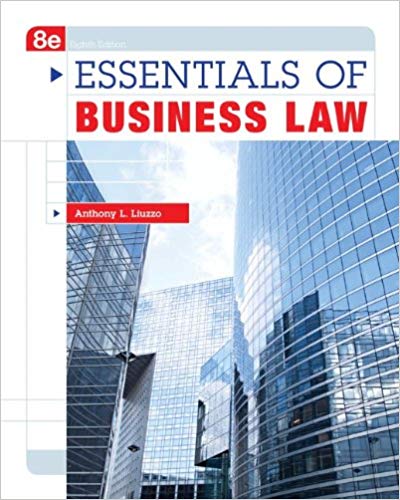
Essentials of Business Law 8th Edition by Anthony Liuzzo - Test Bank

Essentials of Business Law 8th Edition by Anthony Liuzzo - Test Bank   Instant Download - Complete Test Bank With Answers     Sample Questions Are Posted Below     True / False Questions The United States Constitution forms the basis for all American Law. True    False   There are three types of constitutional powers. True    False …

$19.99

Essentials of Business Law 8th Edition by Anthony Liuzzo – Test Bank


Instant Download – Complete Test Bank With Answers


Sample Questions Are Posted Below


True / False Questions

  1. The United States Constitution forms the basis for all American Law.
    True    False


  1. There are three types of constitutional powers.
    True    False


  1. Express powers are those that are specifically stated in a statute.
    True    False


  1. The process of a court deciding whether a law is contrary to the constitution is known as judicial review.
    True    False


  1. Each amendment of the federal constitution needs to be ratified by the legislatures of half of the 50 states.
    True    False


  1. Since its inception, the federal Constitution of the United States has never been amended nor changed.
    True    False


  1. The Commerce Clause creates one of the most fundamental powers of the Constitution.
    True    False


  1. It is constitutionally acceptable for a municipality to pass a law limiting what a journalist could write or say about a political candidate or issue.
    True    False


  1. The right to bear arms is unlimited.
    True    False


  1. Under the Fourth Amendment police officers and other government officials (but not private citizens) must have probable cause to be able to conduct a personal or property search.
    True    False


  1. If Owen refused to testify on the premise that the information he would divulge would self-incriminate him, he can legally do so under the Fifth Amendment protection.
    True    False


  1. The Eight Amendment mandates that people accused or convicted of crimes are subject to excessive bail.
    True    False


  1. The Eight Amendment prevents the Government from imposing an unjustly harsh fine on a person convicted of a crime.
    True    False


  1. The Fourteenth Amendment applies to actions of the federal government.
    True    False


  1. The Fourteenth Amendment provides that when states pass laws they must treat all individuals equally.
    True    False


  1. The strict scrutiny test is a standard that measures whether the legislature had a compelling interest for enacting a particular statute
    True    False


  1. The Sixteenth Amendment granted the federal government the power to impose and collect a tax on individuals’ incomes.
    True    False


  1. The Sixteenth Amendment granted the federal government the power to impose and collect a tax on individuals’ incomes.
    True    False


  1. The IRS does not improve taxpayers’ understanding of tax laws.
    True    False


Multiple Choice Questions

  1. In the United States, how many types of powers do the federal Constitution and state constitutions confer on the government?
    A. Eight
    B. Six
    C. Four
    D. Two


  1. Each constitutional amendment must be proposed by a:
    A. one-third vote of Congress.
    B. one-fourth vote of Congress.
    C. two-thirds vote of Congress.
    D. three-fourths vote of Congress.


  1. The Constitution is divided and subdivided in all of the following EXCEPT:
    A. articles.
    B. sections.
    C. clauses.
    D. papers.


  1. The following are clauses of the Constitution who have a specific impact on businesses EXCEPT:
    A. Commerce Clause.
    B. Full Faith and Credit Clause.
    C. Supremacy Clause
    D. Competitive Clause


  1. “According to the supremacy clause, a Supreme Court ruling that involves a constitutional issue is binding on state courts.” This statement is part of which Clause or Article:
    A. Article 1, Section 8, Clause 3.
    B. Article IV, Section 1.
    C. Article IV, Section 2.
    D. Article V, Section 1.


  1. Freedom of Speech is covered under which Amendment:
    A. First Amendment.
    B. Second Amendment.
    C. Fourth Amendment.
    D. Sixteenth Amendment.


  1. All the following speeches may be limited or silenced under the First Amendment EXCEPT:
    A. speech that incites imminent danger.
    B. political or religious speech.
    C. child pornography.
    D. speech that is defamatory.


  1. The right to bear arms is protected under the ________________Amendment:
    A. First.
    B. Second.
    C. Eight.
    D. Sixteenth.


  1. Examples of unreasonable searches and seizures include the following EXCEPT:
    A. a detention of longer than 48 hours after a criminal arrest.
    B. a nonconsensual extraction of blood.
    C. the gathering of fingerprint evidence in certain circumstances.
    D. the stop of motorists at sobriety checkpoints to investigate possible instances of driving under the influence.


  1. The Fifth Amendment required that all persons be granted procedural and _____________ due process:
    A. reflective.
    B. substantive.
    C. criminal.
    D. questionable.


  1. Under the _________________Amendment the following are examples of punishments which are prohibited: a person convicted of armed robbery is sentenced to death; a person convicted of shoplifting is sentenced to life in prison; a minor is sentenced to life in prison for stealing a car; a person convicted of assault and battery is sentenced to death.
    A. First.
    B. Fourth.
    C. Eight.
    D. Sixteenth.


  1. The Eight Amendment does the following EXCEPT:
    A. restricts both the severity and the types of punishments that may be imposed by federal and state governments..
    B. mandates that people accused or convicted of crimes are not to be subject to excessive bail..
    C. allows for barbarous punishment.
    D. prevents the government from imposing an unjustly harsh fine on a person convicted of a crime.


  1. Under the Fourteenth Amendment, laws that do not treat all people equally are unconstitutional unless the state can show that the law passes the following tests EXCEPT:
    A. the effect on a person’s conscience test.
    B. rational basis test.
    C. intermediate scrutiny test.
    D. strict scrutiny test.


  1. The _______________test is a standard that measures whether a particular statute is substantially related to an important government objective:
    A. peer pressure test.
    B. rational basis test.
    C. intermediate scrutiny test.
    D. strict scrutiny test.


  1. The ______________ Amendment granted the federal government the power to impose and collect a tax on individuals’ incomes.
    A. Fourth
    B. Eight
    C. Fourteenth
    D. Sixteenth


  1. The ___________________ is a federal agency established by Congress and tasked with administering and collecting federal income tax:
    A. FDA.
    B. IRS.
    C. FDIC.
    D. SEC.


Short Answer Questions

  1. Identify and describe the process of deciding if a law is contrary to the Constitution.


  1. Describe the Doctrine of Preemption.


  1. Discuss the Free Speech part of the First Amendment and what types of speeches may be limited or silenced.


  1. Provide examples searches and seizures considered to be unreasonable under the Fourth Amendment.


  1. What power did the Sixteenth Amendment grant the federal government?


True / False Questions

  1. (p. 74)The United States Constitution forms the basis for all American Law.
    TRUE


Bloom’s: Knowledge
Learning Outcomes: 5.1 Explain the difference between express and implied powers; describe the process used to amend the U.S. Constitution; and explain judicial review and the doctrine of preemption.

  1. (p. 74)There are three types of constitutional powers.
    FALSE


Bloom’s: Knowledge
Learning Outcomes: 5.1 Explain the difference between express and implied powers; describe the process used to amend the U.S. Constitution; and explain judicial review and the doctrine of preemption.

  1. (p. 74)Express powers are those that are specifically stated in a statute.
    TRUE


Bloom’s: Knowledge
Learning Outcomes: 5.1 Explain the difference between express and implied powers; describe the process used to amend the U.S. Constitution; and explain judicial review and the doctrine of preemption.

  1. (p. 74)The process of a court deciding whether a law is contrary to the constitution is known as judicial review.
    TRUE


Bloom’s: Knowledge
Learning Outcomes: 5.1 Explain the difference between express and implied powers; describe the process used to amend the U.S. Constitution; and explain judicial review and the doctrine of preemption.


  1. (p. 74)Each amendment of the federal constitution needs to be ratified by the legislatures of half of the 50 states.
    FALSE


Bloom’s: Knowledge
Learning Outcomes: 5.1 Explain the difference between express and implied powers; describe the process used to amend the U.S. Constitution; and explain judicial review and the doctrine of preemption.

  1. (p. 74)Since its inception, the federal Constitution of the United States has never been amended nor changed.
    FALSE


Bloom’s: Knowledge
Learning Outcomes: 5.1 Explain the difference between express and implied powers; describe the process used to amend the U.S. Constitution; and explain judicial review and the doctrine of preemption.

  1. (p. 75)The Commerce Clause creates one of the most fundamental powers of the Constitution.
    TRUE


Bloom’s: Knowledge
Learning Outcomes: 5.2 Discuss the main provisions of the commerce clause, the full faith and credit clause, and the supremacy clause.

  1. (p. 77)It is constitutionally acceptable for a municipality to pass a law limiting what a journalist could write or say about a political candidate or issue.
    FALSE


Bloom’s: Knowledge
Learning Outcomes: 5.3 Describe three provisions of the First Amendment.

  1. (p. 78)The right to bear arms is unlimited.
    FALSE


Bloom’s: Knowledge
Learning Outcomes: 5.4 Discuss the current state of constitutional law with respect to the Second Amendment.


  1. (p. 79)Under the Fourth Amendment police officers and other government officials (but not private citizens) must have probable cause to be able to conduct a personal or property search.
    TRUE


Bloom’s: Knowledge
Learning Outcomes: 5.5 Describe the requirement of probable cause under the Fourth Amendment.

  1. (p. 80)If Owen refused to testify on the premise that the information he would divulge would self-incriminate him, he can legally do so under the Fifth Amendment protection.
    TRUE


Bloom’s: Analysis
Bloom’s: Comprehension
Learning Outcomes: 5.6 Identify and explain four protections provided by the Fifth Amendment.

  1. (p. 81)The Eight Amendment mandates that people accused or convicted of crimes are subject to excessive bail.
    FALSE


Bloom’s: Knowledge
Learning Outcomes: 5.7 Provide examples of cases that are addressed by the Eighth Amendment.

  1. (p. 81)The Eight Amendment prevents the Government from imposing an unjustly harsh fine on a person convicted of a crime.
    TRUE


Bloom’s: Knowledge
Learning Outcomes: 5.7 Provide examples of cases that are addressed by the Eighth Amendment.

  1. (p. 82)The Fourteenth Amendment applies to actions of the federal government.
    FALSE


Bloom’s: Knowledge
Learning Outcomes: 5.8 Explain the due process and equal protection clauses of the Fourteenth Amendment.


  1. (p. 82)The Fourteenth Amendment provides that when states pass laws they must treat all individuals equally.
    TRUE


Bloom’s: Knowledge
Learning Outcomes: 5.8 Explain the due process and equal protection clauses of the Fourteenth Amendment.

  1. (p. 82)The strict scrutiny test is a standard that measures whether the legislature had a compelling interest for enacting a particular statute
    TRUE


Bloom’s: Knowledge
Learning Outcomes: 5.8 Explain the due process and equal protection clauses of the Fourteenth Amendment.

  1. (p. 83)The Sixteenth Amendment granted the federal government the power to impose and collect a tax on individuals’ incomes.
    TRUE


Bloom’s: Knowledge
Learning Outcomes: 5.9 Discuss how the Internal Revenue Service administers the collection of income taxes pursuant to the Sixteenth Amendment.

  1. (p. 83)The Sixteenth Amendment granted the federal government the power to impose and collect a tax on individuals’ incomes.
    TRUE


Bloom’s: Knowledge
Learning Outcomes: 5.9 Discuss how the Internal Revenue Service administers the collection of income taxes pursuant to the Sixteenth Amendment.

  1. (p. 83)The IRS does not improve taxpayers’ understanding of tax laws.
    FALSE


Bloom’s: Knowledge
Learning Outcomes: 5.9 Discuss how the Internal Revenue Service administers the collection of income taxes pursuant to the Sixteenth Amendment.


Multiple Choice Questions

  1. (p. 74)In the United States, how many types of powers do the federal Constitution and state constitutions confer on the government?
    A. Eight
    B. Six
    C. Four
    D. Two


Bloom’s: Knowledge
Learning Outcomes: 5.1 Explain the difference between express and implied powers; describe the process used to amend the U.S. Constitution; and explain judicial review and the doctrine of preemption.

  1. (p. 74)Each constitutional amendment must be proposed by a:
    A. one-third vote of Congress.
    B. one-fourth vote of Congress.
    C. two-thirds vote of Congress.
    D. three-fourths vote of Congress.


Bloom’s: Knowledge
Learning Outcomes: 5.1 Explain the difference between express and implied powers; describe the process used to amend the U.S. Constitution; and explain judicial review and the doctrine of preemption.

  1. (p. 75)The Constitution is divided and subdivided in all of the following EXCEPT:
    A. articles.
    B. sections.
    C. clauses.
    D. papers.


Bloom’s: Knowledge
Learning Outcomes: 5.2 Discuss the main provisions of the commerce clause, the full faith and credit clause, and the supremacy clause.


  1. (p. 75)The following are clauses of the Constitution who have a specific impact on businesses EXCEPT:
    A. Commerce Clause.
    B. Full Faith and Credit Clause.
    C. Supremacy Clause
    D. Competitive Clause


Bloom’s: Knowledge
Learning Outcomes: 5.1 Explain the difference between express and implied powers; describe the process used to amend the U.S. Constitution; and explain judicial review and the doctrine of preemption.

  1. (p. 75)“According to the supremacy clause, a Supreme Court ruling that involves a constitutional issue is binding on state courts.” This statement is part of which Clause or Article:
    A. Article 1, Section 8, Clause 3.
    B. Article IV, Section 1.
    C. Article IV, Section 2.
    D. Article V, Section 1.


Bloom’s: Knowledge
Learning Outcomes: 5.2 Discuss the main provisions of the commerce clause, the full faith and credit clause, and the supremacy clause.

  1. (p. 77)Freedom of Speech is covered under which Amendment:
    A. First Amendment.
    B. Second Amendment.
    C. Fourth Amendment.
    D. Sixteenth Amendment.


Bloom’s: Knowledge
Learning Outcomes: 5.3 Describe three provisions of the First Amendment.


  1. (p. 77)All the following speeches may be limited or silenced under the First Amendment EXCEPT:
    A. speech that incites imminent danger.
    B. political or religious speech.
    C. child pornography.
    D. speech that is defamatory.


Bloom’s: Knowledge
Learning Outcomes: 5.3 Describe three provisions of the First Amendment.

  1. (p. 78)The right to bear arms is protected under the ________________Amendment:
    A. First.
    B. Second.
    C. Eight.
    D. Sixteenth.


Bloom’s: Knowledge
Learning Outcomes: 5.3 Describe three provisions of the First Amendment.

  1. (p. 79)Examples of unreasonable searches and seizures include the following EXCEPT:
    A. a detention of longer than 48 hours after a criminal arrest.
    B. a nonconsensual extraction of blood.
    C. the gathering of fingerprint evidence in certain circumstances.
    D. the stop of motorists at sobriety checkpoints to investigate possible instances of driving under the influence.


Bloom’s: Knowledge
Learning Outcomes: 5.4 Discuss the current state of constitutional law with respect to the Second Amendment.


  1. (p. 80)The Fifth Amendment required that all persons be granted procedural and _____________ due process:
    A. reflective.
    B. substantive.
    C. criminal.
    D. questionable.


Bloom’s: Knowledge
Learning Outcomes: 5.6 Identify and explain four protections provided by the Fifth Amendment.

  1. (p. 81)Under the _________________Amendment the following are examples of punishments which are prohibited: a person convicted of armed robbery is sentenced to death; a person convicted of shoplifting is sentenced to life in prison; a minor is sentenced to life in prison for stealing a car; a person convicted of assault and battery is sentenced to death.
    A. First.
    B. Fourth.
    C. Eight.
    D. Sixteenth.


Bloom’s: Knowledge
Learning Outcomes: 5.7 Provide examples of cases that are addressed by the Eighth Amendment.

  1. (p. 80-81)The Eight Amendment does the following EXCEPT:
    A. restricts both the severity and the types of punishments that may be imposed by federal and state governments..
    B. mandates that people accused or convicted of crimes are not to be subject to excessive bail..
    C. allows for barbarous punishment.
    D. prevents the government from imposing an unjustly harsh fine on a person convicted of a crime.


Bloom’s: Knowledge
Learning Outcomes: 5.7 Provide examples of cases that are addressed by the Eighth Amendment.


  1. (p. 82)Under the Fourteenth Amendment, laws that do not treat all people equally are unconstitutional unless the state can show that the law passes the following tests EXCEPT:
    A. the effect on a person’s conscience test.
    B. rational basis test.
    C. intermediate scrutiny test.
    D. strict scrutiny test.


Bloom’s: Knowledge
Learning Outcomes: 5.8 Explain the due process and equal protection clauses of the Fourteenth Amendment.

  1. (p. 82)The _______________test is a standard that measures whether a particular statute is substantially related to an important government objective:
    A. peer pressure test.
    B. rational basis test.
    C. intermediate scrutiny test.
    D. strict scrutiny test.


Bloom’s: Knowledge
Learning Outcomes: 5.8 Explain the due process and equal protection clauses of the Fourteenth Amendment.

  1. (p. 83)The ______________ Amendment granted the federal government the power to impose and collect a tax on individuals’ incomes.
    A. Fourth
    B. Eight
    C. Fourteenth
    D. Sixteenth


Bloom’s: Knowledge
Learning Outcomes: 5.9 Discuss how the Internal Revenue Service administers the collection of income taxes pursuant to the Sixteenth Amendment.


  1. (p. 83)The ___________________ is a federal agency established by Congress and tasked with administering and collecting federal income tax:
    A. FDA.
    B. IRS.
    C. FDIC.
    D. SEC.


Bloom’s: Application
Learning Outcomes: 5.9 Discuss how the Internal Revenue Service administers the collection of income taxes pursuant to the Sixteenth Amendment.


Short Answer Questions

  1. (p. 74)Identify and describe the process of deciding if a law is contrary to the Constitution.

The process of deciding if a law is contrary to the Constitution is known as judicial review. Courts have the power to determine whether laws enacted by legislatures or decisions made by lower courts violate the provisions of the Constitution. If a court decides that a law is contrary to the constitution, the law can be declared unconstitutional, and, therefore, invalid.


Bloom’s: Application
Learning Outcomes: 5.1 Explain the difference between express and implied powers; describe the process used to amend the U.S. Constitution; and explain judicial review and the doctrine of preemption.

  1. (p. 74-75)Describe the Doctrine of Preemption.

If a state or local law is inconsistent with the federal law, the state or local law may be declared unconstitutional, and the federal law must be followed. This is known as the doctrine of preemption—that is, the federal law preempts, or supersedes, the state law. This doctrine applies only in instances where the law in question pertains to a power that the Constitution has expressly or implicitly granted to Congress.


Bloom’s: Knowledge
Learning Outcomes: 5.1 Explain the difference between express and implied powers; describe the process used to amend the U.S. Constitution; and explain judicial review and the doctrine of preemption.


  1. (p. 77)Discuss the Free Speech part of the First Amendment and what types of speeches may be limited or silenced.

The First Amendment’s freedom of speech clause gives Americans a fundamental right.
Individuals have the right to freedom of political or religious speech, but this right should be guarded most zealously when the speech is unpopular, upsetting, ignorant, or even anger-provoking. As such, speech that is sexist, racist, ageist, or otherwise offensive is also protected.
The following are examples of speech that may constitutionally be limited or silenced: speech that incites imminent danger; child pornography; speech that is legally obscene; speech that threatens physical harm; speech that is defamatory, including both slander and libel; interference with works protected by trademark, patent, or copyright law


Bloom’s: Knowledge
Learning Outcomes: 5.3 Describe three provisions of the First Amendment.

  1. (p. 79)Provide examples searches and seizures considered to be unreasonable under the Fourth Amendment.

Examples of unreasonable searches and seizures include a detention of longer than 48 hours after a criminal arrest; a nonconsensual extraction of blood; and the gathering of fingerprint evidence in certain circumstances.


Bloom’s: Application
Learning Outcomes: 5.5 Describe the requirement of probable cause under the Fourth Amendment.

  1. (p. 83)What power did the Sixteenth Amendment grant the federal government?

The Sixteenth Amendment granted the federal government the power to impose and collect a tax on individuals’ incomes.


Bloom’s: Knowledge
Learning Outcomes: 5.9 Discuss how the Internal Revenue Service administers the collection of income taxes pursuant to the Sixteenth Amendment.


Additional information

Add Review

Your email address will not be published. Required fields are marked *