Subtotal: $660.00

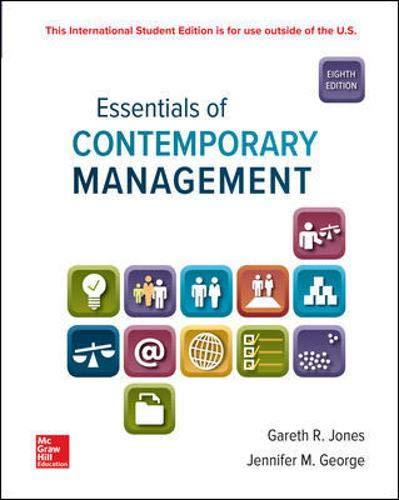
Essentials of Contemporary Management 8Th Edition By Jones - Test Bank

Essentials of Contemporary Management 8Th Edition By Jones - Test Bank   Instant Download - Complete Test Bank With Answers     Sample Questions Are Posted Below   Essentials of Contemporary Management, 8e (Jones) Chapter 5   Decision Making, Learning, Creativity, and Entrepreneurship   1) The classical decision-making model assumes that managers have all of the …

$19.99

Essentials of Contemporary Management 8Th Edition By Jones – Test Bank


Instant Download – Complete Test Bank With Answers


Sample Questions Are Posted Below


Essentials of Contemporary Management, 8e (Jones)

Chapter 5   Decision Making, Learning, Creativity, and Entrepreneurship


1) The classical decision-making model assumes that managers have all of the information they need in order to make the optimum decision.


2) When a manager chooses an acceptable alternative instead of the optimum alternative, we say that a satisficing decision has occurred.


3) The first step in decision making that a manager needs to take is generate a set of feasible alternative courses of action in response to the opportunity or threat.


4) While assessing the practicality of alternatives, managers must decide whether they have the capabilities and resources required to implement the alternative, and they must be sure that the alternative will not threaten the attainment of other organizational goals.


5) In the decision-making process, to compare what actually happened to what was expected to happen as a result of the decision is a procedure of choosing among alternatives.


6) Rationalization is a critical analysis of a preferred alternative to ascertain its strengths and weaknesses before it is implemented.


7) When a member of a group challenges the decision that is being made by the group in an attempt to make the group carefully consider the pros and cons of a particular alternative, this member is playing the role of the devil’s advocate.


8) The ability of a decision maker to discover novel ideas that lead to feasible alternatives in decision making is known as creativity.


9) The nominal group technique is especially useful when an issue is not controversial and when different managers are expected to champion a similar course of action.


10) Individuals who believe that they are responsible for what happens to them and that their own actions determine important outcomes are said to have an external locus of control.


11) Decisions that have been made many times in the past and for which managers have rules and guidelines about how to make similar decisions in the future are known as ________ decisions.

  1. A) nonprogrammed
  2. B) judgment
  3. C) programmed
  4. D) optimum


12) When an organization’s accounting department decides to send out a bill to a new customer, this represents a(n) ________ decision.

  1. A) programmed
  2. B) nonprogrammed
  3. C) intuitive
  4. D) groupthink


13) Regina, a manager, orders raw materials when the raw materials inventory reaches a certain point. This is an example of which type of decision?

  1. A) intuition
  2. B) satisficing
  3. C) nonprogrammed
  4. D) programmed


14) The manager of a charity asks the board of directors for permission to hire temporary help when the regular secretary goes on vacation. This is an example of which type of decision?

  1. A) programmed
  2. B) groupthink
  3. C) nonprogrammed
  4. D) intuition


15) Martin, a plant foreman, hires an additional worker whenever overtime hours for the previous month increase by more than 25 percent. This is an example of which type of decision?

  1. A) intuition
  2. B) groupthink
  3. C) satisficing
  4. D) programmed


16) Nikola, the accountant for a small firm, always pays the real estate taxes seven days before they are due. This represents which type of decision?

  1. A) satisficing
  2. B) programmed
  3. C) intuition
  4. D) nonprogrammed


17) What do managers do to regulate routine activities?

  1. A) They create a mission statement.
  2. B) They establish rules and guidelines.
  3. C) They create cross-functional teams.
  4. D) They facilitate a strong organizational culture.


18) An organization’s finance department decides to go to the company’s usual bank and take out a loan whenever the company’s revenues for the month are projected to be less than its expenses. What type of decision does this represent?

  1. A) optimum
  2. B) satisficing
  3. C) programmed
  4. D) risk


19) You are a manager who wants to give some of your programmed decisions to your assistant to leave you more time to devote to nonprogrammed decisions. Considering this, which of the following actions would you delegate to your assistant?

  1. A) how much to invest in a new product
  2. B) whether to expand into a new market
  3. C) when to time a new advertising campaign
  4. D) when to bill customers


20) Nonroutine decisions made in response to novel situations in business are known as ________ decisions.

  1. A) devil’s advocacy
  2. B) ambiguous
  3. C) groupthink
  4. D) nonprogrammed


21) Apex, Ltd., is trying to decide whether or not to launch a new product nationally. This represents a(n) ________ decision.

  1. A) programmed
  2. B) intuitive
  3. C) groupthink
  4. D) nonprogrammed


22) Star, Inc., is attempting to decide whether or not it should change its manufacturing process to a new type of technology. This represents a(n) ________ decision.

  1. A) programmed
  2. B) nonprogrammed
  3. C) groupthink
  4. D) intuitive


23) Go-Getter, Co., is attempting to decide whether or not to launch a new $10 million advertising campaign for a product whose sales have been lagging well below its projected sales. This represents which type of decision for the organization?

  1. A) optimum
  2. B) intuitive
  3. C) nonprogrammed
  4. D) satisficing


24) An organization that has been focusing on a target market located in the eastern part of the United States is attempting to decide whether to expand its sales to the West Coast of the United States. Which of the following types of decisions is being made by the organization?

  1. A) intuition
  2. B) nonprogrammed
  3. C) groupthink
  4. D) satisficing


25) When fire chiefs manage firefighters battling hazardous, out-of-control fires, they frequently have to depend on their professional instincts to make on-the-spot decisions that will protect the lives of the firefighters, save the lives of others, control the fires, and preserve property—decisions made in emergency situations involving high ambiguity and rapidly changing conditions. This is an example of which of the following types of decision making?

  1. A) programmed
  2. B) routine
  3. C) groupthink
  4. D) intuition


26) The classical model of decision making specifies how decisions should be made by managers; this is a way of saying that this model of decision making is

  1. A) heuristic.
  2. B) prescriptive.
  3. C) incomplete.
  4. D) intuitive.


27) The classical model of decision making assumes that

  1. A) the number of alternatives is so great that a manager could never come close to evaluating them all.
  2. B) managers have little information to use in making a decision.
  3. C) managers have access to all the information they need to make the optimum decision.
  4. D) managers have neither the time nor the money to search for all possible alternative solutions.


28) The most appropriate decision in light of what managers believe to be the most desirable consequences for the organization is called the ________ decision.

  1. A) tactical
  2. B) optimum
  3. C) rational
  4. D) operational

29) Which of the following explains the reasons for the inherently uncertain and risky nature of decision making and the making of satisfactory rather than optimum decisions by managers?

  1. A) logical model
  2. B) administrative model
  3. C) perspective model
  4. D) rational model


30) In the administrative model of decision making, when the number of possible alternatives to a decision is so large that the manager cannot possibly evaluate all of them before making a decision, which of the following has occurred?

  1. A) satisficing
  2. B) bounded rationality
  3. C) brainstorming
  4. D) devil’s advocacy


31) Managers in the field of biotechnology know that new drugs have a 10 percent chance of passing advanced clinical trials and always assign probabilities to the results of clinical trials. This is an example of

  1. A) risk.
  2. B) uncertainty.
  3. C) bounded rationality.
  4. D) incomplete information.


32) When managers know the possible outcomes of a decision and can assign probabilities to each of these outcomes in terms of their likelihood of occurrence in the future, this is known as

  1. A) uncertainty.
  2. B) certainty.
  3. C) risk.
  4. D) bounded rationality.


33) A software firm is considering introducing a new product on the market. However, managers cannot estimate the probability of success for the new product. Which of the following best describes the situation?

  1. A) risk
  2. B) uncertainty
  3. C) bounded rationality
  4. D) incomplete information

34) When managers cannot assign probabilities of future occurrence to possible alternatives with a decision, this is known as

  1. A) certainty.
  2. B) risk.
  3. C) bounded rationality.
  4. D) uncertainty.


35) When the meaning of the information available to a manager is unclear and can be interpreted in several ways, the information is

  1. A) certain.
  2. B) ambiguous.
  3. C) bounded.
  4. D) irrational.


36) A manager considers a limited sample of the potential alternative solutions for a problem and selects one that is acceptable instead of attempting to select the optimum solution. This type of decision is called

  1. A) programmed.
  2. B) intuition.
  3. C) certainty.
  4. D) satisficing.


37) You are a manager in an organization that needs to advertise a product. To do this, you decide to use satisficing. Considering this, which of the following actions would you take?

  1. A) review all the advertising media available in the area
  2. B) consider every advertising technique that can be used for your product
  3. C) select three advertising agencies to pitch a proposal
  4. D) ask all the advertising agencies in the area to make a pitch


38) Instead of calling a hundred possible windshield suppliers, the purchasing manager for Telsa Motor Co. decides to call three suppliers of automobile windshields for a bid on an order for 1,000 windshields for a new car. What type of decision does this represent?

  1. A) nonprogrammed
  2. B) illusion of control
  3. C) satisficing
  4. D) programmed

39) Marco is considering opening a theater in a mid-size city. However, before he does this, he wants to lower the risk of such an endeavor. Many theaters have opened before but have failed because of financial difficulties. Marco has some experience as an actor and as a stage manager, but this will be his first real foray into the business side of things. To best increase his chances of achieving his goal, Marco should

  1. A) plan the slate of theater productions for the first year based on his gut feeling of what will be successful in this particular community.
  2. B) conduct a survey to determine local cultural tastes, evaluate other cities as options, and search for a central location with a reasonable rent.
  3. C) contact well-known actors who he feels certain will be a big draw in his city’s theater-going community.
  4. D) talk to a friend who works for successful theater in another state and take his advice on what shows to choose and how much to charge.


40) To use a programmed decision in dealing with occasional company overspending, a manager would

  1. A) have a brainstorming session to gather possible solutions to the overspending.
  2. B) listen to the opinions of various employees about why the company overspends.
  3. C) conduct an analysis to determine the possible causes for overspending.
  4. D) devise procedures to take depending on the amount of overspending in a month.


41) Based on the work of March and Simon’s administrative model of decision making, the first step in the managerial decision-making process is to

  1. A) choose among alternatives.
  2. B) assess alternatives.
  3. C) implement the chosen alternative.
  4. D) recognize the need for a decision.


42) Which step of the decision-making process requires managers to be sure all the information available is brought to bear on the problem or issue at hand while ranking the alternatives?

  1. A) assess alternatives
  2. B) choose among alternatives
  3. C) recognize the need for a decision
  4. D) generate alternatives

43) Koki, a production manager, was engaged in the development of a core component of a machine. He realized that the component would not be ready for QC testing as per the fixed deadline and suggested allotting two more weeks for its complete development or sending only a part of it for testing in the first cycle. Which two decision-making steps does this represent?

  1. A) choose among alternatives and assess alternatives
  2. B) generate alternatives and choose among alternatives
  3. C) recognize the need for a decision and generate alternatives
  4. D) recognize the need for a decision and choose among alternatives


44) Ayaru, a marketing manager, wants to budget the advertising for a new product launch. She is trying to determine the amount of money that her company can afford to spend on advertising this new product. In the context of decision-making, which of the following criteria of alternative courses of action is Ayaru implementing?

  1. A) legality
  2. B) ethicalness
  3. C) economic feasibility
  4. D) practicality


45) When managers decide that they have the capabilities and resources required to implement an alternative, and they are sure that the alternative will not threaten the attainment of other organizational goals, they are focusing on which of the following criteria of alternative courses of action?

  1. A) legality
  2. B) ethicalness
  3. C) economic feasibility
  4. D) practicality


46) Esteban, a manager, performs a financial analysis of several investment alternatives in order to determine which alternative is most likely to impact the organization’s profitability. Esteban is focusing on

  1. A) bounded rationality.
  2. B) ethicalness.
  3. C) economic feasibility.
  4. D) dialectical inquiry.


47) Briana, a manager, is attempting to determine whether she has both the capability and the resources to produce one of several possible new products. In the context of decision making, on which of the following criteria of alternative courses of action is Briana focusing?

  1. A) practicality
  2. B) ethicalness
  3. C) legality
  4. D) economic feasibility

48) You are a manager assessing possible alternatives for the solution of a problem. To do this, you have to determine the net financial payoff of each alternative. Which of the following criteria of decision making do you have to implement to accomplish this?

  1. A) economic feasibility
  2. B) practicality
  3. C) ethicalness
  4. D) legality


49) Stojan, a plant manager, wants to initiate a diversity training program in his plant. He is considering whether his department has enough extra people to cover for the time his employees will be engaged in the classes. Which of the following criteria of decision making is Stojan implementing?

  1. A) legality
  2. B) practicality
  3. C) devil’s advocacy
  4. D) economic feasibility


50) You are a manager assessing possible alternatives for the solution of a quality problem in his department. As part of this process, you want to determine if a possible alternative will threaten other company projects. To accomplish this, which of the following criteria of decision-making will you implement?

  1. A) economic feasibility
  2. B) practicality
  3. C) legality
  4. D) ethicalness


51) The explosion of the space shuttle Challenger is an example of poor managerial decision making by the managers at NASA and Morton Thiokol, who considered and then downplayed the criterion of

  1. A) ethicalness.
  2. B) practicality.
  3. C) legality.
  4. D) economic feasibility.


52) KJ, Inc., has received a poor rating for one of its newly launched products from the customers. Joe, a top manager at KJ, Inc., wants to find out why this product performed poorly. To accomplish this, which of the following decision-making steps does Joe have to implement?

  1. A) generate alternatives
  2. B) learn from feedback
  3. C) recognize the need for a decision
  4. D) implement the chosen alternative

53) With reference to the steps of decision-making process, which of the following is the last step in the managerial decision-making process?

  1. A) generate alternatives
  2. B) learn from feedback
  3. C) recognize the need for a decision
  4. D) implement the chosen alternative


54) Kareem is the new owner of a major league baseball team. Over the last several years, the team has consistently had a losing record and, as a result, attendance is slumping. Kareem is currently evaluating potential solutions, including revamping the affiliated minor league team, moving the team to a new city, and hiring all new coaching staff. Kareem’s next step is to

  1. A) evaluate the effect that revamping the minor league team has on the major league team.
  2. B) decide that revamping the minor league team is better than moving the team to a new city or hiring new coaches.
  3. C) revamp the affiliated minor league team by firing most of the managers, coaches, and scouts.
  4. D) determine whether there is anything he can do to positively impact the team’s losing record.


55) To access the ethicalness of an alternative for a restaurant, the manager would

  1. A) decide if the cost of advertising on both TV and radio is affordable.
  2. B) decide if serving alcoholic beverages would be legal in a city.
  3. C) determine if the lower-priced beef source used inhumane methods to slaughter the livestock.
  4. D) determine if profits are high enough to open an additional restaurant location in another city.


56) The pattern of faulty and biased decision making that occurs in groups whose members strive for agreement at the expense of good decision making is called

  1. A) brainstorming.
  2. B) groupthink.
  3. C) devil’s advocacy.
  4. D) bounded rationality.


57) The marketing managers of Compliant, Ltd., strive so hard to agree on an important decision to launch a product that they ignore information that a similar product already exists in the market and that the barriers to entry into the market are high. This refers to which of the following decision-making processes?

  1. A) dialectical inquiry
  2. B) devil’s advocacy
  3. C) groupthink
  4. D) intuition

58) Why is group decision making considered beneficial?

  1. A) It takes less time than individual decision-making.
  2. B) It is easy to get two or more managers to agree to the same solution.
  3. C) It allows more information processing and correction of errors.
  4. D) It cannot be undermined by biases.


59) A critical analysis of a preferred alternative to ascertain its strengths and weaknesses before it is implemented, with the purpose of identifying all the reasons that might make the preferred alternative unacceptable, is

  1. A) dialectical inquiry.
  2. B) devil’s advocacy.
  3. C) groupthink.
  4. D) the Delphi technique.


60) Lila is a manager involved in group decision making with other managers. She wants to make sure that the group avoids groupthink. Which of the following actions should she take to ensure that the group makes the best possible decision?

  1. A) encourage the group to agree with one of the alternatives to support esprit de corps and to facilitate a quick resolution
  2. B) challenge the way the group evaluates alternatives and points out some reasons why the alternative preferred by the group is not acceptable
  3. C) make sure the group has a healthy mix of women and men and that various ethnic backgrounds are represented
  4. D) staunchly support one of the alternatives, providing detailed data to back her position


61) Anja is taking part in a brainstorming group that is supposed to think of new storylines for films for a major studio. The studio wants creative stories that are different from previously produced films, but also marketable. However, Anja soon notices that members in the group tend to rely on old storylines, especially about superheroes, that seem like “safe” bets at the box office. Additionally, when one of them proposes an idea, the others almost invariably go along with it. What should Anja do in order to effectively counteract this dynamic?

  1. A) point out that many superhero films have recently failed at the box office and that audiences are looking for alternative stories that are not similar to video games
  2. B) suggest that the group include more woman and more people from different ethnic backgrounds to get different perspectives on storylines
  3. C) agree that superhero films are a great idea and suggesting superheroes that have not been portrayed in mainstream media for at least several years
  4. D) get two of the members to agree with her idea of developing a movie that combines the musical genre with the superhero genre

62) To counteract groupthink on a merchandising team, a manager decides to brings in two

  1. A) female co-workers because five of the nine current members are women.
  2. B) co-workers of Mexican descent because none of the current members have a Latino background.
  3. C) co-workers who agree with the ideas of most of the current members.
  4. D) male co-workers who agree with the ideas of four current female members in order to create a majority.


63) Managers can increase their ability to make nonprogrammed decisions that will allow them to adapt to, modify, and even drastically alter their task environments so that they can continually increase organizational performance through organizational

  1. A) learning.
  2. B) satisficing.
  3. C) group thinking.
  4. D) diversity.


64) In managerial decision making, the ability of a manager to discover novel ideas that lead to alternative courses of action for the organization to use for solving a particular problem is known as

  1. A) groupthink.
  2. B) satisficing.
  3. C) innovation.
  4. D) creativity.


65) At the heart of organizational learning is

  1. A) devil’s advocacy.
  2. B) risk-taking.
  3. C) satisficing.
  4. D) creativity.


66) To create a learning organization, managers must empower employees and allow them to experiment, create, and explore what they want through developing a sense of

  1. A) personal mastery.
  2. B) mental models.
  3. C) team learning.
  4. D) shared vision.

67) Jack, a manager, wants to promote creativity in his company. To do this, which of the following actions would he take?

  1. A) allow a subordinate to proceed on a work project even though he does not agree with how the subordinate wants to do the work
  2. B) keep a close eye on a subordinate to make sure he or she is working steadily and efficiently to find a solution to a problem
  3. C) set a strict deadline on a subordinate, thereby using this pressure to motivate the subordinate to think of novel solutions to a problem
  4. D) inform a subordinate not to think of outlandish ideas to solve a problem, but rather think of ideas that seem practical


68) Fyodor, a manager of the research and development team of an organization, challenges his subordinates to “think outside the box” to improve the way the unit does its work. Fyodor is focusing on ________.

  1. A) personal mastery.
  2. B) mental models.
  3. C) team learning.
  4. D) shared vision.


69) A sales manager wants to promote a shared vision among his staff. Considering this, which of the following would he do?

  1. A) emphasize how using creativity can enhance the development of a learning organization
  2. B) have some of the sales staff try one sales method and have others try another approach
  3. C) encourage his sales staff to think of different methods to sell a product
  4. D) talk with his sales staff about the way they should all treat customers


70) The idea that one level of learning affects other levels is part of the ________ principle of creating a learning organization.

  1. A) systems thinking
  2. B) mental models
  3. C) team learning
  4. D) shared vision


71) A group of managers meets face-to-face and generates and debates a wide variety of alternatives from which to make a decision. What is this process of decision making called?

  1. A) Delphi technique
  2. B) dialectical inquiry
  3. C) brainstorming
  4. D) nominal group technique

72) After one person shares an idea, the next thing that should happen in a brainstorming session is

  1. A) criticism of the idea.
  2. B) sharing of other ideas.
  3. C) acceptance and implementation of the idea.
  4. D) ranking of the idea.


73) The main reason for the loss of productivity in brainstorming is

  1. A) complex mental models.
  2. B) groupthink.
  3. C) production blocking.
  4. D) bounded rationality.


74) Which of the following is most likely to be a disadvantage of brainstorming in an organization?

  1. A) Group members are allowed to criticize an alternative when it is described and it leads to confusion.
  2. B) Brainstorming in an organization means that support can only be given to a limited number of ideas.
  3. C) It discourages group members from building on each other’s suggestions for fear of seeing “unoriginal.”
  4. D) Group members cannot always simultaneously understand the alternatives and think up additional alternatives.


75) Sometimes in a brainstorming session, group members cannot simultaneously make sense of all the alternatives being generated, think up additional alternatives, or remember what they were thinking. This problem is known as

  1. A) production blocking.
  2. B) groupthink.
  3. C) nominal group problem.
  4. D) bounded rationality.


76) When an issue is controversial and when different managers might be expected to champion different courses of action, which of the following is the preferred technique for encouraging creativity?

  1. A) production blocking technique
  2. B) brainstorming technique
  3. C) team learning technique
  4. D) nominal group technique


77) In a meeting, after hearing a member describe a problem to be addressed, all other members of the group first wrote down ideas and solutions. After this, everyone shared those suggestions without criticism. The group, one by one, clarified, critiqued, and then discussed the alternatives in the sequence in which they were first proposed. Finally, each member ranked all the alternatives, and the highest-ranking alternative was chosen. Which of the following decision-making techniques did the group implement?

  1. A) Delphi technique
  2. B) dialectical inquiry
  3. C) brainstorming
  4. D) nominal group technique


78) Which of the following is a way to bring distant managers together to brainstorm and is a written approach to creative problem solving?

  1. A) brainstorming
  2. B) dialectical inquiry
  3. C) Delphi technique
  4. D) nominal group technique


79) Which of the following is a part of the Delphi technique of group decision making?

  1. A) Group members write down, read their suggestions, discuss, and then rank the alternatives.
  2. B) Group members engage in videoconferencing and present their ideas.
  3. C) Group members respond in writing to questions posed by the group leader.
  4. D) Five to fifteen managers meet in a closed-door session and decide for the group.


80) Fatima is the manager of the tennis division of a large sporting goods company. An employee named Anika shows great promise but seems to lack the confidence to share her creative ideas. Based on what you know about promoting creativity, which of the following actions should Fatima take?

  1. A) share Anika’s idea for a square-shaped tennis racquet with the company’s CEO, even though the idea might not be practical
  2. B) share Anika’s idea for a square-shaped tennis racquet in a group session, in which members are encouraged to criticize the idea.
  3. C) point out to Anika the drawbacks of her idea for a square-shaped tennis racquet and supervise her more closely as she thinks of other ideas
  4. D) praise Anika for her square-shaped tennis racquet idea and allow her to think of more ideas without any hands-on supervision

81) To enhance the interaction between members of a brainstorming group, a manager should

  1. A) allow members to present ideas without being criticized.
  2. B) encourage members to “piggyback.”
  3. C) refuse to let members debate the ideas presented.
  4. D) present to members an outline about the problem being faced.


82) An individual who looks for opportunities and is aware of mobilizing the resources required for producing new and improved goods and services is called a(n)

  1. A) decision maker.
  2. B) entrepreneur.
  3. C) advocate.
  4. D) steward.


83) Individuals who pursue opportunities to address problems and needs in order to improve society and well-being, such as reducing poverty, are known as

  1. A) social entrepreneurs.
  2. B) social-thinkers.
  3. C) ethical entrepreneurs.
  4. D) nominal group entrepreneurs.


84) When entrepreneurs believe that they are responsible for what happens to them and that their own actions determine important outcomes such as the success or failure of a new business, they have

  1. A) an external locus of control.
  2. B) less openness to experience.
  3. C) moderate need for achievement.
  4. D) an internal locus of control.


85) An entrepreneur is likely to have

  1. A) a reluctance to try new experiences.
  2. B) high self-esteem.
  3. C) high need for affiliation.
  4. D) an external locus of control.


86) A manager who takes “ownership” of a project and provides the leadership and vision that takes a commodity from the idea stage to the final customer is a product

  1. A) innovator.
  2. B) advocate.
  3. C) champion.
  4. D) satisficer.

87) If you want to develop a skunkworks, which of the following actions would you take?

  1. A) separate a group from the normal operations of an organization
  2. B) combine people from various departments to form a group
  3. C) take “ownership” of a project and form a group that supports your ownership
  4. D) have people who have similar ideas about an organization into a group


88) A group of intrapreneurs who are separated from the normal operation of an organization in order to develop new products with a relatively brief development time is known as a(n)

  1. A) product champion.
  2. B) innovator.
  3. C) skunkworks.
  4. D) satisficer.


89) Calla is the manager for a fragrance company that is considering starting a line of organic perfumes. Her employees have mixed feelings about this idea. Some criticize it as being impractical, but others are enthusiastic about it, despite the costs involved in producing perfumes with organic ingredients. Which of the following actions should Calla take to efficiently and effectively ensure that the company’s organic perfume line reaches the end consumer?

  1. A) recognize that one employee is the staunchest advocate for organic perfume and encourage her to take charge of the project
  2. B) form a group of employees to come up with ideas to implement the product and constantly check in with them to monitor their progress
  3. C) cut bonuses for employees who think of good ideas for implementing organic perfume and spend the money on advertising their ideas
  4. D) tell employees who support the idea of organic perfume that they should start their own company if the idea is rejected


90) A human resource manager for a large company wants to hire people who show strong potential to become intrapreneurs. Considering this, the manager would most likely hire the applicant who

  1. A) achieved success with a project in his previous job, but downplays his contribution to the project.
  2. B) achieved success with a safe project in her previous job and opposed riskier projects.
  3. C) took responsibility for the failure of a project in his previous job and is confident he will correct his mistakes.
  4. D) took responsibility for the successes in her previous job, but blamed others for the failures.


91) Compare and contrast programmed and nonprogrammed decision-making in organizations. Give an example of each.

92) What is intuition? Give an example to support your definition. Should managers use intuition in decision making? Why or why not?


93) Discuss the assumptions that underlie the classical model of decision-making.


94) March and Simon developed three important concepts in their administrative model of decision making. Discuss these three concepts.


95) Researchers have identified a six-step model that can be used by managers who are faced with an important decision. Discuss any two of these steps.


96) In assessing alternatives, explain the four criteria to evaluate the pros and cons of alternative courses of action.


97) Describe why the stage of learning from feedback is considered very important for managers in an organization. List the benefits of this step in the decision-making process.


98) Identify the advantages and disadvantages of group decision making.


99) Define groupthink. Explain a technique that counteracts groupthink.


100) Managers can use a variety of techniques in group decision-making situations to counteract situations in which the group is suffering from groupthink or cognitive biases. Two such techniques have been shown to be especially useful in such situations. Discuss these two techniques and give an example of each.


101) Peter Senge has identified five principles that can be used by an organization to create “a learning organization.” Discuss any three of these principles.


102) What can managers do to promote individual creativity?


103) There are three important techniques that managers can use to promote creativity in group decision-making situations. Discuss any two of these techniques.


104) You are a manager who works with managers employed in different cities. All of you are working on developing the same new product. These managers encounter problems to the ones you face. Even so, you are unable to meet face-to-face with them for any discussion. Explain two ways you can solve this problem.


105) Explain the different ways by which organizations can promote intrapreneurship.

Additional information

Add Review

Your email address will not be published. Required fields are marked *