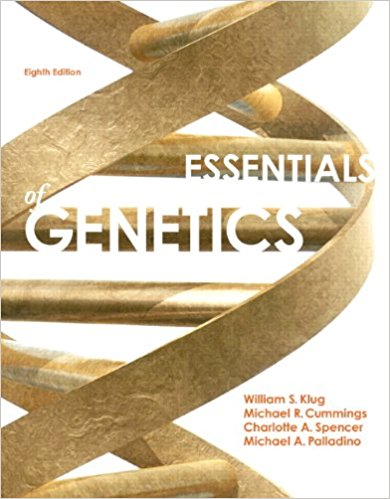
Essentials Of Genetics 8th Edition by William S. Klug - Test Bank

Essentials Of Genetics 8th Edition by William S. Klug - Test Bank   Instant Download - Complete Test Bank With Answers     Sample Questions Are Posted Below   Essentials of Genetics, 8e (Klug) Chapter 6   Chromosome Mutations: Variation in Number and Arrangement   1) The condition that exists when an organism gains or loses one …

$19.99

Essentials Of Genetics 8th Edition by William S. Klug – Test Bank


Instant Download – Complete Test Bank With Answers


Sample Questions Are Posted Below


Essentials of Genetics, 8e (Klug)

Chapter 6   Chromosome Mutations: Variation in Number and Arrangement


1) The condition that exists when an organism gains or loses one or more chromosomes but not a complete haploid set is known as ________.

  1. A) polyploidy
  2. B) euploidy
  3. C) aneuploidy
  4. D) triploidy
  5. E) trisomy

Answer:  C

Section:  6.1


2) Trisomy 21, or Down syndrome, occurs when there is a normal diploid chromosomal complement but one (extra) chromosome 21. Although fertility is reduced in both sexes, females have higher fertility rates than males. Van Dyke et al. (1995; Down Syndrome Research and Practice 3[2]:65-69) summarize data involving children born of Down syndrome individuals. Assume that children are born to a female with Down syndrome and a normal 46-chromosome male. What proportion of the offspring would be expected to have Down syndrome?

  1. A) One-third of the offspring would be expected to have Down syndrome.
  2. B) Two-thirds of the offspring would be expected to have Down syndrome.
  3. C) All the children would be expected to have Down syndrome.
  4. D) None of the offspring would be expected to have Down syndrome.
  5. E) One-half of the offspring would be expected to have Down syndrome.

Answer:  E

Section:  6.2


3) Trisomy 21, or Down syndrome, occurs when there is a normal diploid chromosomal complement but one (extra) chromosome 21. Although fertility is reduced in both sexes, females have higher fertility than males. Van Dyke et al. (1995; Down Syndrome Research and Practice 3[2]:65-69) summarize data involving children born of Down syndrome individuals. Given the fact that conceptuses with 48 chromosomes (four chromosome 21s) are not likely to survive early development, what percentage of surviving offspring would be expected to have Down syndrome if both parents have Down syndrome?

  1. A) One-third of the surviving offspring would be expected to have Down syndrome.
  2. B) All the children would be expected to have Down syndrome.
  3. C) None of the surviving offspring would be expected to have Down syndrome.
  4. D) Two-thirds of the surviving offspring would be expected to have Down syndrome.
  5. E) One-half of the surviving offspring would be expected to have Down syndrome.

Answer:  D

Section:  6.2


4) The condition known as cri-du-chat syndrome in humans has a genetic constitution designated as ________.

  1. A) 45, X
  2. B) heteroplasmy
  3. C) 46, 5p-
  4. D) triploidy
  5. E) trisomy

Answer:  C

Section:  6.5


5) Although the most frequent forms of Down syndrome are caused by a random error, nondisjunction of chromosome 21, Down syndrome occasionally runs in families. The cause of this form of familial Down syndrome is ________.

  1. A) an inversion involving chromosome 21
  2. B) a chromosomal aberration involving chromosome 1
  3. C) too many X chromosomes
  4. D) a translocation between chromosome 21 and a member of the D chromosome group
  5. E) a maternal age effect

Answer:  D

Section:  6.8


6) A genomic condition that may be responsible for some forms of fragile-X syndrome, as well as Huntington disease, involves ________.

  1. A) F plasmids inserted into the FMR-1 gene
  2. B) various lengths of trinucleotide repeats
  3. C) multiple breakpoints fairly evenly dispersed along the X chromosome
  4. D) multiple inversions in the X chromosome
  5. E) single translocations in the X chromosome

Answer:  B

Section:  6.9


7) Recently, a gene located on chromosome 3 in humans, FHIT, has been shown to be associated with the significant human malady known as ________.

  1. A) cancer
  2. B) Huntington disease
  3. C) “mad-cow” disease
  4. D) Klinefelter syndrome
  5. E) XYY/XY mosaicism

Answer:  A

Section:  6.9


8) What explanation is generally given for lethality of monosomic individuals?

Answer:  Monosomy may unmask recessive lethals that are tolerated in heterozygotes carrying the wild-type allele.

Section:  6.2


9) Describe the maternal age effect associated with Down syndrome.

Answer:  For unknown reasons, the nondisjunctional event that produces Down syndrome occurs more frequently during oogenesis in women older than age 35.

Section:  6.2

10) In what way might gene duplication play a role in evolution?

Answer:  In 1970, Ohno proposed that gene duplication provides a way in which new genes arise.  By duplicating a gene, the duplicated copy or the original gene is able to mutate without necessarily having an adverse influence on the phenotype.

Section:  6.2


11) Name two methods used in genetic prenatal diagnostic testing in humans.

Answer:  amniocentesis and chorionic villus sampling (CVS)

Section:  6.2


12) Trisomics are observed in humans; monosomics are not. Why?

Answer:  Monosomics are inviable. Such haploinsufficiency combines the loss of multiple genes.

Section:  6.2


13) Name the polyploid condition that is formed from the addition of one or more extra sets of chromosomes identical to the normal haploid complement of the same species.

Answer:  autotetraploidy, assuming the normal chromosome complement is diploid

Section:  6.3


14) Given that a human normally contains 46 chromosomes, give the chromosome number for each of the following conditions:


Turner syndrome (female, no Barr bodies)

Klinefelter syndrome (male, one Barr body)

triploid

Down syndrome (trisomic)

trisomy 13

Answer:

Turner syndrome (female, no Barr bodies)    45

Klinefelter syndrome (male, one Barr body) 47

triploid                                                            69

Down syndrome (trisomic)                             47

trisomy 13                                                       47

Section:  6.3


15) Colchicine is an alkaloid derived from plants. What is its effect on chromosome behavior?

Answer:  By interfering with spindle formation, replicated chromosomes fail to migrate to the poles at anaphase; thus, sister chromatids end up in the same nucleus.

Section:  6.3


16) Deletions are chromosomal aberrations in which some portion of a chromosome is missing. Describe a method using Drosophila deletions to determine the actual, physical location of a gene.

Answer:  Cross homozygous mutant flies to homozygous wild-type flies that have been irradiated (or those with a series of known deletions). Select mutant flies in the F1. Those of the F1 that display the mutant phenotype may have resulted from the wild-type allele being deleted by the X-ray treatment. Establish a stock of the exceptional mutant fly; then examine polytene chromosomes in larvae. The mutation in question may be contained in the compensation loop in the homolog of the deleted chromosome. If a series of known deletions is available (and these do exist in stock centers throughout the world), one can test (by the mating described above) the mutation against each deletion. Obviously, this would be a time-consuming task unless one had some prior knowledge as to the general location of the mutant gene. This can be accomplished using balancer chromosomes and standard linkage determination. Once the mutant gene is “exposed” by a given deletion, a series of additional deletions can be used to “fine map” the region and determine a fairly accurate location for the gene.

Section:  6.5


17) Provide an example of gene redundancy that occurs in both eukaryotes and prokaryotes.

Answer:  rDNA

Section:  6.6


18) Describe Bar mutations in Drosophila melanogaster.

Answer:  Bar mutations are duplications in portions of the X chromosome.

Section:  6.6


19) Inversion heterokaryotypes are often characterized as having reduced crossing over and reduced fertility. Assume that you were examining a strain of organisms you knew to be inversion heterokaryotypes and saw a relatively high number of double chromatid bridges extending between anaphase I nuclei. What would be a likely explanation for this observation? Explain with a labeled diagram.

Answer:  A four-strand double crossover in the inversion loop of a paracentric inversion (in the heterozygous state) would generate the double bridge and two acentric fragments (which would be lost).

Section:  6.7


20) Clearly illustrate the pairing configuration of an inversion (paracentric) heterokaryotype.

Answer:  The pairing of homologous chromosomes of an inversion heterokaryotype is typically one of an “outside” loop filled by an “inside loop.”

Section:  6.7


21) What is meant by the terms acentric and dicentric?

Answer:  A chromosome without a centromere is acentric; a chromosome with two centromeres is dicentric.

Section:  6.7


22) Under what circumstance can an individual with Down syndrome have 46 chromosomes?

Answer:  if he or she carries a D/G translocation, 14/21, for example

Section:  6.8


23) Fragile-X syndrome (or Martin-Bell syndrome) is the most common form of inherited mental retardation in humans. Is it more common in males or females? What is FMR1?

Answer:  males (1/4000 compared to 1/8000 in females); FMR1 is one of a growing number of genes in which a sequence of three nucleotides is repeated many times, expanding the size of the gene.

Section:  6.9


24) The term aneuploidy is synonymous with the term segmental deletion.

Answer:  FALSE

Section:  6.1


25) Nondisjunction is viewed as a major cause of aneuploidy.

Answer:  TRUE

Section:  6.1


26) Assume that a species has a diploid chromosome number of 24. The term applied to an individual with 25 chromosomes would be triploid.

Answer:  FALSE

Section:  6.2


27) An expected meiotic pairing configuration in a triploid would be a trivalent.

Answer:  TRUE

Section:  6.2

28) An individual with Patau syndrome would be called a triploid.

Answer:  FALSE

Section:  6.2


29) Chorionic villus sampling (CVS) is sometimes preferred to amniocentesis because results can be provided earlier in the pregnancy.

Answer:  TRUE

Section:  6.2


30) In Drosophila melanogaster (2n = 8), a fly with seven chromosomes could be called a haplo-IV.

Answer:  TRUE

Section:  6.2


31) Doubling the chromosomes of a sterile species hybrid with colchicine or cold shock is a method used to produce a fertile species hybrid (amphidiploid).

Answer:  TRUE

Section:  6.3


32) Assume that an organism has a diploid chromosome number of 14. There would be 28 chromosomes in a tetraploid.

Answer:  TRUE

Section:  6.3


33) An autotriploid may arise when three sperm cells are involved in fertilization of a single egg.

Answer:  FALSE

Section:  6.3


34) Assume that an organism has a haploid chromosome number of 7. There would be 14 chromosomes in a monoploid individual of that species.

Answer:  FALSE

Section:  6.3


35) Assume that a species has a diploid chromosome number of 24. The term applied to an individual with 36 chromosomes would be triploid.

Answer:  TRUE

Section:  6.3


36) A deletion may set up a genetic circumstance known as overdominance.

Answer:  FALSE

Section:  6.5


37) Gene duplications provide an explanation for the origin of gene families.

Answer:  TRUE

Section:  6.6


38) rDNA in eukaryotes is typically redundant.

Answer:  TRUE

Section:  6.6

39) A paracentric inversion is one whose break points do not flank the centromere.

Answer:  TRUE

Section:  6.7


40) Inversions suppress crossing over by providing a chemical imbalance because of breakpoints within certain genes.

Answer:  FALSE

Section:  6.7


41) A pericentric inversion includes the centromere.

Answer:  TRUE

Section:  6.7


42) Individuals with familial Down syndrome are trisomic and have 47 chromosomes.

Answer:  FALSE

Section:  6.8


43) Familial Down syndrome can be caused by a translocation between chromosomes 1 and 14.

Answer:  FALSE

Section:  6.8


44) Familial Down syndrome is caused by a translocation involving chromosome 21.

Answer:  TRUE

Section:  6.8


45) A position effect occurs when a gene’s expression is altered by virtue of a change in its position. One might expect position effects to occur with inversions and translocations.

Answer:  TRUE

Section:  6.8


46) Translocations may be pericentric or paracentric.

Answer:  FALSE

Section:  6.8


47) Inversions and translocations are without evolutionary significance.

Answer:  FALSE

Section:  6.8


48) In general, inversion and translocation heterozygotes are as fertile as organisms whose chromosomes are in the standard arrangement.

Answer:  FALSE

Section:  6.8

Additional information

Add Review

Your email address will not be published. Required fields are marked *