Subtotal: $459.95

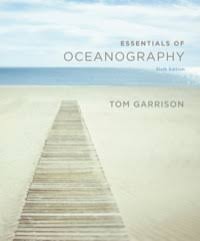
Essentials of Oceanography 6th Edition by Tom S. Garrison – Test Bank

Essentials of Oceanography 6th Edition by Tom S. Garrison – Test Bank   Instant Download - Complete Test Bank With Answers     Sample Questions Are Posted Below   Chapter 5—Ocean Sediments   MULTIPLE CHOICE   The oozes on the seafloor mostly consist of: a. boulders and cobbles from glaciers oozing off the land. b. …

$19.99

Essentials of Oceanography 6th Edition by Tom S. Garrison – Test Bank


Instant Download – Complete Test Bank With Answers


Sample Questions Are Posted Below


Chapter 5—Ocean Sediments


MULTIPLE CHOICE


  1. The oozes on the seafloor mostly consist of:
a. boulders and cobbles from glaciers oozing off the land.
b. bones and teeth of bottom-dwelling fishes.
c. fine muds washed down the continental slope to the seafloor.
d. microscopic hard parts of single-celled living organisms.


ANS:  D                    PTS:   1

REF:   5.5 Pelagic Sediments Vary in Composition and Thickness


  1. Which of the following metals is not usually found in manganese nodules?
a. iron
b. uranium
c. nickel
d. cobalt


ANS:  B                    PTS:   1

REF:   5.5 Pelagic Sediments Vary in Composition and Thickness


  1. Underlying the unconsolidated sediments of the seafloor are:
a. basalt pillows and basement rocks.
b. granite crust.
c. glacial deposits left from the Ice Age.
d. ancient remnants of continental crust.


ANS:  A                    PTS:   1

REF:   5.5 Pelagic Sediments Vary in Composition and Thickness


  1. Large volumes of bottom sediments may be transported long distances by:
a. storm waves.
b. icebergs.
c. tidal action.
d. turbidity currents.


ANS:  D                    PTS:   1

REF:   5.5 Pelagic Sediments Vary in Composition and Thickness


  1. Carbonate sediments are rare in deep sea sediments because:
a. the organisms providing shells do not live in the deep sea.
b. the abundance of muds and clays cover the carbonate shells.
c. the carbonate shells are dissolved in deep water.
d. the organisms do not live beyond the edge of the continental shelf.


ANS:  C                    PTS:   1

REF:   5.5 Pelagic Sediments Vary in Composition and Thickness


  1. Most of the floor of the North Pacific Ocean is covered with:
a. manganese nodules.
b. biogenous oozes.
c. red and brown clays.
d. evaporites.


ANS:  C                    PTS:   1                    REF:   5.3 Sediments May Be Classified by Source


  1. Which of the following would be considered oozes?
a. Terrigenous sediments.
b. Biogenous sediments.
c. Hydrogenous (or authigenic) sediments.
d. Cosmogenous sediments.


ANS:  B                    PTS:   1

REF:   5.5 Pelagic Sediments Vary in Composition and Thickness


  1. Which of the following sediments cover the greatest area of seabed?
a. terrigenous sediments
b. biogenous sediments
c. hydrogenous (or authigenic) sediments
d. cosmogenous sediments


ANS:  B                    PTS:   1                    REF:   5.3 Sediments May Be Classified by Source


  1. Which of the following is the most abundant sediment in neritic deposits?
a. terrigenous sediments
b. biogenous sediments
c. hydrogenous (or authigenic) sediments
d. cosmogenous sediments


ANS:  A                    PTS:   1                    REF:   5.3 Sediments May Be Classified by Source


  1. Which of the following is generated in place, on the spot where we find them?
a. terrigenous sediments
b. biogenous sediments
c. hydrogenous (or authigenic) sediments
d. cosmogenous sediments


ANS:  C                    PTS:   1                    REF:   5.3 Sediments May Be Classified by Source


  1. Which of the following is of organic origin; i.e., made by organisms?
a. terrigenous sediments
b. biogenous sediments
c. hydrogenous (or authigenic) sediments
d. cosmogenous sediments


ANS:  B                    PTS:   1                    REF:   5.3 Sediments May Be Classified by Source


  1. Which of the following arrive in the ocean from continents via rivers?
a. terrigenous sediments
b. biogenous sediments
c. hydrogenous (or authigenic) sediments
d. cosmogenous sediments


ANS:  A                    PTS:   1                    REF:   5.3 Sediments May Be Classified by Source


  1. All of the following are valid methods for classifying sediments EXCEPT:
a. the size and settling rate of sediment grains.
b. the thickness of sediment layers.
c. the source material of the sediment.
d. the location on the sea floor where the sediment accumulates.


ANS:  B                    PTS:   1                    REF:   5.2 Sediments May Be Classified by Particle Size


  1. In the process of lithification, sediments:
a. are subducted into the mantle at a deep trench.
b. are converted into solid rock.
c. slip into the center of the mid-ocean ridges and become new seafloor.
d. are uplifted to form the edges of continents.


ANS:  B                    PTS:   1                    REF:   5.4 Neritic Sediments Overlie Continental Margins


  1. Select the finest particles in this list.
a. sand
b. silt
c. clay
d. granules


ANS:  C                    PTS:   1

REF:   5.5 Pelagic Sediments Vary in Composition and Thickness


  1. Scientists can derive all of the following types of information from observing deep ocean cores EXCEPT:
a. how much light penetrates the ocean
b. the presence or absence of mineral resources
c. historical water temperatures
d. ancient current patterns.


ANS:  A                    PTS:   1

REF:   5.6 Scientists Use Specialized Tools to Study Ocean Sediments


  1. Radiolarians and diatoms are both examples of:
a. multicellular organisms.
b. single-celled animals.
c. creatures whose shells form siliceous oozes.
d. calcareous oozes in the deepest parts of the ocean.


ANS:  C                    PTS:   1

REF:   5.5 Pelagic Sediments Vary in Composition and Thickness


  1. Which of the following are hydrogenous sediments?
a. quartz sand
b. evaporites
c. siliceous oozes
d. tektites


ANS:  B                    PTS:   1                    REF:   5.3 Sediments May Be Classified by Source


  1. Which statement characterizes sediments of the North Pacific?
a. The sediments of the North Pacific are primarily composed of radiolarian deposits.
b. The sediments of the North Pacific are thicker than the sediments of the Atlantic.
c. The sediments of the deep North Pacific are mainly pelagic clays.
d. The sediments of the North Pacific are mostly calcareous oozes.


ANS:  C                    PTS:   1

REF:   5.5 Pelagic Sediments Vary in Composition and Thickness


  1. Sediments that originate in the ocean are called:
a. pelagic sediments.
b. abyssal sediments.
c. biogenous sediments.
d. neritic sediments.


ANS:  A                    PTS:   1                    REF:   5.3 Sediments May be Classified by Source


  1. Neritic sediments are found on the:
a. deep ocean floor mostly in the Atlantic Ocean.
b. continental shelf.
c. continental rise.
d. abyssal plains.


ANS:  B                    PTS:   1                    REF:   5.4 Neritic Sediments Overlie Continental Margins


  1. Sand is classified as sediment that has a diameter no larger than:
a. 4 mm.
b. 0.2 mm.
c. 2 mm.
d. 0.004 mm.


ANS:  C                    PTS:   1                    REF:   5.2 Sediments May Be Classified by Particle Size


  1. The age of most marine sediments is:
a. no older than about 10,000 years old.
b. about 1 million years old.
c. rarely older than about 180 million years old.
d. not possible to determine.


ANS:  D                    PTS:   1                    REF:   5.1 Sediments Vary Greatly in Appearance


  1. A layer of sediment that contains a mixture of sediments with various sizes is referred to as:
a. homogeneous.
b. poorly sorted.
c. well-sorted.
d. eroding sediments.


ANS:  B                    PTS:   1                    REF:   5.2 Sediments May Be Classified by Particle Size


  1. Which of the following is a major source of terrigenous sediments?
a. Erosion.
b. Dissolved organic material.
c. Dissolved nutrients.
d. Precipitation over the open ocean.


ANS:  A                    PTS:   1                    REF:   5.3 Sediments May Be Classified by Source


  1. More than 75% of the total ocean floor is considered:
a. continental shelf.
b. deep ocean floor.
c. continental slope.
d. continental rise.


ANS:  B                    PTS:   1                    DIF:    5.3 Sediments May Be Classified by Source


  1. A depression along the boundary of a seamount where sediment has built-up is a:
a. scour moat.
b. guyot.
c. island arc.
d. abyssal plain.


ANS:  A                    PTS:   1                    REF:   5.1 Sediments Vary Greatly in Appearance


  1. One area in the ocean that has an extreme abundance of sediment deposition is:
a. the shallow waters around Alaska.
b. the waters around the tip of  Africa.
c. the deep ocean floor in the middle of the Pacific Ocean.
d. the waters near the Gulf Coast of North America.


ANS:  D                    PTS:   1                    REF:   5.3 Sediments May Be Classified by Source


  1. Over millions of years, natural gas and oil can be formed from:
a. erosion.
b. volcanic ash.
c. biogenous sediments.
d. terrigenous sediments.


ANS:  C                    PTS:   1                    REF:   5.3 Sediments May Be Classified by Source


  1. The analysis of layered sedimentary deposits in the ocean is:
a. stratigraphy.
b. oceanography.
c. marine biology.
d. ecology.


ANS:  A                    PTS:   1

REF:   5.7 Sediments Are Historical Records of Ocean Processes


TRUE/FALSE


  1. Clays are the coarsest and most easily transported of the terrigenous sediments.


ANS:  F                    PTS:   1

REF:   5.5 Pelagic Sediments Vary in Composition and Thickness


  1. Scientists use ocean sediments to obtain information about ocean processes throughout the history of the ocean.


ANS:  T                    PTS:   1

REF:   5.6 Scientists Use Specialized Tools to Study Ocean Sediments


  1. Sediment refers to the inorganic materials that accumulate on the ocean floor.


ANS:  F                    PTS:   1                    REF:   5.1 Sediments Vary Greatly in Appearance


  1. Some sediment originates from the remnants of organisms.


ANS:  T                    PTS:   1

REF:   5.5 Pelagic Sediments Vary in Composition and Thickness


  1. An example of a terrigenous sediment is the manganese nodule.


ANS:  F                    PTS:   1                    REF:   5.3 Sediments May Be Classified by Source


  1. Stratigraphy is the study of the deposition and layering of sediments over time.


ANS:  T                    PTS:   1

REF:   5.7 Sediments Are Historical Records of Ocean Processes


  1. Manganese nodules were discovered during the Challenger expedition and are hydrogenous sediments.


ANS:  T                    PTS:   1

REF:   5.5 Pelagic Sediments Vary in Composition and Thickness


  1. The only way in which calcium carbonate sediment can form is by evaporation.


ANS:  F                    PTS:   1

REF:   5.5 Pelagic Sediments Vary in Composition and Thickness


  1. An example of a siliceous ooze are those formed from radiolarian shells.


ANS:  T                    PTS:   1

REF:   5.5 Pelagic Sediments Vary in Composition and Thickness


  1. The white cliffs of Dover are chalk-like deposits of coccolithophores and are around 100 million years old.


ANS:  T                    PTS:   1

REF:   5.5 Pelagic Sediments Vary in Composition and Thickness


ESSAY


  1. Paleoceanography is the study of past processes and past events that have occurred in the ocean. What types of questions do paleoceanographers ask and what are the methods they use to obtain information about the ocean’s past?


ANS:

Deep-sea sediments hold about a 180 million year history about the ocean, its chemistry and its inhabitants. Paleoceanographers may ask questions about the history of the ocean and Earth.  These questions may range from climate science, to species biology to geological phenomena and more. Scientists use many different sampling techniques such as clamshell samplers, piston corers, and deep-sea drilling to extract sediment samples from different depths.  Paleooceanographers can infer several types of  information held within these sediments including the age of the sediments, the identification of microfossils trapped in the layer of sediments, the historical temperatures of the ocean and other aspects of past ocean chemistry and behavior.  In addition, scientists are currently trying to interpret both oceanic and climate change history.  New advances in instrumentation and technologies have enabled scientists to probe deeper into sediments unveiling more information about the ocean of the past.


PTS:   1                    REF:   5.7 Sediments Are Historical Records of Ocean Processes


  1. What are the main sources of terrigenous sediments?


ANS:

Terrigenous sediments are those sediments that have their origins on land and are typically the most common and abundant sediment type on the ocean floor, especially in neritic deposits. There are several sources of terrigenous sediments. .  First, rivers transport huge amounts of sediments into the ocean and river runoff is the primary source of terrigenous sediments. Scientists predict that 15 billion metric tons of terrigenous sediment is transported by rivers to the ocean each year.  Secondly, winds blow dust, sand and volcanic ash into the ocean.  It is estimated that about 100 million tons of dust, sand and ash blow into the ocean each year.


PTS:   1                    REF:   5.3 Sediments May Be Classified by Source


  1. Describe neritic sediments and explain what you would expect the composition of a typical neritic sample to be.


ANS:

Neritic sediments are those that form and are found on the continental shelves that line the Earth’s continents.  Because of the proximity to the continents, most neritic sediments are terrigenous in origins; sediments are eroded from the land and carried to the ocean in rivers and streams.  Once in the ocean, currents and wave action distribute sand and larger particles along the coast.  Smaller particles such as clays and silts are transported off shore and are deposited on the ocean floor in deeper waters.  Neritic sediments may also contain biogenous oozes in highly productive regions (i.e. where lots of microorganisms grow).


PTS:   1                    REF:   5.4 neritic Sediments Overlie Continental Margins


  1. What is sediment and what are the 4 classifications of marine sediments based on their origin?


ANS:

Sediment is a general term referring to particles of matter that accumulate on the ocean floor. The appearance of sediment can vary widely, coming in a range of sizes and types, from the common beach sand to manganese nodules of the deep Pacific seafloor.  In general, the sediments that cover the surface of seafloor are either terrigenous in origin (i.e., from land erosion), biogenous sediments that originated from microorganisms and/or hydrogenous sediments that formed from chemical reaction in the water.  The last type of sediment is cosmogenous sediments, which have an extraterrestrial origin, though these are rare in today’s surface layer of sediment.


PTS:   1                    REF:   5.3 Sediments May Be Classified by Source


  1. What is the origin of manganese nodules?


ANS:

Manganese nodules are hydrogenous sediments that are formed from in-situ chemical reactions as the minerals in the water precipitate to form a solid.  Manganese nodules are primarily composed of manganese and iron oxides but have small amounts of cobalt, nickel, chromium, copper, molybdenum and zinc.  Although the exact chemical mechanism by which they are formed is not fully understood, scientists do know that they grow at a rate of about 1-10 mm per million years.


PTS:   1                    REF:   5.5 Pelagic Sediments Vary in Composition and Thickness

Additional information

Add Review

Your email address will not be published. Required fields are marked *