Subtotal: $620.00

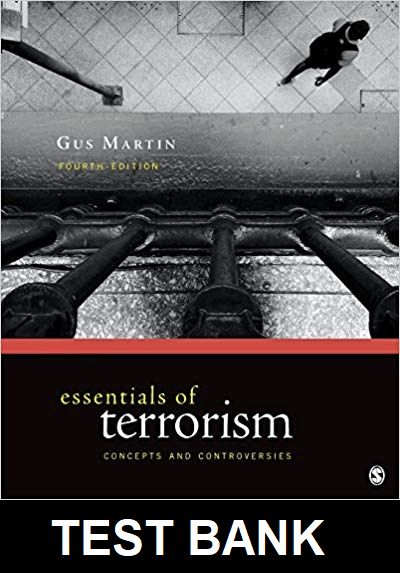
Essentials of Terrorism Concepts and Controversies 4th Edition By Martin - Test Bank

Essentials of Terrorism Concepts and Controversies 4th Edition By Martin - Test Bank   Instant Download - Complete Test Bank With Answers     Sample Questions Are Posted Below     Martin, Gus.  Essentials of Terrorism, Fourth Edition: Concepts and Controversies.  Thousand Oaks, CA: Sage Publications, 2016   TEST BANK     Chapter 5: Terrorism …

$19.99

Essentials of Terrorism Concepts and Controversies 4th Edition By Martin – Test Bank


Instant Download – Complete Test Bank With Answers


Sample Questions Are Posted Below


Martin, Gus.  Essentials of Terrorism, Fourth Edition: Concepts and Controversies.  Thousand Oaks, CA: Sage Publications, 2016


TEST BANK


Chapter 5: Terrorism by the State


Essay


Why do some governments engage in international terrorism as a matter of policy?  Discuss international environments that give rise to international state terrorism.  Is government-sponsored international political violence ever justifiable?


What are “terrorist proxies?”  Explain how countries use these proxies.  Why do they do so?  Discuss potential benefits enjoyed by sponsors who use such proxies.  Discuss potential risks.


Why do some governments engage in domestic terrorism as a matter of policy?  Discuss domestic social and political environments that give rise to domestic state terrorism.  Is government-sponsored domestic political violence ever justifiable?


Compare and contrast the Anfal Campaign in Iraq and the behavior of the Khmer Rouge in Cambodia.  Discuss the selection of their victims and reasons, including why these victims were targeted.  Discuss lessons from these cases on how and why state-sponsored genocide occurs.


In your opinion, are authoritarian regimes more likely to engage in domestic and international terrorism than are democratic regimes?  If so, why?  If not, why not?  Explain your answer.


In your opinion, are authoritarian regimes more likely to engage in domestic and international terrorism than are democratic regimes?  If so, why?  If not, why not?  Explain your answer.


Briefly discuss the role of paramilitaries and how they can be effective in suppressing internal opposition.


Discuss the reporting of state repression within the context of international “watchdog” organizations.  Why is this a critical function when dealing with official government versions of events?


Genocidal repression by governments is universally condemned.  Nevertheless, international responses are often slow at best.  Why?  What factors enter into the calculation to intervene or condemn such behavior?


Discuss why some governments engage in social and ethnic cleansing.  What is the purpose of such campaigns?


In your opinion, why do democracies sometimes use authoritarian methods?


Short Answer


Discuss why governments often try to hide or otherwise cover up their participation in international terrorism.


Is “social cleansing” inherently a terrorist policy?  Explain your answer.


Why do governments, such as Robert Mugabe’s regime in Zimbabwe, engage in repressive practices that only seem to harm their own country?


Were death squads in Latin America an outgrowth of global ideological conflict?  Explain your answer.


In what ways does state terrorism pose a more significant threat to the international community than do non-state terrorist groups?


In your opinion, what sort of government was that of Muammar el-Qaddafi?


In your opinion, what sort of government was that of Saddam Hussein?


Briefly describe the purpose of “blacklisting” and other authoritarian measures during Red Scares in the United States.


Are authoritarian measures sometimes justifiable and necessary?


What explains the pattern of right-wing governments in Latin America during the Cold War?


True-False


State Terrorism involves the overt use of force abroad.  (ANS: False)


Governments often justify domestic violence as being necessary for the good of the nation.  (ANS: True)


Vigilante domestic state terrorism is when governments “unleash” their proxies.  (ANS: True)


Ethnic and social cleansing peacefully occur when governments ask the people to help enforce the laws.  (ANS: False)


The Anfal Campaign was an act of genocide in Cambodia.  (ANS: False)


Auto-genocide refers to genocide conducted automatically.  (ANS: False)


Muammar el-Qaddafi was a primary perpetrator of international state-sponsored terrorism for nearly two decades.  (ANS: True)


One purpose of paramilitary death squads is to provide a degree of “deniability” for the state.  (ANS: True)


The contras fought against the United States in Nicaragua.  (ANS: False)


Pol Pot was an architect of the “killing fields” on behalf of the Viet Cong.  (ANS: False)


Multiple Choice


Why was a new international counter-terrorist legal framework established during the second half of the Twentieth Century?  (ANS: d)

  1. Communism threatened democracy.
  2. Terrorism had never been illegal prior to this time.
  3. No one had thought of it before.
  4. A legal framework was needed to respond to rogue-state sponsors of terrorism.


The United States imposes which of the following sanctions against state sponsors of terrorism?  (ANS: c)

  1. Bans on arms-related exports and sales.
  2. Prohibitions on economic assistance.
  3. Both “a” and “b”.
  4. “a” but not “b”.


State sponsors of terrorism are listed in which of the following publications?  (ANS: d)

  1. The Annual Report on Terrorism.
  2. Country Reports of Terrorist Attacks.
  3. Foreign Terrorist Organizations.
  4. Country Reports on Terrorism.


Senator Joseph McCarthy presided of a period known as “McCarthyism” that involved which of the following countermeasures?  (ANS: c)

  1. The “Palmer Raids.”
  2. Internment camps.
  3. Senate hearings and investigations.
  4. Suspension of the writ of habeas corpus.


Terrorist “proxies” refer to  (ANS: c)

  1. Terrorists who resist control by governments.
  2. Terrorists who are independent of any constraints.
  3. Terrorists who have government sponsors.
  4. Both “a” and “b”.


The Anfal Campaign targeted which group of people?  (ANS: c)

  1. Cambodian ideological undesirables and enemies.
  2. Basque separatists in Spain.
  3. Kurdish residents in Iraq.
  4. Christians and religious minorities in Sudan.


The Khmer Rouge targeted which group of people?  (ANS: a)

  1. Cambodian ideological undesirables and perceived enemies.
  2. Basque separatists in Spain.
  3. Kurdish residents in Iraq.
  4. Christians and religious minorities in Sudan.


Paramilitaries have historically been used by governments for which of the following purposes?  (ANS: d)

  1. For the suppression of internal opposition.
  2. For the defense of government interests during times of political instability.
  3. To serve as deniable assets.
  4. All of the above.


International “watchdog” organizations will often engage in which of the following activities?  (ANS: b)

  1. Conduct covert surveillance on government officials and activities.
  2. Serve as a counterpoint to official government versions of events.
  3. Impose economic sanctions on rogue governments.
  4. Both “a” and “b”.


Possible purposes of government-sponsored social and ethnic cleansing include which of the following? (ANS: d)

  1. To keep cities and towns neat and clean when undesirables move in.
  2. Finish creating an orderly society for the benefit of all the people.
  3. To keep the peace for the benefit of the poor.
  4. Promote law and order and/or eliminate the presence of an ethnic group.


Which of the following statements regarding government “deniability” is most accurate? (ANS: c)

  1. Some governments deny that terrorism exists.
  2. Some governments deny the people’s human rights.
  3. Some governments try to hide or otherwise cover up their participation in international terrorism.
  4. All of the above.


Which of the following statements regarding death squads in Latin America is most accurate? (ANS: d)

  1. Death squads have been used in the international war on terrorism.
  2. Death squads assisted in the recovery and burial of victims of political violence.
  3. Death squads were a product of cult-like opposition to government authority.
  4. Death squads were often supported by elites and governments to carry out extra-legal acts of violence.


Which of the following regimes engaged in state-sponsored terrorism in the modern era. (ANS: d)

  1. The regime of Idi Amin in Uganda.
  2. The regime of Muammar el-Qaddafi in Libya.
  3. The regime of Saddam Hussein in Iraq.
  4. All of the above.


Which of the following statements most accurately reflects the attributes of state terrorism? (ANS: d)

  1. The use of covert force abroad.
  2. The justification that domestic violence is necessary for the good of the nation.
  3. Authoritarian measures are the only way to achieve stability.
  4. All of the above.


Vigilante domestic state terrorism refers to (ANS: a)

  1. Environments when governments “unleash” their proxies.
  2. The use of “wild west” tactics.
  3. Hiring deputized law enforcement officers.
  4. Violent watchful vigilance by government officials.


Social cleansing refers to (ANS: c)

  1. Government-sponsored purification policies.
  2. Assuring that the population is adequately provided for.
  3. Targeted repression of identified “undesirable” social groups.
  4. Genocidal annihilation of undesirables.


Auto-genocide refers to (ANS: a)

  1. Genocide directed against one’s own people.
  2. Genocide that occurs automatically.
  3. Genocide supported by corporate leaders.
  4. Genocide that is being planned, but has not yet been carried out.


Among the degrees of state violence, which of the following involves the elimination of a scapegoat group? (ANS: c)

  1. None of the above.


Among the degrees of state violence, which of the following involves the application of homicidal state violence to eliminate a single person or a specified group of people? (ANS: a)

  1. None of the above.


Among the degrees of state violence, which of the following involves the marshaling of the conventional military forces of the state? (ANS: d)

  1. None of the above.


Additional information

Add Review

Your email address will not be published. Required fields are marked *