Subtotal: $720.00

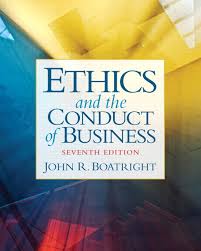
Ethics And The Conduct Of Business 7th Edition By Boatright - Test Bank

Ethics And The Conduct Of Business 7th Edition By Boatright - Test Bank   Instant Download - Complete Test Bank With Answers     Sample Questions Are Posted Below   Chapter 1 Ethics in the World of Business CHAPTER SUMMARY Business ethics is concerned with identifying and understanding the ethical issues that arise in business …

$19.99

Ethics And The Conduct Of Business 7th Edition By Boatright – Test Bank


Instant Download – Complete Test Bank With Answers


Sample Questions Are Posted Below


Chapter 1
Ethics in the World of Business
CHAPTER SUMMARY
Business ethics is concerned with identifying and understanding the ethical issues that arise
in business and with developing the knowledge and skills needed by a practicing manager to
address these issues and to make sound business decisions—that is, decisions that are
sound from both an ethical and a business perspective. Ethical issues are an inevitable
element of business decision making and are deeply intertwined with managerial practice
and economic activity generally. Business ethics is important for managers because many
business decisions upon which the success of individual managers, business organizations,
and, indeed, the whole economic system depend, are involved in ethical issues. Both
economics and law are important guides for business decision making, but they are not
complete. Nor is business ethics understood merely as the treatment of ethical issues from
a philosophical perspective. As the work of psychologists and sociologists on organizational
misconduct show, it is not enough merely to determine a right course of action. Misconduct
in organizations is also the result of flaws in individual and organizational decision making
that can be corrected only by changes in decision-making processes. Practicing managers
must also address the larger challenge of preventing misconduct within organizations.
CHAPTER OBJECTIVES
• Explain how business decision-making can run afoul of ethical concerns.
• Describe the kinds of decisions that are characteristic of the various levels of
business organization.
• Describe the relationship between ethics and the law.
SUGGESTED DISCUSSION PROMPTS
1. What types of ethical concerns do decision-makers at the management level need to
take into account?
2. What types of ethical concerns do decision-makers at lower organizational levels
need to take into account?
3. How would you respond to someone who says that a business should always do
whatever is in its economic interests?
4. What is wrong with the thought that abiding by the law is all the ethics that a
businessperson needs to worry about?
5. How does specialized knowledge come into play in the management of ethics?
© 2012 Pearson Education, Inc. All Rights Reserved.
2
ASSESSMENT FOR IN-CLASS USE
The following assessment has been created for in-class use. This assessment may be
available through Pearson’s MyTest website—allowing for easy access for creating your own
tests. This assessment may also be offered in a Blackboard/Angel/D2L/WebCT package.
Please contact your local Pearson sales representative to learn about the options available.
Visit, http://www.pearsonhighered.com/replocator.
Multiple Choice Questions
Choose the BEST possible answer for each of the following.
1. In many cases, rules of business ethics can be determined by .
A. applicable laws
B. company guidelines
C. economic requirements
D. rules of conduct that apply in everyday life
Answer: D
2. The economic character of business can be seen in its .
A. trading characteristics
B. ethical dimensions
C. personal aspects
D. legal guidelines
Answer: A
3. Organization in business is characterized mainly by its .
A. rules
B. hierarchy
C. profits
D. products
Answer: B
4. Decision making in business occurs at various distinctive .
A. places
B. levels
C. objectives
D. profits
Answer: B
5. It is possible for there to be unethical actions that are not .
A. illegal
B. wrong
C. avoidable
D. harmful
Answer: A
© 2012 Pearson Education, Inc. All Rights Reserved.
3
6. Economic reasoning describes how we .
A. ought to reason
B. prioritize our desires
C. reason when pursuing our goals
D. would reason if we could have whatever we wanted
Answer: C
7. Adam Smith’s economic theory is based on which of the following assumptions?
A. People want to promote each others’ interests.
B. Morality is not relevant to economic concerns.
C. Free markets will fix their own ethical problems.
D. People will behave rationally as they pursue their interests.
Answer: D
8. What fact does the “ultimatum bargaining game” demonstrate?
A. It is often rational to price products below their market value.
B. Free markets will usually self-regulate.
C. Many people do not understand economics.
D. Many people would rather not trade than be treated unfairly.
Answer: D
9. The school of thought that says that law and ethics govern two different realms is
wrong because .
A. ethics applies to every field of life
B. anything that is legal is also ethical
C. anything that is illegal is also unethical
D. the law governs every aspect of life
Answer: A
10. It is not ethically sufficient to obey the law because .
A. the law does not apply to business in general
B. ethical constraints sometimes require that the law be ignored
C. ethics goes beyond what can be legally codified
D. the law itself is stricter than ethics
Answer: C
Essay Questions
1. What is economic efficiency, and in what ways might the pursuit of economic
efficiency be unethical?
2. Describe and explain an example of a business decision that would be unethical even
though it is legal.
3. In what ways does it benefit businesses to pursue ethical choices beyond what they
are legally required to do?

Additional information

Add Review

Your email address will not be published. Required fields are marked *