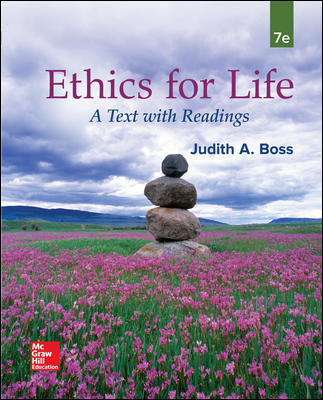
Ethics For Life 7Th Edition By Boss - Test Bank

Ethics For Life 7Th Edition By Boss - Test Bank   Instant Download - Complete Test Bank With Answers     Sample Questions Are Posted Below   Ethics for Life, 7e (Boss) Chapter 5   Divine Command Theory and Civil Religion   1) In the context of morality, the divine command theory claims that: A) morality …

$19.99

Ethics For Life 7Th Edition By Boss – Test Bank


Instant Download – Complete Test Bank With Answers


Sample Questions Are Posted Below


Ethics for Life, 7e (Boss)

Chapter 5   Divine Command Theory and Civil Religion


1) In the context of morality, the divine command theory claims that:

  1. A) morality is created collectively by people and, therefore, differs from culture to culture.
  2. B) morality is relative to or dependent on God’s will.
  3. C) human knowledge comes through the five senses.
  4. D) the existence of evil in the world disproves the existence of God.


Answer:  B

Accessibility:  Keyboard Navigation

Gradable:  automatic


2) According to divine command theorists, ________.

  1. A) the Ten Commandments are morally binding on all people at all times, including people who do not accept the Bible as the word of God
  2. B) it was morally acceptable for the terrorists to bomb the World Trade Center on 9/11, if the command to do so came from God
  3. C) God would not command a person to commit an act of terror because it is morally wrong to target innocent people, even in war
  4. D) God does not exist because an all-good God is incompatible with the existence of evil in the world


Answer:  B

Accessibility:  Keyboard Navigation

Gradable:  automatic


3) According to Kai Nielsen, which of the following comes first?

  1. A) divine command before natural law
  2. B) the worship of God before a concept of morality
  3. C) a concept of morality before the worship of God
  4. D) the chicken before the egg


Answer:  C

Accessibility:  Keyboard Navigation

Gradable:  automatic


4) According to Robert Bellah, the morality supported by mainstream religion in the United States is primarily based on:

  1. A) divine command theory.
  2. B) egoism.
  3. C) cultural relativism.
  4. D) ethical subjectivism.


Answer:  C

Accessibility:  Keyboard Navigation

Gradable:  automatic

5) In the context of religion’s role in society, sociologist Robert Bellah coined the term ________, which he defined as an institutionalized set of beliefs, symbols, and rituals that provide a religious dimension to a nation’s collective life.

  1. A) “civil religion”
  2. B) “religious extremism”
  3. C) “moral community”
  4. D) “ethical relativism”


Answer:  A

Accessibility:  Keyboard Navigation

Gradable:  automatic


6) Which of the following is a basic tenet of American civil religion?

  1. A) We have a moral obligation to redistribute America’s wealth to the poorer nations of the world and to open our borders to the poor of the world.
  2. B) Waging a preemptive war is immoral, even if it may be in the best interest of the United States to do so, since doing so is a violation of the just war theory.
  3. C) God is actively involved in history and has a special interest in America.
  4. D) Jesus is the supreme ruler of America.


Answer:  C

Accessibility:  Keyboard Navigation

Gradable:  automatic


7) According to Sioux holy man and philosopher Black Elk, the moral community in many Native American spiritual traditions includes:

  1. A) all and only humans.
  2. B) all and only Native Americans.
  3. C) all and only rational beings.
  4. D) all rational and irrational beings.


Answer:  D

Accessibility:  Keyboard Navigation

Gradable:  automatic


8) In the context of morality and religion, which of the following best defines spirituality?

  1. A) an inner attitude of reverence or deep respect for the ultimate moral worth or sacredness of oneself and others
  2. B) an admirable character trait or disposition to habitually act in a manner that benefits others over oneself
  3. C) an institutionalized set of beliefs about a transcendent god-figure that created the world
  4. D) an intrinsic awareness of what is morally good or bad that is not dependent on one’s religious beliefs or views on society


Answer:  A

Accessibility:  Keyboard Navigation

Gradable:  automatic

9) Why does one of the critiques of divine command theory suggest that God as envisioned by the Christian tradition does not exist?

  1. A) Human culture, not God, is the source of morality.
  2. B) There is evil and suffering in the world.
  3. C) The world is mechanistic; God, free will, and morality do not exist.
  4. D) The Bible is fictional; Abraham and Isaac never existed.


Answer:  B

Accessibility:  Keyboard Navigation

Gradable:  automatic


10) In the context of morality and religion, morality that is beyond what is normally expected of an individual is known as ________.

  1. A) moral extremism
  2. B) a divine command
  3. C) spirituality
  4. D) supererogatory


Answer:  D

Accessibility:  Keyboard Navigation

Gradable:  automatic


11) Which of the following is the best example of a supererogatory act?

  1. A) Because she loves him so much, Jane suggests that her boyfriend Harry, who is unprepared for an exam, cheat by copying from her answer paper, even though she realizes that she may be kicked out of college if they are caught.
  2. B) Harry refrains from cheating because he knows cheating is wrong.
  3. C) Jane volunteers in a homeless shelter as part of a requirement for her ethics course.
  4. D) Harry spent the previous week, at his own expense, helping to rescue flood victims in Alabama.


Answer:  D

Accessibility:  Keyboard Navigation

Gradable:  automatic


12) Which of the following people is most likely to be a true moral reasoner?

  1. A) a religious person who subscribes to the divine command theory
  2. B) a psychopath who rejects spirituality
  3. C) an extrinsically religious person
  4. D) an intrinsically religious person


Answer:  D

Accessibility:  Keyboard Navigation

Gradable:  automatic


13) Identify a common critique of divine command theory.

  1. A) It is problematic because there are no independent criteria to determine if someone’s actions were actually commanded by God.
  2. B) It is irrelevant because the number of people with irreligious or atheistic beliefs far outnumber the number of religious people in the world.
  3. C) It is not a valid theory because religious scriptures do not specify that God commanded everyone to live a morally just life.
  4. D) It is self-contradictory in that it identifies morality as independent of God’s will and yet expects people to follow God’s commands unquestioningly.


Answer:  A

Accessibility:  Keyboard Navigation

Gradable:  automatic


14) According to Gordon Allport, which of the following people can be categorized as an intrinsically religious person?

  1. A) Farah, who is deeply religious because her faith is meaningful to her
  2. B) Jonah, who is very active in his synagogue because his father expects him to be
  3. C) Nina, a faith healer who uses ancient rituals to help people quit addictions
  4. D) Bill, an atheist who works with Doctors Without Borders to help children in developing nations


Answer:  A

Accessibility:  Keyboard Navigation

Gradable:  automatic


15) According to Gordon Allport, extrinsically religious people tend to:

  1. A) be morally autonomous and tend to adhere to universal moral principles instead of religious tenets.
  2. B) prioritize spiritual experiences over the worship of a superior transcendent being.
  3. C) be heteronomous moral reasoners who uncritically accept the tenets of civil religion.
  4. D) consider morality to be subjective and variable from person to person.


Answer:  C

Accessibility:  Keyboard Navigation

Gradable:  automatic

16) In the context of religiosity, unlike heteronomous moral reasoners, truly moral people:

  1. A) uncritically accept the tenets of their religion.
  2. B) emphasize the worship of a superior transcendent being as the highest expression of morality.
  3. C) strive to be a good kind of person because they personally believe it is the right thing to do.
  4. D) have narrow definitions of what moral communities are.


Answer:  C

Accessibility:  Keyboard Navigation

Gradable:  automatic


17) In the context of morality and religion, natural law theory maintains that:

  1. A) an action is moral when God commands it.
  2. B) modern American society conceptualizes god as patriarchal and racially biased.
  3. C) morality is autonomous and is independent of religion or God’s commands.
  4. D) Judeo-Christian concepts of moral worth are universally applicable to all people.


Answer:  C

Accessibility:  Keyboard Navigation

Gradable:  automatic


18) In the context of religion and society, with which of the following sentiments is Karl Marx most likely to agree?

  1. A) To live without religion is to live without hope, because without hope, and thereby without God, there is no future.
  2. B) Without a just and powerful god watching over people, morality would cease to exist.
  3. C) Religion is a destructive force created by people to maintain the divisive and oppressive status quo in society.
  4. D) Religion is the worship of society, and it renders the sacred cultural norms and values of all peoples everywhere.


Answer:  C

Accessibility:  Keyboard Navigation

Gradable:  automatic

Identify the person who said each of the following.


19) “My friends, I must say to you that we have not made a single gain in civil rights without determined legal and nonviolent pressure. History is the long and tragic story of the fact that privileged groups seldom give up their privileges voluntarily… We know through painful experience that freedom is never voluntarily given by the oppressor; it must be demanded by the oppressed.” Which of the following persons is most likely to have said this?

  1. A) Ruth Benedict
  2. B) Thomas Aquinas
  3. C) Martin Luther King Jr.
  4. D) Robert Bellah


Answer:  C

Accessibility:  Keyboard Navigation

Gradable:  automatic


20) “What is pleasing to the gods, and the man that pleases them, are holy; what is hateful to the gods, and the man they hate, unholy. But the holy and unholy are not the same; the holy is directly opposite to the unholy.”

  1. A) Thomas Aquinas
  2. B) Martin Luther King Jr.
  3. C) Black Elk
  4. D) Socrates


Answer:  D

Accessibility:  Keyboard Navigation

Gradable:  automatic

Additional information

Add Review

Your email address will not be published. Required fields are marked *