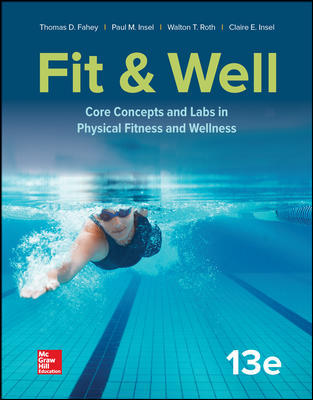
Fit & Well Core Concepts and Labs in Physical Fitness and Wellness 13Th Edition By Thomas Fahey - Test Bank

Fit & Well Core Concepts and Labs in Physical Fitness and Wellness 13Th Edition By Thomas Fahey - Test Bank   Instant Download - Complete Test Bank With Answers     Sample Questions Are Posted Below   Fit & Well (Fahey), 13e Chapter 5   Flexibility and Low-Back Health   1) Upon what does static flexibility …

$19.99

Fit & Well Core Concepts and Labs in Physical Fitness and Wellness 13Th Edition By Thomas Fahey – Test Bank


Instant Download – Complete Test Bank With Answers


Sample Questions Are Posted Below


Fit & Well (Fahey), 13e

Chapter 5   Flexibility and Low-Back Health


1) Upon what does static flexibility depend?

  1. A) length of the muscles
  2. B) looseness of the ligaments
  3. C) muscular strength
  4. D) structure of a joint


Answer:  D

Page Ref: 148

Section:  Types of Flexibility

Topic:  Flexibility

Learning Objective:  Explain factors that affect flexibility.

Bloom’s:  Remember

Accessibility:  Keyboard Navigation


2) Which activity best demonstrates dynamic flexibility?

  1. A) touching your toes
  2. B) performing a split
  3. C) pitching a softball
  4. D) side lunges


Answer:  C

Page Ref: 148

Section:  Types of Flexibility

Topic:  Flexibility

Learning Objective:  Explain factors that affect flexibility.

Bloom’s:  Understand

Accessibility:  Keyboard Navigation


3) What determines flexibility?

  1. A) heredity
  2. B) mitochondria
  3. C) ligament length
  4. D) muscle strength


Answer:  A

Page Ref: 148

Section:  What Determines Flexibility?

Topic:  Flexibility; Genetics

Learning Objective:  Explain factors that affect flexibility.

Bloom’s:  Remember

Accessibility:  Keyboard Navigation


4) What are joint capsules?

  1. A) yellow fibers that make connective tissue flexible
  2. B) sense organs in muscles that initiate nerve signals
  3. C) semielastic structures that surround major joints
  4. D) white fibers that provide support in connective tissue


Answer:  C

Page Ref: 148

Section:  What Determines Flexibility?

Topic:  Joints

Learning Objective:  Explain factors that affect flexibility.

Bloom’s:  Remember

Accessibility:  Keyboard Navigation


5) What are the two principal types of connective tissue in a muscle?

  1. A) collagen and myofibrils
  2. B) myofibrils and elastin
  3. C) myofibrils and disks
  4. D) elastin and collagen


Answer:  D

Page Ref: 149

Section:  What Determines Flexibility?

Topic:  Connective Tissues

Learning Objective:  Explain factors that affect flexibility.

Bloom’s:  Remember

Accessibility:  Keyboard Navigation


6) What are the yellow fibers that make connective tissue flexible?

  1. A) collagen
  2. B) elastin
  3. C) titin
  4. D) stretch receptors


Answer:  B

Page Ref: 149

Section:  What Determines Flexibility?

Topic:  Connective Tissues

Learning Objective:  Explain factors that affect flexibility.

Bloom’s:  Remember

Accessibility:  Keyboard Navigation


7) Which is a proprioceptor?

  1. A) collagen
  2. B) elastin
  3. C) a nerve
  4. D) titin


Answer:  C

Page Ref: 149

Section:  What Determines Flexibility?

Topic:  Nervous System Regulation

Learning Objective:  Explain factors that affect flexibility.

Bloom’s:  Remember

Accessibility:  Keyboard Navigation


8) What is one likely outcome of good flexibility?

  1. A) decreased sports performance
  2. B) an increased number of injuries
  3. C) improved body composition
  4. D) a lower risk of sport injuries


Answer:  D

Page Ref: 149

Section:  Benefits of Flexibility

Topic:  Flexibility Benefits

Learning Objective:  Identify the benefits of flexibility.

Bloom’s:  Remember

Accessibility:  Keyboard Navigation


9) What is one benefit of stretching?

  1. A) It allows muscles to lengthen.
  2. B) It prevents overuse injuries.
  3. C) It increases muscle endurance.
  4. D) It makes connective tissue brittle.


Answer:  A

Page Ref: 149

Section:  What Determines Flexibility?

Topic:  Flexibility Benefits

Learning Objective:  Identify the benefits of flexibility.

Bloom’s:  Remember

Accessibility:  Keyboard Navigation


10) Which benefit comes with flexibility?

  1. A) increased muscle endurance
  2. B) prevention of overuse injuries
  3. C) improved energy production
  4. D) prevention of muscle strains


Answer:  D

Page Ref: 149

Section:  Benefits of Flexibility

Topic:  Flexibility Benefits

Learning Objective:  Identify the benefits of flexibility.

Bloom’s:  Remember

Accessibility:  Keyboard Navigation


11) What is the long-term lengthening of connective tissues called?

  1. A) plastic elongation
  2. B) elastin damage
  3. C) structural flexibility
  4. D) elastic elongation


Answer:  A

Page Ref: 149

Section:  What Determines Flexibility?

Topic:  Connective Tissues

Learning Objective:  Explain factors that affect flexibility.

Bloom’s:  Remember

Accessibility:  Keyboard Navigation


12) Which test is used to determine the flexibility of muscles in the hamstrings?

  1. A) a static stretch test
  2. B) a sit-and-reach test
  3. C) a dynamic stretch test
  4. D) a ballistic stretch test


Answer:  B

Page Ref: 151

Section:  Assessing Flexibility

Topic:  Assessing Flexibility

Learning Objective:  Describe how to assess flexibility.

Bloom’s:  Remember

Accessibility:  Keyboard Navigation


13) Which of the following results from poor posture?

  1. A) structural body changes
  2. B) greater flexibility
  3. C) osteoporosis
  4. D) increased blood pressure


Answer:  A

Page Ref: 151

Section:  Benefits of Flexibility

Topic:  Flexibility Benefits

Learning Objective:  Identify the benefits of flexibility.

Bloom’s:  Understand

Accessibility:  Keyboard Navigation


14) According to the American College of Sports Medicine (ACSM), how many days a week should one perform stretching exercises?

  1. A) at least 2 or 3
  2. B) at least 3 or 4
  3. C) at least 4 or 5
  4. D) at least 5 or 6


Answer:  A

Page Ref: 151

Section:  Creating a Successful Program to Develop Flexibility

Topic:  FITT-VP Principle

Learning Objective:  Explain how to create a flexibility program.

Bloom’s:  Remember

Accessibility:  Keyboard Navigation


15) How many repetitions of a stretch should you do during a stretching session?

  1. A) 1
  2. B) 2 to 4
  3. C) 5 to 6
  4. D) at least 10


Answer:  B

Page Ref: 152

Section:  Creating a Successful Program to Develop Flexibility

Topic:  FITT-VP Principle

Learning Objective:  Explain how to create a flexibility program.

Bloom’s:  Remember

Accessibility:  Keyboard Navigation


16) Which stretching technique do experts recommend for general fitness?

  1. A) static stretching
  2. B) ballistic stretching
  3. C) proprioceptive neuromuscular facilitation
  4. D) passive stretching


Answer:  A

Page Ref: 152

Section:  Creating a Successful Program to Develop Flexibility

Topic:  Stretching

Learning Objective:  List exercises to increase flexibility.

Bloom’s:  Remember

Accessibility:  Keyboard Navigation


17) Why are ballistic stretches considered dangerous?

  1. A) They may cause a muscle to relax.
  2. B) They may stimulate a muscular contraction during a stretch.
  3. C) They do not increase flexibility.
  4. D) They do not trigger action by stretch receptors.


Answer:  B

Page Ref: 152

Section:  Creating a Successful Program to Develop Flexibility

Topic:  Stretching

Learning Objective:  List exercises to increase flexibility.

Bloom’s:  Understand

Accessibility:  Keyboard Navigation


18) Which stretching technique is most commonly associated with injury?

  1. A) static stretching
  2. B) ballistic stretching
  3. C) proprioceptive neuromuscular facilitation
  4. D) active stretching


Answer:  B

Page Ref: 152

Section:  Creating a Successful Program to Develop Flexibility

Topic:  Stretching

Learning Objective:  List exercises to increase flexibility.

Bloom’s:  Remember

Accessibility:  Keyboard Navigation


19) What is the focus of dynamic stretching?

  1. A) maximally relaxing the muscle spindles
  2. B) functionally based movements
  3. C) PNF movements
  4. D) proprioceptive neuromuscular facilitation


Answer:  B

Page Ref: 152-153

Section:  Creating a Successful Program to Develop Flexibility

Topic:  Stretching

Learning Objective:  Explain how to create a flexibility program.

Bloom’s:  Remember

Accessibility:  Keyboard Navigation


20) What type of stretching features contracting a muscle prior to stretching?

  1. A) active stretching
  2. B) passive stretching
  3. C) ballistic stretching
  4. D) proprioceptive neuromuscular facilitation


Answer:  D

Page Ref: 153

Section:  Creating a Successful Program to Develop Flexibility

Topic:  Stretching

Learning Objective:  List exercises to increase flexibility.

Bloom’s:  Remember

Accessibility:  Keyboard Navigation


21) Which is an essential component of safe passive stretching?

  1. A) rapid movement
  2. B) heavy resistance
  3. C) extreme flexibility
  4. D) good communication with one’s partner


Answer:  D

Page Ref: 153

Section:  Creating a Successful Program to Develop Flexibility

Topic:  Stretching

Learning Objective:  Explain how to create a flexibility program.

Bloom’s:  Remember

Accessibility:  Keyboard Navigation


22) What is a disadvantage of active stretching?

  1. A) It takes a long time to perform each stretch.
  2. B) It has a very high risk of injury.
  3. C) It may not produce a sufficient stretch.
  4. D) It requires a partner.


Answer:  C

Page Ref: 153

Section:  Creating a Successful Program to Develop Flexibility

Topic:  Stretching

Learning Objective:  Explain how to create a flexibility program.

Bloom’s:  Remember

Accessibility:  Keyboard Navigation


23) What is considered one of the safest stretching techniques?

  1. A) inactive stretching
  2. B) active static stretching
  3. C) isotonic stretching
  4. D) ballistic stretching


Answer:  B

Page Ref: 153

Section:  Creating a Successful Program to Develop Flexibility

Topic:  Stretching

Learning Objective:  List exercises to increase flexibility.

Bloom’s:  Remember

Accessibility:  Keyboard Navigation


24) The modified hurdler stretch targets which muscles?

  1. A) core
  2. B) hamstrings
  3. C) inner thigh
  4. D) calf


Answer:  B

Page Ref: 157

Section:  Exercises to Improve Flexibility: A Sample Program

Topic:  Flexibility Exercises

Learning Objective:  Describe how to assess flexibility.

Bloom’s:  Remember

Accessibility:  Keyboard Navigation


25) What is most likely to cause back pain?

  1. A) injury to the hip
  2. B) weak muscles
  3. C) increased flexibility
  4. D) upright posture


Answer:  B

Page Ref: 158

Section:  Preventing and Managing Low-Back Pain

Topic:  Causes of Back Pain

Learning Objective:  Describe the causes of lower-back pain and how it can be managed.

Bloom’s:  Remember

Accessibility:  Keyboard Navigation


26) Which of the following best describes a function of the spinal column?

  1. A) It is an attachment site for internal organs.
  2. B) It is an attachment site for the spinal cord.
  3. C) It provides protection of tendons and ligaments.
  4. D) It provides structural support for the body.


Answer:  D

Page Ref: 158

Section:  Preventing and Managing Low-Back Pain

Topic:  Causes of Back Pain; Spine

Learning Objective:  Describe the causes of lower-back pain and how it can be managed.

Bloom’s:  Remember

Accessibility:  Keyboard Navigation


27) What structures absorb and disperse stress on the spine?

  1. A) nerve roots
  2. B) vertebral arches
  3. C) intervertebral disks
  4. D) spinal curves


Answer:  C

Page Ref: 158

Section:  Preventing and Managing Low-Back Pain

Topic:  Spine

Learning Objective:  Describe the causes of lower-back pain and how it can be managed.

Bloom’s:  Remember

Accessibility:  Keyboard Navigation


28) What muscles are included in the core muscles?

  1. A) abdomen, pelvic floor, sides of the trunk, back, buttocks, hips, and pelvis
  2. B) abdomen, pelvic floor, sides of the trunk, back, buttocks, hips, and thighs
  3. C) abdomen, sides of the trunk, back, buttocks, hips, and thighs
  4. D) abdomen, back, buttocks, hips, and thighs


Answer:  A

Page Ref: 158

Section:  Preventing and Managing Low-Back Pain

Topic:  Core Muscles

Learning Objective:  Describe the causes of lower-back pain and how it can be managed.

Bloom’s:  Remember

Accessibility:  Keyboard Navigation


29) What is the most common site of back pain?

  1. A) the cervical area
  2. B) the lumbar area
  3. C) the thoracic area
  4. D) the coccyx area


Answer:  B

Page Ref: 159

Section:  Preventing and Managing Low-Back Pain

Topic:  Causes of Back Pain; Spine

Learning Objective:  Describe the causes of lower-back pain and how it can be managed.

Bloom’s:  Understand

Accessibility:  Keyboard Navigation


30) Which statement is correct regarding the prevention and management of low-back pain?

  1. A) Exercises should be done early in the morning.
  2. B) Exercises should be performed at least three days per week.
  3. C) The exercise program should emphasize muscular strength.
  4. D) The exercise program will yield results after a few weeks.


Answer:  B

Page Ref: 162

Section:  Exercises for the Prevention and Management of Low-Back Pain

Topic:  Managing Back Pain

Learning Objective:  List exercises for low-back health.

Bloom’s:  Remember

Accessibility:  Keyboard Navigation


31) Full-range-of-motion spine exercises performed soon after waking can lead to injury because

  1. A) coordination is lower.
  2. B) circulation is reduced.
  3. C) core muscles are stiff.
  4. D) disks are full of fluid.


Answer:  D

Page Ref: 162

Section:  Exercises for the Prevention and Management of Low-Back Pain

Topic:  Preventing Back Pain

Learning Objective:  List exercises for low-back health.

Bloom’s:  Remember

Accessibility:  Keyboard Navigation


32) What are stabilization exercises particularly good for?

  1. A) strengthening hamstrings
  2. B) building core stiffness
  3. C) stretching the lower back
  4. D) increasing hip flexibility


Answer:  B

Page Ref: 162

Section:  Exercises for the Prevention and Management of Low-Back Pain

Topic:  Preventing Back Pain

Learning Objective:  List exercises for low-back health.

Bloom’s:  Remember

Accessibility:  Keyboard Navigation


33) Flexibility is an adaptable fitness component.


Answer:  TRUE

Page Ref: 148

Section:  Introduction

Topic:  Flexibility

Learning Objective:  Explain factors that affect flexibility.

Bloom’s:  Remember

Accessibility:  Keyboard Navigation

34) The flexibility of a joint is affected by its structure, nervous system regulation, and muscle elasticity and length.


Answer:  TRUE

Page Ref: 148

Section:  What Determines Flexibility?

Topic:  Flexibility; Joints

Learning Objective:  Explain factors that affect flexibility.

Bloom’s:  Remember

Accessibility:  Keyboard Navigation


35) The amount of stretch a muscle will tolerate is unlimited.


Answer:  FALSE

Page Ref: 149

Section:  What Determines Flexibility?

Topic:  Flexibility; Muscle Tissue

Learning Objective:  Explain factors that affect flexibility.

Bloom’s:  Remember

Accessibility:  Keyboard Navigation


36) Several recent studies show an inverse relationship between physical activity and the risk for bone fractures.


Answer:  TRUE

Page Ref: 150

Section:  Benefits of Flexibility

Topic:  Injury Prevention

Learning Objective:  Identify the benefits of flexibility.

Bloom’s:  Remember

Accessibility:  Keyboard Navigation


37) Poor flexibility may increase risk of injuries.


Answer:  TRUE

Page Ref: 151

Section:  Benefits of Flexibility

Topic:  Flexibility Benefits; Stretching

Learning Objective:  Identify the benefits of flexibility.

Bloom’s:  Remember

Accessibility:  Keyboard Navigation

38) Increased flexibility can improve performance in some sports by allowing a person to exert force through a greater range of motion.


Answer:  TRUE

Page Ref: 151

Section:  Benefits of Flexibility

Topic:  Injury Prevention

Learning Objective:  Identify the benefits of flexibility.

Bloom’s:  Remember

Accessibility:  Keyboard Navigation


39) There are no tests to rate a person’s general body flexibility.


Answer:  TRUE

Page Ref: 151

Section:  Assessing Flexibility

Topic:  Assessing Flexibility

Learning Objective:  Describe how to assess flexibility.

Bloom’s:  Remember

Accessibility:  Keyboard Navigation


40) A stretch should be held in position for a minimum of 45 seconds.


Answer:  FALSE

Page Ref: 152

Section:  Creating a Successful Program to Develop Flexibility

Topic:  FITT-VP Principle

Learning Objective:  Explain how to create a flexibility program.

Bloom’s:  Remember

Accessibility:  Keyboard Navigation


41) Stretches that involve bouncy movements are the safest way for you to improve your range of motion.


Answer:  FALSE

Page Ref: 152

Section:  Creating a Successful Program to Develop Flexibility

Topic:  Types of Stretching

Learning Objective:  Explain how to create a flexibility program.

Bloom’s:  Remember

Accessibility:  Keyboard Navigation

42) In active stretching, an outside force or resistance assists muscles and joints as they move through a range of motion.


Answer:  FALSE

Page Ref: 153

Section:  Creating a Successful Program to Develop Flexibility

Topic:  Types of Stretching

Learning Objective:  Explain how to create a flexibility program.

Bloom’s:  Remember

Accessibility:  Keyboard Navigation


43) There are hundreds of flexibility exercises to choose from.


Answer:  TRUE

Page Ref: 154

Section:  Exercises to Improve Flexibility: A Sample Program

Topic:  Flexibility Exercises

Learning Objective:  Describe how to assess flexibility.

Bloom’s:  Remember

Accessibility:  Keyboard Navigation


44) The thoracic vertebrae are found in the neck.


Answer:  FALSE

Page Ref: 158

Section:  Preventing and Managing Low-Back Pain

Topic:  Spine

Learning Objective:  Describe the causes of lower-back pain and how it can be managed.

Bloom’s:  Remember

Accessibility:  Keyboard Navigation


45) Intervertebral disks maintain the spaces between vertebrae.


Answer:  TRUE

Page Ref: 158

Section:  Preventing and Managing Low-Back Pain

Topic:  Spine

Learning Objective:  Describe the causes of lower-back pain and how it can be managed.

Bloom’s:  Remember

Accessibility:  Keyboard Navigation

46) Nerve roots in the spine are the key component of intervertebral disks.


Answer:  FALSE

Page Ref: 158

Section:  Preventing and Managing Low-Back Pain

Topic:  Spine

Learning Objective:  Describe the causes of lower-back pain and how it can be managed.

Bloom’s:  Remember

Accessibility:  Keyboard Navigation


47) The most common site of back pain is the cervical region.


Answer:  FALSE

Page Ref: 159

Section:  Preventing and Managing Low-Back Pain

Topic:  Causes of Back Pain

Learning Objective:  Describe the causes of lower-back pain and how it can be managed.

Bloom’s:  Remember

Accessibility:  Keyboard Navigation


48) Smoking is a risk factor for low-back pain.


Answer:  TRUE

Page Ref: 159

Section:  Preventing and Managing Low-Back Pain

Topic:  Causes of Back Pain

Learning Objective:  Describe the causes of lower-back pain and how it can be managed.

Bloom’s:  Remember

Accessibility:  Keyboard Navigation


49) Numbness in the foot is a possible symptom of damaged intervertebral disks.


Answer:  TRUE

Page Ref: 160

Section:  Preventing and Managing Low-Back Pain

Topic:  Causes of Back Pain

Learning Objective:  Describe the causes of lower-back pain and how it can be managed.

Bloom’s:  Remember

Accessibility:  Keyboard Navigation

50) Most cases of acute back pain last longer than a month.


Answer:  FALSE

Page Ref: 160

Section:  Preventing and Managing Low-Back Pain

Topic:  Managing Back Pain

Learning Objective:  Describe the causes of lower-back pain and how it can be managed.

Bloom’s:  Remember

Accessibility:  Keyboard Navigation


51) Sleeping on your stomach usually reduces low-back pain.


Answer:  FALSE

Page Ref: 161

Section:  Preventing and Managing Low-Back Pain

Topic:  Preventing Back Pain

Learning Objective:  Describe the causes of lower-back pain and how it can be managed.

Bloom’s:  Remember

Accessibility:  Keyboard Navigation


52) Brisk walking while swinging your arms naturally may help ease back pain.


Answer:  TRUE

Page Ref: 162

Section:  Exercises for the Prevention and Management of Low-Back Pain

Topic:  Preventing Back Pain

Learning Objective:  List exercises for low-back health.

Bloom’s:  Remember

Accessibility:  Keyboard Navigation


53) The hip, thigh, and abdominal muscles are among the major muscle groups that affect back health.


Answer:  TRUE

Page Ref: 162

Section:  Exercises for the Prevention and Management of Low-Back Pain

Topic:  Preventing Back Pain

Learning Objective:  List exercises for low-back health.

Bloom’s:  Remember

Accessibility:  Keyboard Navigation

54) Stretching and warming up are synonymous.


Answer:  FALSE

Page Ref: 167

Section:  Exercises for the Prevention and Management of Low-Back Pain

Topic:  Flexibility Benefits; Stretching

Learning Objective:  Identify the benefits of flexibility.

Bloom’s:  Remember

Accessibility:  Keyboard Navigation


55) Describe at least three factors that determine the flexibility of a joint.


Answer:  Answers will vary.

Page Ref: 148-149

Section:  What Determines Flexibility?

Topic:  Flexibility; Joints

Learning Objective:  Explain factors that affect flexibility.

Bloom’s:  Understand

Accessibility:  Keyboard Navigation


56) Explain how stretching affects muscles to improve flexibility.


Answer:  Answers will vary.

Page Ref: 148-149

Section:  What Determines Flexibility?

Topic:  Flexibility; Muscle Tissue

Learning Objective:  Explain factors that affect flexibility.

Bloom’s:  Understand

Accessibility:  Keyboard Navigation


57) List at least four benefits of flexibility, and describe how developing flexibility provides each benefit.


Answer:  Answers will vary.

Page Ref: 149-151

Section:  Benefits of Flexibility

Topic:  Flexibility Benefits

Learning Objective:  Identify the benefits of flexibility.

Bloom’s:  Understand

Accessibility:  Keyboard Navigation

58) Define and explain the differences among static stretching, ballistic stretching, dynamic stretching, proprioceptive neuromuscular facilitation, passive stretching, and active stretching. For each, give an example of a stretch utilizing the technique.


Answer:  Answers will vary.

Page Ref: 151-154

Section:  Creating a Successful Program to Develop Flexibility

Topic:  FITT-VP Principle; Types of Stretching

Learning Objective:  Explain how to create a flexibility program.

Bloom’s:  Understand

Accessibility:  Keyboard Navigation


59) Apply the FITT-VP principle to flexibility training. Describe a complete stretching program for general fitness according to the FITT-VP guidelines.


Answer:  Answers will vary.

Page Ref: 151-154

Section:  Creating a Successful Program to Develop Flexibility

Topic:  FITT-VP Principle; Types of Stretching

Learning Objective:  Explain how to create a flexibility program.

Bloom’s:  Apply

Accessibility:  Keyboard Navigation


60) Describe the basic structure of the spine. Include information on the vertebrae, intervertebral disks, and nerve roots.


Answer:  Answers will vary.

Page Ref: 158-160

Section:  Preventing and Managing Low-Back Pain

Topic:  Spine

Learning Objective:  Describe the causes of lower-back pain and how it can be managed.

Bloom’s:  Remember

Accessibility:  Keyboard Navigation


61) List and explain at least four strategies for preventing low-back pain. Briefly describe the recommended strategies for managing acute and chronic low-back pain.


Answer:  Answers will vary.

Page Ref: 160-162

Section:  Preventing and Managing Low-Back Pain

Topic:  Managing Back Pain; Preventing Back Pain

Learning Objective:  Describe the causes of lower-back pain and how it can be managed.

Bloom’s:  Understand

Accessibility:  Keyboard Navigation

62) Discuss the general guidelines for creating a low-back exercise program. Describe three specific exercises that would be a part of such a program, and explain how they benefit back health.


Answer:  Answers will vary.

Page Ref: 162-166

Section:  Exercises for the Prevention and Management of Low-Back Pain

Topic:  Managing Back Pain

Learning Objective:  List exercises for low-back health.

Bloom’s:  Understand

Accessibility:  Keyboard Navigation

Additional information

Add Review

Your email address will not be published. Required fields are marked *