Subtotal: $720.00

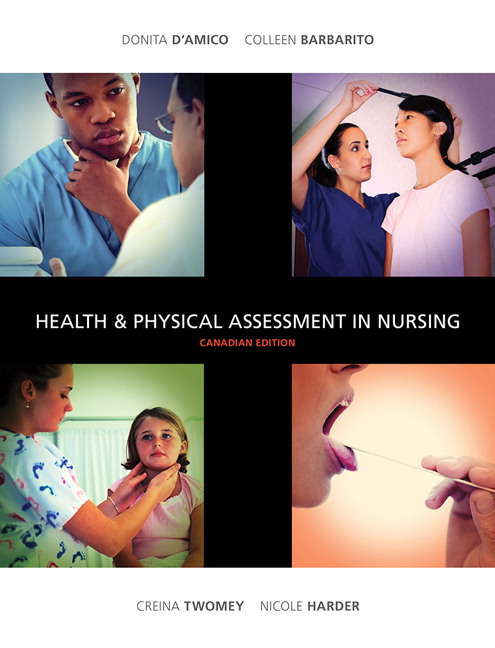
Health & Physical Assessment in Nursing, Canadian Edition By Donita T D'Amico - Test Bank

Health & Physical Assessment in Nursing, Canadian Edition By Donita T D'Amico - Test Bank   Instant Download - Complete Test Bank With Answers     Sample Questions Are Posted Below   Chapter 5 MULTIPLE CHOICE. Choose the one alternative that best completes the statement or answers the question.   1)   A nurse is caring …

$19.99

Health & Physical Assessment in Nursing, Canadian Edition By Donita T D’Amico – Test Bank


Instant Download – Complete Test Bank With Answers


Sample Questions Are Posted Below


Chapter 5

MULTIPLE CHOICE. Choose the one alternative that best completes the statement or answers the question.


1)   A nurse is caring for a woman who is complaining of chest pain. She states that she was walking from her apartment to the grocery store when the pain became severe. She reported that people were following her. She said she couldn’t really see them but she could hear them talking about “grabbing me.” While the woman is explaining the event, she alternates between wringing her hands and manipulating the items in her purse over and over. The nurse would obtain what further assessment data in this situation?

1)   Spiritual affiliations

2)   Dietary preferences and habits

3)   Review of systems

4)   Focused psychosocial interview

1) 4

Explanation:

  1. A spiritual assessment is important, but the psychosocial interview would be a priority given the behaviours exhibited.
  2. Dietary preferences are important, but the psychosocial interview would be a priority given the behaviours exhibited.
  3. The physical examination is conducted after the psychosocial assessment is complete.
  4. The woman is exhibiting bizarre behaviour and her story indicates some paranoia; therefore, a focused psychosocial interview is warranted.

Assessment

Application

Objective – 4

Page – 78

Difficulty – 2


2)   A nurse is interviewing a client prior to a physical examination. The client tells the nurse, “ I have been experiencing a lot of aches, pains, and abdominal discomfort.” What factor should the nurse suspect is impacting physical health?

1)   Income

2)   Stress

3)   Ethnicity

4)   Occupation

2) 2

Explanation:

  1. Income can impact physical health; however, stress has the most impact.
  2. Emotional stress affects the immune system and typically causes individuals to be less attentive to their personal health. Individuals under stress may also use mood-altering substances to “feel better.”
  3. Ethnicity can impact physical health; however, stress has the most impact.
  4. Occupation can impact physical health; however, stress has the most impact.


Assessment

Knowledge

Objective – 2

Page – 74, 77

Difficulty – 1


3)   Julian, 17 years old, looks downward and speaks softly when answering questions. He has a flat affect. The nurse identifies a problem with Julian’s self-concept. What would support this conclusion?

1)   Increased desire to form lasting relationships

2)   Decreased ability to form attachments with other people

3)   Inability to maintain stable employment

4)   Feelings of worthlessness, anxiety, and/or depression

3) 4

Explanation:

  1. The increased desire to form lasting relationships may be seen in individuals with healthy or unhealthy self-concepts.
  2. Decreased ability to form attachments to other people results from many factors not limited to poor self-concept.
  3. Inability to maintain stable employment results from many factors not limited to poor self-concept.
  4. Problems with self-concept may manifest in feelings of worthlessness, anxiety, and/or depression, among other issues.

Application

Knowledge

Objective – 4

Page – 76, 79, 83

Difficulty – 2


4)   Andrew, 7 years old, was admitted to the hospital following an appointment in the oncology clinic. His mother, who is distraught over his recent leukemic relapse, accompanies Andrew. She is crying and asking, “What did I do wrong?… Why does he deserve this?… Why can’t it be me?” What do these statements indicate to the nurse?

1)   Ineffective coping

2)   Emotional emptiness

3)   Spiritual distress

4)   Psychological anxiety


4) 3

Explanation:

  1. Those types of statements are common responses to a serious diagnosis and do not indicate ineffective coping.
  2. Emotional emptiness requires further evidence, as well, and is not an acceptable term to describe behaviours indicating distress.
  3. Questions such as “What did I do wrong?… Why does he deserve this?”, etc. indicate spiritual distress.
  4. Further evidence would be required before determining psychological anxiety.

Diagnosis

Analysis

Objective – 4

Page – 73, 83

Difficulty – 2


5)   Which client is at greatest risk for suicide?

1)   34-year-old married man who drives a transport truck

2)   18-year-old male who recently broke up with his girlfriend

3)   42-year-old Metis woman who has a fear of closed spaces

4)   21-year-old woman whose sister is cognitively impaired

5) 2

Explanation:

  1. There are no characteristics that would place this client at greatest risk.
  2. The characteristics of those at highest risk of suicide are: males, ages 15 to 24, Aboriginal ancestry. This client posesses two of these high risk characteristics.
  3. Although aboriginal people may be at higher risk, none of the other characteristic increase her risk.
  4. Although age of this client places her at risk, none of the other characteristics increase her risk.

Assessment

Knowledge

Objective – 4

Page – 82 (Box 5.1)

Difficulty – 2


6)   What is the definition of psychosocial health?

1)   The state of being emotionally balanced and socially astute

2)   Being mentally stable, physically fit, and psychologically well

3)   Becoming spiritually and psychologically mature

4)   The state of being mentally, emotionally, socially, and spiritually well

6) 4

Explanation:

  1. Although the term emotionally balanced is not often used, it is another phrase for emotionally well. Being socially astute is a characteristic that one may develop, but is not necessary for social wellness.
  2. Mental stability is a component of psychosocial health and includes psychological health. Being physically fit may influence psychosocial health, but individuals may not be physically fit and still be in good psychosocial health.
  3. Many would argue that children are not spiritually and psychologically mature, yet may exhibit psychosocial health, so being spiritually and psychologically mature are not criteria for psychosocial health.
  4. Psychosocial health is defined as being mentally, emotionally, socially, and spiritually well.

Assessment

Knowledge

Objective – 1

Page – 73 (Figure5.1)

Difficulty – 1


7)   A nurse is conducting a class on health promotion and uses the following definition: “The ability to perform daily tasks vigorously and alertly, with energy left over for enjoying leisure-time activities and meeting emergency demands.” What has the nurse defined?

1)   Physical fitness

2)   Emotional health

3)   Physical health

4)   Psychological well-being

7) 1

Explanation:

  1. Physical fitness is the ability to perform daily tasks vigorously and alertly, with energy left over for enjoying leisure-time activities and meeting emergency demands.
  2. Physical fitness is an important component of physical and emotional health. Physical fitness influences mental alertness and emotional stability, as well as a general feeling of well-being, which some may call psychological fitness.
  3. Physical health is associated with satisfaction of basic needs, quality of life, and psychosocial well-being.
  4. Psychological well-being refers to a healthy self-identity, positive emotions and an ability to cope with stress.

Assessment

Knowledge

Objective – 2

Page – 74

Difficulty – 1


8)   Mrs. Murphy, 47 years old, has recently experienced the loss of three close family members and has withdrawn from all social activities. What is the best tool for the nurse to use to assess Mrs. Murphy’s level of stress?

1)   Social Readjustment Scale

2)   HOPE

3)   Mental Status

4)   Spiritual Well-being Scale

8) 1

Explanation:

  1. The Social Readjustment Scale rates the stress in Mrs. Murphy’s life.
  2. The HOPE is a tool used for a formal spiritual assessment.
  3. The Mental Status Examination assesses affect and mood, level of anxiety orientation and speech.
  4. The Spiritual Well-being Scale measures religious and existential well-being.


Assessment

Knowledge

Objective – 3

Page – 78, 80, 81 (Table 5.3)

Difficulty – 1


9)   A nurse administered the Holmes Social Adjustment Scale to her client. The client scored 270. What is the client’s risk of developing a serious illness within the next two years based on stress alone?

1)   25%

2)   33.3%

3)   50%

4)   90%


9) 3

Explanation:

  1. The lowest level of risk is 33.3% for those with a score below 150.
  2. Individuals with a score below 150 have a 33.3% chance of developing a serious illness within two years.
  3. Those with a score between 150 and 300 have a 50% chance of developing a serious illness within two years.
  4. Those will a score over 300 have a 90% chance of developing a serious illness within two years.

Assessment

Application

Objective –3

Page – 81 (Table 5.3)

Difficulty – 1


10) Ben, 16 years old, has been admitted for observation. He jokingly tells the nurse, “Sometimes I get so angry that I want to get into my dad’s car and drive it straight into a bus.” What should the nurse do next?

1)   Ask Ben if it is easy to get access to his father’s car

2)   Tell Ben that lot of teenagers feel this way

3)   Talk to Ben’s parents about anger management

4)   Explore with Ben ways he might cope with his anger


10) 1

Explanation:

  1. Ben has indicated that he has thoughts of suicide, and the nurse needs to determine if he has a method and means at his disposal.
  2. This does not address that Ben may be suicidal.
  3. The nurse needs to address Ben’s comment about suicide.
  4. This may be appropriate but not at this time; the nurse first needs to determine whether Ben has the means to follow through on his suicidal thoughts.

Assessment

Application

Objective – 4

Page – 81

Difficulty – 2


11) Sister MacDonald, 59 years old, has been admitted to hospital. She asks the nurse if they hold mass in the Chapel. What assessment tool should the nurse use to assess spirituality and spiritual needs?

1)   Healthy Day Measures

2)   Multidimensional Health Profile

3)   HOPE

4)   Duke Social Support and Stress Scale

11) 3

Explanation:

  1. The Health Day Measures is used to measure quality of life.
  2. The Multidimensional Health Profile is used to screen for psychological problems.
  3. The HOPE is a formal spiritual assessment tool.
  4. The Duke Social Support and Stress Scale is used to assess family and non-family support and stress.

Assessment

Knowledge

Objective – 3

Page – 77, 78 (Table 5.1)

Difficulty – 1


12) While being interviewed, a client admits to the nurse, “I have been hearing voices and sounds recently.” What would be the nurse’s best response?

1)   “How long have you been hearing these voices?”

2)   “Tell me about what the voices are tell you to do.”

3)   “There must be other things you are hearing.”

4)   “Do the voices bother you during the night only?”

12) 2

Explanation:

  1. Knowing the length of time a person has had auditory hallucinations is helpful, but is not the most important next question.
  2. The most appropriate next question after the client tells the nurse she hears voices is asking the client if the voices tell her what she must do. Command hallucinations are dangerous and may lead to self-destructive or harmful behaviour.
  3. Expressing doubt in what the client is telling you may make the client stop answering your questions.
  4. Asking whether or not the voices are only bothersome to the client at night does not yield helpful information as hallucinations are not a normal phenomenon and treatment goals would include eliminating the hallucinations. Additionally, the goal of the interview is to obtain the information most important to the treatment plan and is not to dwell on the hallucinations, thereby reinforcing them to the patient.

Assessment

Application

Objective – 3

Page – 82

Difficulty – 2


13) What internal factor can influence psychosocial health?

1)   Mother who is bipolar

2)   Culture

3)   Growing up in a supportive family

4)   Spiritual beliefs

13) 1

Explanation:

  1. Genetics is an internal factor that can impact psychosocial health.
  2. Culture is an external factor.
  3. Family support is very important in psychosocial health, but it is an external factor.
  4. Religion and spiritual beliefs are important, but are external factors.

Assessment

Knowledge

Objective – 2

Page – 73, 74, 75

Difficulty – 1


14) A nurse is completing the psychosocial history on a newly admitted adult client. The client reports trouble concentrating, rapid heartbeats, irritability, and inability to make decisions. What might the nurse suspect is happening to the client?

1)   Stress reaction

2)   Role confusion

3)   Impending heart attack

4)   Dysfunctional anxiety

14) 1

Explanation:

  1. A high level of stress may result in symptoms such as irritability, indecisiveness, confusion, pounding heart or pulse, and trouble concentrating, among other symptoms.
  2. There is no data to support the concern of role confusion.
  3. Symptoms of an impending heart attack may include irritability, confusion, and a pounding heart rate, but there are other more classic symptoms that typically also appear.
  4. Symptoms of anxiety include some of the above symptoms, but there is not enough evidence to call it dysfunctional.

Diagnosis

Application

Objective – 4

Page – 77

Difficulty – 2


15) An elderly client, who is hard of hearing, is observed withdrawing form conversation and sitting quietly in the corner of the room. This client’s physical ailment is impacting which psychosocial dimension?

1)   Mental

2)   Emotional

3)   Social

4)   Spiritual

15) 3

Explanation:

  1. The mental dimension refers to an individual’s ability to reason, to find meaning in, and make judgments from, information, to demonstrate rational thinking, and to perceive realistically.
  2. The emotional dimension is subjective and includes feelings.
  3. Social functioning refers to the individual’s ability to form relationships with others.
  4. The spiritual dimension is beliefs and values that give meaning to life.

Diagnosis

Analysis

Objective – 1

Page – 73

Difficulty – 1


16) Mrs. Petrenko, 53 years old, cares for her elderly mother. Mrs. Petrenko states, “When my mother takes ill, you can predict I’ll be sick in about six weeks.” What does this statement indicate?

1)   Her mother has a communicable disease.

2)   Mrs. Petrenko has uncared for health problems.

3)   Mrs. Petrenko is more ill than her mother.

4)   Mrs. Petrenko is experiencing emotional stress.

16) 4

Explanation:

  1. There is no evidence that the mother has a communicable disease.
  2. There is no evidence that Mrs. Petrenko has health problems.
  3. There is no evidence that Mrs. Petrenko is ill.
  4. Emotional health affects physical health in several ways. Stress affects the immune system leading to increased susceptibility to infections. During periods of stress or change, the individual is less likely to adhere to positive health behaviours.

Evaluation

Analysis

Objective – 4

Page – 74, 77

Difficulty – 2

17) A client tells the nurse, “I want to make sure my children have every possible opportunity to complete their education.” The nurse realizes this client’s philosophy on education will influence which aspect of her children’s health?

1)   Meeting immediate needs

2)   Helping to elevate self-concept

3)   Contributing to ongoing family disturbances

4)   Preventing mental illness

17) 2

Explanation:

  1. The client is discussing long-term needs; there is no mention of anything immediate.
  2. Better education leads to greater occupational opportunity, better housing, and the ability to participate in a variety of leisure activities. These advantages contribute to the development of high self-worth and self-concept.
  3. There is no evidence that there are problems within the family.
  4. There is no assurance that education will prevent mental illness.

Diagnosis

Analysis

Objective – 4

Page –75

Difficulty – 2


18) Based on statements made by the client during a physical assessment, the nurse believes the client is at risk for developing a major illness. What statement would cause the nurse to be concerned for this client?

1)   “Look at that person’s pants! Don’t they realize how ugly they are?”

2)   “That sounds like a good idea! I think I will try that at home.”

3)   “I just love spending time outside. It energizes me!”

4)   “I set aside a period of time each day for myself.”

18) 1

Explanation:

  1. Those who are psychosocially unhealthy will demonstrate pessimism, will openly laugh at others, are a “challenge” to be around, have little fun, and are self-absorbed.
  2. The client demonstrates a willingness to try new things. This is consistent with someone who is psychologically healthy.
  3. Individuals who are psychosocially healthy will demonstrate a zest for life.
  4. Individuals who are psychosocially healthy will attend to their own health and psychological well-being.

Diagnosis

Analysis

Objective – 4

Page – 76

Difficulty – 2


19) Mr. Knapp, 41 years old, has hypertension. He stops into the clinic for his weekly blood pressure measurement and tells the nurse that he is in a hurry because he started a new job and has to get back to work. What evidence might indicate that the Mr. Knapp is responding to his new job in a stressful way?

1)   Elevated blood pressure

2)   Respirations 16 and regular

3)   Temperature within normal limits

4)   Heart rate 86 and regular

19) 1

Explanation:

  1. Physical signs of stress include elevated blood pressure, pulse, and respirations, dilated pupils, increased blood volume, and elevated blood glucose level.
  2. Respirations are elevated with stress.
  3. With severe stress the body may be more susceptible to infection causing an increase in temperature. Otherwise a normal temperature in not indicative of whether Mr. Knapp is experiencing stress.
  4. The heart rate would be elevated with stress..

Assessment

Application

Objective – 2

Page – 74, 77

Difficulty – 2


20) A nurse is assessing a client’s spiritual and belief patterns and is currently asking the client about participation in organized religion. The nurse is on which step of the HOPE assessment with this client?

1)   H

2)   O

3)   P

4)   E

20) 2

Explanation:

  1. H focuses on spiritual resources.
  2. O focuses on participation in organized religion.
  3. P focuses on personal spiritual practices.
  4. E focuses on the effects of healthcare and end-of-life issues.

Assessment

Application

Objective – 3

Page – 77

Difficulty – 1


21) Asal, 10 years old, has recently been adopted from an orphanage in Afghanistan by a Canadian couple. What might impact Asal’s psychological health?

1)   Access to better education

2)   Living with a supportive family

3)   Growing up in Canada, a country not in turmoil

4)   Being physically healthy

21) 3

Explanation:

  1. Better educational opportunity can improve self-esteem. We do not know if this is true for Asal.
  2. Although a supportive family positively impacts psychosocial health, we do not have enough information to reach this conclusion.
  3. Growing up in Canada may seem to be positive, but to Asal it could be very stressful. She has left behind the people and environment she knew and now needs to learn a new language and new customs.
  4. There is no indication that physical well-being is a concern. If Asal is under a lot of stress it may impact her physical health.

Assessment

Application

Objective – 2

Page – 75

Difficulty – 2


22) A nurse is concerned that a client is having a problem with self-concept. What statement would cause the nurse to have this concern?

1)   “I never have any fun.”

2)   “I am the oldest in the family.”

3)   “I think I’m pretty much outgoing.”

4)   “At times I like to be alone.”

22) 1

Explanation:

  1. Clients who are unable to explain a social life or who do not have any fun may be depressed or out of touch with reality.
  2. Self-concept refers to how we feel about ourselves. Stating one is the eldest in the family does not indicate anything about the client’s feelings about themself.
  3. This comment is positive. A person with a positive self-concept is able to develop and maintain relationships.
  4. People with a positive self-concept enjoy spending some time alone.

Assessment

Analysis

Objective – 3

Page – 76, 79, 80

Difficulty – 2


23) Which assessment question would best help the nurse identify the client’s coping ability?

1)   Who is your closest friend?

2)   What social groups do you belong to?

3)   What is your birth order in your family?

4)   Who do you call when you need help?

23) 4

Explanation:

  1. Questions about friends assess the client’s roles and associations.
  2. Questions about social groups assess roles and associations.
  3. Questions about birth order focus on the client’s family history.
  4. Questions that are helpful to gather additional information about a client’s stress and coping mechanisms include: What do you do for relaxation? For recreation? What is your greatest source of comfort when you are feeling upset? Who do you call for help? What is your current level of stress?

Planning

Application

Objective – 3

Page – 80, 81

Difficulty – 1


24) During an assessment, the nurse observes the client jumping from one idea to another, unable to completely answer any of the assessment questions. What speech pattern is the client using?

1)   Circumlocution

2)   Flight of ideas

3)   Neologisms

4)   Echolalia

24) 2

Explanation:

  1. Circumlocution means the client is demonstrating numerous digressions.
  2. The speech pattern where thoughts and ideas jump round is termed “flight of ideas.”
  3. Neologisms are the coining of new words that have significance to the client.
  4. Echolalia is the constant repetition of words or phrases that the client hears others say.

Diagnosis

Analysis

Objective – 5

Page – 83 (Box 5.2)

Difficulty – 2


25) Mr. Kuromi, 34 years old, has been admitted for observation. He tells the nurse, “Pink happies are flying on me but no woman likes short fish.” What speech pattern is this?

1) Neologism

2) Word salad

3) Clanging

4) Echolalia


25) 2

Explanation

  1. Neologism is inverting works or expressions that have meaning to the client.
  2. This is an example of a word salad.
  3. Clanging is saying words or phrases that sound alike.
  4. Echolalia is repeating words that the client hears others say.

Diagnosis

Analysis

Objective – 5

Page – 83 (Box 5.2)

Difficulty – 2


26) Mrs. Danachuk, 43 years old, was widowed four months ago. She has missed her third appointment with the health nurse. When called, Mrs. Danachuk is weeping and tells the nurse she was really tired and could not get out of bed this morning. What should the nurse suspect is causing Mrs. Danachuk to feel so tired?

1) Poor nutrition

2) Working too hard

3) Abusing sleep medication

4) Depression


26) 4

Explanation

  1. There is no mention that there is a problem with nutrition. Mrs. Danachuk is likely depressed due to the death of her partner.
  2. There is no indication that this is a concern.
  3. Danachuk is likely depressed, but there is no evidence that she is abusing drugs or alcohol.
  4. Danachuk is likely depressed. A person who is depressed may suffer from sadness, crying spells, insomnia, lack of appetite, weight loss, weight gain, loss of sex drive, constipation, fatigue, hopelessness, irritability, indecisiveness, confusion, pounding heart or pulse, trouble concentrating,


Diagnosis

Analysis

Objective – 4

Page – 80, 81

Difficulty – 2


SHORT ANSWER. Write the word or phrase that best completes each statement or answers the question.


27) Mr. Barton, 51 years old, is admitted with a broken arm after a fall. He appears disheveled and has a body odour. The family arrives and expresses surprise at Mr. Barton’s appearance. They report that this is not his normal appearance and that he is usually clean and meticulously groomed. What assessment(s) does the nurse need to complete? (Select all that apply.)

___      Dietary history

___      Psychosocial assessment

___      Memory assessment and orientation

___    Family medical history

___      Lab studies

___      Physical examination


27)

___      Dietary history

_X_      Psychosocial assessment

_X_      Memory assessment and orientation

_X_    Family medical history

___      Lab studies

_X_      Physical examination


Explanation:

The client’s appearance indicates that there has been some change in mental outlook or condition since last seen by the family. Alternatively, physical illness may have impacted the client’s ability to groom himself appropriately. The physical examination is important to look for complications resulting from not cleaning the skin. A psychosocial history is very important to determine the client’s usual state of psychological health and well-being, and if similar deteriorations have occurred in the past. An assessment of memory and orientation is important because it will affect how the client is cared for, considering the short-term memory loss (if it exists) and lack of orientation to surroundings, if that occurs. Not only safety, but also knowledge gained from this assessment will be important data on which to note improvements or declines in condition. The family medical history may yield some clues if someone in the family has experienced a similar deterioration and now has a condition for which treatment is needed.

Lab studies would be ordered by the physician, not completed by the nurse. A dietary history is not indicated at this time. The physical examination may reveal evidence that might require this type of assessment later.

Assessment

Analysis

Objective – 4

Page – 78, 80, 83

Difficulty – 1


Additional information

Add Review

Your email address will not be published. Required fields are marked *