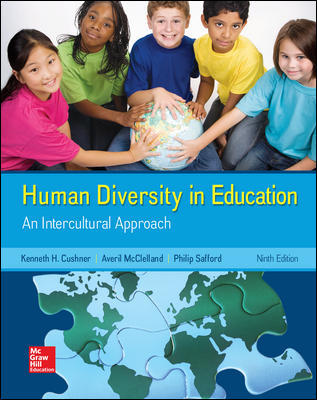
Human Diversity in Education 9th Edition By Kenneth Cushner - Test Bank

Human Diversity in Education 9th Edition By Kenneth Cushner - Test Bank   Instant Download - Complete Test Bank With Answers     Sample Questions Are Posted Below   Human Diversity in Education, 9e (Cushner) Chapter 5   Intercultural Development: Considering the Growth of Self and Others   1) In which of the following stages of …

$19.99

Human Diversity in Education 9th Edition By Kenneth Cushner – Test Bank


Instant Download – Complete Test Bank With Answers


Sample Questions Are Posted Below


Human Diversity in Education, 9e (Cushner)

Chapter 5   Intercultural Development: Considering the Growth of Self and Others


1) In which of the following stages of the developmental model of intercultural sensitivity (DMIS) does the inability to see cultural differences occur?

  1. A) the defense stage
  2. B) the denial stage
  3. C) the acceptance stage
  4. D) the adaptation stage


Answer:  B

Accessibility:  Keyboard Navigation


2) In which of the following stages of the developmental model of intercultural sensitivity (DMIS) does a recognition of cultural difference coupled with negative evaluations of those whose culture is different from one’s own and superior judgments of one’s own culture occur?

  1. A) the defense stage
  2. B) the denial stage
  3. C) the acceptance stage
  4. D) the adaptation stage


Answer:  A

Accessibility:  Keyboard Navigation


3) Which of the following would NOT be considered an ethnorelative stage based on Bennett’s developmental model of intercultural sensitivity (DMIS)?

  1. A) the denial stage
  2. B) the acceptance stage
  3. C) the adaptation stage
  4. D) the integration stage


Answer:  A

Accessibility:  Keyboard Navigation


4) Which of the following would be considered an ethnocentric stage according to Bennett’s developmental model of intercultural sensitivity (DMIS)?

  1. A) the acceptance stage
  2. B) the minimization stage
  3. C) the adaptation stage
  4. D) the integration stage


Answer:  B

Accessibility:  Keyboard Navigation


5) Which of the following stages of the developmental model of intercultural sensitivity (DMIS) represents an individual’s ability to recognize and appreciate cultural difference in terms of both people’s values and their behavior?

  1. A) the integration stage
  2. B) the minimization stage
  3. C) the acceptance stage
  4. D) the adaptation stage


Answer:  C

Accessibility:  Keyboard Navigation


6) The ability to adapt to and value cultural differences is a characteristic of a:

  1. A) member of a pluralistic society.
  2. B) person who has grown up in a monocultural environment.
  3. C) person who dislikes people who are different.
  4. D) person who is interculturally competent.


Answer:  D

Accessibility:  Keyboard Navigation


7) In general, an increase in cultural awareness is accompanied by a(an):

  1. A) increase in emotional intelligence.
  2. B) increase in cognitive sophistication.
  3. C) decrease in emotional intelligence.
  4. D) decrease in cognitive sophistication.


Answer:  B

Accessibility:  Keyboard Navigation


8) Models of intercultural competence:

  1. A) promote the acceptance of one’s own group.
  2. B) focus on managing effectively across cultures.
  3. C) focus on one’s own understanding of cultural identity.
  4. D) insist that members of minority groups ignore the dominant society.


Answer:  B

Accessibility:  Keyboard Navigation


9) Early studies in intercultural competence suggested that effectively working across cultures means that:

  1. A) one can manage psychological stress.
  2. B) one is able to communicate effectively.
  3. C) one can develop and maintain new and essential interpersonal relationships.
  4. D) all of these answers are correct.


Answer:  D

Accessibility:  Keyboard Navigation

10) All of the following are examples of interculturally competent skills, EXCEPT:

  1. A) the ability to be nonjudgmental.
  2. B) the ability to interpret behavior from more than one perspective.
  3. C) the ability to be intolerant of those who are different.
  4. D) the ability to mediate conflicts.


Answer:  C

Accessibility:  Keyboard Navigation


11) Bennett’s developmental model of intercultural sensitivity (DMIS) provided a framework for understanding intercultural development and awareness along a continuum from:

  1. A) individual to social development.
  2. B) highly ethnocentric to highly ethnorelative.
  3. C) insensitive to sensitive development.
  4. D) none of these answers are correct.


Answer:  B

Accessibility:  Keyboard Navigation


12) In which of the following stages of the developmental model of intercultural sensitivity (DMIS) is an individual’s understanding of cultural difference minimal?

  1. A) the defense stage
  2. B) the minimization stage
  3. C) the denial stage
  4. D) the acceptance stage


Answer:  C

Accessibility:  Keyboard Navigation


13) In the context of the stages of the developmental model of intercultural sensitivity, when one accepts superficial cultural differences but asserts that people are more alike than they are different, one is in the:

  1. A) denial stage of the DMIS.
  2. B) adaptation stage of the DMIS.
  3. C) minimization stage of the DMIS.
  4. D) acceptance stage of the DMIS.


Answer:  C

Accessibility:  Keyboard Navigation


14) The stage of the developmental model of intercultural sensitivity (DMIS) in which people begin to see cultural categories as more flexible and become more competent in their ability to communicate across cultures is known as:

  1. A) acceptance.
  2. B) adaptation.
  3. C) integration.
  4. D) minimization.


Answer:  B

Accessibility:  Keyboard Navigation


15) During the adaptation stage of the developmental model of intercultural sensitivity, an individual is able to:

  1. A) shift frames of reference.
  2. B) treat all people exactly the same.
  3. C) ignore his or her own ethnic identity.
  4. D) internalize negative stereotypes.


Answer:  A

Accessibility:  Keyboard Navigation


16) Acceptance of another’s difference does not necessarily mean agreement.


Answer:  TRUE

Accessibility:  Keyboard Navigation


17) Behavioral adaptation refers to the internalization of more than one complete worldview.


Answer:  TRUE

Accessibility:  Keyboard Navigation


18) Cultural adaptation refers to the ability to accept another’s culture as superior to one’s own.


Answer:  FALSE

Accessibility:  Keyboard Navigation


19) According to Bennett, intercultural sensitivity is a natural human phenomenon.


Answer:  FALSE

Accessibility:  Keyboard Navigation


20) Integration is the final stage of the developmental model of intercultural sensitivity.


Answer:  TRUE

Accessibility:  Keyboard Navigation


21) Interculturally competent people have a hard time communicating effectively across cultures.


Answer:  FALSE

Accessibility:  Keyboard Navigation

22) People at the defense stage of the developmental model of intercultural sensitivity (DMIS) prefer to separate themselves from others because they often do not have categories for dealing with difference.


Answer:  TRUE

Accessibility:  Keyboard Navigation


23) Cultural adaptation refers to the internalization of more than one complete worldview, enabling people to shift into different frames without much conscious effort and then act in culturally appropriate ways.


Answer:  FALSE

Accessibility:  Keyboard Navigation


24) According to Bennett, who proposed the developmental model of intercultural sensitivity (DMIS), as people’s ability to understand difference increases, so does their ability to negotiate a variety of worldviews.


Answer:  TRUE

Accessibility:  Keyboard Navigation


25) Denigration is a type of defense that may occur in the denial stage of the developmental model of intercultural sensitivity (DMIS).


Answer:  FALSE

Accessibility:  Keyboard Navigation


26) In the context of the stages of the developmental model of intercultural sensitivity, briefly discuss the types of adaptation.


Answer:  Answers will vary

Accessibility:  Keyboard Navigation


27) Discuss Deardorff’s Pyramid Model of Intercultural Competence.


Answer:  Answers will vary

Accessibility:  Keyboard Navigation


28) Briefly discuss at least three characteristics of an interculturally competent person.


Answer:  Answers will vary

Accessibility:  Keyboard Navigation


29) List the areas of defense that Bennett mentioned in the developmental model of intercultural sensitivity (DMIS). Give examples that depict each area of defense using characters from movies, literature, or television. Give a brief explanation of why you chose your examples.


Answer:  Answers will vary

Accessibility:  Keyboard Navigation

30) Consider a situation where a teacher visits France along with the students of his/her French class. How might the teacher help his/her students who are in the minimization stage of the developmental model of intercultural sensitivity (DMIS) move to the acceptance stage of the DMIS? List four possible steps you would advise him/her to take.


Answer:  Answers will vary

Accessibility:  Keyboard Navigation

Additional information

Add Review

Your email address will not be published. Required fields are marked *