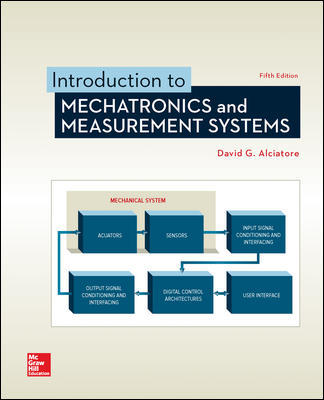
Introduction to Mechatronics And Measurement Systems 5Th Edition By David Alciatore - Test Bank

Introduction to Mechatronics And Measurement Systems 5Th Edition By David Alciatore - Test Bank   Instant Download - Complete Test Bank With Answers     Sample Questions Are Posted Below   Introduction to Mechatronics and Measurement Systems, 5e (Alciatore) Chapter 5   Analog Signal Processing Using Operational Amplifiers   1) The current into the inverting input …

$19.99

Introduction to Mechatronics And Measurement Systems 5Th Edition By David Alciatore – Test Bank


Instant Download – Complete Test Bank With Answers


Sample Questions Are Posted Below


Introduction to Mechatronics and Measurement Systems, 5e (Alciatore)

Chapter 5   Analog Signal Processing Using Operational Amplifiers


1) The current into the inverting input terminal of an ideal op amp is always

  1. A) zero
  2. B) nonzero and the negative of the current into the noninverting input terminal
  3. C) the same as the output current
  4. D) positive
  5. E) negative


Answer:  A


2) The voltage at the inverting input terminal of an ideal op amp with negative feedback is always

  1. A) zero
  2. B) the negative of the voltage at the noninverting input terminal
  3. C) the same as the voltage at the noninverting input terminal
  4. D) the same as the output voltage
  5. E) negative


Answer:  C


3) The closed-loop gain of an inverting amplifier circuit is

  1. A) positive
  2. B) negative
  3. C) zero
  4. D) always infinite, assuming an ideal op amp


Answer:  B


4) The closed-loop gain of an noninverting amplifier circuit is

  1. A) positive
  2. B) negative
  3. C) zero
  4. D) always infinite, assuming an ideal op amp


Answer:  A


5) Because an op amp is an “active device,” it

  1. A) requires an external power supply
  2. B) doesn’t require an external power supply
  3. C) requires an edge-triggered signal to activate the output
  4. D) responds only to inputs that provide large currents


Answer:  A


6) If a shunt resistor is placed in parallel with the feedback capacitor of an ideal integrator circuit, the resulting circuit works well (integrates properly) only when the input frequency components are:

  1. A) very low
  2. B) mid range
  3. C) low and high, but not mid range
  4. D) low and mid range, but not very high
  5. E) very high


Answer:  B


7) When you increase the gain magnitude of a 741 op amp circuit (e.g., a noninverting amplifier), the bandwidth of the circuit

  1. A) increases
  2. B) decreases
  3. C) remains unchanged
  4. D) becomes negative
  5. E) becomes infinite


Answer:  B


8) When you decrease the gain magnitude of a 741 op amp circuit (e.g., a noninverting amplifier), the bandwidth of the circuit

  1. A) increases
  2. B) decreases
  3. C) remains unchanged
  4. D) becomes negative
  5. E) becomes infinite


Answer:  A


9) An op amp follower circuit is useful because

  1. A) the output is fixed (i.e., doesn’t change) even when the input changes
  2. B) the output voltage is equal to the input voltage and the input current is almost zero
  3. C) the output voltage is equal to the input voltage and the input current is very large
  4. D) the output voltage is the negative of the input voltage and the input current is almost zero
  5. E) the output voltage is the negative of the input voltage and the input current is very large


Answer:  B


10) What is the approximate maximum output voltage swing for a 741 op amp powered by a ±15 V supply?

  1. A) 0 to 15 V
  2. B) 0 to 13.6 V
  3. C) −15 to 15 V
  4. D) −13.6 to 13.6 V
  5. E) −13.6 to 15 V


Answer:  D


The subsequent problems deal with the improved integrator circuit shown below, where: R1 = R2 = Rs = R.


11) The voltage at the inverting input of the op amp is always

  1. A) 0 V
  2. B) Vin/ 2
  3. C) 2Vin
  4. D) Vin− Vout
  5. E) Vout


Answer:  A


12) What is the current through R2?

  1. A) 0
  2. B) Vin/ R
  3. C) Vin/ 2R
  4. D) R / Vin
  5. E) 2R / Vin


Answer:  A

13) If Vin = 5V dc, what is the steady state voltage at Vout?

  1. A) 0 V
  2. B) −5 V
  3. C) 5 V
  4. D) −2.5 V
  5. E) 2.5 V


Answer:  B


14) If Vin is a 5Vpp sine wave of extremely high frequency, what is Vout?

  1. A) 0 V
  2. B) a sine wave of the same frequency and phase as Vin
  3. C) a sine wave of the same frequency but out of phase with Vin
  4. D) −2.5 V
  5. E) 2.5 V


Answer:  A


The subsequent problems deal with the circuit below:


NOTE: Assume the op amp is ideal.


15) If Vin = 5 V, what is V1?

  1. A) 5 V
  2. B) 2.5 V
  3. C) 0 V
  4. D) −2.5 V
  5. E) −5 V


Answer:  A


16) If Vin = 5 V, what is I1?

  1. A) 0
  2. B) 2.5 mA
  3. C) 5 mA
  4. D) −2.5 mA
  5. E) −5 mA


Answer:  A

17) If Vin = 5 V, what is Vout?

  1. A) 5 V
  2. B) 2.5 V
  3. C) 0 V
  4. D) −2.5 V
  5. E) −5 V


Answer:  A


18) If Vout = 2.5 V, what is V2?

  1. A) 5 V
  2. B) 2.5 V
  3. C) 0 V
  4. D) −2.5 V
  5. E) −5 V


Answer:  B


19) If V2 = −2 V, what is I2?

  1. A) −2 mA
  2. B) −1 mA
  3. C) 0 mA
  4. D) 1 mA
  5. E) 2 mA


Answer:  E

20) If V2 = −2 V, what is I3?

  1. A) 2 mA
  2. B) 2.5 mA
  3. C) 3 mA
  4. D) 5 mA
  5. E) 7 mA


Answer:  E


21) What is Vd, given the polarity shown?

  1. A) −10 V
  2. B) −5 V
  3. C) 0 V
  4. D) 5 V
  5. E) 10 V


Answer:  B


22) What is I4?

  1. A) −10 mA
  2. B) −5 mA
  3. C) 0 mA
  4. D) 5 mA
  5. E) 10 mA


Answer:  C


23) If V2 = 2 V, what is I5?

  1. A) −2 mA
  2. B) −1 mA
  3. C) 0 mA
  4. D) 1 mA
  5. E) 2 mA


Answer:  E


The subsequent problems deal with the circuit below where the op amps are LM741’s powered by a ±15 V power supply. Assume R1 = R2 = R3 = R4 = R. Assume the op amps are ideal.


24) If Vi = 1 V, V1 would be

  1. A) 0 V
  2. B) 1 V
  3. C) 2 V
  4. D) −2 V
  5. E) −13.6 V


Answer:  B


25) If Vi = 20 V, V1 (for the “real” LM741) would be approximately

  1. A) 0 V
  2. B) 5 V
  3. C) 10 V
  4. D) 13.6 V
  5. E) 20 V


Answer:  D


26) If V1 = 1 V, the voltage at the inverting input terminal of op amp 2 is

  1. A) 0 V
  2. B) 1 V
  3. C) 2 V
  4. D) 15 V
  5. E) −15 V


Answer:  B

27) If V1 = 1 V, V2 is

  1. A) 0 V
  2. B) 1 V
  3. C) 2 V
  4. D) −2 V
  5. E) −1 V


Answer:  C


28) If V2 = 10 V, I4 is

  1. A) 0
  2. B) 10 / R
  3. C) 10 R
  4. D) 10 / 2R
  5. E) 10 / 3R


Answer:  B


29) If V2 = 2 V, the current output by op amp 2 is

  1. A) 0
  2. B) 1 / R
  3. C) 2 / R
  4. D) 3 / R
  5. E) 2 / 3R


Answer:  D


30) The circuit below is not a voltage follower and Vo ≠ Vi because


  1. A) there is negative feedback.
  2. B) there is positive feedback
  3. C) there is no feedback resistor
  4. D) the inverting input is not grounded
  5. E) the noninverting input is not grounded


Answer:  B

31) When applying the principle of superposition to an op amp circuit with two inputs V1 and V2, and one output Vo, Vo can be found by adding the outputs due to each voltage individually. In finding the contribution of V1 to Vo, V2 is replaced by

  1. A) a short circuit
  2. B) an open circuit
  3. C) a current source and Thevenin resistance
  4. D) 1 V
  5. E) −1 V


Answer:  A


The subsequent problems deal with the circuit below, where the op amp is an LM741 with an output short circuit current of 25 mA, and a maximum output voltage swing of +/− 13.6 V. NOTE: do not assume the op amp is “ideal.”


The open-loop frequency response curve for the op amp, as provided by the manufacturer is:


32) If Vin=5V, and R=1kΩ, what would you expect for Vout for the real (not ideal) op amp?

  1. A) −2.5 V
  2. B) 2.5 V
  3. C) −10 V
  4. D) 10 V
  5. E) 13.6 V


Answer:  C

33) If Vin=10V, and R=1kΩ, what would you expect for Vout for the real (not ideal) op amp?

  1. A) 5 V
  2. B) −20 V
  3. C) 20 V
  4. D) −13.6 V
  5. E) 13.6 V


Answer:  D

34) If Vin=5V, and R=1kΩ, what is the magnitude of the current the op amp is sourcing or sinking at the output?

  1. A) 0 mA
  2. B) 2.5 mA
  3. C) 5 mA
  4. D) 10 mA
  5. E) 20 mAV


Answer:  C


35) If Vin=5V, and R=1kΩ, which direction is current flowing into or out of the op amp output pin?

  1. A) 0 (not in or out)
  2. B) in (current is being “sunk”)
  3. C) out (current is being “sourced”)


Answer:  B


36) If Vin = 2 sin(2πft) V, and R=1kΩ, which of the below frequencies is the highest input frequency (f) that will result in the expected amplified output voltage amplitude (without attenuation)?

  1. A) 100 Hz
  2. B) 1,000 Hz
  3. C) 10,000 Hz
  4. D) 100,000 Hz
  5. E) 1,000,000 Hz


Answer:  D


37) If Vin=5V, What is the smallest R can be and still have the op amp circuit work properly (i.e., the output voltage will be as expected)?

  1. A) 100 Ω
  2. B) 200 Ω
  3. C) 500 Ω
  4. D) 1 kΩ
  5. E) 2 kΩ


Answer:  B

Additional information

Add Review

Your email address will not be published. Required fields are marked *